A while back I caught this YouTube video from Driftwood Guitars regarding a small saw-like tool from Stewart-McDonald that can provide your acoustic guitar with better tone.
The procedure involves cutting a slot in the string ball-end holes of the bridge so that there is more contact between the string and the guitar itself. Normally, the string comes out of the bridge hole and has the slightest contact across the saddle before traveling over the fretboard, nut, and to the tuning gear. This procedure allows the string to be in contact with the wood of the guitar as well as more contact with the saddle, providing more resonation of the guitar (the video shows how).
A few years back, I purchased a used Jasmine S35 acoustic guitar with case at a real cheap price (the cost was worth the case alone!). I noticed during playing it that, while the tone was not fantastic, it was quite loud, especially for a cheap acoustic that sold for about $150 new. After seeing the Driftwood video, I checked out the Jasmine’s bridge, and sure enough, there were slots in the string holes.
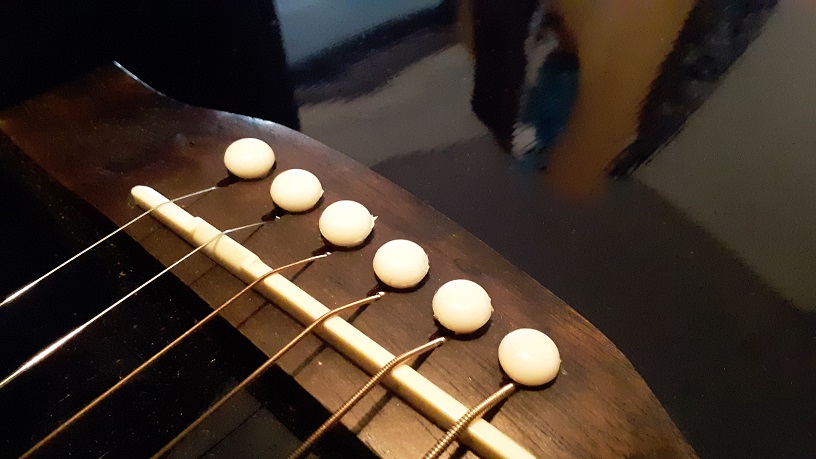
Now the tool from Stewart-McDonald costs about $25, and add to that shipping costs and having to wait for the package, I decided to make my own device. I took a hacksaw blade, cut off about an inch from the upper half of one side of the blade, then attached it to a smaller holder. Total cost was about $3.00.
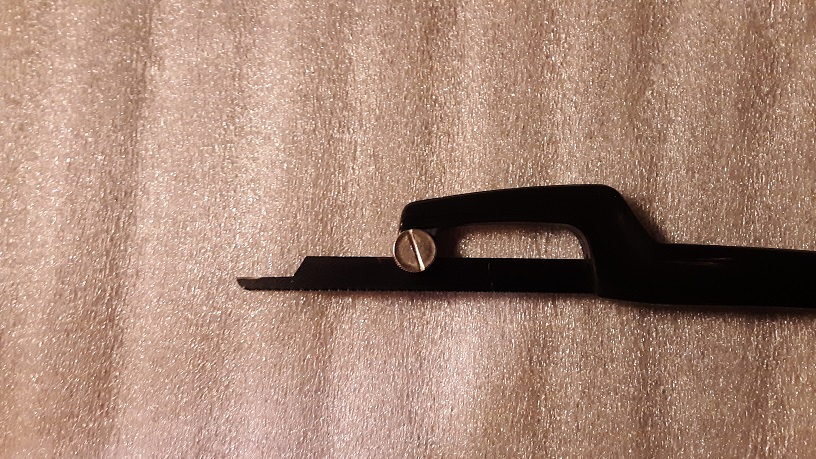

With it, I dug into the bridge of a Yamaha F-325 that I was cleaning up. I figured that I would try this procedure out on a less expensive guitar than my Martin D-28. I learned a few things along the way:
– Hacksaw blades have finer teeth, meant to cut through metal. It takes a lot of time and effort to cut even a little slot, especially when two different woods and some glue are fighting you.
– I was working on this while quarantined at home during my battle with COVID. Do physical work, even light physical work, when you are healthy.
– It seems that while I could tell the difference in volume and tone, the normal (i.e., non-guitar geek) doesn’t care. I played a slotted Yamaha F-325 against a non-slotted Yamaha F-325 to a friend, and she didn’t hear any difference.
I do plan on doing this procedure on the other two Yamaha acoustics that I have, as well as one or two other acoustics that I own. Until I get really good at it, I will hold off on the Martin. This was a good lesson learned about improving the sound of an acoustic guitar, and I feel that it is worth the work. If you are still jittery about attempting it on your own, check with your local guitar repair person or a luthier.
Chew on it and comment.

 Luegra