Categories
Uncategorized

Jim Mills RIP

Jim Mills, one of the best banjo players I have ever seen, passed away May 3rd of a heart attack at his home in North Carolina. He was 57 years old, a way too young age to pass away for a man who showed us so much on the five-string as well as being an expert on the history of the banjo, especially pre-war Gibson models.

Both his father and grandfather were also banjo players. His hearing of Flatt& Scruggs’ “Foggy Mountain Breakdown” cemented his interest in the instrument as well. As a youngster, he was so infatuated with Earl Scruggs that he would put a toothpick between his two front teeth to create a gap like what Scruggs had.

After performing with some regional bluegrass bands, Mills spent much of the 1980s and 1990s performing with Doyle Lawson & Quicksilver, recording four albums with the band. He then joined Ricky Skaggs & Kentucky Thunder around 1998, and stayed with the band until 2010. Afterwards, he spent most of his time collecting and detailing history of banjos, especially early Gibson models. Huber Banjo issued a Jim Mills signature model, which was a replica of his prized Gibson Mastertone RB-75 “Mack Crow” model.

During the 2000s, he was a studio stalwart, recording with Dolly Parton, Dan Tyminski, and Alan Bibey, as well as with Skaggs and two banjo-centric albums for Huber. In 2012, he served as banjo player for Vince Gill on a brief bluegrass tour. He also found time to record three solo albums.

His research with banjos produced a book on Gibson pre-war models in 2009 entitled Gibson Mastertone: Flathead 5-String Banjos of the 1930s and 1940s. He built a museum of sorts in his basement of vintage banjos, including a Gibson RB-4 model that was originally owned by Snuffy Jenkins. He welcomed anyone from collectors to just browsers to his home to check out the collection. He would eventually expand his collection to include vintage guitars, including pre-CBS Gibson Les Paul models.

As far as accolades, he won six IBMA Banjo Player of the Year awards, and was on six Grammy-winning albums. There wasn’t a vintage musical instrument shop in the country that he didn’t stay in contact with, and his knowledge was always called upon when a unique banjo appeared at a shop.

I was fortunate enough to get to see him play with Kentucky Thunder at The Ark in Ann Arbor back in the mid-2000s. As fast as Skaggs like to play the songs, Mills could easily keep up and well as keep his cool. Although his biggest influence admittedly was Scruggs, his picking style and speed was much more akin to J.D. Crowe. No matter how fast the fingers were going, there were never any slip-ups or wrong notes. Everything was perfect.

I recommend checking out Ricky Skaggs & Kentucky live recording Live at the Charleston Music Hall to really hear how great Mills’ picking was and how well he fit into the band situation.

Jim, you are now able to do some jamming with Earl. Rest in Peace, sir.

Chew on it and comment.

Categories
Bluegrass Mandolin Bluegrass Music

Frank Wakefield RIP

Last week, a great bluegrass mandolin player passed away. Frank Wakefield was a bluegrass character to be sure, and seems to be forgotten be most modern bluegrass musicians. Where Bill Monroe was the Elvis Presley of bluegrass, and the Stanley Brothers were the Everly Brothers of bluegrass, Frank Wakefield was the Johnny Rotten of bluegrass.

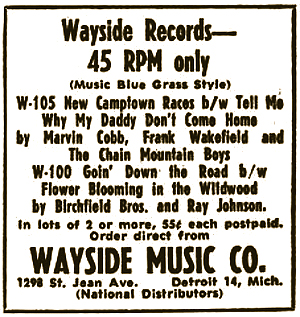
He was always pushing the boundaries of the mandolin in bluegrass, which turned off many traditionalists. He started off playing with Red Allen in the early 1950s, then moved up to Detroit to audition for Jimmy Martin. While Martin at the time did not need a mandolin player, he recommended that Wakefield contact Marvin Cobb, leader of the Chain Mountain Boys. Wakefield played with the band for a while, then joined up with the Stanley Brothers. However, Ralph Stanley and Wakefield did not get along musically, so Wakefield went back to the Chain Mountain Boys.

Wakefield’s style was boundary-pushing to say the least. The Chain Mountain Boys recorded the single “Tell Me Why My Daddy” with the B-side of the classic “New Camptown Races” for a small Detroit label, Wayside Records, that specialized in country and bluegrass. In fact, an advertisement in Billboard in 1957 is considered the first use of “bluegrass” to describe the music.

The Chain Mountain Boys disbanded in late 1957, and Wakefield continued to record for Wayside with Buster Turner. He also toured with Jimmy Martin for a time, then moved to Washington, DC to work again with Red Allen. With Allen, Wakefield would play such venues as Carnegie Hall, and he began to teach mandolin to future luminary David Grisman. He would later work with the Greenbriar Boys, and began to write classical-influenced instrumentals for the mandolin. This work would eventually get him invited to perform with the New York Philharmonic and the Boston Pops.

Wakefield would spend the 1970s recording solo work, being backed up by banjoist Don Reno and fiddler Chubby Wise. He would also tour with Jerry Garcia’s solo projects and warm up for Grateful Dead shows. His last notable recording was on the 1999 Grammy-nominated Bluegrass Mandolin Extravaganza, which also featured Grisman, Sam Bush, Ricky Skaggs, Ronnie McCoury, Jesse McReynolds, and Bobby Osborne.

The best description of Wakefield comes from Grisman: “He split the bluegrass mandolin atom. Some of us, obviously, will never be the same again.”

While I never got a chance to meet Wakefield or see him perform, I always had a soft spot for him in my bluegrass heart due to his time in the Detroit area when he really began to use the mandolin as a bluegrass weapon. Those early Wayside Records recordings were released in 1976 by Rounder Records called Early Days of Bluegrass, Volume 2, so if you can ever find that album, be sure to get it.

Frank, you will be missed by those who truly appreciate no0t allowing bluegrass to become stale.

Chew on it and comment.

Categories
Bluegrass Music Music Instruction

SEMBMA Youth Scholarship Showcase: Afterword

Last Sunday, April 21st, the Southeastern Michigan Bluegrass Music Association held its showcase of the Youth Scholarship recipients at Woldumar Nature Center in Lansing. It was great to see the four students perform, and even better to see a great turnout for an audience. I tried once again to video the event, and while the video itself was good, the audio going into the built-in microphone was terrible. Hopefully I can get the hang of this camcorder someday.

I had mentioned this showcase a few weeks ago (https://luegra.design.blog/2024/03/09/sembma-youth-showcase-april-21st/), and was glad that it was a moderate success. SEMBMA member Marcia Bailey also brought a few instruments for interested kids to try out at the Association’s “petting zoo.”

What made me pleased the most was that the four students are really passionate about improving on their playing. Eleven-year-old Dominic impressed me the most with his off-the-cuff knowledge of old-time fiddle tunes that he was warming up to. Belinda is another 11-year-old fiddler that I first saw at the Michigan Old-Time Fiddlers Contest back in 2022 and worked hard to get her parents to apply for a scholarship. She has a great teacher in Keala Venema, who is a well-known fiddler in the western part of the State. Thirteen-year-old Henson was performing standard banjo tunes in the style of Earl Scruggs. Lydia was also performing on banjo, but I was really impressed by her strong vocals for a girl of 14.

The four joined their instructors for a jam session at the end of the performance. It was great to talk to Keala again, as well as talk to some of the parents about how proud they are of the students. I was really glad to see Lydia jamming with some of the older musicians at the session going on downstairs.

I hope that between seeing these performers, as well as testing out some instruments in the petting zoo, that we can see more young people interested in taking up an instruments and pursuing music as a dedicated hobby or even an eventual career. I was able to talk to one mother who was really interested in getting her son involved, as he plays violin at school but is more interested in bluegrass and folk music than classical.

For more news about the event, you can visit the Bluegrass Today website where SEMBMA president Bill Warren posted some of his photos (https://bluegrasstoday.com/woldumar-nature-center-monthly-jam-in-lansing/). There’s one of me with a really small guitar. It says that I am part of the jam session, but I was really only tuning the thing for the petting zoo.

Chew on it and comment.

Categories
Bluegrass Music

Ben Eldridge RIP

Earlier this week, one of the great second-generation bluegrass musicians passed away. Ben Eldridge was best known for his reserved yet perfectly fitting banjo work in The Seldom Scene. What made him unique was that he was able to fit the banjo tastefully into the progressive (for the time) songs that the band was perfroming.

With the folk-rock style songwriting of John Starling, and the in-your-face tenor vocals and mandolin leads of John Duffey, The Seldom Scene had an “artist’s artist” reputation in the bluegrass field. While highly respected among other bluegrass bands, The Seldom Scene gained praises from people in the pop, rock, and country music genres, including Linda Rondstadt, Emmylou Harris, and Ricky Skaggs. Eldridge helped solidify that reputation by being a banjo-slinger, not just a player. He knew exactly what would fit in each and every song. His playing was perfect in every song.

During the 1960s, he would play in a few traditional bluegrass bands, including with Cliff Waldron. However, it was when he hosted jam sessions with Duffey, Starling, and dobro player Mike Aldridge at his home in Bethesda, Maryland that there was a realization that something rich was going on. Most of the band had regular jobs and could not fully commit to a touring schedule, so on an off-shot remark from Country Gentlemen leader Charley Waller, they took the name The Seldom Scene.

Eldridge was a mathematician by trade at the time, but the band found themselves getting regular evening performances in the Baltimore and DC areas. Through the years, there were a number of personnel changes, to the point where, after Duffey’s death in 1996, Eldridge became the sole founding member. The band would continue to prolifically record albums and sparsely tour (sticking mostly to shows and festivals in the DC area), but after 44 years, Eldridge decided to retire in 2016. His legacy with the band included 55 albums, including one of the earliest live albums released by a bluegrass band.

Though he would appear on stage with either The Seldom Scene or other bands, the last few years of Eldridge’s life were spent in full retirement. He passed away on April 14 at the age of 85.

Unfortunately, I never got to meet Ben Eldridge, but I have conversed many times with his son Chris, who performs with the Punch Brothers. Chris is an amazing bluegrass guitarist, probably one of the best on the scene today. If there is ever any truth to the adage “the fruit doesn’t fall far from the tree,” it would be of Chris and his father Ben.

I recommend that you seek out a Seldom Scene recording, especially a live one. I guarantee that you will hear some of the best interacting among players, be it musically or on-stage banter. Ben Eldridge’s to the band, as well as early progressive bluegrass music, cannot be denied.

Chew on it and comment.

Categories
Bass Guitar Rock Music

Underrated Punk Rock Bassist: Norman Watt-Roy

I was vaguely familiar with Norman Watt-Roy during the 1980s, more of just seeing his name on a lot of albums that I had back then. As I have done more reading and researching on my favorite music from back then, I have come to realize that he was an unsung hero from the punk/new-wave era.

Watt-Roy started put playing in a number of rock bands during the late 1960s and early 1970s with his brother Garth. Later that decade he met up with Ian Dury and played on the Blockheads first album, New Boots and Panties!! on the Stiff label in 1977. Watt-Roy would later join up in Wilko Johnson’s band in 1985.

However, it is his guest appearances on other albums that let me know how great he was. He plays on Nick Lowe’s album Jesus of Cool (known in the US as Pure Pop for the Now People), giving memorable bass lines on “Nutted by Reality.” However, my favorite of his bass work appears on The Clash’s album Sandinista! Watt-Roy laid down some of the greatest grooves on the most memorable songs, “The Magnificent Seven” and “Hitsville UK,” along with “The Call Up.” Charlie Don’t Surf,” and “Something About England.” Those first two songs have always been held in high regard with me, and when I was playing bass during that time, those were two songs that I had to learn. It was painstakingly difficult, as I was using a pick, while Watt-Roy plucked with his fingers. It was only recently that Clash drummer Topper Headon stated that Watt-Roy played the bass groove on the band’s biggest hit, “Rock the Casbah” from Combat Rock.

Watt-Roy also worked with The Selecter, and laid down bass work on Frankie Goes to Hollywood’s “Relax” in 1983, although the final mix didn’t have his playing. He did session work with Roger Daltrey and Wreckless Eric, and during the early 2000s, he performed with a later incarnation of Madness. Recently, he has been appearing with reincarnations of The Blockheads.

I urge any bass player in pop and modern rock/punk bands to search out Watt-Roy’s bass work. The man had a way of making average songs get a dance able groove without going too pop. I hope that he also gets more recognition for his amazing work.

Chew on it and comment.

Categories
Bass Guitar Rock Music

Underrated Punk Rock Bassist: Bruce Foxton

I came across this online article last week from Consequence regarding the 100 greatest bass players (https://consequence.net/2024/04/100-greatest-bassists-of-all-time/11/amp/). The survey tried to cross most genres (rock, pop, blues, jazz, R&B), but like any opinion list or survey, I disagree with much of it. I would probably agree with the top three (James Jamerson, Paul McCartney, Jaco Pastorius), but after that, it is totally off as far as I am concerned. Flea above Geddy Lee and John Entwistle? Dee Dee Ramone even on the list? Pleeeze!

This got me thinking about some of the bassists that influenced me in my early years of playing the instrument in my first band doing oldies with my cousin, my first punk bands, and through today recording my own bluegrass, folk, and Americana songs. Over the next few weeks, I want to look at a few bassists from the punk era that were a lot more expertise on the four-string than the usual punk bass players just plunking eighth notes with down strokes and a pick (like Dee Dee).

The first bassist I will cover is Bruce Foxton of The Jam. From 1976 to the band’s break up in 1983, Foxton handled the bass chores with an intensity that was rarely seen in the first wave of punk bands, let alone any rock/pop band in general. Originally a guitarist, he switched over to bass when the band went from a four-piece to a three-piece. Listening to the band’s first single, “In the City,” instead of following the opening guitar chord progression, Foxton does a descending bass line. Rumor has it that the Sex Pistols borrowed the bass line and used it on their single “Anarchy in the UK” and released the song before The Jam could release their single.

Foxton was never content with just playing the root note on a chord progression. Like most three-piece bands (Cream, Jimi Hendrix Experience, The Who), the bassist provides a melodic line along with a pulse to the song. Foxton was no different. While the debut album In the City has some moving bass lines, it was on the second album This is the Modern World, that he really started to show his prowess. Songs like “The Modern World” and “London Girl” show what talent he had on his Rickenbacker 4003 bass. Be it him or the production, that sound, along with those great bass lines, were distinctive and powerful.

Then comes All Mod Cons. While the entire album is bass-friendly, it is the song “Down in the Tube Station at Midnight” that Foxton is at his best. In fact, the bass line IS the song! I remember thinking that I was a god when I finally got that bass line down pat. He does EVERYTHING on that bass! This is literally one of the best bass recordings ever in rock history!

The following album, Setting Sons, continues with some great bass lines, especially “Smithers-Jones” in which the bass basically carries the entire song, and “Eton Rifles,” with Foxton again working with the vocals instead of the guitar. But it is with Sound Affects in which Foxton, and the whole band for that matter, put aside their Who/Small Faces/Mod influences to use The Beatles as a primary influence. This is blatantly obvious with “Start!”, which definitely rips off the bass line form The Beatles’ “Taxman,” but moves it even further. Another great bass groove comes with “Man in the Corner Shop.” Finally, there is “That’s Entertainment,” which Foxton makes the song move like a bus traveling down a deserted city street at midnight.

The band’s final studio album, The Gift, has Foxton heavily influenced by Motown. One listen to “Town Called Malice” will convince you. Other bass line treasures on the album include “Ghosts” and “Precious.” This was followed by two single releases, Beat Surrender” and “The Bitterest Pill (I Ever Had to Swallow),” both of which show Foxton doing his best Motown/Stax bass work.

After The Jam’s breakup in 1983, Foxton would join Stiff Little Fingers from 1991-2006, as well as play in some other short-lived bands. However, it is his work with The Jam that he is best known. The bass lines were amazing to say the least, and live, he was as animated as a marionette with tangled stings. The Jam were one of the most influential punk rock bands of the late 1970s/early 1980s, but were just a footnote in the US. That is a shame. Yes, while the band’s lyrics were British-centric, the band’s overall musical sound was addictive to say the least. They had a raw energy, pushing the sound of the 1960s to a new height. At the very least, seek out a The Jam compilation, or if you can, any othe original albums. Foxton was a maestro on the bass.

Chew on it and comment.

Categories
Bluegrass Music Gospel Music

Two Cherished Songbooks

I have two small songbooks that I absolutely treasure. I have had them for years now, and have more than served their purpose for me when researching old-time Gospel songs. I wouldn’t let go of either of these for any money. They both come from the publishing house of Albert E. Brumley & Sons of Powell, Missouri. For those of you who don’t know, Albert Brumley was a songwriter and song collector, much in the vein as A.P. Carter. Some of the most famous and popular Gospel songs come either from his pen or his desk, including “I’ll Fly Away,” “Jesus, Hold My Hand,” and “Turn Your Radio On.”

The first book we’ll look at is Albert E. Brumley’s America’s Memory Valley (orange cover). Back over 20 years ago when I was still playing in the roots-rock/alt-country band Gravel Train, the drummer Mark Kaster gave me this songbook because he knew that I had a strong affection for old-time music. The book contains about 50 folk and country songs from the 1920s through 1950s that were performed by popular acts of the time, including The Carter Family, Bill Monroe, Little Jimmy Dickens, and Uncle Dave Macon. There is also some wee bits of history, either about the song or folk and Gospel music in general. Albert’s father, William Brumley, is seen playing the fiddle on the cover. I can remember around the time that Mark gave me the book, I was working as a proofreader at an advertising agency. One of my co-workers used to perform in Branson, Missouri with Albert’s son, Albert Jr. I showed her the book, and she got very emotional because she remembered both Alberts, as well as performing a number of these songs on stage with Albert Jr.

The other book, the one that I really cherish, is Albert E. Brumley’s All-Day Singin’ and Dinner on the Ground (black & white cover). This contains the musical notation for my favorite Brumley song, “Turn Your Radio On.” I have always loved John Hartford’s rendition, and have wanted to learn the lyrics to perform it (hopefully some day). While this booklet has a lot less songs than the other, they are all Gospel related, which always sound wonderful when a bluegrass band or old-time music ensemble performs them. The other charming thing about this booklet is that it includes a number of recipes for dishes that were popular for Sunday “dinners on the ground.” Back in the early to mid 20th century, many Protestant-based churches would have these picnic-style get-togethers where members of the congregation would prepare food for a potluck lunch, and the preachers and deacons would provide some words of faith while everyone sat on the ground and ate. Many times songs such as those included in the booklet would be sung by the attendees. It was a good, clean time to spend a Sunday afternoon.

A quick Google search shows that a few copies of All-Day Singin’ can still be found at Amazon or on eBay, as well as other Brumley publications. Most seem to be reasonably priced, so it may be worthwhile to pick up a copy, if only to see how people entertained themselves way back when.

With the advancement of society due to technology, it seems that such events are not as popular as they were 50-100 years ago. The youth of today are much less interested in getting together with others for religious outings, and the elders have become apathetic in encouraging the young to a faith-based lifestyle. Western society seems to slightly ridicule its religions, only referring to them when it seems necessary, such as Christmas or Easter, or when convenient, such as the few months following 9/11. While I am a devout Roman Catholic, I show no disdain for other denominations, as well as other faiths such as Judaism or Islam. However, I remember the many church picnics and get-togethers when I was a kid, and that connection seems to have disappeared for the most part. I can only hope that there is a change in that attitude, and it not happen because of a tragic event. Singing old-time Gospel songs does an amazing thing to your heart and soul.

Chew on it and comment.

Categories
Lutherie Musical Instruments

Amnon Weinstein RIP

On Friday of this week, I learned of the death of Amnon Weinstein at the age of 84. He was a luthier living in Tel Aviv and had run his violin repair shop there since 1986 when he took over the business with the passing of his father. Like his father, the trained his own son to become a luthier as well. He was known internationally for his repair work, but it was his special work over the past four decades that brought him his highest acclaim.

Amnon’s parents left Lithuania (part of the Soviet Union) in 1938 and moved to then Palestine. They left almost all of their relatives behind, most of whom would perish in concentration camps during the Holocaust. His father was a violinist, but found better work as a luthier, and trained Amnon to do the same. He did not know much about his relatives that died in the Holocaust, as his mother was very subdued about that information.

In the 1980s, as he started taking an interest in learning about his ancestry, a survivor of Auschwitz came to his shop for a violin repair. As Amnon took the violin apart to assess damage, the body had ashes inside. It turned out that this man had played the violin at the camp to prisoners that were being led to the gas chambers, and these ashes were remnants from the air near the crematoriums. It moved Amnon so much that he went on a quest to locate violins that had been played by Jews either imprisoned or used as slave labor.

The book Violins of Hope by James A. Grymes covers the stories of these musical instruments, as well as what happened to the owners. Amnon restored over 60 of these violins, and founded an organization, also called Violins of Hope, that loans out these instruments to professional musicians to perform with at concerts and educational programs. His work was highlighted in a 2016 PBS documentary.

I happened to come across the above-mentioned book through a clearance house and ordered it. The stories within the text of prisoners, slave laborers, and resistance fighters who relied on the violin to provide comfort was so moving, I was brought to tears. While I have read dozens of books on various aspects of World War II, including the Holocaust, this book was especially moving, due to my love of music as well.

The Violins of Hope collection has toured all over the world and has received enormous praise. Amnon’s work in restoring violins that were close to disintegrating from age and lack of care is extraordinary. I implore you to read more about Amnon Weinstein in this New York Times article (https://www.nytimes.com/2024/03/21/arts/music/amnon-weinstein-dead.html), as well as find a copy of the Violins of Hope book. You will learn how important music is to a culture, even in the the most tragic of times.

Chew on it and comment.

Categories
Lutherie Musical Instruments

Pink Fiddle Part 2

I got around time this past week to work on the pink violin that I talked about a few weeks ago (https://luegra.design.blog/2024/03/02/working-on-a-pink-fiddle/). Basically, it needed a new bridge, strings, and replacing the bow. The results of my work was a bit of a let down, but not a failure.

I purchased a replacement bow through eBay. I didn’t want to spend a lot on one, just around $15 for a student model. One seller had some colorful ones for that price, and I asked for a red one that would go with the fiddle. They sent me a blue on instead. I’m not going to go through the trouble of returning it, as I have had problems with another eBay seller accusing me of stealing from him when I returned a product.

As for the bridge, that was a bit more of a problem. I ordered one bridge from an eBay seller that turned out to be unfinished. As anyone that works with violins knows, the bridge has to be carved a special curvature for the strings, as well as a certain height from the fingerboard.. I tried my best to cut, file and sand the curvature, but was not able to get it correct. I have since then ordered some violin bridge templates, just in case I attempt this job again. With one bridge ruined, I decided to spend a few bucks more and get a finished bridge from Fiddleshop.com in Pompano Beach, Florida along with some rosin. The bridge only requires a little fine sanding before putting in place. Unfortunately, the soundpost inside the body is placed a bit too far back from where the bridge is supposed to rest on the body, so the tone is not that great. I don’t have the tools nor the patience right now to re-adjust the soundpost.

Stringing a violin can be a job to say the least. Unlike a guitar that has a set bridge/saddle and tailpiece, all of the string contact rely solely on the pressure of the strings. That is why when changing strings on a violin or viola, it is usually done one string at a time so that the bridge remains in place. In this case, I had to attached each string to the tailpiece and the tuning peg, making sure that each string was taut but not tight, then fitting the bridge under the strings in the correct position on the body, then correctly tuning each string. Tuning pegs on a violin are not geared like guitar tuners, so any little twist can send the string into a two- or three-note change. The fine tuners found on beginner violins are usually only good enough to adjust a semi-tone. For new strings, you need to work with the tuning pegs a lot just to get the strings stretched.

Finally, getting the strings relatively in-tune, I rosined up the bow and took Ms. Pink for a test-drive. Eeeek! The curve of the bridge is good, and the fingerboard/string contact seemed fine, but the tone was very weak. Granted, this is a cheap, made-in-China violin not meant for concert performances, and as I said before, the soundpost is not in the best position within the body. However, I would have hoped for a little bit better tone given that the violin is in good shape structurally. It is another lesson learned.

I definitely do not plan on keeping this violin, but I do appreciate the lutherie lessons learned while working on it. Hopefully I can find some young girl who is interested in learning the violin and will appreciate having this as her first fiddle.

Chew on it and comment.

Categories
Bluegrass Music Music Instruction

SEMBMA Youth Showcase April 21st

Well, the Southeast Michigan Bluegrass Music Association will get to showcase some of the young talent we have been supporting with scholarship funds over the past year. Anyone in the southern part of the Lower Peninsula of Michigan is encouraged to keep the afternoon of Sunday, April 21st open.

The Woldumar Nature Center in Lansing hosts folk and bluegrass bands monthly during the spring and summer. On April 21st, they are presenting SEMBMA’s Youth Scholarship Recipients, showcasing the talent and progress that these youngsters have made over the past year. These students were either tutored at one-on-one sessions with an instructor, or received online instruction from a professional bluegrass musician.

As readers may know, I have been an avid supporter of young bluegrass musicians. It goes beyond praising people like Billy Strings, Molly Tuttle, Wyatt Ellis, and Carson Peters. I enjoy seeing very young kids take an interest in playing a musical instrument, especially stringed instruments, and maturing as great players. Being on the SEMBMA Scholarship Committee, I have not only posted flyers up at music stores as well as ads on Craigslist, but I have scouted out events such as the fiddle contest atApplefest in New Boston, Michigan for young players that show promise. SEMBMA has money for these young, motivated musicians to continue on instruction, as part of the organization’s philosophy is to promote bluegrass music in the area by supporting young musicians.

There are not a lot of venues or scheduled events in the area that offer opportunities for people, especially youngsters, to show off their talent. Open mic events are usually offered at bars on a weekday evening, and acoustic music is usually glossed over for electric rock and blues. Even folk and acoustic open mic shows are geared more toward the songwriter crowd. Bluegrass festivals have plenty of parking lot jam sessions, but attention by the attendees leans more toward what performers are on the main stage. Even so, these festivals are beginning to disappear one-by-one due to financial concerns.

The Woldumar Nature Center is a fantastic place for all to visit. While its main purpose it to serve as a nature preserve for everyone to enjoy, it is appreciated that the Center provide other activities such as the Folk and Bluegrass Jam shows. I hope that other people appreciate what Woldumar is doing to give the community so many opportunities for education and entertainment, and I hope to see other places around Michigan to provide such activities.

Again, the SEMBMA Youth Scholarship Recipients showcase is Sunday, April 21st at 3:00 pm. The Woldumar Nature Center is at 5739 Old Lansing Road in Lansing. I hope to see you there!

Chew on it and comment.

Design a site like this with WordPress.com
Get started