Categories
Acoustic Guitars

More About Acoustic Guitars: Blueridge

I have very briefly mentioned the Blueridge line of acoustic guitars in my previous blogs. Let me spend this blog covering my experiences with these guitars and why I value the old ones, just like many players value the old Martins (including me, of course!).

Blueridge guitars are marketed in the US by Saga Instruments. During the line’s history, they have been like most imported guitars from Asia, being manufactured in Korea, then in China, and eventually also in Indonesia. The brand has been around since the 1980s, and made a big comeback around 2000, producing a line of acoustics that were re-vamped with extra visual frills (i.e., fancy headstock inlays) to target the bluegrass market.

It was around that time that I started taking an interest in the brand. At the time, I was playing with a Martin DXM, which was the lowest-end Martin that was still being made in the Nazareth, Pennsylvania factory. While it was a good, solid acoustic guitar, it still lacked a lot of tone that one would expect from a Martin. I began seeing on the internet some stories about older Blueridge acoustic guitars that had a great tone comparable to Martins. I spent some time surfing eBay and found a model called the BR-OS going for about $125.00. I took a chance and purchased it.

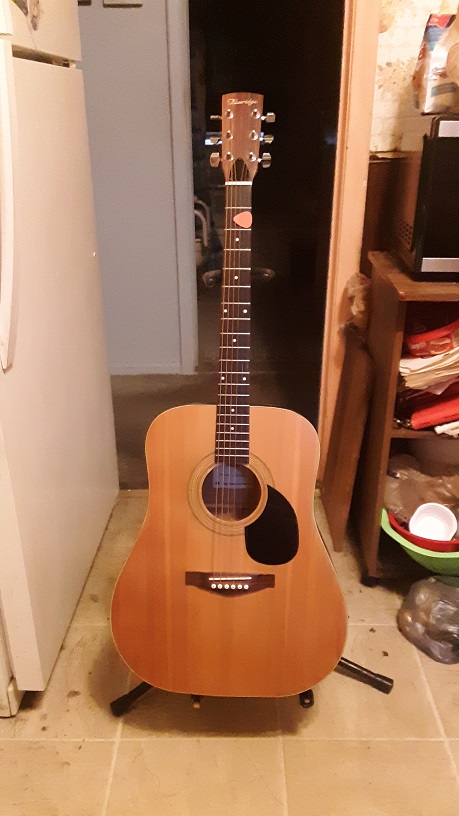
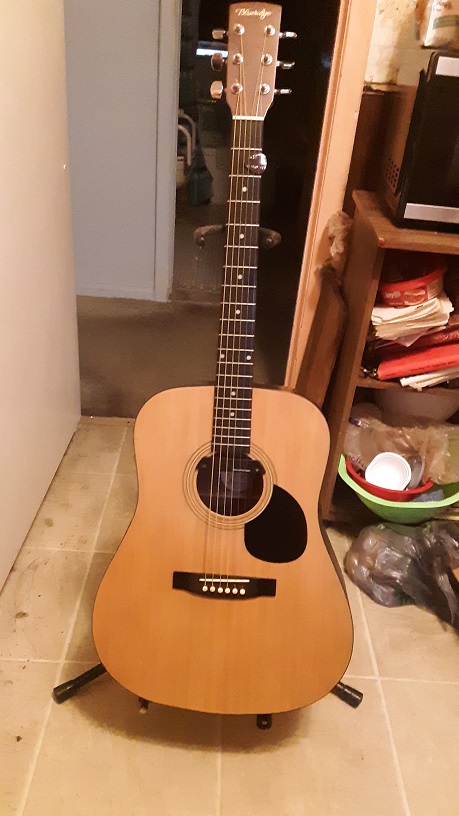
I was amazed at how great the thing sounded! A nice, warm sound, almost too close to a Martin, just a wee bit quieter overall. But this guitar was excellent to say the least, especially for what I paid. It showed some road wear, with a few small dents in the body and a small piece of binding missing along the fretboard. The BR-OS was made in China, based on the Martin D-28, with a solid spruce top along with rosewood back and sides. The inner bracing is also similar, and the headstock is reminiscent of Martin, with a simple cursive logo. I have owned this one now for over 20 years, and it is still one of the best acoustic guitars that I have ever played.

I immediately sought out to purchase more of these models. I came upon another BR-OS for about the same price and grabbed that one up as well. However, it had a lot of differences. It still sounded great, but the neck had a much more “V” cut to it, and the headstock had a curved “V” cut as well, similar to the Dean electric guitars. I kept it for a while, and sold off the Martin DXM for the same amount that I had paid for it a few years back (about $300.00). Side note: While Martin still has the X series of acoustic guitars, they stopped making the DXM long ago. It was a good guitar, and if you can find a decent used one for about the same amount of money, I would recommend it, especially as a back-up acoustic.

I was also checking out the newer models of Blueridge the were coming out at the time. I purchased the lowest-priced model, the BR-40. While it had a decent volume, I was not too satisfied with the tone, and re-sold it soon after, losing a few bucks in the transaction. I also came across a BR-OM on eBay, and snagged that for about $100.00. This is similar to the BR-OS, only with a laminated top, which doesn’t have as rich of a tone. I did like that the neck was very similar in comfort, so I decided to put a pickup in it and use it for my live solo shows.

When I got my 1981 Martin D-28 around 2005, I knew that it would be my main acoustic from that point on. My acoustic collection was a bit big, and I eventually sold off the V-cut Blueridge for the same amount that I paid. It was around that time that I was finding more articles about the old Blueridge acoustics and how great they were compared to the newer models. From my experience with the BR-40, I could attest to that thought. Saga has been putting out much more quality models of Blueridge guitars over the past two decades, including the limited-edition Carter Stanley and Larry Sparks models. I have noticed that the prices for new models have jumped up in price to almost double than what they were going for about 10 years ago. Of course, that is true with just about all guitars today, be it acoustic or electric. Guitar Center and Elderly Instruments are selling the BR-40 for about $645.00. To get at the beginner market, Saga introduced a lower-priced Bristol line of acoustic guitars. This reminded me of when Martin put out the Sigma guitars years ago. These Bristol guitars are good beginner guitars, but do not have that great of a tone, due in part to so much laminated wood being used.

The older Blueridge models have also seen a price jump, probably due to the reputation that they have. Scanning eBay recently, I did see a few V-cut BR-OS models going from $300.00 to $500.00, and a Martin-style headstock BR-OS for $598.00. There was also an early made-in-Korea model labeled BR-O5 going for $350.00. If these were in great shape, it would be worth looking into. However, purchasing a used guitar online without trying it out is a risky chance.

As for the newer Blueridge models, the “Pre-War” and “Historic” models seem to have a great tone and volume, and are a lower-priced alternative to a Martin. Elderly sells these models anywhere from $865.00 to $1,995.00 with a gig bag. Personally, after playing some of these models, I am pleased more with the Sevillana 2208 dreadnought that I secured back in 2022 from a distributor in China (https://luegra.design.blog/2022/07/16/this-dreadnought-needs-to-come-to-the-u-s/). I am still hoping that this guitar can make it to the US before the world sees more international turmoil.

Chew on it and comment.

Categories
Bluegrass Music

IBMA World of Bluegrass: Where Will You Go?

Last week during the World of Bluegrass conference in Raleigh, the IBMA announced that 2024 would be the last year that WOB would be held in that city. It has been there for about a decade, moving from Nashville. When that move was announced, I pretty much decided that I would not be attending due to the driving distance from Detroit to Raleigh, about 14 hours one-way. That meant that I would have to take off two extra days just for driving, and the job I had at the time didn’t give me that much vacation time.

Of course, I later dropped my membership with the IBMA due to political reasons, but have continued to get emails from them, and since the association is central to the bluegrass music industry, whatever it does gets around as news to all bluegrass fans. The strange thing about this announcement was that the IBMA did not announce where it will be moving the WOB convention in 2025. I can remember when it announced in Nashville that Raleigh would be its next location for three years, then the contract kept getting renewed for three-year extensions. It was originally in Owensboro, Kentucky, moving to Louisville in 1997. It then moved to Nashville from 2005 to 2012, and then to Raleigh starting in 2013. COVID wiped out the convention completely in 2020, was brought back in a smaller capacity in 2021, and a hurricane half-ruined the 2022 edition. One can only assume that the past three years had some sort of impact on the decision to relocate.

On many of the bluegrass news websites and chat groups, the big debate is where WOB will happen starting in 2025. Chris Jones even wrote a humorous take about the future location in his Bluegrass Today column (https://bluegrasstoday.com/from-the-side-of-the-road-new-home-for-world-of-bluegrass/). I may even consider re-attending if the IBMA takes up Chris’ suggestion of holding it at Galesburg, Michigan!

If you follow any of the debate, more cities are suggested than I can ever find on a map. Will it go back to Louisville, Owensboro, or Nashville? Perhaps, but I doubt it will go back to Music City, even though Nashville has set itself up as a perfect convention city over the past two decades. The other two Kentucky locations have built themselves up to be more convention-friendly over the past few years, but it is still a “maybe” for either one.

A new location? Most likely, but where? Hard-core bluegrassers would go to war-torn Ukraine if they knew Del McCoury would be headlining. The United States is such a large country that no matter where the convention was held, it would be a long distance for some people. One also has to consider convention center availability, the amount of hotels available, highway access, airport access, hospitality and dining, smaller venues for showcasing, and cooperation with local authorities. I am sure that IBMA has a verbal agreement with some location, else they would have not made the announcement. Perhaps making the announcement, they hoped to get some bids on locating it at particular cities. It all just seems that there is a lot going unanswered with little time to fully prepare.

The IBMA has moved away a lot from its original traditional values over the past few years, which again made me leave the association. Who knows? Maybe the 2025 WOB will be in New York or San Francisco, if only to show how progressive the association has become. It would be a shame if the association would continue to ignore its most sacred traditions that the founders such as Bill Monroe, Flatt & Scruggs, Jimmy Martin, and the Osborne Brothers bought forth — that there are family and Christian values within the bluegrass community, and that while its music is now appreciated world-wide, there is still that precious heart and soul of the genre that continues to live in the east-central region of the country.

In the meantime, we still have the SPBGMA conference in Nashville this January!

Chew on it and comment.

Categories
Acoustic Guitars

Jasmine Guitars: The Good, As Well As The Bad and Ugly!

Jasmine acoustic guitars. You either love them or hate them. And that depends on the model, I guess. I have had three Jasmine guitars over the years, and only one has really impressed me.

Jasmine started out as being marketed by Takamine Guitars to be a low-cost alternative to its acoustic guitar lineup. They were made during the 1990s and early 2000s in China. About 10 years ago, Jasmine was created as its own separate brand by KMC Music, and most of the guitars are manufactured in Indonesia. Early models will have “Jasmine by Takamine” on the headstock, while more recent models will just state “Jasmine.”

My first Jasmine was a 12-string (I don’t remember the model number) that was purchased used back in the mid-1990s. My pop-punk band The Masons (of detroit) (yes, that is how we spelled it) were doing some acoustic shows, and since it was just single guitar/bass/drums, I wanted to fill out the sound more with a 12-string. I remember that the thing was a pain to stay in tune, even after I replaced the tuning gears. The nut was not sturdy, moving about if you loosened even one string. Even though it had a dreadnought body, it wasn’t every loud. I actually trashed it after a few years because it was falling apart so much. Its legacy still lives on, as the headstock appears on the cover of the CD compilation that I produced in 1997, Boombacoustic!

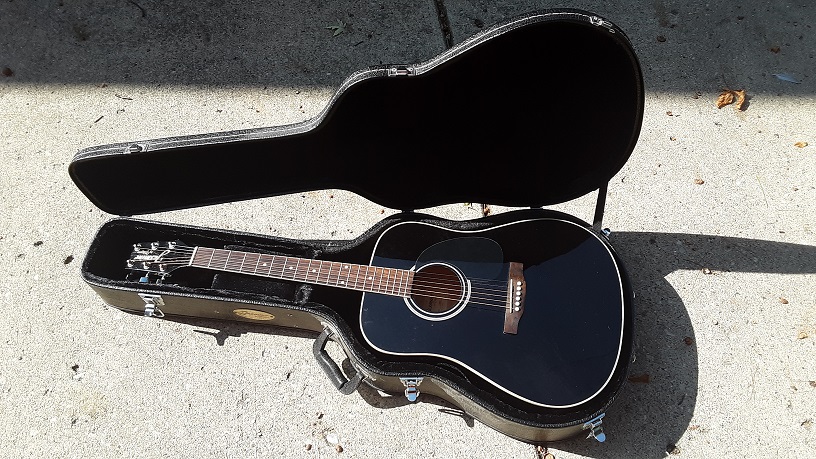
Just prior to the COVID pandemic, I was shopping around for some acoustic guitars that I could bang around at jam sessions and such, not wanting to take my prized Martin or Blueridge guitars to get damaged. I came across a Craigslist ad that someone in town was selling a Jasmine S341 with case real cheap. He was leaving town and wanted to get rid of everything except the clothes on his back. I gave him $50, I figured that the hardshell case was worth that. I probably was not that far off with that thought. The S341 was a model that Jasmine put out in the mid-2000s to be a somewhat total package for a beginning guitarist. It retailed for about $250.00, and came with that hardshell case covered in faux leather with a big brass-like badge showing “Jasmine by Takamine” on the side. The dreadnought guitar has a black finish, something that I have never been a big fan of (apologies to Johnny Cash). The previous owner must have not played it much, or even pulled it out of the case often, as the guitar still had that glue smell to it that newer, cheaper guitars give off. Like my previous experiences with Jasmine guitars, the tone was not that great, typical of acoustic guitar bodies made almost entirely of laminated wood finished in a opaque paint. It plays well, the neck is pretty comfortable, but other than playing it solo, it wouldn’t cut through too well in a jam, especially a bluegrass setting. I played it once at a Songwriters Anonymous meeting, and then the pandemic kicked in, so it has sat in waiting ever since. I plan on selling it off soon, hopefully to someone who could appreciate it more than the previous owner or myself.

Two weeks ago, I purchased a Jasmine S35 off of eBay. I was a bit sorry at the time, as although I got a decent final bid price, the shipping was higher than the price of the guitar. It totalled just under $70, and without a case or gigbag. I received it a few days ago, and I have been surprised by the sound of this beginner acoustic! It has a dreadnought body, although at first glance, it looks a wee bit smaller. This is one of the newer models not marketed by Takamine. It has the specifications of most lower-cost acoustics (spruce sitka laminated top, mahogany sides/back, rosewood fingerboard), but the sound is much more loud than I expected, and has a much richer tone than most beginner guitars. I don’t plan on keeping it, but after a clean up and bridge modification, I am sure that I can find an interested customer. I have seen this particular model going anywhere from about $80 used to $150 new, and if all of them sound as good as the one I have now, it is a good buy.

Chew on it and comment.

Categories
Bluegrass Guitar Bluegrass Music

Josh Williams: Bluegrass Instrumental Genius

More cleaning around my soon-to-be sold house, I came across a great DVD. Guitarmageddon: Josh Williams, Andy Falco and Chris Eldridge Live at the Station Inn. This was recorded around 2007, was put out by Flatpicking Guitar Magazine, and the three of them look young and energetic. If you get a chance to watch or purchase this DVD, or come across clips on YouTube, be sure to watch it!

This got me to thinking about Josh Williams again and what an amazing bluegrass musician he truly is. If you ever get to see the 1994 documentary Gather at the River: A Bluegrass Celebration, which covers the 1993 IBMA World of Bluegrass convention, you will see the first incarnation of Pete Wernick’s Young Bluegrass All-Stars. This band included very young versions of Williams (on banjo), Chris Thile (mandolin), Cody Kilby (guitar) and Michael Cleveland (fiddle), all of whom went on to bigger fame in the bluegrass community. Williams would later join Special Consensus on mandolin, then spend a good deal of time playing guitar with Rhonda Vincent and The Rage. He would also win the IBMA Guitar Player of the Year award three times!

He would leave The Rage due to some addiction troubles, but would form a solo band, as well as sit in with a number of bluegrass and country artists. Around 2008, I got a call from Jim Lauderdale asking if I would pick up Williams from the Detroit Metro Airport and drive him to a gig in Grand Rapids, about three hours away. I agreed, but then we hit one of the worst snowstorms in west Michigan, so the three hours turned to about six hours. Moreover, Williams was in a depressed mood due to the untimely death of mandolinist Butch Baldassari earlier that day. But we kept in touch for a while (I would always refer to him as “Colonel,” due to his home state of Kentucky), but slowly lost contact.

Williams would eventually kick the addiction habit and get back to performing with Rhonda Vincent for a few more years, as well as tour on a Tony Rice package. A few years back, he decided to leave touring completely, citing spending more time with his family. His output since then has been very sparse, but fortunately, he has not been forgotten by those that have worked with him in the past and are still active.

I bring Williams up now for a few good reasons. Currently, we have some great young guitarists in the bluegrass fold, most notably Billy Strings and Molly Tuttle. I am taking nothing away from these two – I find them both as incredibly talented players. However, there were some amazing bluegrass flatpickers in the previous generation of bluegrass that has slowly been forgotten. As for the Guitarmageddon video, Eldridge gained cred performing with The Punch Brothers, and Falco has been a highlight of the band The Infamous Stringdusters. Williams should not be forgotten at all. His body of work with Special C, Rhonda Vincent, and solo projects prove that he is a fantastic instrumentalist to be highly recognized on his own.

I have found a few videos of him on YouTube recently, showing up for a jam at the Acoustic Shoppe with members of The Chapmans, and performing on some tribute projects. I hope to get in touch with him soon, but I hope more that he can get back on stage a lot in the near future to showcase what a talent he really is.

Chew on it and comment.

Categories
Polka Music

Perfect Song #10: “Who Stole the Kiszka” by Frankie Yankovic

I have told my buddy Ken that there are certain songs that I want played at my wake after I pass away, and this is one of them. I was raised in a Polish-American household, and my father would constantly play polka music when he was home. That man could play with the AM radio dial and find a polka station in the middle of nowhere while we were driving in the car.

As a kid, I got tired of polka music, but this song always remained in my heart. During the 1970s, Detroit had a Saturday night horror movie host called The Ghoul on Channel 50 that used this song as his introduction. I still have to pull it up on YouTube every so often when I need a good smile.

Frankie Yankovic was like the Elvis Presley of polka music, especially in the Midwest. He was of Solvene descent and grew up in Cleveland. His polka band The Yanks were extremely popular with the first-and second-generation Polonia people from the late 1940s until his death in 1998. There wasn’t a Polish, Slovene, or Bohemian immigrant family that didn’t have at least one Frankie Yankovic record. He had a number of hits, including, “I’ve Got a Wife at Home,” “Blue Skirt Waltz,” “Just Because,” and this one. He was dubbed “America’s Polka King” in 1948 during a battle of the polka bands in Milwaukee. His music appealed to the masses, especially in cities that had a high Eastern European immigrant populations such as Cleveland, Detroit, Buffalo, Chicago, and Milwaukee. Weird Al Yankovic, although not related, paid many tributes to him in his performances.

For anyone not familiar, kiszka is Polish blood sausage, originally made with animal intestine, blood, ground meat and barley. You either love it or hate it. My parents loved it, and I hated it. I still cannot stand the smell of it being cooked, let alone the taste. Which is what makes this song so special. The singer values it so much that he is willing to give up szynka (ham), kielbasa, and pierogi for his kiszka. Fortunately, Jasu (“John” in Polish) finds the kiszka and brings it back.

From the drum beat and baritone sax introduction, one can tell that this is a happy song. Polkas have that great 2/4 beat for dancing, but this song is a bit faster than normal polkas. With that fast tempo, all of the musicians are at their peak. Then when Frankie sings that first line of “Someone stole the kiszka,” you cannot help but laugh, because who in their right minds would want to steal blood sausage?

This is a definite party song. If the J. Geils Band were a polka band, they would have recorded this song. Even non-Polonia people love to hear this classic. It has all the makings of a fun song – the fast tempo, the playful saxophone, and the hilarious lyrics. My mother told me that this song was a favorite of my grandfather, and I can understand why. It is a slight humorous slam at our Polonia background, but also makes us proud to be Polonia.

If you ever need a good smile, put this song on. It’s two minutes of pure fun!

Chew on it and comment.

Categories
Bluegrass Music Music Instruction

Bluegrass School Instruction?

I came across another article this past week regarding teaching music to children. This one is from a blog that is posted on the Alfred Music website (https://www.alfred.com/blog/tips-starting-elementary-guitar-program/). Alfred Music is similar to Hal Leonard and Mel Bay, in that they produce hundreds of books and videos on musical instrument instruction. However, its focus is much more toward educational programs, covering a wider variety of instruments (strings, woodwinds, brass, percussion, etc.), and setting up actual teacher/student paths.

The blog brings up some interesting thoughts for teaching guitar-centric curriculum to younger students. Some say that it is hard for a young person to learn guitar. The author states that he has had continual success with young students. My thought is that getting them to be interested in the instrument at a young age is the best bet for continued interest, not just as a hobby but perhaps as a possible profession. The struggle is getting young students to be disciplined in practice and progressing. As I mentioned in an earlier blog, distractions are aplenty, mostly coming from social media and video games. Playing video games is easy, but the teacher (or parent) needs to instill the idea that there is no long-term satisfaction with winning a video game, yet progressing on a musical instrument has tons of rewards.

The Alfred blog looks at setting up an actual guitar instruction classroom. It mentions the initial (and follow-up) cost of having everyone in class secure a guitar. It is very unlikely that in a class of about 25 elementary students, every one of them will afford a decent acoustic guitar, and it is even more unlikely that someone like Billy Strings will donate guitars to a school (https://bluegrasstoday.com/billy-strings-donates-guitars-to-all-the-students-at-his-former-school/). Thinking way back to my elementary school days, the music program consisted of everyone in 4th grade being taught basic instrumental music theory by purchasing a cheap recorder/flutophone (which one or two students’ parents even passed on), learning the basics, then moving on to some regular instrument such as trumpet, snare drum, violin, etc. While I wanted to pursue drums at the time, my parents only gave me one choice – play the old saxophone that my brother ditched, or nothing at all. After two years, I lost interest in it completely. I took an interest in guitar (particularly, bass guitar) at 15, played in my cousin’s oldies band, and went from there, much to my parents’ dismay.

The blog suggests that to cover some costs, the teacher/students/parents could resort to fundraising. Now this blog was written in 2018, pre-pandemic, and these days, people a lot more conscious of where their money goes. If anything, considering setting up such a project will require a lot a research. First, seeing if it is feasible – if enough kids would be interested in such a program in one classroom. Personally, I think that it would be unlikely, but perhaps an after-school project for an entire school would work.

Interest may also be gathered by presenting a music performance at the school by a local or touring bluegrass band. A lot of bluegrass bands have an educational program. The best initial place to find out this information is when Bluegrass Unlimited magazine publishes its Annual Talent Directory (https://bluegrassunlimited.com/article/2022-talent-directory/). Bands will note in their listing if they provide educational programs. While most kids will probably be fidgety during performance, there will most likely be a few that will take interest in learning an instrument. Maybe a few will not be interested in guitar but another instrument like bass, banjo, mandolin, or fiddle.

There are a few other suggestions within the Alfred blog to look over that I will not cover here. I recommend reading the article. If serious about starting a music program within a school, you may consider securing the instructional books that Alfred offers entitled Sound Innovations for Elementary Class Guitar (https://www.alfred.com/sound-innovations-elementary-class-guitar-overview/). I am certain that a quality basic program in elementary school can lead to a bluegrass-oriented program in middle or high school. If I could turn back my personal hands of time and stuck with using my high-school teaching degree, I would have been motivated to set up some form of bluegrass/folk music club at the school at which I was working. As one can see form my past blogs, I am very interested in getting young people to be interested in performing acoustic music, particularly bluegrass music.

Chew on it and comment.

Categories
Bluegrass Music Live Music

Where Have All of the Bluegrass Fans Gone?

Last evening, I went to the Kentuckians of Michigan Lodge in Romulus, Michigan to see Fast Track, a bluegrass band consisting of players formerly of the Bluegrass Cardinals, Continental Divide, and the Rarely Herd to name a few. The lodge and association are known in the local bluegrass community for hosting many touring bluegrass acts as well as some local country artists.

Now bluegrass shows are not that common in the Detroit area, and with summer coming to a close, area festivals are not readily available. Add to that many festivals have permanently closed up. So when a bluegrass show is available, one would think that there would be a decent crowd.

Unfortunately, the audience number was sparse. Maybe 50 people, including a few lodge staff members. Now there a few factors that affected the low attendance. The show was booked only a few weeks ago, as Fast Track was actually heading to Ontario for a festival during the weekend and probably wanted to squeeze in a Friday night show where they could. Also, the K of M does not heavily promote the shows that they present, usually just posting the announcement on its website and Facebook page.

However, good bluegrass fans keep their eyes open and their ears to the ground. I don’t have a Facebook page, but I still check the internet at least once per week for shows in my area. While I haven’t been to The Ark in Ann Arbor since before the pandemic, I still check out the website to see what is coming up.

And that leads to another problem – the pandemic. That was over two years of panic among the masses, the closing of venues, banning socializing, and loss of personal communication. With that, people stopped going to see bands, especially at smaller venues, and bands stopped touring, either limiting performances to internet streaming or even disbanding due to no income. When the COVID bans were lifted, people had found other entertainment, basically continuing to stay at home.

Oh, there were live shows to go see. However, it strikes me that people will not go to a small bluegrass (or most any other music format) show for $15.00, yet will pay hundreds/thousands of dollars to go see Taylor Swift at a nosebleed seat and be surrounded by thousands of sweaty, heavy-breathing individuals holding up their iPhones to film this moment. Now, I will be the first to say that I am glad that someone like Billy Strings can fill a large venue and give a fantastic live performance. He is a phenomenal guitarist, and humbly pays tribute to his bluegrass roots during his shows. But how many of these “bluegrass” fans will then go to a local venue in the next few weeks to go see a touring bluegrass band like Fast Track? Probably close to zero.

The post-pandemic apathy of music fans has driven another nail into the live-music coffin. Instead of people going out to spend a few bucks to see what is happening on the music scene, the thought is to save up a few week’s wages to go see that one special act that everyone is talking about. Back when I was in punk and alt-rock bands in the 80s, we used to go to plenty of shows to see what bands were out there, thinking that we may be witnessing the next-big-thing in one of these dives. Today, we wait for the media to tell us what is good and what we should spend out money on. This concept has always been around, but it has exploded over the past few years.

Other than Billy, Rhonda Vincent, and a very few other bluegrass acts, most bluegrass performers have other jobs, and only tour during most weekends. I am sure all of them would love to be making a living playing the music that they love, but it is near impossible, and a lot of it has to do with the music-loving(?) public. The same liberal people that claim there should be a more fair distribution of wealth will make sure that Taylor Swift is a multi-millionaire while so many talented musicians still have to paint houses, dig ditches, and bartend.

Bluegrass fans take note: While I am glad that you helped someone like Billy Strings achieve big success, you should also take the time to search out smaller bluegrass shows, especially ones that are not at festivals, in your area and attend those as well. And you Billy Strings fans that think you know bluegrass music, then how about going out and seeing other bands, especially the more traditional ones. Billy would be the first to tell you that.

Chew on it and comment.

Categories
Bluegrass Music Music Instruction

Keeping Young Bluegrass Musicians Motivated

Last week, this article popped up on the Google search page: https://www.guitarworld.com/features/how-to-keep-your-kids-interested-in-playing-guitar . As expected with Google and its spying, I get a lot of articles related to music, and most of them I tend to ignore. However, this article piqued my curiosity, and after reading it, saw that it had some good information.

While the article leans toward young electric guitar players and keeping them interested in continuing to play, the information presented can be used to motivate young musicians of any instrument, including bluegrass instruments. Young people get interested in the fun of playing guitar, mandolin, or fiddle, especially when they see other young bluegrass musicians on stage getting a lot of attention. However, convincing them that regimented practice is what makes success, and informing them that flashy playing doesn’t just come in a few minutes, can be difficult. Moreover, there are a lot of other distractions, including video games and social media. The article makes some great suggestions, so let’s go over them an cover how this can work with bluegrass youngsters.

Take them to a gig – Especially during the summer, bluegrass festivals abound. While most seem to be in the mid-east and south of the US, there are many spread out in the northeast, mid-west, and western parts of the country. Add to that folk and old-time fiddle festivals that also showcase instrumental talent. One can stay for just an afternoon or evening, or camp out for the extended weekend. These events give the chance for the youngster to see a number of bands/artists, and bluegrass festivals have that treasure of the band members talking and shaking hands directly with their fans. What could a young musician value more than talking with someone playing the instrument that he/she is starting on? Moreover, many of these festivals have instrument workshops for amateurs to learn a few tricks from the professionals. Do some internet searching for music festivals in your state.

Buy a new piece of gear – What bluegrass musician doesn’t have a capo? Or get the kid a new, better strap. Pay attention to how he/she is playing. Perhaps instead of guitar, let them try a mandolin, or bass. Check with perhaps getting some sort of “jam” recording or video so that he/she has a virtual band to practice with.

Keep the instrument accessible – Instead of putting it in the case after practice, have it on a stand so that it can be easily seen and picked up to practice with at odd times.

Online lessons – In-person lessons always seem to work the best, but they are not always convenient. YouTube, of course, has tons of free lessons, but there are also web sites like ArtistsWorks that have big-time bluegrass guitarists, fiddlers, banjo players, and mandolinists offering in-depth lessons for a subscription. Again, pay attention to what the student needs, then ask around.

Learn with them – An excellent parent/child bonding is to both be learning the instrument at the same time. You can actually learn from each other.

Introduce them to other musicians – As stated earlier, band members at bluegrass festivals totally appreciate their fans, and will spend hours after a performance talking to people, signing CDs, and taking photos. So many of these artist will be flattered to know that a youngster is learning the same instrument, and will usually sit for a few minutes to show a technique or give the kid a guitar pick as a souvenir. Bluegrass musicians are so easily approachable. One of the fun things about staying at festivals overnight are the jam sessions happening as someone’s trailer. It is not uncommon for a person that you just saw on stage earlier come walking up to join in. Also, pay attention to bluegrass bands that have younger players. Cherryholmes was a great family band years back, but today one can see The Petersens, Williamson Branch, and the Cotton Pickin Kids show up at festivals.

Set some fun challenges – Find some songs that might be just a wee bit more difficult than what is currently being worked on, then present them in a short while. Perhaps implement some different types of music into the bluegrass fold. Billy Strings does this a lot, yet still keeps it near the bluegrass idea.

Find the right amount of encouragement – Follow all of these previous concepts, but don’t suffocate the kid, nor push them into hating music. Remember that all kids are different, even within one family, and it is possible that while one child may be a banjo prodigy, the next sibling could not care less about music and wants to play baseball instead. Ask other parents of musically inclined children what has worked for them, and try those ideas out. Just keep tabs on what works, and always be positive with the student’s progress.

Hopefully some of these thoughts will help parents with bluegrass students keep them motivated and produce the next Billy Strings, Molly Tuttle, or Sierra Hull.

Chew on it and comment.

Categories
Acoustic Guitars Music Stores Old-Time Fiddle

Yard Sales, Fiddle Conventions, Elderly Instruments

Last weekend I did my yearly trek to two of my favorite ventures – the Michigan Avenue World’s Longest Yard Sale and the Michigan Fiddlers Association Fiddlers’ Convention. Before this year, the Fiddlers’ Convention was held in Hillsdale, so I could take Michigan Avenue all the way from Saline to Hillsdale to see the fiddling as well as do some yard sale shopping. This year, the convention was moved to Hastings (west of Lansing), so I ended up taking Friday off of work and doing each activity on separate days. Rain was predicted both Friday and Saturday, so here’s how it went.

Friday: The morning started off sunny, but I was frustrated with being stuck in traffic for an hour due to construction on Michigan Ave. and US-23. Once moving, I was able to stop in a few places that set up tables in quaint towns such as Clinton, Allen, and Quincy. My first stop led me to an old garage full of antique/junk toys, games, and nick-nacks. While I passed on almost all of it, I did get something that brought back memories of a when I was a kid – salt and pepper shakers that look like vintage Squirt soda pop bottles. Totally going up on a shelf in the kitchen.

About the time that I reached Quincy (a few miles east of Coldwater), the skies were starting to turn dark, so I figured to head back toward home. I was primarily looking for music-related items, but almost everything that was in that category was priced way too high, even if I was able to barter down some. However, I was able to secure a used Applause AE-32 acoustic/electric guitar for a decent price.. For the unfamiliar, Applause guitars were put out by Kaman in the late 1970s to be a lower-end version of the popular Ovation acoustic guitar series. The main difference was a laminated top instead of a solid top. Other than that, most everything was the same. I was never a big fan of these guitars due to the rounded molded-plastic back/sides that made them difficult to play while balanced on the lap sitting, requiring a strap and standing up to hold. Bringing it home, I tested it out and it still had a good sound unplugged, also being clean and loud when plugged into an amp. While it seems like a good guitar, I plan on just cleaning it up and selling it off, hopefully making a few bucks in the process. Fortunately, I did beat the rain making it home.

And I did make a pit stop at Randy’s BBQ near the Michigan International Speedway in Brooklyn. It is a trailer where they make some of the best pulled pork barbeque you have ever tasted. Every year I stop by and order a Godzilla sandwich, which consists of pulled pork, pulled chicken, brisket, mac & cheese, cole slaw, and pickles on a bun! I literally starved myself all day because I knew that I would be devouring one of these in the afternoon.

Saturday: This day went a lot worse in so many ways. First off, getting to Hastings is not an easy task. I used to go to a park near Hastings every June for a Civil War reenactment. I had forgotten how many two-lane roads with police cars shooting radar there were along the way. No, I didn’t get busted, but I kept my eye on the speedometer almost all of the way there and back.

As soon as I pulled up to the campground where the convention was, Mother Nature let out a storm that made you want to start building an ark! It kept going on and off for over an hour. I was able to catch most of the fiddle workshop and jam session under the pavilion. I had attempted to video some of the activities, but the video camera that I was using was brand new and my first time using it, so I was unfamiliar with the set-up. The result was absolute garbage! Live and learn. I have to say that the workshop leader, a left-handed fiddler named Dave Langdon, has a great demeanor with the students, being very patient and hands-on with learning each part of a song.

After some time at the convention, I decided to head to Lansing for a stop at Elderly Instruments. This place used to be a Mecca for me prior to the pandemic. I would either schedule time off from work or make a clean slate on Saturdays to make the trip and spend a few hours testing out guitars and thumbing through the room full of CDs, videos, and music books. When I walked into the store, I was extremely disappointed. A lot has changed at the place in three years. What was once a room full of books and CDs was now limited to two or three bins each. The videos were completely gone, most likely due to the lack of interest in hard-copy videos and the move to online instruction. It was all replaced with walls of ukeleles – not my favorite stringed instrument to be sure. They still had the Martin guitar room, but the violin room was converted to a left-handed instrument room. It just didn’t have the same appeal to me as a whole than it did a few years back. I should have sensed that it would be a disappointment when I checked out the website earlier this year and noticed that there was a lot less being offered. I guess that my trips to the store will be extremely rare, only if I should happen to be in the area and the store is open at that time. No going-out-of-the-way trips for me any more.

Because of that, I will be scouting around for other music stores to make the trips to in the future.

Chew on it and comment.

Categories
Americana Music

Robbie Robertson RIP

Robbie Robertson, the guitarist and songwriter for The Band, passed away on August 9th from complications of prostate cancer. Anyone that knows me knows that The Band is one of my all-time favorite bands, EVER! There was a reason that no one argued that these guys called themselves The Band. They could play anything, as a group, and they fit in with anyone.

With the passing of each member, starting with Richard Manuel in 1986, I continually had a piece of my soul ripped out. I was able to see Rick Danko at a live solo show shortly before he died in 1999 (strangely, a few days before he had passed, he played The Ark in Ann Arbor, and signed one of the green room walls with the statement “I’m not feeling well”). If I were to say the one bassist that my style was most like, it was Rick.

I was also able to catch Levon Helm perform at the Ryman Auditorium in Nashville a day prior to one of the Americana Music Association’s annual conference in 2008. Even though the original band had broken up in 1976 as seen in the triumphant film The Last Waltz, one could tell in Levon’s performance that there was still a piece of The Band in his heart.

I remember also watching the 1989 Juno Awards (the Canadian equivalent to the Grammys) on the Windsor station that we could watch here in Detroit. Robbie, Rick, and Garth Hudson (along with Richard’s children) accepted the Hall of Fame award, then the three performed “The Weight” with Blue Rodeo (another of my all-time favorite bands) backing them up.

The breakup of The Band had a lot to do with songwriting control. Many of the songs, especially all of them on their self-titled second album, were credited to Robbie. Other members, especially Levon, claimed that they had contributed to the compositions. Levon wrote about it in his autobiography This Wheel’s On Fire, and held that grudge to his death. For Robbie’s part, he often admitted that other members threw in ideas. Like The Beatles, the members of The Band became too close, like a family, and had their family arguments, which led to a divorce.

I always had respect for Robbie’s guitar playing. It was totally underrated by rock music listeners, but fellow musicians often praised his six-string work. Bob Dylan (who often worked with The Band), George Harrison, and Eric Clapton are just a few fans. In fact, Robbie was able to not only keep up with Clapton in a guitar duel in The Last Waltz, but even jumped in fast when Clapton’s guitar strap broke so there was no dead air. Robbie was humble about his guitar work, but I will always be in awe of his simple but effective intro to “The Weight.”

Robbie was a fan of film, and became good friends with The Last Waltz director Martin Scorsese. He would handle the soundtracks for a number of Scorsese’s films as well as other films. However, one of the best outputs I loved from Robbie was his 1987 self-titled solo release. Although he was from Toronto, his mother had Native-American roots, and his passion for this ancestry shows up in the music. He also secured some amazing talent to record with him, such as U2, Peter Gabriel, The BoDeans, and Maria McKee. Both Gorth and Rick also appeared on the album.

While I always had a leaning toward Levon as far as who was my favorite member, all of the members of The Band mean a lot to me. That includes Robbie, who was more than just a cog in the machine. His work in The Band helped make it the forefathers of the Americana music genre (no one can deny that “The Weight” is the Americana national anthem), and he will never be forgotten by those who understand how important his work was. This weekend, I plan on watching The Last Waltz.

Chew on it and comment.

Design a site like this with WordPress.com
Get started