Musician and writer (both song and print) for over 30 years. Primarily interested in roots music (Americana, bluegrass, blues, folk). Current contributing writer for Fiddler Magazine, previous work with Metro Times (Detroit), Ann Arbor Paper and Real Detroit Weekly, as well as other various music and military publications. As songwriter, won the 2015 Chris Austin Songwriting Contest (Bluegrass Category, "Something About A Train," co-written with Dawn Kenney and David Morris) as well as having work performed on NPR and nominated for numerous Detroit Music Awards.
Small practice amps are aplenty and can be purchased at some reasonable prices. Kustom has always made smaller practice amps since its inception back in the 1960s. For a long period, it was the only thing that they were producing, as its trademark roll-n-tuck padded monster solid-state amps were becoming unpopular. Recently, the company has gone back to making larger amps, even some retro padded ones, but they still mostly produce the small practice varieties.
Kustom has always had a mediocre reputation at best. While the roll-n-tuck models were what every garage band had back in the 60s, they proved to be cumbersome (they were housing large transformers meant for tube amps, using them on the tiny transistor circuits), and the “naugahyde” covering would tear easily. Solid-state circuitry fell from grace during the 70s and never gained much of a following afterwards except for smaller practice amps.
Through the years, Kustom built a number of different smaller amps, usually no more than 20 watts, at cheaper prices than Fender or Marshall could do, so they were popular with beginning musicians (and cost-conscious parents). The KLA10 is probably the most popular practice amp that Kustom has put out for a long time. It has seen different stylings and trim colors, but has remained pretty much the same as far as features and performance.
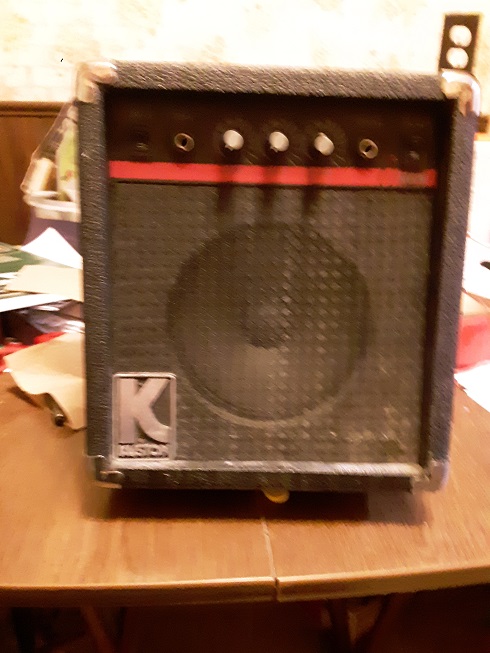
What you get with this amp is the basics. From left to right on the front panel, there is the Drive switch, input jack, gain control, voice control (a fancy way to say tone control), volume control, headphone jack, LED power indicator, and power switch. The open back exposes the rear of the six-inch speaker, and the power cord is coming out of the circuitry casing. Nothing else, just covered in Tolex and pseudo-chrome corner guards. For the beginning guitarist, it is a fun amp to use. The overdrive/distortion is decent sounding. It’s not Marshall stack or other tube overdrive, but can give a good distorted sound, especially with a humbucker pickup. The headphone output allows playing without disturbing others.
The KLA10, however, is no longer manufactured, replaced by Kustom with the KG1 with very similar specifications and features. The KLA10 can be found on eBay or Reverb for under $40.00. If you can snag one for under $25.00 in good condition, you may want to get it. I will be honest, I picked up mine, with some dirt on the covering, surface rust on the chrome corners, and some scratchy pots, for only $6.00! A little elbow grease and some TV tuner cleaner in the pots should make it sound great. In short, it is a great practice amp, be it headphone or through speaker. Moreover, it will serve as a satisfactory recording amp if using a regular guitar amp proves too loud and disruptive. HINT: Make sure that the guitar is in tune. One string out of tune through a solid-state amp sounds horrible!
Occasionally, the YouTube algorithm pays off. In recent days, I have come across two young fiddlers that impressed me with their talent. It makes my heart swell that there are some young people out there that are really taking an interest in music, particularly roots music like old-time fiddling. It brings up my spirits after the disappointing turnout at the Fiddle Contest I was at a few weeks ago (https://luegra.design.blog/2024/10/12/2024-michigan-old-time-fiddlers-contest-sad-turnout/).
The first is Fiddlin’ Hayley King. I only found her a few days ago, so I haven’t seen a lot of her videos, and I notice that her YT page does not have a lot of them. However, I was impressed with her original tune, “Little White Pumpkin,” which she performs on both fiddle and clawhammer banjo. From the looks of it, she also plays mandolin and guitar, and has a sweet voice. There’s not much information about her on the internet besides the YT page and a Facebook page, but a 2019 article on her states that she secured a full ride scholarship from Morehead (Kentucky) State University at age 16 (https://www.blythewoodonline.com/2019/01/king-fiddles-her-way-to-college/). She is definitely someone who will snag some interest in the bluegrass and old-time fiddle crowd shortly. I do see her being picked up be a bluegrass band real soon.
Next is Hollace Oakes. At 14 years old, she is impressing everyone that comes across her. Another multi-instrumentalist (fiddle, mandolin, piano, guitar) as well as flatfoot/clogging expert, she has competed for the last few years at the famous Galax Old-Time Fiddle Convention for the past few years, winning the blue ribbon in 2023. This past August, she performed the National Anthem on fiddle at the Convention. She is often seen performing with clawhammer banjoist Margo McSweeny, and has won praises and jammed with Carley Arrowood. I have a feeling that within five years, this young lady will be appearing on a lot of bluegrass stages, probably even the Grand Ole Opry stage.
Lone Justice was one of my favorite bands of the mid-1980s. Along with X, the Long Ryders, the Blasters, the Swimming Pool Q’s, Green on Red, and a few others, they were helping to create a sound that combined punk rock with traditional country, bluegrass, folk, and a touch of R&B and blues to garner the label cowpunk, which later was deemed alt-country, which helps to wean what would become Americana music a decade later. Lone Justice’s lineup consisted of great young musicians, but the highlight was the powerful vocalist Maria McKee.
McKee was perfect in so many ways. She had a voice that could cut through the thickest fog of bland pop music. Her songwriting was winning critics’ hearts with its matching of powerful emotions and Tennessee Williams style storytelling. And her presence on stage was eye catching to say the least. Small in stature, she had a unique look, with a Goth-meets-Madonna-meets-Dorothy from The Wizard of Oz persona. I, along with hundreds of other guys, had a big crush on her. When she slung a Telecaster around her neck, you know she meant business!
The band hit the Los Angeles alt-music scene in 1983 like a rocket. They gained praise from luminaries like Dolly Parton and Linda Rondstadt, who would put the band in touch with David Geffen of Geffen Records fame. Benmont Tench, keyboardist for Tom Petty and the Heartbreakers, would often sit in with the band and worked on their first album.
That first album, 1985’s Lone Justice, was produced by famed studio wiz Jimmy Iovine, and included guitarist Tony Gilkyson, who joined the band temporarily. The album was praised by critics from Rolling Stone and The Village Voice. However, even with the Tom Petty/Mike Campbell penned “Ways To Be Wicked” released as a single, the album was not a commercial success.
The band toured with Petty as well as U2, but never got the success that critics expected of them. Bassist Marvin Etzioni and drummer Don Heffington left the band, and replacements were soon found for recording the second 1986 album, Shelter. With both Iovine and Miami Steve Van Zandt producing, the raw cowpunk sound was traded in for a more synth-pop sound. Even with the powerful vocals on the title cut released as a single, the album hardly hit the Billboard charts. By 1987, McKee called it quits with the band.
All remaining band members went on to varying solo careers. McKee caught most of the spotlight, releasing seven solo albums and garnering some songwriting success, as well as appearing in a few independent films with her husband, filmmaker Jim Akin. There were a few band compilations released through the years, most notably the 1999 This World is Not My Home. Along with some sporadic reference news blips, not much was heard about the band.
So it came as a shock to me that I recently came across this new album, Viva Lone Justice, while surfing the internet. The album cover is of the original quartet, most likely an early publicity photo. The description listed on Amazon stated that it was the first release by the band in 40 years. That caught my attention immediately. It also stated that it featured the original members. That had me scratching my head, as I was aware that the original drummer Heffington passed away in 2021. One press release stated “thanks to modern technology.” That made me really wonder about this project. Did they use AI to create Heffington’s drumming? Anyone who knows me knows how much I despise having AI involved with the arts, especially music.
It turns out that the majority of the album’s material is demos that Etzioni found of the band from the pre-Shelter days. All three remaining original members agreed that it would be good for their souls to release the demos with some re-recording of guitar work, as well as adding a few other recent recordings made by McKee with the help of the SteelDrivers’ fiddle player Tammy Rogers, as well as assistance from Tench, steel guitarist Greg Leisz, and horn player David Ralicke. Along with a number of originals, the album includes covers of Parton’s “I Will Always Love You,” MC5’s “Sister Anne,” and the George Jones/Roger Miller penned “Nothing Can Stop My Loving You,” along with traditional folk songs “Jenny Jenkins” and “Rattlesnake Mama.”
A few reviews that I have seen have been mixed. However, for me, this is a much-needed blessing. I loved the band back then, and it has given me a few minutes of reminiscing what my musical life was like back around 1985. Personally, I want to say thank you to the band for making me smile like I used to back then when hearing the original cowpunk music. For those that still don’t understand, give it a listen if you can.
A couple of crazy things happened to me this past week. Crazy as in “good” crazy, and both are music related.
First, I went to my local post office a few days ago to pick up some stamps. I happened to be wearing a t-shirt with some fiddle bows on it forming the stripes of the US flag. Anyway, he hands me a small sheet of ten Forever stamps. They happened to be ones dedicated to bluegrass music, complete wit guitar, banjo, fiddle and mandolin. I asked if he purposely got me these stamps, and he said that they just happened to be on top of the pile.
I’m not using these. This sheet is going into a frame.
Next, I was talking to a co-worker that does some woodwork, While I dabble in lutherie, she is more into making furniture. We are talking about places to get wood, and she mentioned a small store near where I live called Homestead Hardwoods. The place deals with special woods like mahogany, walnut, and other pricier choices that craftsmen like to use for furniture, shelving, and wall covering. I do not have a Facebook account, but the store does, and I checked out a recent posting that stated “Reject Wood from Gibson.” I was curious to find out what Gibson they were referring to. The store is mostly by appointment only, but are open for a few hours on Friday and Saturday, so I went after work this past Friday.
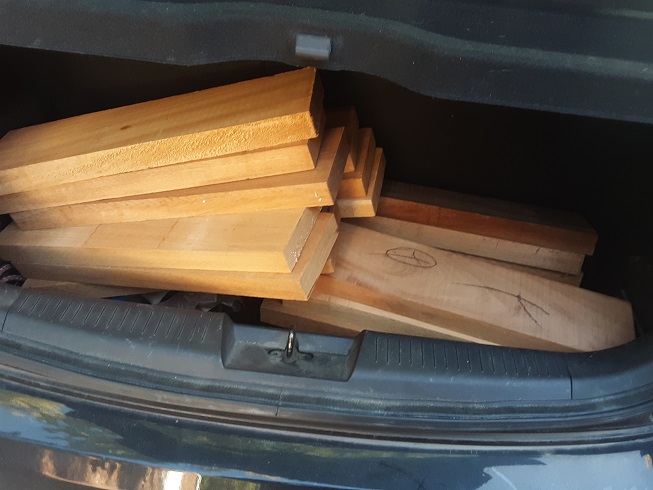
I had passed the place hundreds of times on my way home, but never thought to venture in. This time, I entered to be greeted by the friendly co-owner. Before I could finish asking my inquiry, he confirmed that the small slabs of mahogany (roughly a 2×4 about 18 inches long) came from the Gibson Guitar factory in Nashville. These particular pieces were meant for the bodies of Les Paul Junior models but rejected by the factory inspectors. The guy at the shop told me that he occasionally gets wood meant for guitars and stays in touch with area luthiers. He also told me that he makes banjos on the side. I will definitely be keeping in touch with him.
Just the fact that they were from Gibson made me giddy. This was no ordinary wood – this was potentially going to be a solid-body guitar! I snagged a few that day, and went back today (Saturday) for more. Another co-worker who is also a guitarist told me that he would be interested in a few pieces for his curious collection.
I plan on saving a few for a possible guitar project, but I am also thinking of making a table out of a few, with perhaps the Gibson logo on the face. I am just fascinated with the background of this wood. While it is not a piece of unique history (I actually have a piece of the floor from the Grand Ole Opry that I cherish), this wood does hold a small place in my musical heart. I hope to make good use of it.
In the meantime, I‘ll still be working on guitars and such, thinking of great ways to use this great wood.
Last weekend I attended the 36th Annual Michigan Old-Time Fiddlers Contest, held each year in New Boston during the Huron Township Applefest. I have always accepted the fact that this is not a big event drawing dozens, if not hundreds, of fiddlers to compete like the Galax, Virginia or Weiser, Idaho contests. However, this year was extremely disappointing, and the musicians that consider themselves old-time fiddlers are a lot to blame.
This year, only two competitors showed up. That is correct, only two fiddlers. In the previous years that I have attended, there were at least four competitors vying for the top prize, which is $200.00 plus a trophy and some material awards such as CDs and songbooks. Second place is $100.00 plus a trophy and prizes, and third place is $50.00 plus trophy and prizes. There are usually non-monetary prizes for fourth and fifth places as well. Heck, if I would have known, I would have brought me fiddle with me and hacked through “Flop Eared Mule” just to get the $50.00 cash!
As expected from those familiar, Trae won again this year, and Dave came in second. That was it, the contest lasted about 30 minutes total, including trophy presentation. Audience attendance was sparse, as the preceding act was the local middle school’s band and choir performing the same songs they have done every year, and parents taking pictures, then abruptly leaving when it was over. A few that were there seemed to enjoy a change of pace as far as entertainment was concerned, but of course, there was the screaming kid and parents that refuse to control the kid.
There were a few fiddlers that usually show up every year that didn’t show this year, which surprised me, the MC Tom McKinney, and the two competitors. I know that it was disheartening for a few of us who wanted to see those old faces, as well as hope for one or two newbies. Two years ago, a young girl named Belinda impressed me with her beginner skills that I sought her out in order to get her parents to apply for a Southeast Michigan Bluegrass Music Association scholarship.
With Trae winning a third time, he is considered by rules to be a Master Michigan Old-Time Fiddler, and is no longer eligible to participate in future competitions. So what does that mean? If this year is any indication, there will be only one person showing up to compete next year, if the contest is even held at all.
So what seems to be the problem? There are a lot of little issues that build up to create this dilemma. First, there is very little advertisement for the contest. The Applefest itself has some local advertising, but they are going to promote the festival first, and the fiddle contest, which the festival planners are basically giving a time slot to the fiddle contest and considering it part of the entertainment along with the middle school presentation and a few tribute bands. The organizers of the contest need to get the word out to more music stores, schools and folk music venues to gain interest from both fiddlers and fans. A few years back, I suggested to chief organizer Jim McKinney (Tom’s father and also a fine fiddler) to do a showcase at Elderly Instruments in Lansing a month prior. That peaked some interest in the contest, and I believe there was about 10 competitors that year. When I attend the annual Old-Time Fiddlers Convention in Hastings, there is not talk about the contest, let alone any flyers promoting it. How about putting some flyers up at non-musical locations, like supermarket bulleting boards, area historical museums, and sending announcements to local college and highschool radio stations?
I have done the word-of-mouth to many fiddlers in the area, but there is a general lack of interest due to a number of reasons. One fiddler stated that she would participate if the contest was on a different weekend, as she was doing some instruction at a local music camp. I doubt that the contests organizers would move the contest to another location or weekend as they have held it at the Applefest for at least two decades.
Unlike other fiddle contests, the Michigan Old-Time Fiddlers Contest has strict rules for the participants. The main concern is that the fiddlers perform about 90 seconds each of a waltz, a schottische, a reel and a jig, staying as close to the original structure of the song as possible in order to provide music that one could do cotilion style dancing. There is to be no flashy playing, and songs such as “Orange Blossom Special” or “Lee Highway Blues” are not allowed. This means many country fiddlers would not consider entering the contest, but one would think that some fiddlers would appreciate the challenge of performing such tunes.
Even though I consider myself a bluegrass fan first, I love listening to all forms of roots-based music, including old-time fiddle tunes, as I consider this a precursor to bluegrass. I would think that some bluegrass fans would take the time to check this event out and support these fiddlers.
I have been told by a few that it is a bad weekend to hold the contest, as there are so many things going on in early October, especially on the weekends. Kids have football games, there are other fall festivals going on that may be closer, and the autumn chores of raking leaves and winterizing the homes. In all honesty, there is never a good weekend to schedule some event that doesn’t conflict with other events, no matter what the season. Again, this comes back to promotion, letting people know far in advance that the contest is always at the Applefest held on the first weekend of October, almost always on the Saturday. Because I look forward to the contest, as there is not much other musical events going on at the time, I mark my calendar months in advance. I would hope that other interested parties would do the same.
The contest has always had a decent amount of sponsors to support the contest, providing cash prizes, trophies, and consolation items. If this contest keeps losing interest form the fan base as well as the fiddlers, these sponsors may discontinue providing their services, which in turn would mean the contest may be dissolved completely. In short, the organizers need to step up a bit more tho at least guarantee that there are more than two contestants as well as letting people know that this music is a part of Michigan history.
Last weekend, one of the greatest talents in the country music industry, if not in the whole entertainment industry, passed away. Kris Kristofferson left this world September 28 at the age of 88. He was a singer, songwriter, musician, actor, writer and poet. He was known in the music community as part of the country music Outlaw movement. The one word that I would describe him: Badass!
He was born in Brownsville, Texas with a father that was a US Air Force officer. The family moved around frequently, and he graduated from high school in California. His college interests were in writing, where he had a number of essays printed in the Atlantic Monthly. He worked as a dredging contractor on Wake Island, as well as appearing in Sports Illustrated for his achievements in football, rugby, and track & field. He graduated summa cum laude from Pomona College, and was awarded a Rhodes Scholarship to attend Oxford University in England, where he excelled not only in literature, but also in boxing.
After Oxford, under pressure from his parents, he joined the US Army, where he attained the rank of captain and became a helicopter pilot. While stationed in Germany, he re-launched his fledgling music career by forming a band. He then was assigned to teach literature at West Point, but resigned to pursue songwriting.
In Nashville, he struggled for a few years, taking on a janitorial job at Columbia Recording Studios. It was there that he met June Carter, who gave one of his demos to Johnny Cash. He also took a job as a helicopter pilot for a petroleum company in Louisiana, which is when he wrote some of his most iconic songs. During this time is when he performed his most famous stunt of flying and landing a helicopter in Cash’s front yard to pitch a song. Cash would eventually record Kristofferson’s song “Sunday Morning Coming Down.” That song would win Song of the Year at the 1970 Country Music Association Awards.
He briefly dated Janis Joplin, who would later have a posthumous hit with his song “Me and Bobby McGee.” Other songwriting hits included Ray Price’s “For the Good Times,” O.C. Smith’s “Help Me Make It Through The Night,” and Roger Miller’s “Darby’s Castle.” By the mid-1970s, he was starting an acting career, which included films throughout the next four decades to include Pat Garrett and Billy the Kid, Convoy, Semi-Tough, Alice Doesn’t Live Here Anymore, a remake of A Star is Born (for which he received a Golden Globe Award), and most famously as Abraham Whistler in the Blade trilogy.
He was married three times, with the second marriage being to singer Rita Coolidge. The two of them made a number of recordings together, and even appeared as a couple on The Muppet Show. He was a political activist, especially with anti-war sentiments. He would often perform at rallies, and even performed in Havana, Cuba in 1979.
In the 1980s, he was best known for being part of the country music supergroup The Highwaymen, along with Cash, Willie Nelson, and Waylon Jennings. The quartet put out three critically acclaimed albums, as well as starred in a remake of the movie Stagecoach, and provided voices for audio readings of Louis L’Amour stories. In the later part of his career, he was inducted into the Songwriters Hall of Fame, the Nashville Songwriters Hall of Fame, and the Country Music Hall of Fame. He has received numerous Grammy Awards, along with recognition from BMI, the Americana Music Association, and CMT. He announced his retirement in January 2021, while his last performance was in February 2020.
My view of him as a “badass” comes from the fact that he was multi-talented, supported so many causes, and had that stare from his eyes that he looked like he could kick your ass in if you crossed him (and he probably could). I was fortunate enough to meet him once a few years back at the Ann Arbor Folk Festival. I was working for Jim Lauderdale, who was MC-ing the event, and Kristofferson was one of the headliners. He came in for his soundcheck early. It was cold and flu season, and I had a decent cold going on. I sneezed real hard once, and he turned to me and said that he knew how I was feeling, as he had a cold going on as well. It thanked him for all of his work, not only as a songwriter but for his military service, and he was extremely cordial and friendly to me. We talked about a few things, then he went off to do his soundcheck. All of his time there backstage, he was friendly and kind to everyone that he met. Later that evening, despite his cold, he gave an amazing hour-long solo acoustic performance that had the laid-back crowd go wild.
I have a Kris Kristofferson songbook that I occasionally pick up and look at. Not so much to perform one of his songs, but to look to his lyrics for inspiration. It is truly a gospel reading for songwriters everywhere, no matter what genre.
He was an amazing talent, and I know that his songs will continue to be covered for many years. And I can guarantee you, somewhere in this world right now, at a coffeehouse, there’s a singer/guitarist performing a Kris Kristofferson tune.
I have always loved John Candy. I miss him dearly. Uncle Buck is a classic comedy, right up there with Some Like It Hot. I also treasure his cameo in Home Alone, where he plays Gus Polinski, band leader for the Kenosha Kickers polka band. Growing up around a father that was obsessed with polka music, and as a kid having to go to numerous Polish picnics and have my father talk to various band members that he grew up with, I can truly appreciate Candy’s character in the movie.
I decided to show my love and appreciation recently by ordering myself a Gus Polinski Kenosha Kickers tour jacket. Gold with red piping, the band’s logo emblazoned on back and the name “Gus” embroidered on the left breast. I ordered a 3XL through Amazon, figuring that would make it comfortable to wear. Well, when the package came a few days ago and I saw the Asian shipping address, I knew that I was going to be a little disappointed. The 3XL in Asia clothing mirrors an XL here in the US. It barely fit, and the sleeves are a bit tight. Moreover, the name “Gus” is not embroidered but is a simple patch sewn on. I did write a negative review on Amazon, but I don’t feel like going through the hassle of returning it, as I will still have to pay postage and fight the foreign company through Amazon.
Congratulations to my “kid sister” Vickie Vaughn, who this past week won Bass Player of the Year at the IBMA World of Bluegrass Awards Show for the second year! She totally deserves it, as she is a workhorse when it comes to performing live. She currently plays with both Della Mae and High Fidelity, as well as sits in with a number of other touring bands and, when she’s home in Nashville, spanks the doghouse bass on Mondays with Bronwyn Keith-Hynes at Dee’s Lounge. I suggest that you watch the Dee’s Lounge YouTube channel on Monday evenings for Bronwyn’s jam sessions.
I first met Vickie in 2014 at the IBMA Leadership Bluegrass conference. We hit it off immediately. I call her my kid sister not only because she is everything that I would have wanted in a younger sister, but that our personal lives have paralleled in many ways over the years. She knows that she can always count on me if she ever needs anything, and she stays in my heart even though our paths cross maybe once per year. Check out some of her work with High Fidelity and solo stuff on YouTube!
This past week the David Mayfield Parade (Man, I love that band!) posted a video for their single “Times Winding Up.” The Bluegrass Today website posted an article about it, stating that fans are angered by the graphic violence portrayed (https://bluegrasstoday.com/fans-outraged-at-bluegrass-bands-shocking-new-music-video/). Well, I had to check it out, and yep, I fell for John Lawless’ tongue-in-cheek review. As I stated in the comments section, DMP is a fantastic band, and I love that they did something different than the cliché bluegrass video of the band lip-syncing to the song while performing on a log cabin porch, or shots of them recording in the studio. No, this video has a storyline, and you will love it! Watch it and see what I mean.
I had a crazy Thursday this past week. I took the day off to get the oil changed in my car. After that, I went to see a friend that works at a local gas station. My car has manual transmission, so when I park and turn off the engine, I usually put it in 1st gear to lock it. Well, I must have put it in a higher gear (which doesn’t lock the drivetrain), so as I was walking into the station, I noticed that my car was rolling away, heading to the street. I started running to catch it, but one other man was ahead of me, and like a super-heroine, a young lady literally jumped (practically flew) through the open window of my car and pulled the parking brake. So thank you sir (I didn’t catch his name), but a special big thanks to Jessica, not only for stopping the car, but doing it in an amazing manner. Free guitar lessons to her if she ever wants to take it back up again!
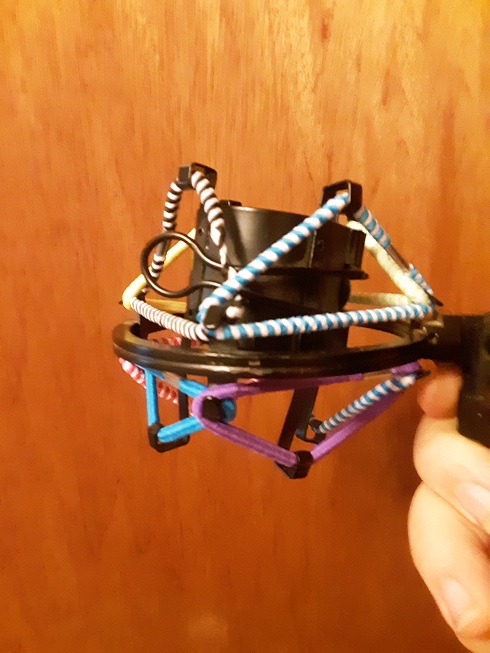
For anyone using a shock mount on a large-diaphragm condenser or ribbon microphone, you know that the rubber bands used for holding the clip to the mount will stretch and wear out after a year or so. If you purchase these bands through a music store or online, they can cost around five dollars apiece. I have instead used women’s hair bands for the same job for a lot less money. You can usually pick up a bag of these at local dollar store or pharmacy. As these are smaller than the normal shock mount band, so you will need to use about eight of them to fully secure the mic clip. However, They do the exact same job, will last about the same amount of time, and will be a lot less on the wallet.
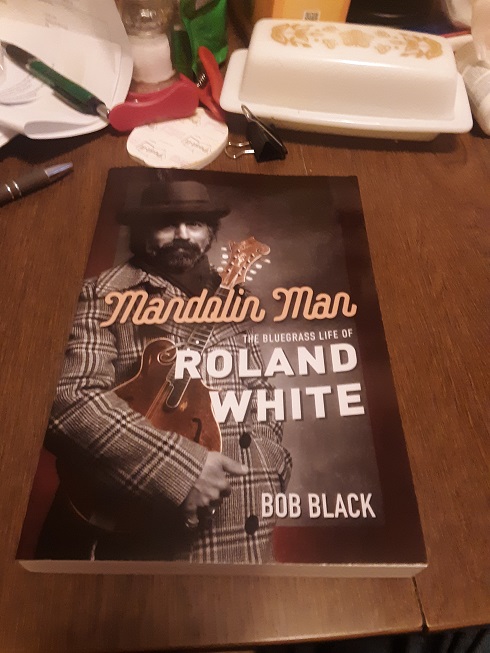
I made a purchase with Hamilton Books recently and found a few gems. First, I got Mandolin Man: The Bluegrass Life of Roland White by Bob Black. I have wanted to read this book ever since it came out in 2022, right about the time the man passed away. I met him a few times, and even went to a last-minute workshop he was hosting at The Ark in Ann Arbor about 20 years ago. He was extremely humble about his career, and was always promoting the legacy of his brother, guitarist Clarence White. I cannot wait to dive in.
The other gem is the CD Punk & New Wave: The Ultimate Collection, put out by a company called Union Square. This company issues a lot of these compilation packages from the looks of the inside cover, including Rock Anthems, Driving Songs, Northern Soul and Running Songs to name a few. I took a chance on getting this one, and WOW, I am glad that I did! Five CDs containing 100 original recordings from The Jam, The Damned, X-Ray Spex, The Buzzcocks, Joe Jackson, Squeeze, and many others from the late 1970s/early 1980s. I was practically crying when listening to the first disc, as it was a bunch of songs that I remember from my youth. I will be listening to this set over and over again!
Yesterday (Saturday), I attended the Southeast Michigan Bluegrass Music Association Annual Picnic and Hall of Honor Presentations. This year it was held at a park in Bath, Michigan, a town about 1- miles northeast of Lansing. The town is famous for a tragic event. In 1929, the city’s school was destroyed by a bomb planted by an irrate school board member. The bomb was supposed to detonate in the evening when no one was there, but instead exploded in mid-morning, killing 38 students. Google “Bath Michigan School Massacre” to learn more.
Moving on, in what would normally take a little more than an hour to drive from my house, took almost two hours due to the number of construction sites on the highway, along with Michigan State University football traffic. There was about 50 people in attendance, with about a dozen people being Hall of Honor recipients and relatives.
One of the recipients, who unfortunately is no longer with us and his wife was accepting the award, was Deja (pronounced “dee-jay”) Davenport. He served as a country and bluegrass DJ (ironic?) at WBYW in Grand Rapids until the station closed in 1997, then created a bluegrass program called Access to Bluegrass on AccessVision cable television network out of Battle Creek. The show lasted from 1997 until Deja’s passing in 2006. Starting out with local bluegrass bands, the show also showcased national touring bluegrass acts such as Cherryholmes, Larry Cordle, and Rhonda Vincent as word spread of the program’s success. Fortunately, most of the shows were videotaped and are now available for viewing on YouTube. To view the 500+ shows, do a YouTube search on “Access to Bluegrass Archive.”
Standing members in attendance were also able to get a quick meeting in to quickly discuss pertinent matters. We are considering sponsoring a monthly jam session at a number of locations, but there seems to be two distinct problems:
Not a lot of places, be they venues, meeting halls, or even a private house, are not too keen on a bunch of people showing up that are unfamiliar. There have been instances of some pickers looking at jam sessions as a place to do some drinking, and other places like bars or restaurants don’t warm up to people showing up to jam and not ordering food or drinks. Private homes may not have ample parking in the area, which makes neighbors ticked off.
The level of players attending is difficult to decipher as well as divide into groups. There are amateurs showing up as well as those that are practically professional pickers. If only one circle is formed, then either the pros get bored with the simple songs, or the amateurs get frustrated because they can’t keep up. One hopes that there is enough space to divide the groups, but then there is also the problem of attitude. Some people try to take over a jam session without question, which can turn off others faster than playing ability.
Another concern with the Association is the lack of students applying for the SEMBA Youth Acoustic Music Scholarships. The Association has enough money for a few scholarships each year through donations, and I spoke to one student that was at the picnic who received a scholarship this past year. I had to convince her to apply again this year, as she thought that it was only for one year. Once again, we need to hit the music stores, schools, and specific media outlets to promote this program. Anyone reading this that knows of a youth 12-18 years old in the southern Lower Peninsula of Michigan that is studying bluegrass, folk, or old-time music on an acoustic instrument, have the parents of that kid contact SEMBMA at smbluegrass@gmail.com or go to the website at www.smbluegrass.com .
This past week, one of the coolest pianists/band leaders passed away. Sergio Mendes led a jazz-pop group in the 1960s that had a number of hits on the charts with his band Brasil ‘66 (often changing the name to reflect each year of performing/touring). He was born in Brazil in 1941, and studied classical piano. He soon took interest in jazz and the rise in bossa nova music, and became a member of Carmen Miranda’s touring band.
He first formed a jazz trio, then added female singers to form Brasil ‘65, which began performing in in the US. After recording a number of low-selling albums, he hired English-speaking female singers so that they could record songs in English as well as Portuguese. Herb Alpert signed the band to A&M Records as Brasil ‘66, and they had a big international hit with “Mas que Nada.” The album Herb Alpert Presents Sergio Mendes & Brasil ‘66 went platinum.
Mendes would have even greater success with the Oscar-nominated song “The Look of Love,” as well as a cover of the Beatles’ song “Fool on the Hill.” The band performed for Presidents Lyndon B. Johnson and Richard Nixon. While his fame lowered in the US during the 1970s, he was still immensely popular in South America. During the cocktail music craze of the 1990s, he saw a renewed interest in his music, winning a Grammy in 1992 for Brasiliero.
During the 21st century, he did a number of collaborations, including with the Black Eyed Peas, Stevie Wonder and Justin Timberlake. He passed away on September 5th from complications of COVID.
I remember as a little kid watching his band perform on variety shows such as The Ed Sullivan Show and Hollywood Palace. His was the kind of music that everyone, from teens to older adults, could get into. Jazz influences, it also had the ingredients of rock, pop, and his native music samba and bossa nova. There was not a lot of flash in the instrumentation, but the band was skilled, and he knew that his female singers were eye candy as well as the perfect voices for the songs. While the music never received heavy rotation on the radio, when one of his songs did come on, you didn’t change the channel. If you were driving, it was the perfect cruising music. His work will always stand out as a great art form of pop music from Latin America.
Last night I went with my buddy Ken to see the bluegrass legend Del McCoury and his band. Now I’ve seen him already about a dozen times, and I probably would have passed on this show due to it being in Pontiac (a 40-minute drive, and I’m getting too old to stay out late and then drive home), but Ken had not seen him yet, and with Del at the age of 85, I knew that the chances of seeing him again were not as great as before.
Del still puts on a helluva show! It was funny, as 10 minutes before the start, there he is walking around the stage, making sure he has water available. His band could easily have roadies, but they still do everything for themselves. He has always loved and respected his audiences, talking to them personally between songs and taking requests. Two 45-minute sets would have probably tired out anyone else at his age, but he handled it like someone half his age. His band, consisting of his sons Ronnie and Rob, along with Jason Carter and Alan Bartram, are professional to a tee! They still do minimal miking, and choreograph their solos and harmony singing like the old days.
Yeah, he forgot the lyrics to songs a few times, but it was understandable, considering that he has a repertoire of a few hundred songs. The audience didn’t care – they loved it when he would just la-dee-dah through a verse to keep it going. He performed his trademark “1952 Vincent Black Lightning” (which I reviewed as a Perfect Song in the blog https://luegra.design.blog/2021/04/17/a-perfect-song-1-del-mccoury-band-1952-vincent-black-lightning/) to a standing ovation, and had no problem taking in about a half dozen requests as is normal for his shows.
I implore you to go see the Del McCoury Band while there is still time. It is worth hours to drive to see this amazing example of a bluegrass band, as well as appreciate the legend that Del McCoury truly is.




 Luegra