Categories
Acoustic Guitars Lutherie

Tone Traveler/ToneRite – Are They Worth It?

Have you ever heard of the Tone Traveler? How about the ToneRite? While these products have been around for a few years, they (especially the Tone Traveler) have been in the acoustic guitar news as of late.

Their purpose is to “break in” a brand-new acoustic guitar so that it has the sound and characteristics of a well-worn model. The device basically vibrates the strings by attaching it to the bridge/saddle, let it run for a few hours (even days), which is supposed to translate into months/years of breaking in the guitar so that the wood stretches in its expected way in relation to the strings. The Tone Traveler looks like a microphone head capsule or a small Bluetooth speaker, with the ToneRite module is a square piece about the size of a large pack of gum. Both are plugged in to a power source to operate.

There are a number of reviews of these devices on YouTube, mostly with positive reviews. The player will leave them on for a few hours, then proceed to show before and after video clips. Some show the devices working, which vibrates all six strings by self-vibrating or producing specific tones. Think about how it sounds when you pluck all six strings without forming a chord. Now imagine that dissonant sound going for hours, even days! A few reviewers have said that they put it in another room (or in the basement) with the door closed so as to muffle the irritating sound.

With that said, by listening to the before/after results on both my laptop and phone speakers, I heard absolutely no differences. I don’t plan on hooking up the computer ot a stereo sound system to try and decipher the changes. I guess that one would have to be sitting in front of the guitar’s soundhole to shear any differences.

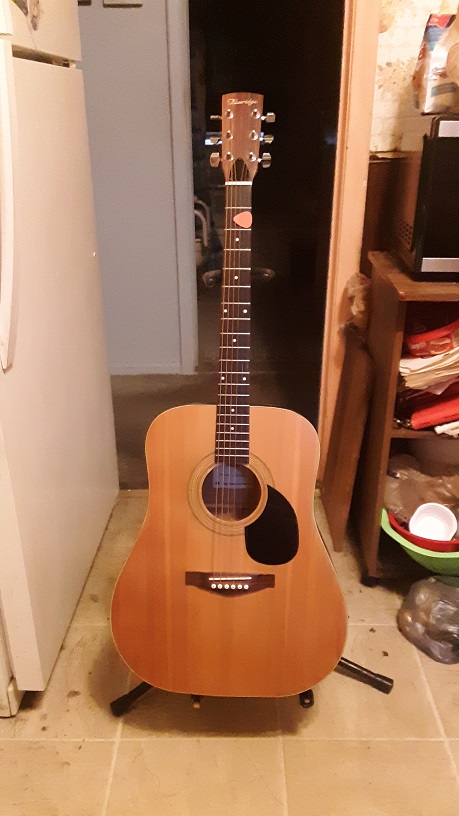
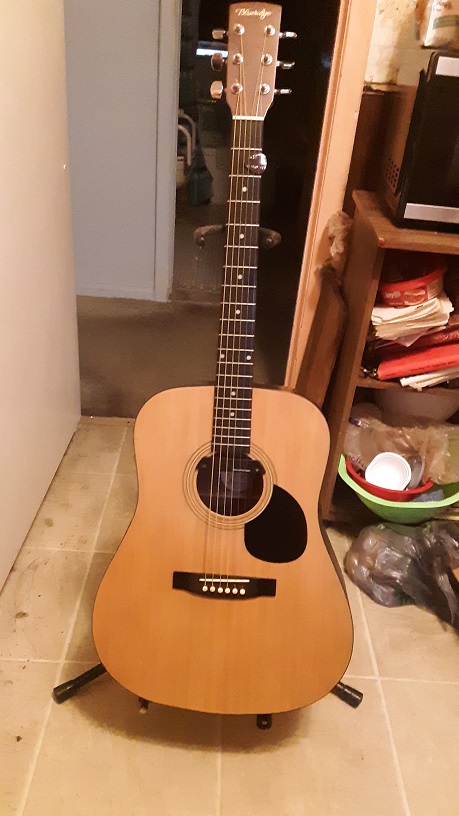
As readers may know, I recently purchased a Cirrus acoustic guitar. I also have a 1991 Martin D-28, the Sevillana 2208 dreadnought, my Blueridge dreadnaught dating probably from the late 1980s, and a few other lower-cost models. Each has its own distinct tone, but not as diverse as, say, a Gibson Les Paul humbucker and a Fender Stratocaster single-coil played through the same amp. However, there are differences in the woods used, the scale length, and size of the body. Even the string gauge can affect the sound.

The argument for one of these products is that a new guitar sounds too new, not broken in. Yes, that may be true, but is spending $150-$250 just to break in the guitar more important instead of actually playing it for a few months? With my new Cirrus, I want to break it in myself, like raising my son or daughter. The change in sound will be subtle over the months/years, and it will be your work, not some plug-in device.

If the “aging” is that important to anyone, I can perhaps see a guitar dealer or luthier using one of these products to break in the new guitars in their showrooms. It can be a selling point to a customer. However, customers rarely buy more than one guitar at at time, and don’t trade in or buy another for years. It seems to buy one of these for a one-time use and put it away for years may not be worth it. It’s not like a tuner or string winder that will be used often.

I plan to spend a bit more time researching these items and what they actually do. If vibrations is their main purpose, I am wondering if the use of a vibrating hand or body massager laid over the bridge/saddle can serve the same purpose for a lot less money (and has another use, of course). If it is tone generator-oriented, perhaps building a cheap tone generator (there are kits out there) may work.

Chew on it and comment.
Categories
Acoustic Guitars

My Cirrus Guitar is Here!

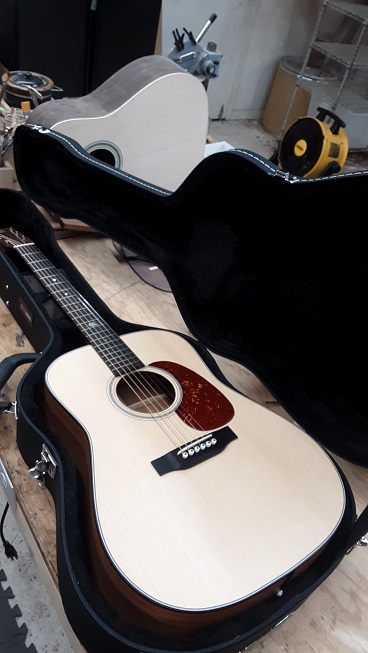
Well, here she is! My new Cirrus guitar, and she is ALL MINE! It is the model CD Dreadnought, basically standard features except that I ordered it to have a slightly shorter 24.9-inch scale fretboard.

She sounds great to be sure, a heavy lower midrange that will cut through as a rhythm guitar during a bluegrass jam without being too boomy. The shorter scale seems to fit perfectly with my smaller hands, as I was playing “Wildwood Flower” without any fretting difficulty. The finish is the way that I like it – semi-gloss, so it’s not too shiny but not dull matte looking either.

It was so worth the 3+ month wait for it, as I know that it is truly my personal guitar, not one that I bought either used or off the rack at a store. I cannot wait to start taking her out for jams. I already have three people at my workplace asking me to bring it in so that they can try it out.

Mike Franks, the owner of Cirrus Guitars, has his shop here in suburban Detroit, so it was great that I could go directly and pick it up instead of waiting for shipment. I have talked about his shop in a previous blog (https://luegra.design.blog/2025/03/29/i-ordered-a-cirrus-guitar/), and he is a big bluegrass fan. He’s made guitars for the Grascals, the Rhonda Vincent Band, and a few other acts. He is also contracting with Gallagher Guitars in making some of their fretboards.

It is great to see a fantastic luthier here in my backyard, so to speak. I will definitely be promoting his work whenever and wherever I can. I plan on taking this guitar to the SPBGMA conference in January. Hopefully I can get some of the artists there to try it out and take an interest.

I’m keeping this one short, as I want to get back to playing my new love. Now I just need to give her a name (all of my other regularly played acoustics have names, all women that have meant a lot to me). I highly recommend you check out Cirrus Guitars at http://www.cirrusguitars.com/ .

Chew on it and comment.

Categories
Acoustic Guitars Musical Instruments

Signature Series Guitars: Are They Worth It?

Earlier this year, Martin Guitars released not one but TWO Billy Strings Signature Dreadnaught guitars, a D-28 and D-X2E. Both have the designs from and backing of Strings himself, and have many similar features while obviously differing in others.

Both guitars have a slightly shorter 25-inch scale, which Strings wanted instead of the 25.4 inch scale, basing it on Tony Rice’s Santa Cruz guitar, along with a 1.72-inch nut. The remaining features on the D-28 are based on Strings’ 1940 model that is his main instrument. This includes the rosewood back/sides, herringbone trim and bone nut/saddle. The D-X2E features a built-in pickup, soundhole string tuner, and high-pressure laminate back/sides. As expected, the prices are drastically different, with the D-28 going for about $3,799.00 and the D-X2E at about $899.00.

Signature series guitars have been around for decades, and Martin is not the only manufacturer to participate. Fender, Gibson, Ibanez, and others have produced numerous signature models. Martin has put out models name plated with artists such as Elvis Presley, Eric Clapton, Johnny Cash, Ed Sheeran, and Judy Collins among others. These are usually in limited edition amounts, and in many cases, become more valuable as the years go by.

However, are they worth it, just because they have a famous guitarist’s name on the label? That is highly debatable. In most cases, the features consist mostly of cosmetic differences. It seems to be a decision for purchase between a player (who will be sweating, picking, and grinding into the fretboard every day) and the collector (who will most likely never play it and just store it for investment purposes). But I highly doubt that getting one will make you play exactly like the artist.

In the case of the D-X2E model, the standard model goes for about $699.00 at various outlets, and an internet search shows them going for as little as $449.00 used. The $200.00 extra for the new Billy Strings model will include the shorter scale and the built-in tuner. Looking at prices for various used Martin X models, they tend to stay the same over the years, if not lowering a bit. I was fortunate enough years ago to sell my DXM model for the same price that I paid. Actually, I see that the DXM is going for more than I paid nowadays, but this could be that the model was still being made at the Nazareth, PA factory. Today’s X models are mostly being produced in Mexico. With Strings’ name on it, we can only wait to see if there will be any collector value on it. However, both Martin and Strings have stated that this is meant as a roadworthy guitar that will see a lot of picking.

As for the D-28, just about all models through the years have gained value, as long as they are well maintained. Prewar models can easily go for over $100,000.00, even if not in tip-top shape. A new model will go for about $3,000.00, give or take a few hundred dollars. The few features on the Strings’ model may not justify the nearly $3,800.00 price tag, but again, while a few players with money to burn may consider buying it, the majority of purchasers will be the collectors.

There’s no doubt that Strings has had an amazing impact on the guitar world, especially in the bluegrass field. I am sure that he has inspired hundreds of young people to pick up a guitar and start forming chords. I do see the D-X2E being a decent seller for Martin, and even the D-28 selling some to collectors. As much as I love and respect Strings, would I consider purchasing one of these models? Highly unlikely, unless I got an unbelievable bargain on one. My acoustic guitar arsenal is already packed. I have my treasured 1991 Martin D-28, the Sevillana 2208, and the Blueridge BR-OS that serve as my most-played models, along with a Blueridge BR-OM that has a pickup installed in case I do any solo performances. Add to that a few Yamaha and Jasmine acoustic guitars that I have gotten at garage sales and have fixed up to sell off. I also have the Cirrus dreadnaught that I am having specially built for me with a shorter scale, similar to these Strings models. So another acoustic guitar in the house is right now out of the question. But I won’t say no to anyone wanting to gift me one!

Chew on it and comment.

Categories
Acoustic Guitars Bluegrass Music

I Ordered a Cirrus Guitar!

I can mark off another item on my bucket list. This morning, I went to the Cirrus Guitars shop and ordered myself an acoustic guitar made to my specifications!

I had blogged about Cirrus Guitars previously (https://luegra.design.blog/2023/10/28/cirrus-guitars/), and have been thinking about getting a guitar from there ever since. With money that could have spent on a bigger TV or some other item that does not really strike my fancy, I love guitars so much that it was what I wanted to treat myself to. I contacted Mike Franks, owner/luthier for Cirrus, a few weeks back, we scheduled a meeting this morning, and I went to the shop in Sterling Heights, Michigan.

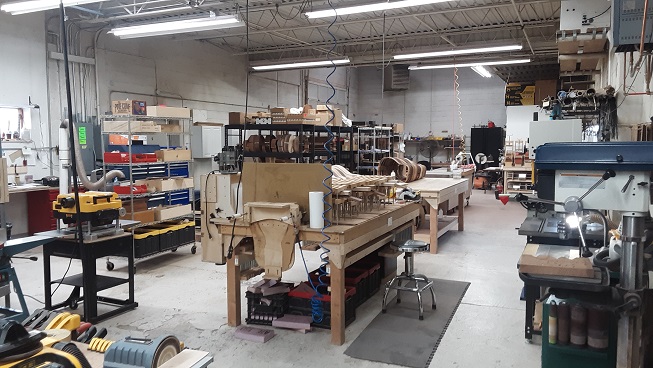
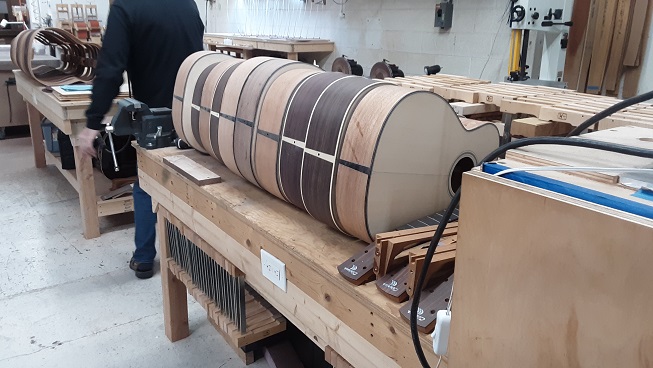
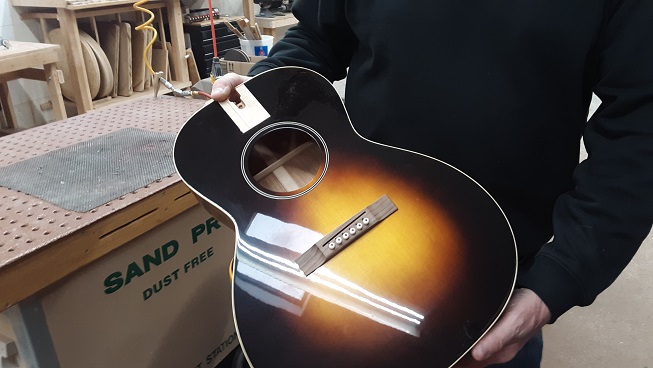
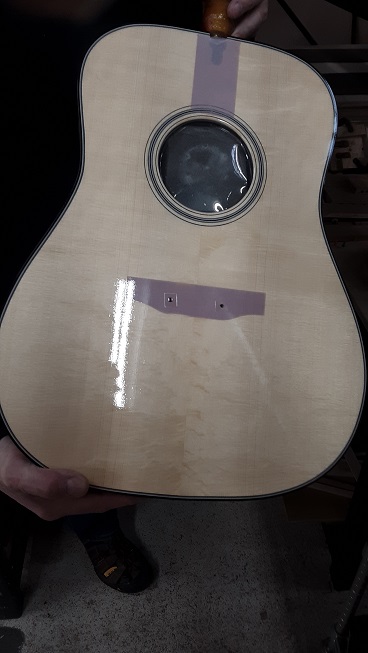
Mike was extremely friendly, and was grateful that I paid for the guitar in full rather than just a down payment. The shop is Heaven if you are a guitar enthusiast like me. Acoustic guitars in every stage of construction line the walls and workbenches. He has a special paint booth, and the whole shop is well ventilated and humidified. He also has a room set up for taking photos of his finished guitars, and a space where he holds small house concerts.

The best part of his tour was seeing some of the guitars that he is making for bluegrass artists. One guitar is a special left-handed model under his M.J. Franks brand of guitars for Jamie Johnson of The Grascals. He is also making a custom dreadnaught for John Bryan of The Grascals as well.

He related a great story of how he once heard an Osborne Brothers tune on the radio that moved him deeply, then fast forward two decades, and Joe Miller of Bobby Osborne and the Rocky Top Xpress requested a guitar made for him. When it was finished, Franks took it to Nashville to present it to Miller at the Grand Ole Opry. He was then sitting on stage at the Opry when Miller performed with the band, and had that song dedicated to him that evening.

Franks knows how special bluegrass artists are, not only with the care and concern they have with acoustic instruments, but how much they appreciate the people around them, be they fans, promoters, or luthiers. You can see in all of the work he puts in every guitar that his respect goes equally back to the artist.

My guitar should be ready in about three months, and I am in no big rush. I know that I will fall in love with the guitar, simply because I see the quality work that goes into Cirrus guitars. Franks has stated that I should stop by the shop in a few weeks to see the progress. Despite the rainy weather going on today, the day was fantastic for me!

http://www.cirrusguitars.com/

Chew on it and comment.

Categories
Acoustic Guitars

Cirrus Guitars

There is a new acoustic guitar company opening up – and it is near my house!!!

Well, it is about an hour drive from where I live, to be honest. However, this is great news to see another luthier starting up in the Detroit area. Cirrus Guitar (https://www.cirrusguitars.com/) is the partnership of Mike Franks (of M.J. Franks Guitars) and Tobin McGlassion (of McGlassion Guitars) that will make high-quality, hand-made acoustic guitars at an affordable price.

They have opened up shop in Rochester Hills, Michigan, and from the looks at their website, they have a good idea of what is needed in the acoustic guitar market. As of now, they are making three models: a Dreadnaught, an OO body, and a OOO 14-fret version. All will have basic features, with options available at additional costs. Prices for these guitars (with case) will start at $2,150.00.

What caught my attention was that they will offer two scale lengths at no additional cost. There will be the standard 25.4-inch scale, as well as the shorter 24.9-inch scale. Because of my smaller hands and slight arthritis, I have always wanted a shorter scale fretboard on a Dreadnaught body. Martin has offered such models, but the price has been way out of reach for me. This looks like it would be a great alternative.

The guitars will be built in the same shop as M.J. Franks Guitars, but with a different attitude. Of course, they are looking at getting these guitars into a players’ market. A M.J. Franks guitar starts at $3,850.00. At nearly half the price, a Cirrus guitar is a great alternative to the more boutique guitars.

In an interview with Bluegrass Today, Franks states that for Cirrus, he will be buying wood in bulk, and wood that may have some minor blemishes that would not be found on his Franks guitars. Personally, a small blemish can be ignored if the guitar has a great tone and feels comfortable at the same time.

Franks’ bluegrass connection comes from building one of his first guitars for Bobby Osborne’s guitarist Joe Miller, and being good friends with songwriter Pete Goble, who also lived in the Detroit area before passing away in 2018.

I will be checking out this Cirrus over the next few weeks, and seriously considering getting myself that Dreadnaught with a short-scale neck.

Chew on it and comment.
Categories
Acoustic Guitars

More About Acoustic Guitars: Blueridge

I have very briefly mentioned the Blueridge line of acoustic guitars in my previous blogs. Let me spend this blog covering my experiences with these guitars and why I value the old ones, just like many players value the old Martins (including me, of course!).

Blueridge guitars are marketed in the US by Saga Instruments. During the line’s history, they have been like most imported guitars from Asia, being manufactured in Korea, then in China, and eventually also in Indonesia. The brand has been around since the 1980s, and made a big comeback around 2000, producing a line of acoustics that were re-vamped with extra visual frills (i.e., fancy headstock inlays) to target the bluegrass market.

It was around that time that I started taking an interest in the brand. At the time, I was playing with a Martin DXM, which was the lowest-end Martin that was still being made in the Nazareth, Pennsylvania factory. While it was a good, solid acoustic guitar, it still lacked a lot of tone that one would expect from a Martin. I began seeing on the internet some stories about older Blueridge acoustic guitars that had a great tone comparable to Martins. I spent some time surfing eBay and found a model called the BR-OS going for about $125.00. I took a chance and purchased it.

I was amazed at how great the thing sounded! A nice, warm sound, almost too close to a Martin, just a wee bit quieter overall. But this guitar was excellent to say the least, especially for what I paid. It showed some road wear, with a few small dents in the body and a small piece of binding missing along the fretboard. The BR-OS was made in China, based on the Martin D-28, with a solid spruce top along with rosewood back and sides. The inner bracing is also similar, and the headstock is reminiscent of Martin, with a simple cursive logo. I have owned this one now for over 20 years, and it is still one of the best acoustic guitars that I have ever played.

I immediately sought out to purchase more of these models. I came upon another BR-OS for about the same price and grabbed that one up as well. However, it had a lot of differences. It still sounded great, but the neck had a much more “V” cut to it, and the headstock had a curved “V” cut as well, similar to the Dean electric guitars. I kept it for a while, and sold off the Martin DXM for the same amount that I had paid for it a few years back (about $300.00). Side note: While Martin still has the X series of acoustic guitars, they stopped making the DXM long ago. It was a good guitar, and if you can find a decent used one for about the same amount of money, I would recommend it, especially as a back-up acoustic.

I was also checking out the newer models of Blueridge the were coming out at the time. I purchased the lowest-priced model, the BR-40. While it had a decent volume, I was not too satisfied with the tone, and re-sold it soon after, losing a few bucks in the transaction. I also came across a BR-OM on eBay, and snagged that for about $100.00. This is similar to the BR-OS, only with a laminated top, which doesn’t have as rich of a tone. I did like that the neck was very similar in comfort, so I decided to put a pickup in it and use it for my live solo shows.

When I got my 1981 Martin D-28 around 2005, I knew that it would be my main acoustic from that point on. My acoustic collection was a bit big, and I eventually sold off the V-cut Blueridge for the same amount that I paid. It was around that time that I was finding more articles about the old Blueridge acoustics and how great they were compared to the newer models. From my experience with the BR-40, I could attest to that thought. Saga has been putting out much more quality models of Blueridge guitars over the past two decades, including the limited-edition Carter Stanley and Larry Sparks models. I have noticed that the prices for new models have jumped up in price to almost double than what they were going for about 10 years ago. Of course, that is true with just about all guitars today, be it acoustic or electric. Guitar Center and Elderly Instruments are selling the BR-40 for about $645.00. To get at the beginner market, Saga introduced a lower-priced Bristol line of acoustic guitars. This reminded me of when Martin put out the Sigma guitars years ago. These Bristol guitars are good beginner guitars, but do not have that great of a tone, due in part to so much laminated wood being used.

The older Blueridge models have also seen a price jump, probably due to the reputation that they have. Scanning eBay recently, I did see a few V-cut BR-OS models going from $300.00 to $500.00, and a Martin-style headstock BR-OS for $598.00. There was also an early made-in-Korea model labeled BR-O5 going for $350.00. If these were in great shape, it would be worth looking into. However, purchasing a used guitar online without trying it out is a risky chance.

As for the newer Blueridge models, the “Pre-War” and “Historic” models seem to have a great tone and volume, and are a lower-priced alternative to a Martin. Elderly sells these models anywhere from $865.00 to $1,995.00 with a gig bag. Personally, after playing some of these models, I am pleased more with the Sevillana 2208 dreadnought that I secured back in 2022 from a distributor in China (https://luegra.design.blog/2022/07/16/this-dreadnought-needs-to-come-to-the-u-s/). I am still hoping that this guitar can make it to the US before the world sees more international turmoil.

Chew on it and comment.
Categories
Acoustic Guitars

Jasmine Guitars: The Good, As Well As The Bad and Ugly!

Jasmine acoustic guitars. You either love them or hate them. And that depends on the model, I guess. I have had three Jasmine guitars over the years, and only one has really impressed me.

Jasmine started out as being marketed by Takamine Guitars to be a low-cost alternative to its acoustic guitar lineup. They were made during the 1990s and early 2000s in China. About 10 years ago, Jasmine was created as its own separate brand by KMC Music, and most of the guitars are manufactured in Indonesia. Early models will have “Jasmine by Takamine” on the headstock, while more recent models will just state “Jasmine.”

My first Jasmine was a 12-string (I don’t remember the model number) that was purchased used back in the mid-1990s. My pop-punk band The Masons (of detroit) (yes, that is how we spelled it) were doing some acoustic shows, and since it was just single guitar/bass/drums, I wanted to fill out the sound more with a 12-string. I remember that the thing was a pain to stay in tune, even after I replaced the tuning gears. The nut was not sturdy, moving about if you loosened even one string. Even though it had a dreadnought body, it wasn’t every loud. I actually trashed it after a few years because it was falling apart so much. Its legacy still lives on, as the headstock appears on the cover of the CD compilation that I produced in 1997, Boombacoustic!

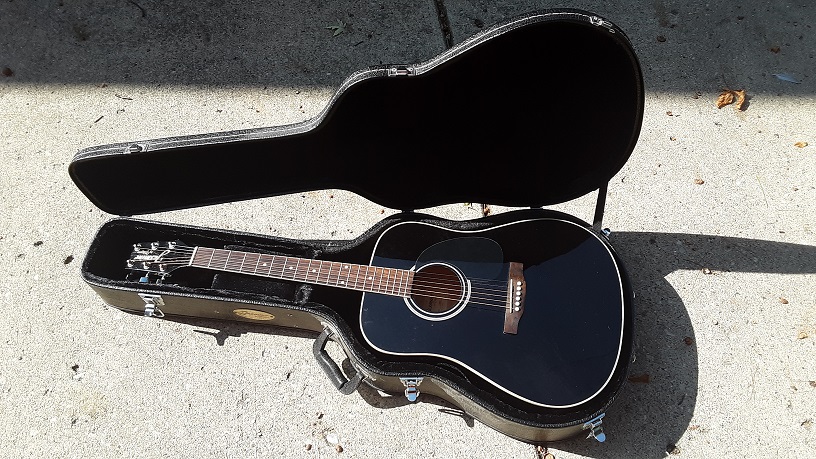
Just prior to the COVID pandemic, I was shopping around for some acoustic guitars that I could bang around at jam sessions and such, not wanting to take my prized Martin or Blueridge guitars to get damaged. I came across a Craigslist ad that someone in town was selling a Jasmine S341 with case real cheap. He was leaving town and wanted to get rid of everything except the clothes on his back. I gave him $50, I figured that the hardshell case was worth that. I probably was not that far off with that thought. The S341 was a model that Jasmine put out in the mid-2000s to be a somewhat total package for a beginning guitarist. It retailed for about $250.00, and came with that hardshell case covered in faux leather with a big brass-like badge showing “Jasmine by Takamine” on the side. The dreadnought guitar has a black finish, something that I have never been a big fan of (apologies to Johnny Cash). The previous owner must have not played it much, or even pulled it out of the case often, as the guitar still had that glue smell to it that newer, cheaper guitars give off. Like my previous experiences with Jasmine guitars, the tone was not that great, typical of acoustic guitar bodies made almost entirely of laminated wood finished in a opaque paint. It plays well, the neck is pretty comfortable, but other than playing it solo, it wouldn’t cut through too well in a jam, especially a bluegrass setting. I played it once at a Songwriters Anonymous meeting, and then the pandemic kicked in, so it has sat in waiting ever since. I plan on selling it off soon, hopefully to someone who could appreciate it more than the previous owner or myself.

Two weeks ago, I purchased a Jasmine S35 off of eBay. I was a bit sorry at the time, as although I got a decent final bid price, the shipping was higher than the price of the guitar. It totalled just under $70, and without a case or gigbag. I received it a few days ago, and I have been surprised by the sound of this beginner acoustic! It has a dreadnought body, although at first glance, it looks a wee bit smaller. This is one of the newer models not marketed by Takamine. It has the specifications of most lower-cost acoustics (spruce sitka laminated top, mahogany sides/back, rosewood fingerboard), but the sound is much more loud than I expected, and has a much richer tone than most beginner guitars. I don’t plan on keeping it, but after a clean up and bridge modification, I am sure that I can find an interested customer. I have seen this particular model going anywhere from about $80 used to $150 new, and if all of them sound as good as the one I have now, it is a good buy.

Chew on it and comment.
Categories
Acoustic Guitars Music Stores Old-Time Fiddle

Yard Sales, Fiddle Conventions, Elderly Instruments

Last weekend I did my yearly trek to two of my favorite ventures – the Michigan Avenue World’s Longest Yard Sale and the Michigan Fiddlers Association Fiddlers’ Convention. Before this year, the Fiddlers’ Convention was held in Hillsdale, so I could take Michigan Avenue all the way from Saline to Hillsdale to see the fiddling as well as do some yard sale shopping. This year, the convention was moved to Hastings (west of Lansing), so I ended up taking Friday off of work and doing each activity on separate days. Rain was predicted both Friday and Saturday, so here’s how it went.

Friday: The morning started off sunny, but I was frustrated with being stuck in traffic for an hour due to construction on Michigan Ave. and US-23. Once moving, I was able to stop in a few places that set up tables in quaint towns such as Clinton, Allen, and Quincy. My first stop led me to an old garage full of antique/junk toys, games, and nick-nacks. While I passed on almost all of it, I did get something that brought back memories of a when I was a kid – salt and pepper shakers that look like vintage Squirt soda pop bottles. Totally going up on a shelf in the kitchen.

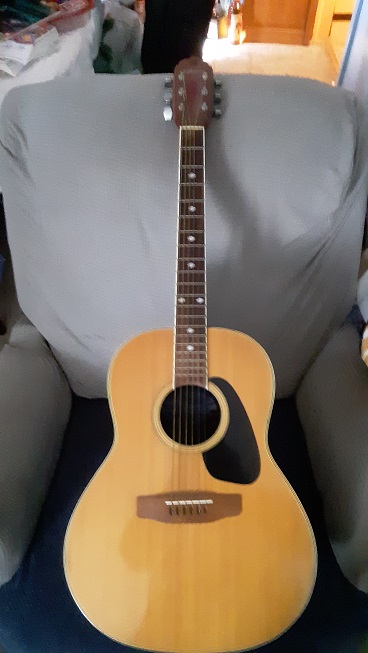
About the time that I reached Quincy (a few miles east of Coldwater), the skies were starting to turn dark, so I figured to head back toward home. I was primarily looking for music-related items, but almost everything that was in that category was priced way too high, even if I was able to barter down some. However, I was able to secure a used Applause AE-32 acoustic/electric guitar for a decent price.. For the unfamiliar, Applause guitars were put out by Kaman in the late 1970s to be a lower-end version of the popular Ovation acoustic guitar series. The main difference was a laminated top instead of a solid top. Other than that, most everything was the same. I was never a big fan of these guitars due to the rounded molded-plastic back/sides that made them difficult to play while balanced on the lap sitting, requiring a strap and standing up to hold. Bringing it home, I tested it out and it still had a good sound unplugged, also being clean and loud when plugged into an amp. While it seems like a good guitar, I plan on just cleaning it up and selling it off, hopefully making a few bucks in the process. Fortunately, I did beat the rain making it home.

And I did make a pit stop at Randy’s BBQ near the Michigan International Speedway in Brooklyn. It is a trailer where they make some of the best pulled pork barbeque you have ever tasted. Every year I stop by and order a Godzilla sandwich, which consists of pulled pork, pulled chicken, brisket, mac & cheese, cole slaw, and pickles on a bun! I literally starved myself all day because I knew that I would be devouring one of these in the afternoon.

Saturday: This day went a lot worse in so many ways. First off, getting to Hastings is not an easy task. I used to go to a park near Hastings every June for a Civil War reenactment. I had forgotten how many two-lane roads with police cars shooting radar there were along the way. No, I didn’t get busted, but I kept my eye on the speedometer almost all of the way there and back.

As soon as I pulled up to the campground where the convention was, Mother Nature let out a storm that made you want to start building an ark! It kept going on and off for over an hour. I was able to catch most of the fiddle workshop and jam session under the pavilion. I had attempted to video some of the activities, but the video camera that I was using was brand new and my first time using it, so I was unfamiliar with the set-up. The result was absolute garbage! Live and learn. I have to say that the workshop leader, a left-handed fiddler named Dave Langdon, has a great demeanor with the students, being very patient and hands-on with learning each part of a song.

After some time at the convention, I decided to head to Lansing for a stop at Elderly Instruments. This place used to be a Mecca for me prior to the pandemic. I would either schedule time off from work or make a clean slate on Saturdays to make the trip and spend a few hours testing out guitars and thumbing through the room full of CDs, videos, and music books. When I walked into the store, I was extremely disappointed. A lot has changed at the place in three years. What was once a room full of books and CDs was now limited to two or three bins each. The videos were completely gone, most likely due to the lack of interest in hard-copy videos and the move to online instruction. It was all replaced with walls of ukeleles – not my favorite stringed instrument to be sure. They still had the Martin guitar room, but the violin room was converted to a left-handed instrument room. It just didn’t have the same appeal to me as a whole than it did a few years back. I should have sensed that it would be a disappointment when I checked out the website earlier this year and noticed that there was a lot less being offered. I guess that my trips to the store will be extremely rare, only if I should happen to be in the area and the store is open at that time. No going-out-of-the-way trips for me any more.

Because of that, I will be scouting around for other music stores to make the trips to in the future.

Chew on it and comment.
Categories
Acoustic Guitars

This Dreadnought NEEDS to come to the U.S.!

I network with a lot of musical instrument sales and distributors in Asia, especially China, through LinkedIn. I have been keeping an eye on many of the guitars that they are marketing. There are a few of them that have piqued my curiosity, and I have stayed in contact with these reps to find out if they will be shipped to the US.

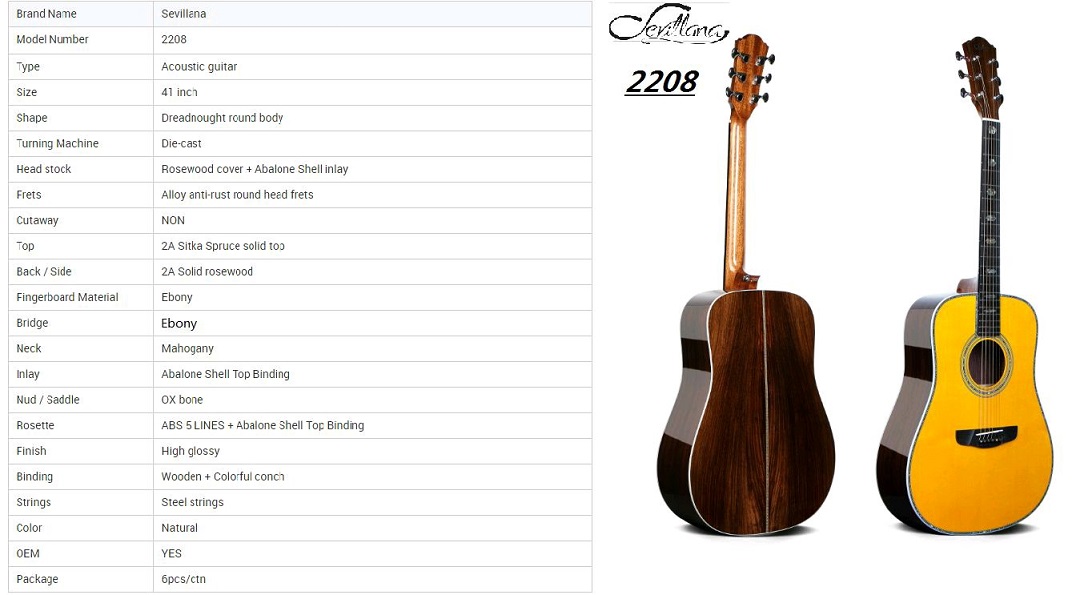
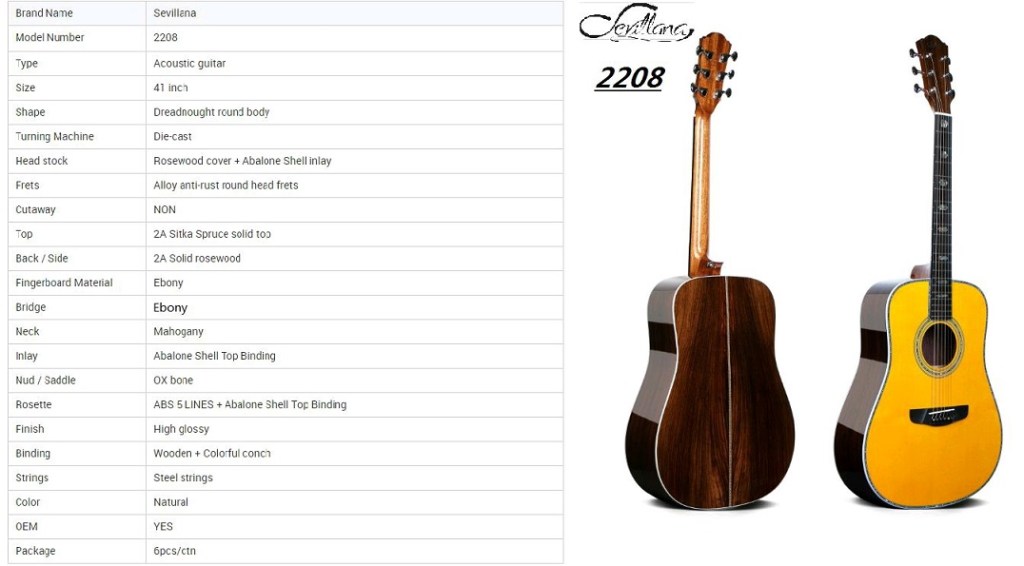
One rep from Deviser Guitars in China named Cherry and I have stayed in contact for over a year now. Recently, the company started making a solid-top dreadnought acoustic that, from the photos, appeared to be a quality product. The Sevillana 2208 “looked” like it could compete with other mid-line dreadnoughts, but a lot of stuff coming out of Asia is a gamble.

I worked with Cherry a bit, and last week, a 2208 was on my doorstep. HO-LEE-COW! This thing is amazing to say the least! Solid top and sides, bone nut and saddle, abalone binding, and a fantastic tone! This guitar would fit in with any bluegrass situation. I did a quick side-by-side test against my Martin D-28, and this 2208 stood up to it!

The only fault that I had was that there was no pickguard. As long as I have played in the bluegrass community, I have never seen a Martin without a pickguard. Cherry informed me that the standard for its company is to ship without a pickguard, but one can be installed at the factory. I do plan on installing one myself on this, preferably a tortoise-shell style.

I have stayed in contact with Cherry regarding getting these guitars to the US, providing her with contact information on wholesale distributors here as well as possible marketing options. From what she tells me, this guitar would retail in the US for about $1,149.00. In my experience with playing and pricing acoustic guitars, that is a good deal, as a sale price would probably bring it down to under $1,000.00. Martin doesn’t have a guitar near that price in its Standard series, and the 2208 has a way better tone than any Martin X series guitar. Blueridge guitars (made in China and distributed through Saga) has a number of comparable guitars in price, but not in tone!

Deviser markets mostly lower-cost guitars, ukeleles and accessories, but I have yet to see them in the US market. This Sevillana line (there are other models, mostly with unique slopes in the lower bouts of the body or strange cutaways) is geared toward more professional players. This 2208 would be a welcome addition in the bluegrass market, particularly with players who cannot afford a Martin or upper-tier Taylor. I cannot see why a US distributor has not looked into this yet. Perhaps Deviser should consider going the route of Glarry and handle its own distribution and sales in the US with strictly mail order.

I hope to have a video review of ths 2208 on YouTube before the end of summer, and plan to take this guitar to a few bluegrass festivals and let some other guitarists try it out. I do feel that there are buyers out there – they just need to be aware of it being available!

Chew on it and comment.

Categories
Acoustic Guitars Lutherie

String Slots for Better Tone

A while back I caught this YouTube video from Driftwood Guitars regarding a small saw-like tool from Stewart-McDonald that can provide your acoustic guitar with better tone.

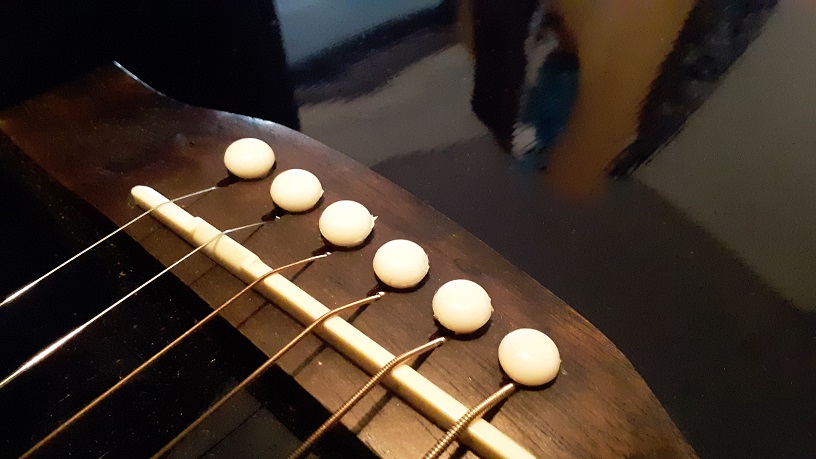
The procedure involves cutting a slot in the string ball-end holes of the bridge so that there is more contact between the string and the guitar itself. Normally, the string comes out of the bridge hole and has the slightest contact across the saddle before traveling over the fretboard, nut, and to the tuning gear. This procedure allows the string to be in contact with the wood of the guitar as well as more contact with the saddle, providing more resonation of the guitar (the video shows how).

A few years back, I purchased a used Jasmine S35 acoustic guitar with case at a real cheap price (the cost was worth the case alone!). I noticed during playing it that, while the tone was not fantastic, it was quite loud, especially for a cheap acoustic that sold for about $150 new. After seeing the Driftwood video, I checked out the Jasmine’s bridge, and sure enough, there were slots in the string holes.

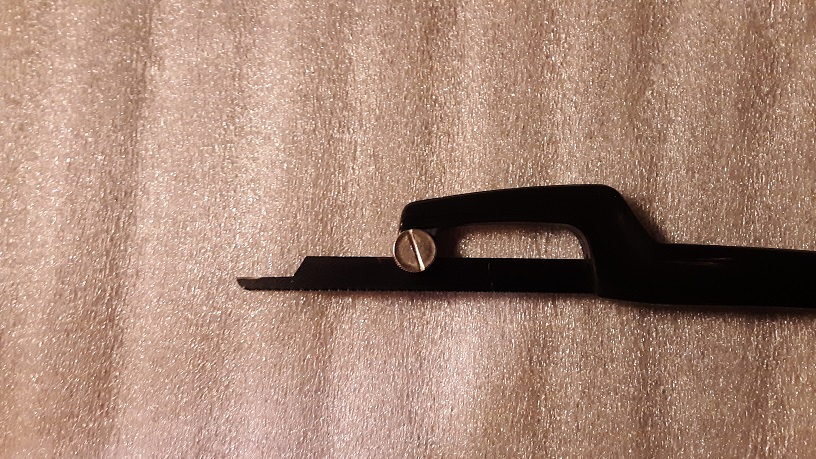
Now the tool from Stewart-McDonald costs about $25, and add to that shipping costs and having to wait for the package, I decided to make my own device. I took a hacksaw blade, cut off about an inch from the upper half of one side of the blade, then attached it to a smaller holder. Total cost was about $3.00.

With it, I dug into the bridge of a Yamaha F-325 that I was cleaning up. I figured that I would try this procedure out on a less expensive guitar than my Martin D-28. I learned a few things along the way:
– Hacksaw blades have finer teeth, meant to cut through metal. It takes a lot of time and effort to cut even a little slot, especially when two different woods and some glue are fighting you.
– I was working on this while quarantined at home during my battle with COVID. Do physical work, even light physical work, when you are healthy.
– It seems that while I could tell the difference in volume and tone, the normal (i.e., non-guitar geek) doesn’t care. I played a slotted Yamaha F-325 against a non-slotted Yamaha F-325 to a friend, and she didn’t hear any difference.

I do plan on doing this procedure on the other two Yamaha acoustics that I have, as well as one or two other acoustics that I own. Until I get really good at it, I will hold off on the Martin. This was a good lesson learned about improving the sound of an acoustic guitar, and I feel that it is worth the work. If you are still jittery about attempting it on your own, check with your local guitar repair person or a luthier.

Chew on it and comment.

Design a site like this with WordPress.com
Get started