Categories
Bass Guitar

A Tale of Two Short-Scale Basses

Readers know that I am a big fan of the bass guitar. It was the first real instrument that I learned (I’m not counting the three horrendous years of saxophone in grade school), and I write a lot of my early songs on the bass before I picked up and learned guitar. I have always been a supporter of teaching the bass guitar to younger students, as one is learning one note on a fretboard is easier to comprehend first before attempting chords on a guitar.

I have seen many times young players with small arms and hands attempting to use a full-scale 34-inch bass guitar with great difficulty. It tells me that the parents did not do much research on purchasing a properly sized bass for the student, but just bought the cheapest bass they could find or let the store salesman talk them into it, saying “They’ll grow into it.” There are a number of shorter-scale bass guitars on the market, many of them very affordable, that can make lessons and performance for the young musician a lot easier.

I recently purchased two short-scale bass guitars made by Glarry to test them out and see if they are worthwhile for the student as far as value, comfort, playability, and performance. Both retail for under $100 on the Glarry website, but I was able to snag each one a lot cheaper through shopping at eBay and Amazon.

The first is the GW101 36-inch Kid’s Electric Bass Guitar. This bass is incredibly small, as the 36 inches refers to its entire length. The scale from nut to bridge is 25.5 inches. That’s actually the scale length of a Fender Stratocaster or Martin acoustic guitar! The body is a lot smaller as well. One YouTube video review of this bass showed the player gripping the entire body of the bass with one hand. If playing with the thumb or fingers, the player can actually rest the rest of the hand on one of the body curves and not need a resting piece mounted on or near the pickups.

Speaking of pickups, there are two Jazz Bass style pickups, and the controls are wired like a standard Jazz Bass (one volume for each pickup, and a single tone control). Since the pickups are so close to each other, there is very little difference in the tone that each creates, so going with a Precision Bass type pickup or a single pickup with two controls (volume and tone) might have brought the price down a bit. The light weight makes it very easy on the back, even a child will not have a problem with it strapped around him/her. The neck is also comfortable, with fret ends filed down so as not to snag on the hand.

The playability was good, not fantastic. The output is typical of a lower-end bass, giving a decent sound but nothing shattering. The dual pickups do serve as a humbucker mode, so some humming noise does cancel out, but not completely. It doesn’t take long to get used to the very short scale, although setting intonation may take a little effort. Besides a suitable bass for a young student, this would also make a good travel bass if needed.

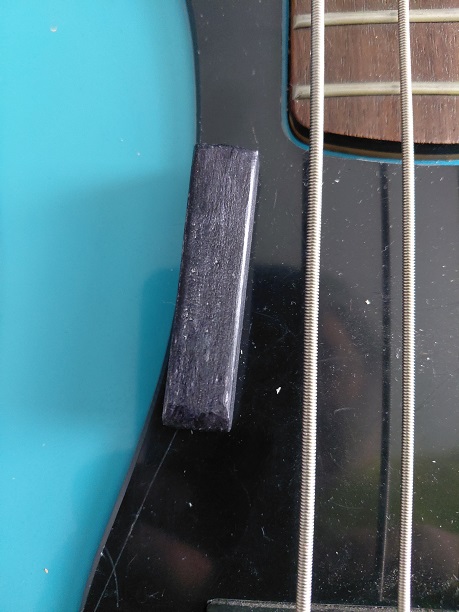
My big complaint is the finish on the body. It was not sanded well, so running your hand over it feels like a piece of rough-cut wood, fearing getting a splinter. The paint job looks like it was done with some spray cans real fast just to cover up the wood. I would recommend rubbing in some good polish to the body so it feels a bit smoother.

The other bass guitar checked out is Glarry model 30-inch GB Electric Bass Guitar. This is a direct copy of the Fender Squier Bronco Bass, with a Mustang-style body and 30-inch scale, a length found on the Hofner 500/1 “Beatle” Bass as well as some Gibson and Epiphone models. The balance is OK, considering the smaller size, as many full-scale basses from Glarry and other Asian manufacturers use a lightweight wood for the body, so the weight of the headstock will pull down and put stress on the shoulder. This one has a slight problem like that, and could have used a smaller headstock. There is only one single coil pickup, and two controls for volume and tone.

The finish on the body and back of neck are quality. Running the fretting hand back and forth along the back of the neck was a smooth endeavor. The paint job is much better than the GW101, and is definitely comparable to upper-grade basses.

I like the playability and comfort of this bass a bit more. My first bass was a 30-inch scale, so I have always been able to play moving bass lines a lot better with my fretting hand, even though I’ve used mostly full-scale basses for the past 30 years. The pickup does kick out some hum noise, but not an annoying amount. The neck is also well finished with no snagging fret ends. This would be a definite first choice for a younger teen student, or even an adult with smaller hands. I have known many female bass players that play this type of bass due to the hand size. As with the GW101, an adjustment with the bridge saddles for proper intonation will be necessary.

Both basses came shipped with a cheap gig-bag, low-end strap, cables, pick, and hex keys for adjusting the neck and bridge saddles. The gig bag for the GW101 was really extremely low-quality, basically a glorified trash bag. When zipping it up with the bass inside, it could barely close around the headstock unless you put the tuning gears in a flat position, which means re-tuning the bass when playing again. Unfortunately, it will be nearly impossible to find a good gig bag or case for this size bass. Maybe a large ukulele gig bag?

As for the cables, the GW101 came with a very low-quality one. After a dozen uses, this type will start to crackle and short out. I am not sure if it was a packaging error, but the GB bass came with a good-quality webbed-covered 10-foot cord, which usually go for about $20.00 at Sweetwater or Guitar Center. Both have bridges and tuning gears that are expected on lower-priced instruments. They serve their purpose, but are not high quality, so if the bass was being used extensively, replacement would eventually be necessary. However, they work fine for a student that is just beginning to learn the bass.

At the bluegrass festival last weekend, at least three bands had bass players using electric basses instead of the more traditional upright bass. So playing an electric bass is not as unusual as expected in bluegrass. For the parents having a young child or teen interested in playing bass in bluegrass, or any other format, these two basses are worth considering. They are extremely affordable, and there is not a lot of investment lost if the kid loses interest and the instrument goes on the garage sale block.

Chew on it and comment.

Categories
Bass Guitar Bluegrass Music Lutherie

Leo Jaymz Guitar Kit/Amazon Scam/Larry Sparks

So even though I haven’t even started on the two guitar kits I already have, I purchased a third kit. This kit comes from Leo Jaymz, and is pretty similar to the Fesley kit I purchased a few weeks ago (https://luegra.design.blog/2024/05/19/inexpensive-guitar-kits/).

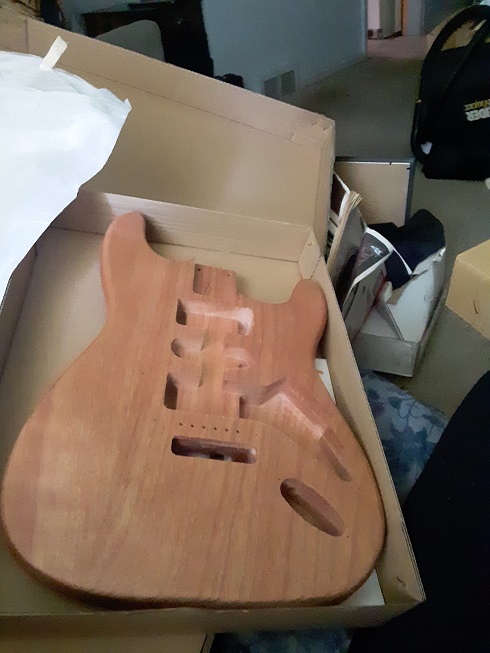
The big difference with the Leo Jaymz kit is the Strat-style body. They have routed it for the customizer, with spaces for humbucker pickups in the neck and bridge positions. The pickguard is still set up for three single coils, and wiring has connectors, so no soldering is needed. The instruction manual has no text, only pictures showing how to install each component. It really could not get any easier, I guess.

I had to take a second look at the body, though. As pretty much with all electric guitar bodies for this low price, it consists of poplar pieces glued together, then cut with a computer-controlled router. The grain of all of the pieces should be running length-wise from bridge to horns. However, this particular body seems to have a slight angle to the grain. It’s not drastic, but is noticeable to someone looking a little closer.

I still want to stain one of these guitars a unique transparent color, so I have to look all three bodies over. As stated previously, the Fesley body is ready for finishing, while the Ktaxon Tele needs a lot of fine sanding before any finish work. This Leo Jaymz body is sort of in between the two as far as surface texture. It is somewhat smooth, but could probably use a buffing with some super-fine steel wool to get it ready.

I am still interested in looking at and reviewing some bass guitars for young students to work with. I did order through eBay a really short-scale (25.5-inch) mini bass put out by Glarry. I plan on reviewing it here, and possibly on my YouTube channel, once it comes in. I was going to purchase the Ktaxon Fender Bronco copy bass that I briefly discussed in a blog three weeks ago (https://luegra.design.blog/2024/05/25/ktaxon-the-latest-cheap-guitar-brand/). I had recently won a gift card for Amazon, and when I went to the Amazon website, I saw that the bass had a price cut from $59.99 to $49.99. A nice incentive to purchase, so I clicked on the order. Well, shipping for the sale-price bass was $29.99, while shipping for the regular-price bass was $19.99, so there was no difference in the final cost. I wrote to Amazon about this, but have not heard back from them. Hopefully, no one fell for this hidden scam.

Finally, this past Thursday I went to see a bluegrass legend perform at the Kentuckians of Michigan hall in Romulus, MI. Larry Sparks, who has been performing for over 61 years as a solo artist, as well as with the Stanley Brothers, Ralph Stanley, and the Lonesome Ramblers, has had to cancel a few previous performances due to health concerns. I figured that I better go to this show, even though it was on a weeknight, because The Man may stop touring altogether. I was even able to talk by bluegrass buddy Ken to go, as he keeps missing local bluegrass shows for numerous reasons.

Larry was just doing a few shows, no festivals booked, with a small combo. No banjo player at this show, so we actually got to hear his smooth vocals and distinct guitar playing a lot better. He is definitely old school, playing a three-minute song, then bantering for 10 minutes more. However, he is a legend, and you listen to every word he has to say because he has great stories to tell and is somewhat of a rural philosopher. I am so glad that I got to see Larry perform, and it was worth going to work Friday morning on about four hours sleep.

Next week’s blog will probably be a bit late, as I will be at the Charlotte (MI) Bluegrass Festival all weekend.

Chew on it and comment.

Categories
Bass Guitar Music Instruction

Bad Recommendations for Beginner Bassists

I read an online article this week posted by Ultimate Guitar online entitled “Best Songs for Beginner Bass Players” (https://www.ultimate-guitar.com/news/lessons/best_songs_for_beginner_bass_players.html). The article listed a dozen or so rock songs that had bass lines that were familiar to most listeners. The problem that I had with the article was that only a handful of the songs listed could qualify for practical to learn for beginning bass players.

I have been playing bass guitar for over 40 years, and have taught bass playing for probably a total of 10 years. I will be the first to admit that I am no Jaco Pastorius, but I can definitely hold my own in almost any situation, save jazz or classical. As I looked down the list provided in the article, I found myself shaking my head, concluding that the person who wrote the article, david89zenum, had no real clue on what is important to a beginner as well as the right material with which to start off.

The first song listed was “La Grange” by ZZ Top. As I started reading the article, I pretty much agreed with that selection, as it is a pretty basic blues-rock groove, with the bass following a simple I-minor III-IV note progression. After that listing, it became confusing at best. There were a few bands/songs with which I was not familiar, and there were a few choices that I would agree with:

“Blitzkreig Bop” – The Ramones
“Smells Like Teen Spirit” – Nirvana
“Bad Moon Rising” – Creedence Clearwater Revival

After that, I would have to disagree with a lot of the choices. Now, there were some artists listed that seem to be here to try and be politically correct, such as Taylor Swift and Salt-N-Pepa. I am not even familiar with the songs from those artists, so I could not tell you what the bass lines entail. However, if they have any similarities to the songs I will discuss in the following paragraphs, this article is way off the mark.

“Billie Jean” by Michael Jackson – The bass line on this hit is fantastic to say the least, but it is also very complex for a beginner. It requires a lot of movement of the fretting fingers, even though the hand stays relatively in the same area of the neck. Give it a few months.

“Phone Booth” by Robert Cray – Cray is a great blues guitarist that likes to push the boundaries of the classic blues progression. Even the article author admits that this song is not your typical I-IV-V blues progression. So why teach it instead of having the student perfect the standard progression first? Note that there was no standard blues song listed in the article.

“Under Pressure” by Queen – Like “Billie Jean,” it is another song with a bass riff that needs some time and strength in both hands to perfect.

“Seven Nation Army” by The White Stripes – Same thing. A great bass line (although this was actually recorded with a guitar and an octave divider pedal), but it has some quirky movement to it. This means that the “beginner” bass player needs to work hard on timing as much as getting the right notes.

“I Got You (I Feel Good)” by James Brown – This is one of those classic R&B songs that had a fantastic bass groove. The thing is, the player never played the exact line twice. There were very slight changes with each passing of the bass lines in each verse. Definitely not a beginner song.

“Sunshine of Your Love” by Cream – Jack Bruce laid down some fantastic bass lines in Cream, as it was almost required when the band is really only a trio. The bass line on this song is immediately recognizable, but like many others already listed, it requires a lot of fretting hand/finger movement.

I was surprised that the article listed no songs by classic rock bands such as The Beatles, The Rolling Stones, The Kinks, or The Animals, all who have songs with memorable bass lines. Heck, Chas Chandler of The Animals laid down some amazing bass work on classic rock songs such as “We Gotta Get Out of This Place,” It’s My Life,” and “Please Don’t Let Me Be Misunderstood.” However, I would never recommend any of those songs to a beginner. Moreover, if the author is going to list James Brown, then why not list something from Motown? James Jamerson was THEEE bass player, and while most of his work is pretty busy on the fretboard (and remember, all of that speed plucking on the strings was done with only one finger), he did lay down some easy lines from which to learn.

Here is my list of a few songs for an actual beginner bass player to work on in order to learn the basics as well as being an integral part of a band. The thing is that the bass player should not only learn the notes, but also timing, working with the drummer, and know what fits well in the song (NOTE: Some of the early songs were recorded with a standup bass, so the recordings do not have great bass response):

“Maybellene” – Chuck Berry
“Ain’t That a Shame” – Fats Domino
“Get Rhythm” – Johnny Cash
“My Girl” – The Temptations (James Jamerson)
“Can’t Buy Me Love” – The Beatles
“Not Fade Away” – The Rolling Stones
“You Really Got Me” – The Kinks
“Can’t Explain” – The Who
“Rock and Roll” – Led Zeppelin
ANYTHING from the Rockpile album Seconds of Pleasure (Nick Lowe on bass)

With anything from Paul McCartney (The Beatles), Bill Wyman (The Rolling Stones), and John Entwistle (The Who), you can hear how their bass playing improved from the early band recordings through the 1960s.

Chew on it and comment.

Categories
Bass Guitar Rock Music

Underrated Punk Rock Bassist: Norman Watt-Roy

I was vaguely familiar with Norman Watt-Roy during the 1980s, more of just seeing his name on a lot of albums that I had back then. As I have done more reading and researching on my favorite music from back then, I have come to realize that he was an unsung hero from the punk/new-wave era.

Watt-Roy started put playing in a number of rock bands during the late 1960s and early 1970s with his brother Garth. Later that decade he met up with Ian Dury and played on the Blockheads first album, New Boots and Panties!! on the Stiff label in 1977. Watt-Roy would later join up in Wilko Johnson’s band in 1985.

However, it is his guest appearances on other albums that let me know how great he was. He plays on Nick Lowe’s album Jesus of Cool (known in the US as Pure Pop for the Now People), giving memorable bass lines on “Nutted by Reality.” However, my favorite of his bass work appears on The Clash’s album Sandinista! Watt-Roy laid down some of the greatest grooves on the most memorable songs, “The Magnificent Seven” and “Hitsville UK,” along with “The Call Up.” Charlie Don’t Surf,” and “Something About England.” Those first two songs have always been held in high regard with me, and when I was playing bass during that time, those were two songs that I had to learn. It was painstakingly difficult, as I was using a pick, while Watt-Roy plucked with his fingers. It was only recently that Clash drummer Topper Headon stated that Watt-Roy played the bass groove on the band’s biggest hit, “Rock the Casbah” from Combat Rock.

Watt-Roy also worked with The Selecter, and laid down bass work on Frankie Goes to Hollywood’s “Relax” in 1983, although the final mix didn’t have his playing. He did session work with Roger Daltrey and Wreckless Eric, and during the early 2000s, he performed with a later incarnation of Madness. Recently, he has been appearing with reincarnations of The Blockheads.

I urge any bass player in pop and modern rock/punk bands to search out Watt-Roy’s bass work. The man had a way of making average songs get a dance able groove without going too pop. I hope that he also gets more recognition for his amazing work.

Chew on it and comment.

Categories
Bass Guitar Rock Music

Underrated Punk Rock Bassist: Bruce Foxton

I came across this online article last week from Consequence regarding the 100 greatest bass players (https://consequence.net/2024/04/100-greatest-bassists-of-all-time/11/amp/). The survey tried to cross most genres (rock, pop, blues, jazz, R&B), but like any opinion list or survey, I disagree with much of it. I would probably agree with the top three (James Jamerson, Paul McCartney, Jaco Pastorius), but after that, it is totally off as far as I am concerned. Flea above Geddy Lee and John Entwistle? Dee Dee Ramone even on the list? Pleeeze!

This got me thinking about some of the bassists that influenced me in my early years of playing the instrument in my first band doing oldies with my cousin, my first punk bands, and through today recording my own bluegrass, folk, and Americana songs. Over the next few weeks, I want to look at a few bassists from the punk era that were a lot more expertise on the four-string than the usual punk bass players just plunking eighth notes with down strokes and a pick (like Dee Dee).

The first bassist I will cover is Bruce Foxton of The Jam. From 1976 to the band’s break up in 1983, Foxton handled the bass chores with an intensity that was rarely seen in the first wave of punk bands, let alone any rock/pop band in general. Originally a guitarist, he switched over to bass when the band went from a four-piece to a three-piece. Listening to the band’s first single, “In the City,” instead of following the opening guitar chord progression, Foxton does a descending bass line. Rumor has it that the Sex Pistols borrowed the bass line and used it on their single “Anarchy in the UK” and released the song before The Jam could release their single.

Foxton was never content with just playing the root note on a chord progression. Like most three-piece bands (Cream, Jimi Hendrix Experience, The Who), the bassist provides a melodic line along with a pulse to the song. Foxton was no different. While the debut album In the City has some moving bass lines, it was on the second album This is the Modern World, that he really started to show his prowess. Songs like “The Modern World” and “London Girl” show what talent he had on his Rickenbacker 4003 bass. Be it him or the production, that sound, along with those great bass lines, were distinctive and powerful.

Then comes All Mod Cons. While the entire album is bass-friendly, it is the song “Down in the Tube Station at Midnight” that Foxton is at his best. In fact, the bass line IS the song! I remember thinking that I was a god when I finally got that bass line down pat. He does EVERYTHING on that bass! This is literally one of the best bass recordings ever in rock history!

The following album, Setting Sons, continues with some great bass lines, especially “Smithers-Jones” in which the bass basically carries the entire song, and “Eton Rifles,” with Foxton again working with the vocals instead of the guitar. But it is with Sound Affects in which Foxton, and the whole band for that matter, put aside their Who/Small Faces/Mod influences to use The Beatles as a primary influence. This is blatantly obvious with “Start!”, which definitely rips off the bass line form The Beatles’ “Taxman,” but moves it even further. Another great bass groove comes with “Man in the Corner Shop.” Finally, there is “That’s Entertainment,” which Foxton makes the song move like a bus traveling down a deserted city street at midnight.

The band’s final studio album, The Gift, has Foxton heavily influenced by Motown. One listen to “Town Called Malice” will convince you. Other bass line treasures on the album include “Ghosts” and “Precious.” This was followed by two single releases, Beat Surrender” and “The Bitterest Pill (I Ever Had to Swallow),” both of which show Foxton doing his best Motown/Stax bass work.

After The Jam’s breakup in 1983, Foxton would join Stiff Little Fingers from 1991-2006, as well as play in some other short-lived bands. However, it is his work with The Jam that he is best known. The bass lines were amazing to say the least, and live, he was as animated as a marionette with tangled stings. The Jam were one of the most influential punk rock bands of the late 1970s/early 1980s, but were just a footnote in the US. That is a shame. Yes, while the band’s lyrics were British-centric, the band’s overall musical sound was addictive to say the least. They had a raw energy, pushing the sound of the 1960s to a new height. At the very least, seek out a The Jam compilation, or if you can, any othe original albums. Foxton was a maestro on the bass.

Chew on it and comment.

Categories
Bass Guitar

Pet Peeve: Narcissistic Bassists

As you well know, I like to surf the YouTube spectrum for interesting videos. I particularly like to watch videos dealing with bass guitars. Although I haven’t played bass in a band for about 20 years, I still hold the bass guitar close to my heart, as that is what I started with when I got into playing in bands.

I pretty much watch all kinds of bass videos: instructional, performance, history, and reviews. While there are a lot of videos that I appreciate, there are some that are just plain annoying. The most annoying to me are the ones where someone is reviewing a bass guitar, but spends the first minute or more just wanking on it, attempting impress the viewer on how good he/she is before telling us about the features and if it is a comfortable bass to work with.

Yeah, great, you are the next Flea or Chris Squire. Then why aren’t you selling out arenas instead of showing us what every other bass player can do and giving off the impression that you are the best? If you are reviewing a bass guitar or amplifier (and I am sure this goes for other musical instrument reviews), talk about the features, and don’t play for more than 10 seconds with each feature.

Another pet peeve are the instructional videos that show some riff or pattern, but there is no actual instruction. The following YouTube short is somewhat of an example. The bassist is playing a famous Stevie Wonder bass groove note for note, but there is no tablature. So why tell us that it is something every bassist should know? As an aside, I know a lot of people that can play along with a recording, but have a difficult time playing with others and not having the recording to play along with.

One of my favorite YouTube bass guitar channels is the Leland Sklar channel. Lee Sklar is probably the most recorded bassist in history. The man has recorded and performed with James Taylor, Jackson Browne, Toto, Phil Collins, Linda Ronstadt, and Lyle Lovett just to start off. At 75 years of age, he is still showing the youngsters how it is done. Besides all of his sideman work, he is occasionally touring with The Immediate Family, which contains other famous Los Angeles studio musicians (they have recently made an award-winning documentary, please check it out at https://www.immediatefamilyband.com/). Anyway, Lee started the channel to talk about some of his more memorable bass lines, but it has grown to him discussing studio experiences, life on the road, and some great philosophy on rock and pop music. Now this is a guy who could put all of us to shame if he wanted to by laying down some bass lines on video. Instead, his humble talk makes one really want to sit and listen to a wise man. That trademark beard makes it all the better. Subscribe to the channel, and here’s a taste of one of his wonderful monologues:

Finally, one of my favorite videos from my favorite bass players. Who doesn’t know Paul McCartney? And what bass player hasn’t copied one of his Beatles or solo bass lines? He helped put the bass player in the forefront. This video is a bass lesson by Sir Macca himself for his song “Ever Present Past” from his 2007 album Memory Almost Full. Again, here is a legend, someone who can show us all how it is done, but he is so humble about his bass playing. That is why we all love him so much.

Chew on it and comment.

Design a site like this with WordPress.com
Get started