Categories
Bluegrass Banjo Comedy Lutherie

Leo Jaymz Guitar Kit/Banjo Practice/Fashion Show Parody

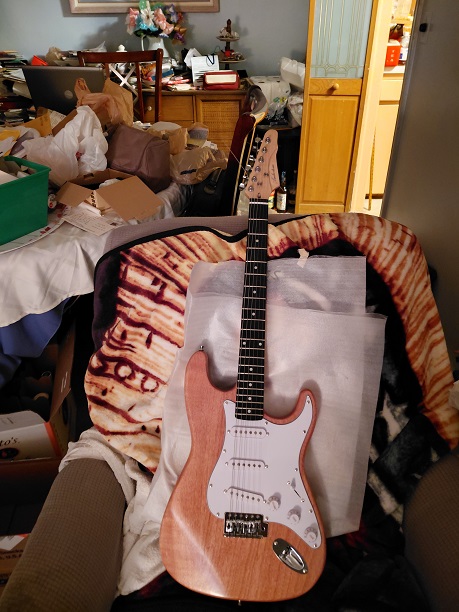
My second guitar kit is finished. Lessons learned from my previous kit were followed, and new lessons learned as well. This was a lit from Leo Jaymz. The Strat-style body had a nice grain structure for the most part, so instead of any paint or even stain, I chose to just finish it with Tru-Oil. There are about a dozen coats on the body, with light sanding between every two coats, and buffing/polishing afterward with car polish.

I would give my work on the body about a 7 out of 10, as the back of the body has a few drip spots from the oil that I had thought I sanded out. The wiring is a lot easier to work with than the first kit, which was a Fesley. Absolutely no soldering was needed, so it makes an excellent starter kit. My one problem is that, while the neck/body joint fit perfectly, the cut of the cavity in the body for the neck joint is ever-so-slightly off, by about a 1/32 of an inch. Thus, the low E string is closer to the neck edge near the joint than the high E string. Barely noticeable, but noticeable anyway.

As expected, much of the hardware is low-end. The tuning gears are rough when turning, and if I plan on keeping this guitar, these will definitely be replaced. The pickups are low-output, which is not a concern for me right now, but I could either replace them or do an update with magnetic pole pieces. I’m not a fan of the design of the headstock. I would have preferred a Strat-style cut, and this one is more like the old Epiphone batwing style.

I have a few other kits that I plan on building soon, including a Precision-style bass that I want to put in some modifications to make it unique. But they are being put on the back burner, as I want to spend my free time over the next few months working on playing the banjo again.

Since I haven’t practiced the banjo in so long, and giving my last banjo to my nephew, getting back into the swing of Scruggs-picking has been a chore. The ring finger on my picking hand has a problem known as Trigger Finger, which makes it difficult and painful to bend at times. Fortunately, it’s not one of the picking fingers, but I still feel pain when I rest it on the banjo head.

I’ve also given my nephew all of my instruction books and videos, so I am back to learning on my own and by watching YouTube videos. I still remember a few basic rolls, but in watching the videos on YT, there are not many that are too helpful to the beginner. Almost none show tablature while showing fingering in the video. My best way of learning things like this has always been the combination video and book. Right now, I am shopping around for one or two DVD/booklet packages. But until then, I am committed to spending a few minutes each day just practicing rolls.

And now for something completely different.

Nothing bluegrass, music, or lutherie related. While surfing on YouTube a few days ago, this video popped up. I haven’t stopped laughing since, and immediately subscribed to the channel. The guy has perfectly parodied the modern fashion-show runway and its models. I hope that you enjoy it half as much as I have.

Chew on it and comment.

Categories
Bluegrass Banjo Lutherie

Tetomas Banjo/Guitar Mat

Over the summer, my nephew helped clean up my back yard of overgrown brush. For payment, instead of money, he asked for my banjo. It was a J.B.Player model, sort of an intermediate banjo with basic parts but did have the more professional tuning gears on it, not the cheaper acoustic guitar style tuners found on an entry-level banjo. I had not picked it up to practice in a long while, so I felt it was a decent trade. I gave him the banjo and all of the instructional books and videos that I had laying around. A few months later, I had the inkling to pick it up again, but alas, it was gone.

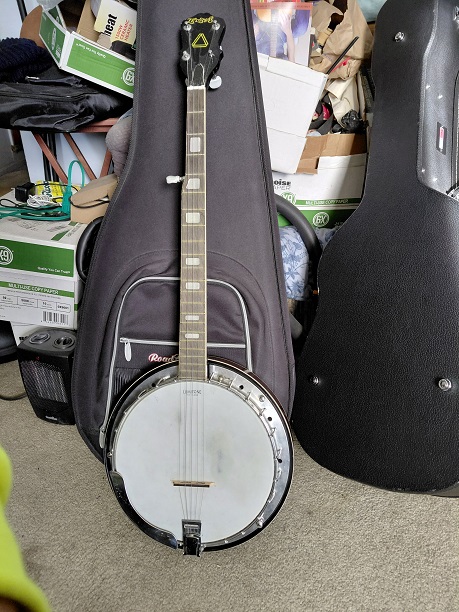
Last week, I was updating some of my Craigslist ads, when I decided to peruse the Music Instrument category. There was an ad for a Tetomas brand banjo with the better tuning gears. Most of the banjos I have seen on CL are usually the beginner models, or occasionally a professional ones costing way too much for my wallet. The seller was a guitarist that had it sitting around and wanted to get rid of it. For the price asking ($60.00), I figured that it might be worth a shot. I contacted him and bought it a few hours later.

Tetomas was a musical instrument brand made in Japan in the 1970s, producing mostly acoustic guitars, but as I see, other instruments like banjos. There isn’t much information available on Tetomas on the internet, so my assumption is that it is like the import brands like Glarry or Ktaxon is for beginners today. I was surprised to see that this had some care put into its construction, especially with the tuning gears. The tone ring and pot of the instrument are pretty basic, so again, it was probably meant for an intermediate market.

Whether it was the seller or someone else, the banjo was set up pretty bad. Two of the strings were wound on the tuners in reverse direction, and the bridge was way out of place. After adjusting the bridge, it came to life. The sound is good, definitely not of the quality tone like a Stelling or Gibson, but can cut through with a good bite when picked three-finger style. When played clawhammer style, it can be pretty loud. I went and bought some new strings (which I will put on soon) and some finger/thumb picks. It felt good to play the simple tunes like “Bile Them Cabbage Down” again. I will be picking up a strap and gig bag shortly, but I do plan on keeping it within reach while watching television to see what comes out of it.

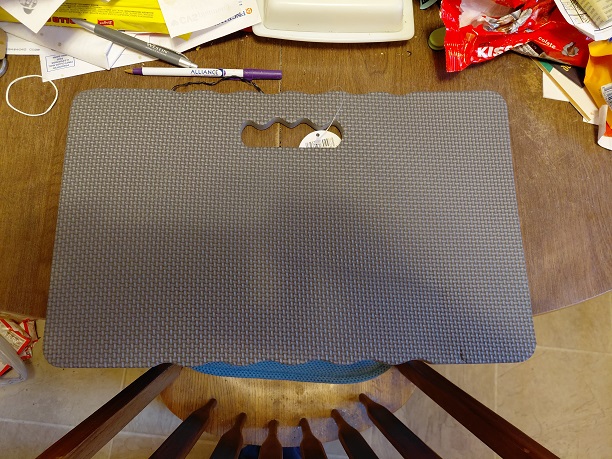
A really good find I purchased at the Dollar Tree recently has proven to be a lifesaver in my luthier work. The store sells these garden knee pads for relief when kneeling while working in the yard. They are about 17×11 inches, made of a semi-hard foam with some rib texture on the surface. This is perfect for laying a musical instrument on while working on it, as it holds the instrument without slipping but doesn’t scratch. The cost was $1.50, well worth it I think. I have already gotten a lot of use from it while working on my next guitar build project, as I can fine sand the guitar body on it with out the body moving around, and doesn’t leave any scratch marks. I have a bigger guitar bench top that I use when I’m doing setups, but this little pad is perfect for the jobs like just working on a body or neck on its own.

Chew on it and comment.

Design a site like this with WordPress.com
Get started