Categories
Bluegrass Mandolin Bluegrass Music

David Grisman at 80

I was reading an article online about a show that David Grisman was doing in Seattle to celebrate his 80th birthday. I had to look twice and research the information, and yes, on March 23rd, David “Dawg” Grisman will be turning 80 years old. Grisman has always been one of my favorite people in the bluegrass field, especially as he loved to push the boundaries of traditional bluegrass to include rock, jazz, blues and klezmer, which critics and fans alike labeled as Dawg Music.

The way that young girls follow Taylor Swift’s every action, my buddy Ken and I always had a keen interest in the bluegrass musicians that gathered in other musical influences to create the Newgrass movement that began in the early 1970s. Along with New Grass Revival, John Hartford, Tony Rice and the Seldom Scene, Grisman made a name for himself with other musical formats while still keeping one foot in bluegrass.

Somewhat of a musical prodigy on the mandolin, though he also played piano and saxophone in his early age. He grew up in the Jewish community of Passaic, New Jersey, but discovered folk and bluegrass while attending New York University. He was a member of Red Allen’s band The Kentuckians, and also recorded with Hazel Dickens & Alice Gerrard on their early beautiful Folkways recordings. He delved into rock music with former Blue Grass Boys guitarist/vocalist Peter Rowan to form the short-lived Earth Opera. The two would also form the legendary bluegrass band Old & In The Way with Vassar Clemens and Jerry Garcia. His friendship with Garcia lasted for decades. He recorded on the Grateful Dead’s American Beauty album, with standout work on the songs “Ripple” and “Friend of the Devil.” During this time, he also worked with Rowan, Richard Greene, and Clarence White in the band Muleskinner, which disbanded due to the untimely death of White. Only weeks prior to White’s death, the band performed on a local television show in California, meant to be a warm-up for an appearance of Bill Monroe which did not happen. Fortunately, a video of the band’s performance was saved and is available as Muleskinner Live.

In the 1970s, Grisman formed the David Grisman Quintet, which had a revolving membership that included Darol Anger, Tony Rice, Mark O’Connor, and Todd Phillips among others. He recorded a number of Dawg Music albums during this time, which were critical favorites, and are cherished mainly by Deadheads.

The Garcia/Grisman collaborations continued throughout the years, with gems such as Jerry Garcia/David Grisman and Not For Kids Only. A wonderful documentary on their relationship was released in 2001 called Grateful Dawg, directed by Grismans’s daughter Gillian. The film includes a number of live performance by the duo which are near perfection. Probably the best storied collaboration was with the two and Tony Rice. During two evenings in February 1993, the three musicians sat down in Grisman’s home studio and recorded a number of standard folk and bluegrass tunes. A copy of the tape somehow got into the hands of a pizza deliveryman, and within months, the songs form the recording were being bootlegged across the country to thousands of Deadheads. At first angered, including confiscating bootlegged CD, Grisman eventually released some of the recordings in 2000 as The Pizza Tapes (an extended version was release online in 2010).

In 1990, Grisman formed Acoustic Disc, a record label that would specialize in unique bluegrass, folk, and jazz recordings, particularly live performances. Along with The Pizza Tapes, the label has released other recording by Grisman, Rice, Jesse McReynolds, Old & In The Way and Doc Watson. The label’s catalogue is a wealth of great acoustic music, and I personally have at least a dozen releases from there.

Grisman was FINALLY inducted into the International Bluegrass Music Association’s Hall of Fame in 2023. This was an honor that should have been given decades before, as his music was what was getting many younger musicians and fans into bluegrass. He never strayed away from bluegrass music, as his love was so deep that he names one of his children Monroe after the great Bill Monroe.

I saw Grisman only once, and it was at an Ann Arbor Folk Festival many years ago when he performed with Doc Watson. There were a number of bands performing at that festival, but that to me was the highlight, as two legends were trading licks and presenting an acoustic format that forced you to pay attention and appreciate it. My only other connection with Grisman is that we both had music played on the NPR program “Car Talk.” His composition “Dawggy Mountain Breakdown” was the shows theme song.

I totally recommend that you get some of Grisman’s recordings. Traditional bluegrass fans will want a copy of one of the Old & In The Way live discs. Acoustic music fans will love The Pizza Tapes or just about any other album on Acoustic Disc (www.dawgnet.com), and I encourage you to check out the documentary Grateful Dawg as well as the performance of Muleskinner Live.

Happy Birthday, Dawg! You have made my musical life, as well as thousands of others, so much more rewarding and enjoyable!

Chew on it and comment.
Categories
Bluegrass Mandolin Bluegrass Music

Frank Wakefield RIP

Last week, a great bluegrass mandolin player passed away. Frank Wakefield was a bluegrass character to be sure, and seems to be forgotten be most modern bluegrass musicians. Where Bill Monroe was the Elvis Presley of bluegrass, and the Stanley Brothers were the Everly Brothers of bluegrass, Frank Wakefield was the Johnny Rotten of bluegrass.

He was always pushing the boundaries of the mandolin in bluegrass, which turned off many traditionalists. He started off playing with Red Allen in the early 1950s, then moved up to Detroit to audition for Jimmy Martin. While Martin at the time did not need a mandolin player, he recommended that Wakefield contact Marvin Cobb, leader of the Chain Mountain Boys. Wakefield played with the band for a while, then joined up with the Stanley Brothers. However, Ralph Stanley and Wakefield did not get along musically, so Wakefield went back to the Chain Mountain Boys.

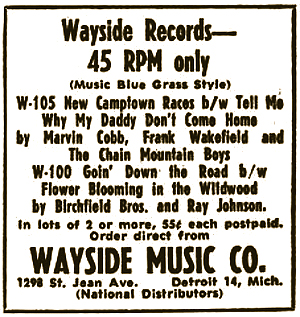
Wakefield’s style was boundary-pushing to say the least. The Chain Mountain Boys recorded the single “Tell Me Why My Daddy” with the B-side of the classic “New Camptown Races” for a small Detroit label, Wayside Records, that specialized in country and bluegrass. In fact, an advertisement in Billboard in 1957 is considered the first use of “bluegrass” to describe the music.

The Chain Mountain Boys disbanded in late 1957, and Wakefield continued to record for Wayside with Buster Turner. He also toured with Jimmy Martin for a time, then moved to Washington, DC to work again with Red Allen. With Allen, Wakefield would play such venues as Carnegie Hall, and he began to teach mandolin to future luminary David Grisman. He would later work with the Greenbriar Boys, and began to write classical-influenced instrumentals for the mandolin. This work would eventually get him invited to perform with the New York Philharmonic and the Boston Pops.

Wakefield would spend the 1970s recording solo work, being backed up by banjoist Don Reno and fiddler Chubby Wise. He would also tour with Jerry Garcia’s solo projects and warm up for Grateful Dead shows. His last notable recording was on the 1999 Grammy-nominated Bluegrass Mandolin Extravaganza, which also featured Grisman, Sam Bush, Ricky Skaggs, Ronnie McCoury, Jesse McReynolds, and Bobby Osborne.

The best description of Wakefield comes from Grisman: “He split the bluegrass mandolin atom. Some of us, obviously, will never be the same again.”

While I never got a chance to meet Wakefield or see him perform, I always had a soft spot for him in my bluegrass heart due to his time in the Detroit area when he really began to use the mandolin as a bluegrass weapon. Those early Wayside Records recordings were released in 1976 by Rounder Records called Early Days of Bluegrass, Volume 2, so if you can ever find that album, be sure to get it.

Frank, you will be missed by those who truly appreciate no0t allowing bluegrass to become stale.

Chew on it and comment.

Categories
Bluegrass Mandolin Bluegrass Music

So Why Did I Buy Another Mandolin?

So back during the pandemic days, I received a $400 debit card from the government. It was the last payment to me before I got a job, and I am not sure why they put it on a debit card instead of the usual sending the money straight to my bank account. Anyway, I completely forgot about it since I was now working.

Fast forward over two years, and while cleaning out my wallet a few weeks ago, I came upon the debit card. I went online and it still had the full amount available, but it was set to expire in about a month. Well, I wasn’t bound to let $400 slip away, but to be honest, I really didn’t know what I would use it for. I am pretty well set as far as basic necessities like food, paying utilities, and clothing. My thought was to treat myself to something special.

I didn’t want to splurge on an expensive meal. No, I wanted to get myself something to last me for a while. I first thought about a pizza oven, but I knew that I would probably use it once or twice, then it would gather dust in the garage. I also considered getting myself a handgun for protection at home, but because it was government money, they would probably deny that purchase the way the current administration is trying to suspend the second amendment.

My choice was then something in the musical instrument field. I have way too many acoustic guitars, and $400 wasn’t going to get me anything as good or better than I already have. The same goes for the bass. I have a banjo, dobro, and fiddle that I work with, but nothing to inspire me to get something more, again not for $400.

I always wanted a F-style mandolin, but the price was always out of reach. I have a decent A-style mandolin which I played regularly until I switched over to fiddle a while back. However, recently I saw that The Loar company (a stringed instrument manufacturer out of China) was marketing a LM-310F model, retailing for $400 through Guitar Center.

(WARNING: If you do an internet search on the The Loar LM-310F, you will find that a number of retailers are selling this model for $100 or less. DO NOT BE TEMPTED! These are international criminal rings that get your credit card information, keep emailing you about a delay in shipping, then after 30 days, you will never hear from them and you get nothing in return. Often these thieves will also sell your credit card information so that you will be REALLY screwed, and it will be difficult to get back your money, unless you have a really good credit card bank).

The GC near my house actually had a LM-310F at the store, and after trying it out by playing a sloppy version of “Bluegrass Stomp,” I knew that I wanted it. Since it was the floor model and they didn’t have any stock in the store room, I got a nice discount, and was able to pick up a heavy-duty gig bag for the $400 plus some change.

Let me tell you, this thing has a great bark to it when strumming those bluegrass chops, and the tone is nice and warm, way more closer to what a bluegrass mandolin usually sounds like instead of an A-style. It has a solid spruce top, a narrow V-cut neck (which is great for my smaller hands), and a nice satin finish. The main difference one can see compared to a standard Gibson F-5 mandolin is that the fretboard ends at the 20th fret. There is no upper extension of the fretboard over the body that made the Gibson model famous (along with a guy named Bill Monroe using it as his main weapon).

I have fallen in love with the mandolin all over again. I enjoy messing around with it while watching television, but I do plan on practicing on it more once I return from the SPBGMA conference next week in Nashville (NOTE: I may be late on next week’s blog, or even miss it entirely, due to the conference, but I will give a full review when I get back).

I would definitely recommend this mandolin for those moving up from a beginner A-style model but still not having the cash to afford a more costly F-style model (https://www.theloar.com/)

Chew on it and comment.

Design a site like this with WordPress.com
Get started