Categories
Bluegrass Music Bluegrass vocals Singing

Bluegrass Harmony Singing Part 1: Either You Have It, …, Or You Can Learn It!

This blog is a few days early due to commitments that I have this weekend.

I wrote a blog about bluegrass vocals last year (https://luegra.design.blog/2020/01/13/the-lost-art-of-bluegrass-singing/), and wanted to elaborate a bit more on the subject. I still feel very strongly that the art of bluegrass singing, especially when it comes to harmonizing, is wrongfully ignored by the jammers, yet so very much admired by audiences. Even if the lead singer is on target, it seems that most of the harmony singing is lost or unrepairable. Being off-key is the main culprit, but there is also timing and proper vocalization of consonants.

If a band is looking for a new player, say a mandolin player, a great ear and voice for harmonies can be just as influential on getting the job as fretboard flash.

I had recommended the video Vocal Techniques for Old-Time Mountain Music with Cary Fridley, put out by Homespun Videos, in that previous blog. Well, Cary has also set up a YouTube channel where she does a lot of instructing of Appalachian music, including singing leads and harmonies, as well as some instruments and other styles of music. Many of these videos were made for her lecture work at Asheville-Buncombe Technical Community College, as well as the Junior Appalachian Musicians organization. Be sure to at least check it out at https://www.youtube.com/user/cfridley.

Pete “Dr. Banjo” Wernick is probably the biggest supporter of bluegrass jam sessions. Aside from his banjo and jam camps, he also posts a number of helpful essays on his website (http://www.drbanjo.com/). In one of his essays, he briefly explains bluegrass harmony theory by remembering the three notes of a chord as well as knowing the diatonic pattern of the key the song is in (https://drbanjo.com/ask-dr-banjo/jamming/161-bluegrass-vocal-harmony/).

That thought is really the first big step in working on bluegrass harmonies. If the song is in the key of G, then you should know that the three notes for the G major chord are G, B, and D. Now let us say that the lead singer is singing his/her lyrics and hitting the D note. One can easily harmonize with that lead singer while still staying in the proper key by singing on a G or B note, and depending on the vocal range of the harmony singer, singing lower or higher than the lead vocalist.

Of course, rarely does a lead singer stay on one note throughout a verse, let alone a whole song. As the lead voice travels up and down with notes, the harmony singer has a musical responsibility to work with what will sound best to make that lead vocals sound even better. Let us say that the lead singer is following a vocal note pattern of D-D-E-E-F#-E-D, and the verse is staying in the key of G. The harmony singer can take one of two approaches:

  1. He/she can stay on the same note of G or B on all seven notes, since the lead singer is not singing either of them.
  2. He/she can walk up and down with harmony notes just like the lead singer, concentrating on relative notes to the key/chord playing (example: G-G-A-A-B-A-G, or a variant of G-G-G-G-B-G-G). This, of course, requires more thought and a keener ear to hear what works.

Moreover, rarely does a song stay with one chord. Typical bluegrass (as well as country, blues, folk, and traditional roots music) songs work with two- and three-chord arrangements. So, staying in the key of G, and the lead singer follows a vocal note pattern of D-D-E-E-G, with that last note moving into a C chord, the harmony singer has to do some musical thinking of a good harmony pattern. First, he/she needs to remember what the three notes for the C chord are (C, E and G). Then, especially if the harmony was staying on G and doesn’t want to sing the same G note as the lead vocalist, he/she may do a pattern such as G-G-G-G-C. Again, it take a keen ear and lots of practice.

When I was in bluegrass bands, the idea of practicing vocals alone had mixed reaction. One band I worked with was keen on it, and we would concentrate about one-fourth of our practice sessions just on vocals. Another band was apathetic, and it showed in our public performances. Harmony singing, especially with bluegrass, gospel, country, and folk music (although other formats relate as well) require either a very, very good ear, or determination to work hard to make it sound good. My situation has always been somewhere in the middle. I can hear a good harmony right off of the bat in some cases, while in others, I need to sit down and work with that lead vocal to find a good path for the harmonies.

This information is just the start, and in another blog, I will talk a bit about timing and phrasing. In the meantime, check out videos and websites dedicated to harmony singing. Also become more familiar with some music theory, such as chord structures and the “Circle of Fifths.”

Chew on it and comment.

Categories
Bluegrass Music Coronavirus

Is Live Bluegrass Within Sight?

I just found out that a local festival, The Hamtramck Music Festival, has been cancelled due to the continued pandemic. While I have lost interest in bar hopping, seeing dozens of bands playing loud music that I really have grown out of, in sweaty bars and drinking warm beer, I know that there are younger generations that go for it (I was once young, too). This festival was great in that monetary proceeds from the festival went to help music education programs in the Hamtramck school district. Past years raised about $10,000 annually.

While the pandemic is still putting a lot of live shows on hold, many artists, particularly acoustic-based performers, have regularly streamed shows online, whether it is through Facebook, YouTube, Zoom, or some other service. These have either been ports in the storm or band-aids temporarily fixing it, depending how you look at it.

I have seen some great performances over the past year, but have also longed for and missed out on many other shows. It seems that solo or duo set-ups seem to work best. Canadian fiddler April Verch has been doing some wonderful performances with her partner Cody. They set up in the living room and play a few songs, then check in with their audience chat to see if there are any requests. You can then tip her through PayPal if you wish. I know that many others are doing it, but April seems to make it the most like she’s performing at a house concert in your own home. They haven’t done a YouTube streaming show in a while, but I would advise checking in to her website at aprilverch.com for updates.

One thing that many bluegrass bands are learning is that they have to adapt to this situation. Social distancing means that four or five bluegrass musicians cannot be standing close together around one microphone. On the flip side, if they do distance themselves to six feet or so apart,, even with separate mics, the camera has to pull back so far that the performers are unrecognizable on screen. Some bands are downsizing, where only two players are performing together. For husband/wife teams like Darin and Brooke Aldridge, this is relatively easy. I have seen other bands such as Mile Twelve doing split-screen performances to keep the band sound. From the looks of the band’s YouTube page, they are starting to say “To Hell!” to COVID and doing some true band performances. This latest video makes me really happy!

Starting around the new year, I began to receive emails regarding bluegrass festivals for the 2021 season. Of course, all have some note stating that due to the Coronavirus, the schedule is tentative, and there is still a possibility of re-scheduling and cancellation. As of this writing, some states are lifting some restrictions, and immunizations shots are becoming more available. I don’t see hitting a show in the next few weeks, but hopefully, by Memorial Day, I can pull out my lawn chair and cooler, and enjoy an outdoor bluegrass performance. Also, I NEED to get back to jamming with others, even though I am not addicted to it! Performing along with YouTube clips and DVDs is getting to be redundant!

Chew on it and comment.

Categories
Bluegrass Music

Bluegrass Covers of Pop Music

I received an email press release a few days ago that I deleted after a quick read-through. A bluegrass artist (the name escapes me) was releasing a new single that was a cover of a mainstream pop-rock song (again, the name escapes me). I do remember that the song, in my mind, did not seem like something that would sound good as a bluegrass tune.

Now I am all for pushing to boundaries a bit when it comes to songs in bluegrass. I really do not like hearing bands covering the same 20-30 established bluegrass standards. Some bands are able to write their own songs to varying degrees of palpability. Other artists like to secure the talents of established songwriters to provide a hit. Then there are some artists that listen to songs outside of the bluegrass realm, especially in the country, pop, and rock categories, and try to interpret hits from those formats into a bluegrass sound.

(Note that this will not discuss the “Pickin’ On” series of bluegrass albums performing songs from various rock bands, released by CMH Records. See my previous post on this at https://luegra.design.blog/2020/11/26/bluegrass-is-in-the-ear-of-the-beholder/)

This of course is not a new thing. Bill Monroe had done this throughout his entire career with the Blue Grass Boys (then again, Bill Monroe could do whatever he wanted when it came to bluegrass). In the 1960s, King Records out of Cincinnati had both bluegrass and R&B acts on its roster, so the execs would try to cash in on royalties by having bands record songs from the other format. The best example was the Stanley Brothers recording a version of Hank Ballard’s “Finger Poppin’ Time.” Ballard’s version was a hit, the Stanley’s version never made it to the charts.

Jim and Jesse McReynolds recorded a whole album of Chuck Berry classics. Flatt & Scruggs recorded a number of Bob Dylan songs. The Country Gentlemen and Seldom Scene were known for finding great pop songs and converting them to a more progressive bluegrass sound. The New Grass Revival also made use of covering pop songs (I still say that NGR’s version of Marvin Gaye’s “Ain’t That Peculiar” is one of the best covers EVER!). I wouldn’t even begin to count the number of times a Beatles song was covered by a bluegrass band. Then there is Tony Rice, who was a big fan of Gordon Lightfoot and recorded a number of the folksinger’s tunes.

In more recent times, there has been a resurgence in this action. Dale Ann Bradley has recorded a number of songs originally performed by Tom Petty, U2, and others. Of course, one fantastic bluegrass cover is Del McCoury’s version of “1952 Vincent Black Lightning,” written and performed originally by English folksinger Richard Thompson.

There are a number of younger bands in the bluegrass fold that are also going to the pop music folder to pull out a gem. The one thing that I have noticed, though, is that there is not much thought into making the song “feel” like a bluegrass tune. Instead, it sound more like an attempt at playing the pop song as a pop song, only with acoustic instruments.

Again, I am all for bluegrass bands trying to find new material to perform, whether it is self-penned or searching for unique covers. However, bands also need to truly listen to the song and decide if it can become a good bluegrass tune. There are a lot of non-bluegrass songs that I love, be it pop, rock, metal, R&B, country, polka, or folk. And there are a lot of times that I listen to those songs and think if they would make good bluegrass tunes. Well, 99% of the time, they do not.

I am not saying that bands should not try, but they also need to be discerning. I have a lot of friends in bluegrass band with national prominence. Some of these band have recorded covers of pop songs and attempted to put a bluegrass slant to them. I have to be honest, I haven’t heard one lately that has been a treat to which to listen. I can understand that many of these bands are trying to get a wider audience, but at what cost? I like to think about the Beatles and their cover of “Mr. Moonlight.” The band was on top of the world, and was doing a lot of other covers along with some fantastic original material. However, that particular cover, with the tacky B3 organ and drum slap after each verse, just did not cut it, and has always been an inside guffaw to many fans.

Established bluegrass bands love to jam, and with that jamming comes creativity. With creativity also comes intelligence. Be smart enough when something creative sounds hokey or sounds like a hit.

Chew on it and comment.

Categories
Bluegrass Music

O Brother, Where Art Thou? at 20

Well, O Brother, Where Art Thou? is now 20 years old, and where is the state of bluegrass now? Has it influenced enough people over the years to take an interest in the format in the long run, or was it a fluke?

Since I was around and involved with the roots-music business 20 years ago as well as now, I think that I have a good perspective of what has happened. I was at an Americana Music Association conference in Nashville when there was initial fanfare about the film. Those of us there thought that it would have a small impact on the entertainment industry, primarily due to George Clooney starring in the film. The concert that would eventually become the Down From the Mountain documentary had just been performed a few months earlier. The film had some success, but not anything spectacular at the box office. However, I don’t think any of us would have guessed the soundtrack would become so popular.

We watched as for two to three years afterward, the recording industry was swamped with bluegrass and roots-music releases. Ralph Stanley got a Grammy for his vocal performance, which meant that people were re-discovering Stanley Brothers, Bill Monroe and Flatt & Scruggs recordings. Bluegrass artists such as Del McCoury and Ricky Skaggs were being highlighted on mainstream television programs. Alison Krauss and Gillian Welch became go-to references in the industry.

By 2005, it seemed that the spotlight had faded for the most part. Flavor-of-the-day fans moved on to the next musical craze. However, there was a strong, albeit small, contingent of fans that continued to listen and love bluegrass music. It wasn’t as powerful as, say, the grunge music fandom, but it did keep bluegrass within reach of curious parties.

From that point, we did see a gain in young musicians who took more than a passing interest in the format and strived to become successful. Krauss’ Union Station band became a supergroup in bluegrass, and kids looked up to them the same way aspiring young rock musicians would look up to My Chemical Romance, Green Day, or The White Stripes. I can still remember seeing an 11-year-old Sierra Hull playing mandolin like it was a natural extension of her body. And of course, Nickel Creek probably did more for young people to take an interest in acoustic music than any other band at the time

There were some great young bluegrass bands to come out during this time period. The Steep Canyon Rangers, The SteelDrivers, King Wilkie, Cherryholmes, and The Grascals are the more recognizable names. Then there was the swarm of acoustic bands that had a small foot in bluegrass but were much more experimental. These included The Punch Brothers, Crooked Still, Mumford & Sons, and Trampled by Turtles to name a few. During the past decade, comedian Steve Martin has taken a big interest in bluegrass music, particularly with the banjo’s influence. His solo music work and work with the Steep Canyon Rangers has pushed bluegrass back into the popular music interest for some short spurts. Add to that his annual award to banjo players along with his connections to late-night talk shows gets bluegrass some quick exposure.

Bluegrass has changed. While bands still perform standards (just as local rock bands still perform Chuck Berry, Beatles, and old Rolling Stones songs), but the young performers want to go further. Sierra Hull, Billy Strings and Molly Tuttle can still play those old-time fiddle songs, but they also want to have their own acoustic sound. Same with two of my favorite bands out now: Mile Twelve and Hawktail. What OBWAT has done is pigeonholed a lot of these young artists. Because there is not electric guitars or drums, the passing music listeners tend to list them as bluegrass.

So does that mean that bluegrass as a format has expanded out to where it is hardly recognizable? Has it gone the route that rock-n-roll led to just “rock” music? One thing that I do know is that there are a lot of young bluegrass players out there, both traditional and progressive, that were not even born when the film and soundtrack came out, yet use them as tools to learn about the format.

I leave you with some videos of young bluegrass performers. The band is the Sleepy Man Banjo Boys. They first appeared on the David Letterman show about 10 years ago, and the second being what they are like today.

Chew on it and comment.

Categories
Bluegrass Guitar Coronavirus Musical Instruments

Tidbits #3: Shure – Part 2, Mandolin Straps, Bluegrass Rhythm Guitar, etc.

A few more ramblin’ thoughts for this week.

For some reason, maybe due to my ordering of the fake Shure SM58 microphone a few weeks ago from Wish.com, I received another microphone in the mail that didn’t cost me anything. This one is labeled a Beta 87a, but it definitely is not a Shure Beta 87a! It came in the same packaging as the SM58, with a faux leather zipper carrying bag, mic clip, cable tie and owner’s manual. Just by looking at the body of the mic, with the poor attempt at engraving the Shure label, one could tell that this was a fake. However, the big giveaway that it was not a true Shure Beta 87a was plugging it in. The 87a is supposed to be a condenser mic, which requires a phantom power of at least 24 volts to operate properly. This fake Shure mic had a dynamic element in it, so it worked without power, and sounded like a dynamic mic. Granted, I got this for free somehow, but true Shure Beta 87a mics list for about $250.00. Wish.com has these advertised for under $30.00. Use common sense when ordering something like this. If you see a Beta 87a under $200.00 new, it is most likely a fake. Unfortunately, some jerks are getting away with selling the fake ones as real. Do yourself a favor if you want a true Shure mic – buy it from a reputable dealer.

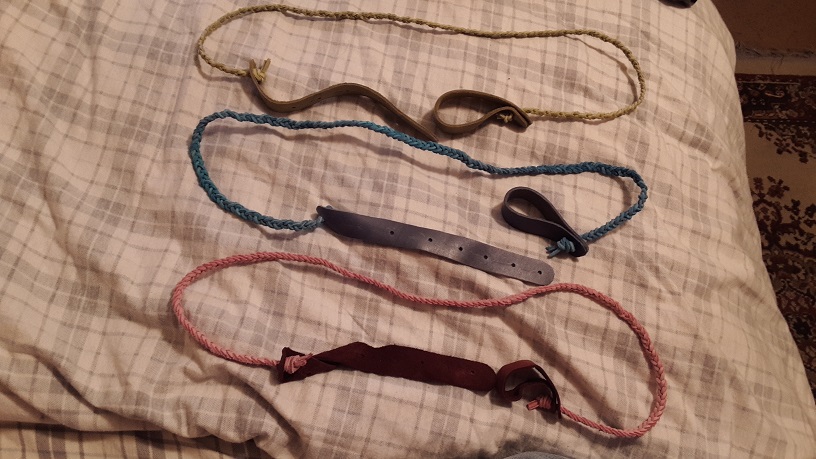
Besides doing some lutherie work, I have also been making braided mandolin straps during the pandemic. I learned to braid from a friend a few years ago, and usually while I am resting up in the evening and watching TV, I like to be a bit industrious by making straps. I started making leather guitar straps a few years back when I was gifted a bunch of nice-sized leather hide pieces. Once that ran out, I started using the leftover scraps and some laces to make mandolin straps. I make them for both A and F models, most are black with a different color ends, but I am making a few pink, blue and green ones. If interested, contact me here and I’ll email you some prices.

This past week I started working on my bluegrass rhythm guitar playing. Man, am I out of shape, musically! Seriously, I forgot how much of a job it is to keep good timing, proper strumming, and make a G run that doesn’t sound lousy, all at the same time! Since I haven’t worked with any band for a number of years, I have used the guitar almost exclusively for songwriting and recording with myself playing all instruments. Now that I’m practicing along with some jam tracks, I recognize what I’ve forgotten and let drift away from my rhythm technique. Lester Flatt and Jimmy Martin knew how important a rhythm guitar was to a bluegrass band, and as phenomenal of a lead player that he was, Tony Rice always stressed the importance of rhythm, and his was like a metronome. Speaking of a metronome, that is what I will be working with for a while.

Well, it looks like the Society for the Preservation of Bluegrass Music in America (SPBGMA) has cancelled this year’s Nashville Convention, which is usually scheduled for the last weekend of January. Yes, it is due to COVID-19, but they are setting the date for 2022 to be January 27-30. Let’s keep our fingers crossed.

One positive note is that the 47th annual Kentucky State Fiddle Championship is scheduled to happen March 20 at the Bluegrass Hall of Fame and Museum in Owensboro. With what little has been available, I am SO tempted to make the trek! Go to https://www.kyfiddler.com/ for more information.

Chew on it and comment.

Categories
Bluegrass Music Coronavirus

Yes, 2020 Sucked!

Yes, 2020 was not a good year for anyone (unless you owned Amazon). I don’t want to lament on it much, so I’ll just go over a few garbage points.

The loss of so many people in the music world. With Tony Rice passing away on Christmas, that was a definite knife to the heart. I will definitely miss him, as I was hoping that by some miracle he would be able to get his strength back and play that D-28 on stage once again.

The COVID-19 pandemic screwing up the lives of so many people. I am on my ninth month of unemployment, and compensation ended last week, so I am turning in pop cans and beer bottles to supplement food costs. In the music world, especially in bluegrass, live shows took a dump. So many bluegrass musicians rely on those live shows, not only for the performance pay but for sales of merchandise. A few musicians that I know had to take on part- and full-time non-music jobs to get by. Others resorted to online concerts with tip jars, Zoom music lessons, and creative alternatives such as selling music-related gifts such as jewelry and pictures. I cannot imagine what the pandemic has done to the other music-related jobs such as studio musicians, audio engineers, and roadies. The year has been a big test for the “blue collar” music workers.

I won’t even get into how our political environment is so divisive.

My hope for 2021 is getting back some more live music (I do miss going to The Ark in Ann Arbor), I can secure a decent job, do more writing (both song and articles), and practice, practice, practice my guitar, bass, mandolin and fiddle. It is an enjoyment and therapy for me. Unfortunately, with spending hours on the computer looking for a job, taking care of my 88-year-old mother, and trying to stay healthy with no access to presecriptions, musical instrument practice falls lower on the list.

Enough griping! It’s New Year’s Eve. Be safe tonight, since the bars are closed, keep the home celebration respectable. With that, I leave you with a holiday message from the beautiful Russian ladies of Beloe Zlato! I love these girls!

Chew on it and comment.

Categories
Bluegrass Guitar Bluegrass Music

Tony Rice RIP

I received the tragic news last night that, on Christmas day, the world lost one of the greatest acoustic guitarists that the industry has ever known. Tony Rice was 69 years old, influenced thousands of artists, and truly defined the role of bluegrass guitar in bluegrass music.

There were others who played the guitar as a lead instrument before Tony. Bill Napier and George Shuffler performed crosspicking on guitar with The Stanley Brothers. Doc Watson gave acoustic lead guitar notice. Clarence White placed lead guitar into a bluegrass band setting. Dan Crary highlighted the bluegrass lead guitarist persona. However, it was Tony Rice that not only defined the role, he gave it an image, and that image was badass cool!

Unlike those before him, who were reproducing fiddle or mandolin lines on acoustic guitar, Tony was creating guitar lines that stood out on their own. There was a lot of pop, rock, and jazz influence in his bluegrass picking, which knocked a lot of traditionalists on their butts, whether they liked it or not. And while he performed in many different bands, one could tell from the first three or four notes that it was a Tony Rice lead.

There are plenty of albums that one could listen to in order to truly understand Toney’s playing. His signature work is definitely Manzanita, which showcases his guitar in a slightly progressive bluegrass setting. To hear what he was initially trying to get across with guitar as a true bluegrass workhorse, secure a copy of the debut self-titled album by J.D. Crowe and the New South on Rounder Records, affectionately known in the bluegrass fold by its issue number, “0044.” In his later years, he did two fantastic guitar-centric bluegrass albums with Peter Rowan as the Rowan & Rice Quartet. He also joined up with a number of other bluegrass stars to record a bunch of albums under the moniker The Bluegrass Album Band. Of course, anything under his own band The Tony Rice Unit should be considered.

While many bluegrassers cite his duet album Skaggs & Rice (with Ricky Skaggs) as his best work with bluegrass guitar and Monroe Brothers style of singing, I prefer the two albums he recorded with Norman Blake. Blake & Rice has some of the best textbook examples of bluegrass guitar lead work, and Blake & Rice 2 should be grabbed if only for the three songs that include Doc Watson performing to create bluegrass guitar powerhouse.

He was also a fantastic soulful baritone singer in the bluegrass vein. His work with Bluegrass Alliance and The New South atone to this. He was an avid fan of Gordon Lightfoot, and recorded many of the folksinger’s songs, either solo or with his family band The Rice Brothers. In 1994 he was diagnosed with muscle tension dysphonia, which put an end to his singing. In an interview I did with him in the early 2000’s, he talked about it, and said that if he were forced to lose one of his two talents, he would rather it be his voice. At his induction into the Bluegrass Hall of Fame in 2013, he lamented on this, and provided a promising result to therapy on his vocal work.

(watch at around 11:30)

He continued to play guitar with Rowan, as well as with Alison Krauss & Union Station and other bands that paid tribute to his work. In 2014, he developed lateral epicondylitis (tennis elbow) which made guitar playing painful. He decided to go into retirement until he could come back and perform as he used to. Unfortunately, that did not come about. However, we are blessed to have so many recordings of his amazing six-string work, and his sound and style will live on through so many young guitarists that were influenced by Tony, whether they realize it or not. You can definitely hear his work in the performing of Billy Strings, Molly Tuttle, Josh Williams, Chris Eldridge, and so many others. One of my favorite photographs of him is when he is in a room with Bill Monroe and he has Monroe play on the famous Clarence White Martin D-28.

If you have any doubts, get on YouTube and search out Tony Rice videos. You will not be disappointed.

Tony, I am truly glad that I got to meet you and speak with you on a few occasions regarding bluegrass guitar and music. You are now with the Angel Band. Take it easy on them with your licks.

Chew on it and comment.

Categories
Bluegrass Music Christmas

Christmas in Luegra Land

Christmas 2020. What a lousy year. Unemployed since April, job prospects suck, and bluegrass shows were practically nonexistent!

Thank God that some of my favorite artists were able to do some performances over the internet. Many thanks to Hawktail, Mile Twelve, April Verch, and my web buddy in Missouri, Jerry Rosa from Rosa String Works! They kept my sanity in place. Festivals were a bust, as well as music conferences, although some were held virtually. Appreciated, but not the same as seeing old friends and networking with new ones face-to-face. Here is Jerry Rosa and his friends doing a bluegrass Christmas jam.

My wish for Christmas (along with world peace, a job, and life back to normal) is to be a better fiddle player, good enough to jam with some people and not sound like a schlep. I try to practice every day, but the last week has been difficult due to getting things taken care of for my mom for the holidays. One thing that I have found myself doing is more research on the history of the violin and fiddle music during the 19th century in America. Interesting stuff that I hope to share in a future blog.

I also need to get back into doing more songwriting. That requires inspiration, and with the pandemic, I haven’t gotten much of that. I need to look harder.

I am not much for the partying and gift-giving with Christmas. I prefer to spend quality time on my own (which upsets the rest of my family). I like to spend time at midnight mass at my church, an old Polish-American Roman Catholic parish where they sing Polish carols (koledy) that echos throughout the building. It is amazing to hear, even if you don’t understand Polish.

I’ll keep this short, so stay safe, and let’s hope for a better 2021. In the meantime, here is the beautiful and talented Sierra Hull, along with the amazing musicians Michael Cleveland and Billy Strings, performing “Santa’s Train.”

Chew on it and comment.

Categories
Bluegrass Music

The Hillbilly Thomists: More Bluegrass-Meets-Catholicism

Remember a few months back when I told you about the Sister Servants of the Eternal Word from Birmingham, Alabama that did a video of them performing the bluegrass standard “I’ll Fly Away”? If not, here’s a link: https://luegra.design.blog/2020/08/07/nuns-performing-bluegrass-and-diversity/.

Anyway, I bring them up again as they were the source for my latest bluegrass discovery. Through their website (https://www.sisterservants.org/) I learned about the Hillbilly Thomists. Taking their name from a comment made by author Flannery O’Connor, the group of Dominican friars, priests and brothers study intensely the writings of St. Thomas Aquinas. However, some of them are also move by the lyrics of many folk and bluegrass gospel songs. Under the guidance of Father Thomas Joseph White, the rotating group of brethren perform on traditional folk and bluegrass instruments (guitar, bass, banjo, mandolin, fiddle), as well as other traditional and ethnic instruments such as drums, piano, bodhran and accordion.

Seeing them on stage, you would think that you were to be serenaded by an age-old Gregorian chant. However, they pick up their stringed instruments and kick into a religious folk standard such as “Leaning On The Everlasting Arms” or “Poor Wayfaring Stranger.” While it may look strange to the eye at first notice, it becomes apparent that these men of Catholic conviction also know how to jam!

YouTube is filled with videos of the Hillbilly Thomists, whether it be live performances or professionally created music videos. What comes across is that they are religious, but they are also human. They like to have fun. They crack jokes, become self-deprecating about their musical skills, and also love to play secular music (one of the many YT vids shows them jamming to “Whiskey In The Jar”). Take away their robes and dress them in suits and ties, and you would think that they were another great-sounding bluegrass band.

However, it is their conviction to the Lord that makes them special. Jesus and his disciples also loved to laugh, sing, and dance. I do believe that God is looking down on the Hillbilly Thomists and smiling, probably even tapping his foot. Catholicism has always gotten a bad rap when it comes to music. The images of friars walking slowly and chanting in Latin seems to many like a depressing drone. Yet if one really takes a step back, the drone can be enlightening, with fluctuations of tones that the heart reacts to.

The Hillbilly Thomists take this a few steps further. They know that music makes people feel better generally. Moreover, the messages that come across in the standard bluegrass gospel songs are ones of hope, not fear. They also show to others that even priests and brothers can have human fun without insulting God. Theirs is a life of devotion to God and Christ, and that devotion can include singing praises in a popular style of music such as bluegrass and folk.

I urge you to check out a few of the Hillbilly Thomists’ videos and, if moved, purchase the album they releases a few years ago (https://www.dominicanajournal.org/music/the-hillbilly-thomists/). It may help you, as Lucinda Williams says, “Get right with God.”

Chew on it and comment.

Categories
Bluegrass Music

Bluegrass Is In The Ear Of The Beholder

I hope that all of the readers are having a safe and peaceful Thanksgiving. I’m putting this blog out a bit early because I’m just sitting around lazily on this holiday. I had AMAZING pie from my friend Nik Sanches who owns Rock City Eatery in midtown Detroit. These pies are works of art. The chocolate pumpkin was pure Heaven. If you are in the Detroit area and want a pie for Christmas that will take you over the top, contact Rock City Eatery at the Facebook page: https://www.facebook.com/rockcityeatery/.

OK, now down to business.

There will always be the continuing argument about “what is bluegrass.” Many will tell you that it isn’t bluegrass unless it has a banjo and upright bass. I will be the first to debate that, as I feel that bluegrass music is not a physical structure, but a structure of the heart and soul. Bluegrass is more about the feeling that it gives the listener, whether it be the lone guitar and vocals of Doc Watson, or a full-blown Flatt & Scruggs type ensemble.

This leads me to my feeling of what is “not” bluegrass, despite the physical structure. For the past dozen years or so, CMH Records out of California (https://www.cmhrecords.com/) has put out a Pickin’ On series of recordings that cover various pop, rock, and country artists and put them in what it feels is a bluegrass format. At this time, CMH has 73 albums offered with this series, and a true bluegrass fans will definitely scratch their heads as to why the record company would waste the time and energy with most of the titles.

The series started with typical choices to cover, such as the Beatles, the Grateful Dead, and Bob Dylan. However, it soon became what seemed to be an obsession. Albums covering Metallica (which became its second biggest seller), Creed (really?), John Mayer (you are kidding?), and Taylor Swift (Jeez, there’s even a volume 2!) have popped up. WTF?!?!? A bluegrass tribute to Swift? Who buys this stuff, let alone listens to it? I never heard any of these cuts when I had Bluegrass Junction on SiriusXM, nor on any of the bluegrass programs that I catch on the radio. In all honesty, it sounds more like a bluegrass ensemble (yes, banjo and upright bass) trying to be hip by showing off that they know all of these tunes.

I’ve punished myself by listening to some of these tracks. About 10% could qualify as palpable bluegrass tunes. The remainder literally sound like bad experiments, or at best, acoustic interpretations of pop songs BUT NOT BLUEGRASS. The following is an example that led to this rant. A few weeks ago, I was on YouTube when this video came up as a recommendation:

A cover of the A-Ha pop hit “Take On Me.” Uh, OK. So it has the same instrumentation as one would find with a bluegrass ensemble. However, where is the theme that most bluegrass songs have (lonesome feeling, mother, coal mines, farming)? Where is either the 2/4 clogging tempo or the 3/4 country waltz? And if you are going to tell me that falsetto at the end of the chorus is the “high lonesome” sound, then I have a bridge in Brooklyn that I would like to sell you. Seriously, if a bluegrass band were to perform this to a traditional bluegrass audience, the best that they would get is stares, if not heckles. On the flip side, most jamgrass audiences would consider it a joke (I could be wrong, but try me).

In short, if one is going to put up the argument of “it ain’t bluegrass unless it has a banjo,” then one can easily offer up that “just because it has a banjo doesn’t automatically make it bluegrass.”

Chew on it and comment.

RIP Hal Ketchum.

Design a site like this with WordPress.com
Get started