Categories
Bluegrass Music Musical Instruments

US-12 Yard Sale 2025/SEMBMA Picnic 2025/Misc.

This weekend was the US-12 Heritage Longest Yard Sale, so I took Friday off from work and did the drive. This year, I started driving west from Dearborn, but as expected, the set-ups really weren’t available until I reached Saline. I went as far as Allen, Michigan and turned around. Of course, I had to hit Randy’s BBQ in Brooklyn, MI for the famous Godzilla Sandwich (Google it!).

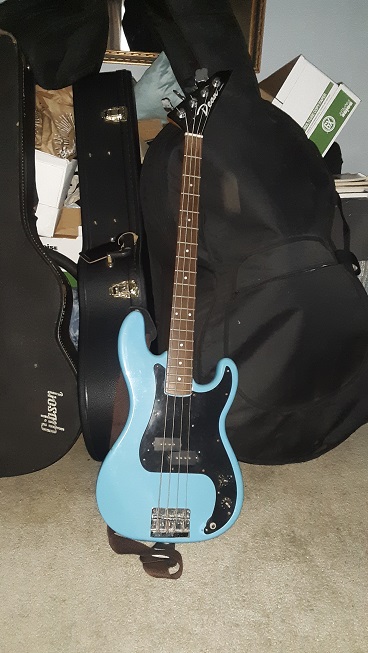
I didn’t get many bargains, as there was not a lot offered as far a music-related stuff. I got a gig bag and an empty Gibson hardshell acoustic guitar case, but the only real bargain (maybe) was a Dean electric bass.

I purchased it on the way back home and didn’t really look at it closely. For what I paid ($60.00), just about any cheap bass would be a decent buy. Once I got it home, I took a better look. The neck, body, and hardware are definitely a Dean model, but it looks like the pickguard and pickup were replaced with a generic setup, which doesn’t properly fit the body. I’ll most likely patch it up in places (like removing some stickers on the back of the body) and sell it off.

The Southeast Michigan Bluegrass Music Association had its annual picnic and Hall of Honor ceremony Saturday. Not much to talk about here, only that we are still in need of young pickers to receive scholarships. Two current recipients showed up for the afternoon jam session, along with a few older members. I have never been much of a jamming enthusiast for myself, but I know how others enjoy it.

I received a nice email from my friend Sister Clare Marie of the Sister Servants of the Eternal Word convent in Alabama (https://luegra.design.blog/2020/08/07/nuns-performing-bluegrass-and-diversity/). It seems that they are in need of some more material. Looks like I need to get finished with some of my incomplete bluegrass gospel songs.

This morning I got the new Billy Strings/Bryan Sutton live CD. I cannot wait to throw it on the player and give a review, which will come probably next week. Also, I got the call that my Cirrus guitar is finished, so I’ll be picking it up next weekend.

Short and sweet for this week, Chew on it and comment.

Categories
Bluegrass Music Musical Instruments

The Music Link Closure: Are Tariffs to Blame?

The big news in the bluegrass instrument field this past week is the closing down of The Music Link Company (https://themusiclink.com/), producers of Recording King guitars and banjos along with Loar mandolins. While this news has not been covered in regular news, and not even much in the music industry news, it has been widely discussed on bluegrass-related chat groups and podcasts.

The company employees were handed their termination papers on July 7, with only a few office staff remaining to clean things up. One of those employees, Greg Rich, helped establish The Music Link in the US while working with instruments coming out of China through the AXL factory. He currently owns the trademark names of Recording King and Loar, and at this time, there is no word on if these brands will continue to be produced.

Recording King and Loar had proved to be quality instruments at generally affordable prices, especially for bluegrass jammers looking for something that can hold up better than beginner acoustic guitars, banjos, and mandolins. I have a Loar Honey Creek F-style mandolin I purchased about a year or so back (https://luegra.design.blog/2024/01/20/so-why-did-i-buy-another-mandolin/) that I totally love because of its warm bite when playing chords. I have played Recording King acoustic guitars and have been impressed for the price going, especially the Dirty 30s line. Basically, these brands were in direct competition with the Blueridge/Bristol guitars and Kentucky mandolins marketed in the US by Saga Music.

While the current tariff war going on between the US and other countries, particularly China, may seem like the main reason for this closing, Rich has stated that it was only the final straw, as poor management through the past decade is mostly to blame. And while tariffs can be to blame for the rising cost of guitars in recent times, it is hardly the main reason, as prices have been rising over the past few years and tariff laws have not fully gone into effect, if at all.

Over the past few years, plenty of brick-and-mortar music stores have closed down for good. Sam Ash is probably the most well-known of this dilemma, with hundreds of mom-and-pop independent stores also closing across the US. There are a lot of factors. During the COVID shutdown earlier in the decade, stores were forced to shutter by local health ordinances, while people being shut in their houses were looking for something to do. Thus, they ordered instruments from the internet, and companies like Wal-Mart and Amazon, as well as music-specific online companies like Sweetwater, flourished. Fender and Gibson soon got into the online-order business (that is how I purchased by Fender Meteora a few months back [https://luegra.design.blog/2025/06/07/the-fender-meteora-has-arrived/]) and have continued this sales process with success, even with the pandemic scare long over. Adding to that, a lot of those sales during COVID are probably being sold on Craigslist or at garage sales because now people are back outside and have lost interest in learning to play a guitar, so the used market is a bit saturated.

Bigger music stores like Guitar Center have had to revamp their sales strategies (https://luegra.design.blog/2025/03/16/guitar-center-times-they-are-a-changin/), and the only smaller music stores to continue tend to be ones that have a great reputation with customer service and repair history. Online companies like Glarry have risen their prices gradually even before the COVID pandemic. When I purchased the GT502 acoustic guitar about five years ago, it was $45.00. Today, the guitar sells for $90.00. All of the company’s products have gone up drastically over the past few years. When I purchased the guitar, the internet was filled with positive reviews of the Glarry products for the price. Now, I rarely see any mention of Glarry in any musical instrument chat groups.

So far, products from Saga Music have not seen too much of a rise in price since the end of the pandemic. That is not to say that they have not become more expensive. I have seen the price of Blueridge acoustic guitars nearly double in the past decade. For example, I purchased a Blueridge BR40 about eight years back new for around $225.00. Today I did a search online, and the cheapest price I could find was $399.00. The more expensive models have seen a similar jump in price. This is most likely why Saga brought in the Bristol brand to try and get the beginner customers.

As for the DIY kits that I have taken an interest in recently, there has been little change in price, although there have been a very slight increase. Moreover, I do not see the big discounts in brands like Glarry and Ktaxon instruments on Amazon that I saw about a year ago. Also, a recent search on Wish.com for “electric bass guitar” produced about one-fourth the results that were there a year ago, and prices jumped about 25%.

So will the tariffs have a big impact in the near future on foreign-made instruments in the near future? Only time will tell. I believe that there will For a feature interview with Rich, go to https://bluegrasstoday.com/greg-rich-talks-banjos-and-the-demise-of-the-music-link/.

Chew on it and comment.

Categories
Bluegrass Music Music Instruction

Bluegrass University in Kentucky for Youth

I caught this article on the Bluegrass Today website a few days ago:

This program at the Leeds Center for the Arts in Winchester, Kentucky is intended to help middle- and high-school students with learning and performing bluegrass music. The program will take place one evening per week, and is headed by Jayd Raines and Zach Combs, two long-time touring bluegrass musicians.

I have not had a chance to fully check out the syllabus or content yet, but it sounds like a fantastic venture. Equal amounts of fun, learning and discipline, and capture teenagers at the most productive age while gitting them away from the iPhones and tablets for at least one evening per week.

For years, I have always wanted to do such a program in my area. Back around 2000, a friend and I found the perfect building to start a non-profit music education program. The building had a sign on the front that read “Americana Music Studio.” The history of the building was that a Polish immigrant couple after World War II moved to the area and converted the building to a studio that the husband would teach piano and violin, while the wife would instruct ballet. There were practice rooms and a small recital room. Eventually, they passed on, their children had no interest in pursuing the work, and the building’s neighborhood began to crumble around it.

It would have been perfect for our idea. Teaching kids folk, bluegrass, and other roots-music, like a miniature Old Town School of Folk in Chicago. Unfortunately, we could not find financial backing, and the building was eventually sold to a medical clinic.

As you may already know, recently I have been working hard with the Southeast Michigan Bluegrass Music Association to reward scholarships to kids aged 12-18 so that they can receive live or online instruction of bluegrass and other roots-oriented music on stringed instruments. However, we are not as fortunate as areas like Kentucky and the Carolinas where bluegrass music is part of life, and young people pick it up naturally. Since the scholarship program started a few years ago, we have really only sponsored about a half dozen kids. While most of those kids have continued to pursue the music, a few have lost interest, just like any other hobby for kids after a while.

As SEMBMA is a non-profit organization, we have to be extremely concerned on how we use the scholarship money. We have received many applicants, but some have been not what we are striving to fund. Once parent asked if we could provide funding so that the child could record a CD. Another requested scholarship help for a student learning electric rock guitar. We have broadened our scope a bit to help interested youngsters by providing instruction in folk and Celtic, but we also have to limit it at a certain point.

I have posted an advertisement for the scholarship on the local Craigslist. The only response that I have gotten in the past few months has been someone who is 35 years old and requesting money. Really? I also post flyers at music stores around town, but the Association gets very few bites.

Last week at the Charlotte Bluegrass Festival on Saturday morning, SEMBMA set up its “petting zoo,” where we put out guitars, banjos, mandolins and dobros for kids to try out. It is great to see young ones picking up instruments and learning an easy chord, then an easy song. While most kids are there as a pseudo babysitting service for parents to drop them off for an hour, one or two kids do take an interest in playing a stringed instrument. With Billy Strings performing on Thursday, it is great to see younger people getting involved in bluegrass music.

But at this time, it seems that we need more. If parents and grandparents are into bluegrass music, they need to show their kids and grandkids how fun bluegrass music really is. Get them off of the iPhones and interacting with other kids face-to-face by jamming together. Show them not only the younger successful artists like Billy Strings, Sierra Hull, and Wyatt Ellis, but some of the rising unknown bluegrass musicians that are all over YouTube. Schools have music programs, but they are dedicated to orchestra and marching band music. A motivated teacher may be smart to start up a Folk and Bluegrass Music Club (similar to a Chess Club or Drama Club), teaching instruments, jamming, and maybe showing videos of bluegrass performances.

I leave you with a video of my favorite 14-year-old fiddler, Hollace Oakes. At this year’s Abingdon Fiddlers Convention in Virginia, she recently took 1st Place in the Adult Old-Time Fiddle competition, 2nd Place in the Adult Bluegrass Fiddle competition, 3rd Place in the Youth Mandolin competition, 3rd Place in the Adult Flatfoot Dance competition, and her band Denim & Plaid won the Youth Band Bluegrass competition. This is what I would love to see with another hundred 14 year olds!

Chew on it and comment.

Categories
Bluegrass Music

Charlotte Bluegrass Festival 2025 Wrap-Up

Wow! What a weekend this has been at the Charlotte Bluegrass Festival. It was memorable to say the least, and in some ways, there are things that I hope never happen again at that festival. Let’s get to the highlights:

Billy Strings – As this was pretty much a last-minute booking on one of Billy’s off days during his tour, he wanted to play at the first festival that he attended when he was four years old. The show was phenomenal. As Billy can read a crowd extremely well, and he knew that the regulars at the festival want to hear to old standards (while the Billy-goats will dance to anything that he plays), the extended set consisted mostly of songs by Bill Monroe, Flatt & Scruggs, the Stanley Brothers, Jimmy Martin, and Larry Sparks. He did throw in a few originals, such as “Dust in a Baggie” and “Red Daisy,” which have a classic bluegrass feel to them. His stepfather Terry Barber came up for a few songs, and Junior Sisk came up to sing a beautiful duet of “Love Me Darlin’, Just Tonight.”

The crowd was twice the size usually found each year at the festival, which meant there was a lot of security, which the regulars are not used to. Add to that we were told the gates would open at 8:00 am, but the couldn’t get in until noon due to the soundcheck. Additionally, the park had let people come in a week early to set up chairs under the pavilion without letting people like me who purchased a three-day pass of that, so we sat in the far-away bleachers or planted lawn chairs ain the mud (yes, it rained all the night before up until noon, so it was like a miniature Woodstock). Moreover, when Billy came on, everyone that was sitting in lawn chairs had to remove them and stand. It was a clusterf**k, to say the least.

While the show was fantastic, it ended on a sad note, as Billy’s mother passed away the next morning. I ask you to keep Billy and his family on your prayers.

Junior Sisk – One of the best traditional bluegrass artists out today. The Billy-goat crowd (by the time Sisk came one, the Billy-goats were crowding the front of the stage) were appreciative of him, whooping and hollering after each song like the older bluegrassers usually do. Sisk put on a great show as well, and the best part was when he announced on stage “If anyone here has a problem with Billy here, they have to talk to me first!”

Red Camel Collective – This is Junior Sisk’s backup band, and play great bluegrass on their own as well. Vocalist Heather Berry Mabe has a wonderful voice, and I recommend anyone looking for a fresh female voice in bluegrass to check her and her band out.

Edgar Loudermilk Band – Another great live band, Loudermilk’s material leans heavily on cowboy and western stories. I have gotten to know him good through the years of playing in the Michigan/Ohio area, though his band is from Georgia, and he loves to talk about fishing, hunting, and songwriting. His parents run the festival merchandise table, selling the special t-shirts for the event, although Billy Strings had his own commemorative shirts for the occasion (I had to snag one, of course).

David Mayfield Parade – What more can I say about this group of fun-loving and talented musicians? From the first time that they appeared at the festival back in 2023, they have been a festival favorite, and never fail to get the crowd motivated. They are also great guys to talk to, and I am glad to be their friend. I implore you to check out the band videos on YouTube, and get some of their CDs or vinyl! The band’s latest album Go Big and Go Home is phenomenal! You will not be disappointed.

Tennessee Bluegrass Band – Old-school bluegrass stylings, to say the least, which the regulars truly appreciate. The band wear matching red sport jackets, which makes them look like the ushers at a church or movie theater. However, their musicianship is excellent to say the least.

Kentucky Just Us – A bunch of younger musicians, I first saw them in January at the SPBGMA conference. While the vocals still needed some strength, the musicianship was wonderful.

Things like extra porta-johns and vendors were brought in because of the expected crowds at Billy’s show, and that was truly appreciated. Wes the promoter of the festival is attempting to book another bigger name bluegrass act for next year, but I have to be honest – I really appreciate the laid-back atmosphere of the previous years. Either way, I will be going next year no matter who is performing. It is my one musical escape from my job in the summer. Of course, with Billy performing, a lot of people were jealous of me.

Chew on it and comment.

Categories
Bluegrass Music

Billy Strings Is At It Again (+ Bluegrass At Work)

Next weekend is the Charlotte Bluegrass Festival, so my blog may be later than usual or shorter, or both. I have enjoyed going to this festival west of Lansing for a few years now, but this year will be extra special.

Last week, there was an announcement that the Thursday evening concert will be headlined by Billy Strings. His touring schedule had a few days gap, and he has stated in a press release that Charlotte was the first bluegrass festival that he ever attended when he was a lad, and that he wanted to perform at it one day. I am not sure if he will be playing solo, with his band, or with his dad. It doesn’t matter, you can guarantee that it will be an amazing show.

Pretty much just hours after the announcement, tickets for the Thursday show were sold out, and the three-day pass sold out soon after. Of course, I purchased my tickets a few months back, so I was safe for getting in. However, I did contact my hotel and reserve Wednesday night as well, mainly so that I can get to the fairgrounds extra early on Thursday to set up my lawn chair.

I have tried talking friends into going to this festival for years, and as expected, no one has followed up. Now a few of them, including my nephew, are asking if there is a possibility of getting tickets. I have to tell them that these festivals are not like other concerts that you can maybe find a scalper to get a ticket from. You buy the pass and get registered online at most of these festivals, and the pass can only be used by you. I expect that with this show, it will be followed even more carefully.

I am sure that next weekend’s blog will be filled with highlights of the festival, especially with Billy’s performance. I apologize that it seems that every other blog has something to do with Billy, but you have to admit, he is in the music news a lot, he is a humble guy, and he has put bluegrass music on the map again, the first time it has been this popular in over 20 years, since the release of the O Brother, Where Art Thou? soundtrack.

In related news …

Two people at where I work are now getting into bluegrass music (sort of), which was quite a surprise to me.

First, my supervisor, who unfortunately just secured a promotion in another city and moved away, was someone who listened mostly to hard rock and metal-oriented rock, as well as bands like Dave Matthews Band. A few days before he left, he asked me if I ever heard of Bela Fleck & The Flecktones. I just about fell off of my chair!

I explained to him that I have been following Bela for decades, as he played banjo in one of my all-time favorite bands, New Grass Revival. He told me that it came up on his Dave Matthews Spotify playlist, and was knocked out by the banjho playing. So I made a suggestion for him to delve into other jamgrass bands like Leftover Salmon, Yonder Mountain String Band, and String Cheese Incident. Well, he can’t seem to get enough of Leftover Salmon, and I followed up with more artists that were early jamgrass purveyors, such as NGR, Tony Rice, and David Grisman.

I told my buddy Ken about this, and his response was, “Well, it’s a start.”

Another co-worker and I were recently talking. She and I both do a lot of woodworking, though mine is lutherie while she builds and refinishes furniture. I told her that I would be on vacation for a few days for the bluegrass festival, and that Billy Strings would be headlining one day. Her response was, “Billy Strings! I love his song ‘Dust In a Baggie’!”

I got right into it, telling her if she’s into his music, she would be into a lot of other bluegrass artists such as Molly Tuttle, Tony Rice, and a few others. She never heard of the other names that I mentioned, so I quickly showed her a short video of Tony Rice performing “Church Street Blues,” and she seemed hooked. The next day I gave her a bunch of duplicate CDs that I had of Alison Krauss, Sam Bush, and the OBWAT soundtrack. We shall see how she reacts. I have invited her a few times to hit local bluegrass shows with me, but while interested, she never seems to follow up. Perhaps when she gets more into the music, she’ll change her mind.

Chew on it and comment.

Categories
Bluegrass Music

Billy Strings Proves He is Cool, …, Again!

The Flatt & Scruggs song “Don’t Get Above Your Raisin’” has a message followed by many in the bluegrass field. Basically, the theme is do not forget where you came from, and do not forget who helped you achieve any success that you have had along the way. Billy Strings proves once again that he is a true follower of this sentiment.

Last September, Strings and his wife Ally were blessed with the birth of a son. Unfortunately, due to immediate health concerns, the infant was placed in the neonatal intensive care unit (NICU) at the Helen DeVos Children’s Hospital in Grand Rapids, Michigan. Through 24-hour monitoring and care, his son gained normal health and was able to leave the hospital after some time.

Last week, to show his appreciation to the staff at the hospital, Strings not only visited the hospital, but also participated in a video for the facility’s music therapy program, as well as performed mini-concerts on each of the floors for the patients, including at the NICU floor.

The video performance is part of the Corwell Health’s Blue Glass Studio program that broadcasts pertinent information related to music therapy. Of course, for this particular video, the name was changed to Blue Grass Studio to honor Strings.

While many entertainment figures take time out of their careers to do charitable acts, most of these actions are usually done on off-time or when the career is in a lull. Billy Strings is at the height of his career, selling out concert venues and working with some of the biggest musical artists in the bluegrass, country, and rock worlds. While his adolescent past has been filled with a number of demons, he has fought them off and offered thanks to the people and prayers that have been there with him.

This incident shows that Strings is grateful for everything good that has happened to him, be it in the music field or his personal life. For that, I continue to have a great respect for him.

For more information on this wonderful hospital visit, including photos, go to https://www.mlive.com/news/2025/05/grammy-winning-billy-strings-pays-visit-to-grand-rapids-childrens-hospital.html .

To conclude, here is a recent interview with Strings about his respect for all of the music that he grew up with. Pardon his French.

Chew on it and comment.

Categories
Bluegrass Fiddle

Farewell to Fiddler Magazine, I Guess

Back in 2012, I wanted to help my friend, fiddler Becky Buller, promote her solo career. I had become aware of Fiddler magazine about a year earlier, grabbing a copy from the rack at Elderly Instruments in Lansing, Michigan. I emailed the editor Mary Larsen if she would be interested in an article on Becky, along with inlcuding my writing resume. Mary got back to me with a request, and it was the start of a decade-long positive relationship with the publication.

I was extremely pleased that the Becky Buller article became the cover story for that issue, and had proceeded to provide an article nearly every quarterly issue since then. While primarily interviewing bluegrass fiddlers, I also produced articles on klezmer, Quebecois, and country music fiddlers, as well as numerous album reviews and survey articles on teaching, instruments, and even handling COVID.

Back in 2022, Mary decided to retire from the editor/publisher end of the publication, and the magazine was purchased by a freelance writer named Narielle Living. The contributing writers of Fiddler were happy that the magazine would continue. Narielle had a strong publishing background, and made the overall look of the magazine receive a more modern appearance. She also had a good business sense when it came to magazine publishing. Unfortunately, Fiddler was meeting the same fate as many other print publications, in that, paper costs and postage were making boutique magazines non profitable, so the decision was made to go online only in 2023.

For some more mainstream publications with a wider scope of readers, online-only magazines can prove survivable, maybe even decently profitable. However, Fiddler was not one of those fortunate ones. The majority readership of Fiddler seemed to prefer print format, particularly since there was tablature for fiddle tunes printed, and it was easy to just put the magazine onto a music stand to practice. Moreover, there is something about print that makes it more comfortable and welcoming to read anywhere at any time, rather than pulling out the laptop, tablet, or iPhone.

It seemed that only one or two online issues of Fiddler were published. I continued to send in my interview and review articles to Narielle. However, by early 2024, I was not seeing any notice in my email inbox that a new issue was being uploaded online. She had updated the magazine website (www.fiddlermag.com/) with cleaner graphics, but nothing to announce the new issue date. Available merchandise consists of different stickers, but no available back issues.

I have attempted to contact Narielle at least a dozen times to get some information on the magazine’s current and future status, but have not received any reply. I have even contacted Mary to see if she has heard anything, but she gets the same non-response. A number of online chatboards dealing with the violin and fiddle have numerous postings about the magazine’s existence, and all answers lead to dead ends.

This is a sad state indeed. I can understand if there is a need to discontinue the publication for any one of a number of reasons, but not providing a statement as to its closure to the contributors and readers is not good. For me, it was an easy outlet for my freelance writing. While the pay vs. time spent interviewing and writing was not that great, it was rewarding to get to know many fiddlers in different genres, as well as keep my writing chops fresh. For readers, this was one of the truly few resources for roots-music fiddlers to learn about the many aspects of fiddling. While there are other magazines that cover roots music in general, and even one or two publications that center on the violin, none covered the subject of fiddling like Fiddler.

This may have been my last opportunity for freelance writing, in particular in the music scene. Fiddler was the perfect outlet for my writing. I will have to re-evaluate my time and commitment to part-time writing, if I should decide to continue. Freelance writing is truly a dog-eat-dog world. Moreover, with print magazines disappearing one by one, online publishing does not provide a steady income, if any income at all. Taking a look at the writing of some online publications, the editorial work is horrendous, and articles look like they were written by a 5th grader.

I so much hate to see Fiddler go, and I keep hoping and praying that this hiatus is temporary, and someone will see how valuable this publication has been to so many fiddlers, both beginners and old-timers, and help to bring it back to life.

Chew on it and comment.

Categories
Bluegrass Music Country Music

Recommended Book: Highways and Heartaches: How Ricky Skaggs, Marty Stuart, and Children of the New South Saved the Soul of Country Music

The 1970s through 1990s were a struggling time for traditional country and bluegrass music. Movies like Urban Cowboy were bringing rock, pop, and even disco influences into the country music vein. It was the start of moving country music stars from honky tonks to arenas, with overdriven guitars and light shows becoming the norm. There were a few sparkles of traditional country lights within the realm, but they were few and far in between. The Grand Ole Opry began to lose its charm, with old stalwarts re-hashing past hits to a senior citizen crowd for nostalgic purposes.

The tail end of the punk/new wave movement did show a lot of respect to the spirits of Hank Williams and Patsy Cline, as well as some near forgotten legends like Johnny Cash, Porter Wagoner, and Loretta Lynn with speed-driven covers and originals that paid musical tribute. However, it would be at least a decade until the fledgling cow-punk and alt-country sub-genres would blossom into what we now know as Americana music.

So during those dry times, there were a few performers that kept the flame going because their hearts were in the right place. Highways and Heartaches: How Ricky Skaggs, Marty Stuart, and Children of the New South Saved the Soul of Country Music provides a decent chronicle of that time by looking at the musical lives of Skaggs, Stuart, and a number of other musicians from that era and group.

The first chapter is a bit too politically correct for my taste, as while it looks at Skaggs’ poor upbringing in Kentucky, it looks at Stuart’s upbringing as being heavily influenced by the racial tensions in his hometown of Philadelphia, Mississippi. While I am sure that there was a lot more bigotry around back in the 1950s, the author Michael Streissguth narrates it as if it was in the blood of every white person in the South. There is way too much coverage of segregation, lynchings, and other racially motivated happenings that have very little to do with the musical influences of Stuart.

Later chapters cover the legacy of Ronald Reagan and the influence of the Moral Majority. Again, it all passes as the author trying to be politically correct and apologetic for being white.

Once the reader gets past that, the flow if the book is quite interesting. Even if you are familiar with both Skaggs’ and Stuarts’ early careers, there are a few things that you may still learn. We all know of Skaggs’ work with Keith Whitley and Ralph Stanley, but there were a lot of inner struggles that he was having to move out on his own, as well as wanting to be known as a serious go-to musician and arranger. For Stuart’s part, his early teen years with Lester Flatt would cement him as a bluegrass prodigy, but the downside is that he really never got to live life as a normal teenager. He spent almost all of that time surrounded by older bluegrass musicians that had their ways of drinking, carousing, and occasional fighting, and his studies were spent in a tour bus instead of a normal high school.

While the gist of the book follows the career of these two modern legends, there is also ample coverage of other artists from that time. These include Jerry Douglas, Emmylou Harris, Larry Cordle, and Linda Ronstadt. Bluegrass coverage includes extensive mentions of J.D. Crowe, Doyle Lawson, the Seldom Scene, and the many festivals that were popping up due to the public’s interest in roots music from both the liberal and conservative teams.

If you can get past the PC talk, this book makes for an interesting read, learning how much Skaggs and Stuart were able to keep traditional country and bluegrass alive during this dark time, and become the highly respected statesmen that they are.

Chew on it and comment.

Categories
Bluegrass Music

Russell Moore Joins AKUS

Unless you are bluegrass fan that has been living under a rock the past few years, you well know that Alison Krauss and Union Station have released its first album in 14 years, Arcadia, and will be touring to support to album, the band’s first tour in over 10 years.

Most of the AKUS member are returning to the fold, including Jerry Douglas on dobro, Barry Bales on bass, and Ron Block on banjo along with Krauss. One big piece of the missing puzzle is guitarist/vocalist Dan Tyminski. After having a solo side project for a number of years, Tyminski has decided to bow out and concentrate on The Dan Tyminski Band full time.

So who could replace Tyminski? After all, it was his voice that made the O Brother, Where Art Thou? soundtrack so successful with his two unique renditions of the bluegrass classic “Man of Constant Sorrow.” For years afterwards, it was mandatory that AKUS perform that song in concert and on numerous television appearances. The song became a staple with bluegrass jam circles, and helped AKUS gain an even larger following of fans not necessarily into bluegrass music.

When I first found out that AKUS was releasing another album and touring, I saw a photo of the band as it is today, and noticed that the one guy did not look like Tyminski. In fact, he looked a lot more like Russell Moore, the guitarist/vocalist for the bluegrass band IIIrd Tyme Out. Reading the accompanying article, I was correct in my thought.

For anyone who is not familiar with Russell Moore, he has been a stalwart in the bluegrass field for decades. He first came onto the notable scene as a member of Doyle Lawson & Quicksilver. He then formed IIIrd Tyme Out in 1991 with former Quicksilver members Ray Deaton and Mike Hartgrove. Since then, the band has earned seven IBMA Vocal Group of the Year Awards, and Moore has won the IBMA Male Vocalist of the Year Award six times. In 2007, as sole remaining original member and long-time head of the band, the name for the group was updated to Russell Moore & IIIrd Tyme Out. If you want to know how good this band is, get one of its live albums, Live at the Mac or Back to the Mac.

So with the opportunity to snag just about any great bluegrass guitarist/vocalist in the format, and there are plenty, why would AKUS choose Moore. My response would be, “Why not?”. Moore is an amazing bluegrass singer, who could easily float between baritone and tenor when needed. While he sang lead exclusively with IIIrd Tyme Out, he also is a genius at harmonizing, learned from his work with Doyle Lawson. He has never really showcased his lead guitar abilities with his band, but from seeing him live (I have, four or five times) he can throw in some tasty licks when required. Mot importantly, as both a band leader and sideman, Moore knows exactly what is needed to make the band sound the best that it can be. He is a workhorse when it comes to personal discipline, and every recording he has been on, as well as every live appearance, he gives it his all.

Will Dan Tyminski be missed? Of course, but all bands in every genre at every level experience personnel changes. AKUS made a wise decision to ask Moore to join the fold. They have already mutually agreed that he will be able to continue work with IIIrd Tyme Out as well. The AKUS tour will continue through early autumn, so while it means intensive touring for the next six months, it also means that all of the AKUS members, including Moore, can bet back to solo projects before the year’s end.

I look forward to seeing AKUS in September when it arrives on the Detroit area. I alo look forward to hear how Moore’s soulful voice will fit in with the band. I am sure that it will sound fantastic as usual.

Chew on it and comment.

Categories
Acoustic Guitars Bluegrass Music

I Ordered a Cirrus Guitar!

I can mark off another item on my bucket list. This morning, I went to the Cirrus Guitars shop and ordered myself an acoustic guitar made to my specifications!

I had blogged about Cirrus Guitars previously (https://luegra.design.blog/2023/10/28/cirrus-guitars/), and have been thinking about getting a guitar from there ever since. With money that could have spent on a bigger TV or some other item that does not really strike my fancy, I love guitars so much that it was what I wanted to treat myself to. I contacted Mike Franks, owner/luthier for Cirrus, a few weeks back, we scheduled a meeting this morning, and I went to the shop in Sterling Heights, Michigan.

Mike was extremely friendly, and was grateful that I paid for the guitar in full rather than just a down payment. The shop is Heaven if you are a guitar enthusiast like me. Acoustic guitars in every stage of construction line the walls and workbenches. He has a special paint booth, and the whole shop is well ventilated and humidified. He also has a room set up for taking photos of his finished guitars, and a space where he holds small house concerts.

The best part of his tour was seeing some of the guitars that he is making for bluegrass artists. One guitar is a special left-handed model under his M.J. Franks brand of guitars for Jamie Johnson of The Grascals. He is also making a custom dreadnaught for John Bryan of The Grascals as well.

He related a great story of how he once heard an Osborne Brothers tune on the radio that moved him deeply, then fast forward two decades, and Joe Miller of Bobby Osborne and the Rocky Top Xpress requested a guitar made for him. When it was finished, Franks took it to Nashville to present it to Miller at the Grand Ole Opry. He was then sitting on stage at the Opry when Miller performed with the band, and had that song dedicated to him that evening.

Franks knows how special bluegrass artists are, not only with the care and concern they have with acoustic instruments, but how much they appreciate the people around them, be they fans, promoters, or luthiers. You can see in all of the work he puts in every guitar that his respect goes equally back to the artist.

My guitar should be ready in about three months, and I am in no big rush. I know that I will fall in love with the guitar, simply because I see the quality work that goes into Cirrus guitars. Franks has stated that I should stop by the shop in a few weeks to see the progress. Despite the rainy weather going on today, the day was fantastic for me!

http://www.cirrusguitars.com/

Chew on it and comment.

Design a site like this with WordPress.com
Get started