Categories
Bluegrass Music Songwriting

More About Songwriting/SPBGMA 2023

A bit of a follow-up from last week.

First off, I did get a 2004 printing of The Songwriter’s and Musician’s Guide to Nashville this morning. Thumbing through it, I can see a lot of updates. They even put in a cartoon-style map of Music Row and which record/publishing companies are in each building. The chapters are set up more as an overview of each aspect for the aspiring songwriter (record companies, publishing houses, management, etc.), then lists the names and addresses. Alas, as the information here is 18 years old, it is mostly outdated again. Looking at the map, I can tell you from my recent years of visiting Nashville that most of Music Row is different. I guess that if one were to follow this book, the best bet would be to search the internet as well to see if there are any address changes, or if the business even still exists.

Even though I am no longer a member of the International Bluegrass Music Association (IBMA), I still get the monthly e-newsletters. This includes the monthly IBMA Songwriter Newsletter put out by the Songwriting Committee. Most of this month’s newsletter is about the songwriting panels at the September World of Bluegrass Conference in Raleigh. I’ve missed it now for about eight years, ever since it moved to Raleigh and now that the IBMA has thrown its hat into the political ring, and I don’t miss it. However, I noticed that they are taking advertisements for the newsletter now, and the one particular company that has an ad this month is called Buy Demo Tracks (www.buydemotracks.com).

This company promotes itself as a stopping place for songwriters to either download or request a recording of a song for a demo, which is uploaded on the site to market to artists. In turn, artists can surf the site for possible songs to record, or even get karaoke-versions of song to sing to for a demo or audition. The three founders of the company are songwriters themselves, and a “staff writer” is Rick Lang, an IBMA board member. I will have to do some more research on this comapny, but at first glance, it is either a great resource for songwriters to get noticed, or another way to get money out of songwriters’ dreams.

No more pussy-footing around for me, I am setting aside the last weekend in January 2023 for the Society for the Preservation of Bluegrass Music of America (SPBGMA) conference in Nashville! I haven’t had a vacation in three years now, and this seems like the perfect get-away to get ready for. I have been wanting to attend for the past few years, but the pandemic and a new job has screwed my time up. No more! I’ll be getting a room at the Sheraton and perhaps spending some time jamming as well as marketing some of my songs. In the meantime, I need to sort out my own demos, perhaps record or re-record some demos, and get back to marketing myself! Anyone out there reading this, let me know if you will be there as well January 26-29. I cannot wait!

Chew on it and comment.

Categories
Bluegrass Music Musical Instruments

Milan Bluegrass Festival 2022: Dave Adkins Tries Out the 2208

Yesterday I spent a few hours at the Milan Bluegrass Festival. This year, the festival was extended to five days. I was planning on attending a few of the days, but because I screwed up my vacation time when I went to work for the law firm for two days, I was only able to go on Saturday. Also, due to family issues, I was only able to stay for the afternoon first sets fo the bands.

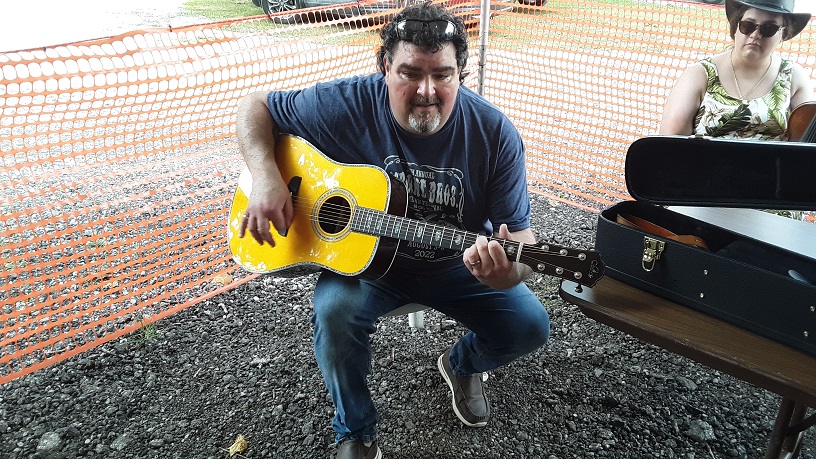
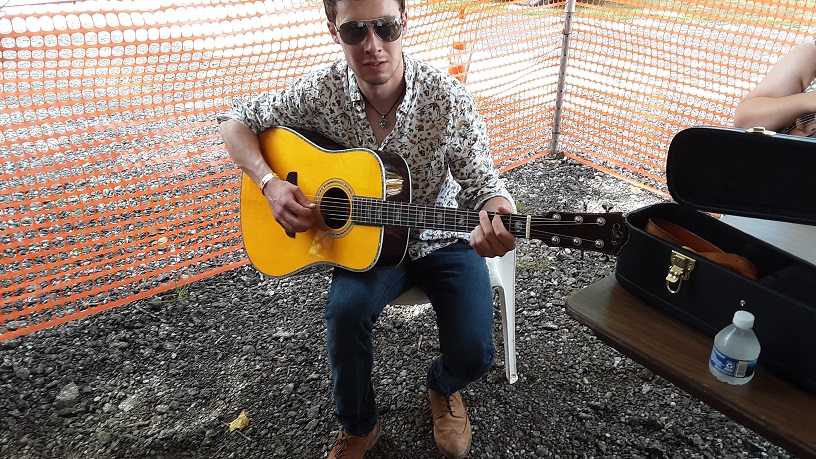
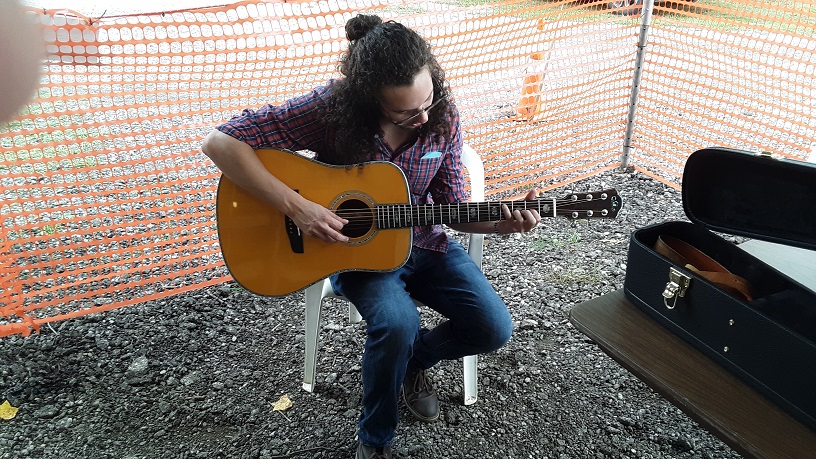
One of the main reasons that I wanted to attend was to meet up with Dave Adkins. He is a great guy, extremely friendly to his fans, and was happy to see me. He and I have worked with some of the same songwriters in the bluegrass field, so we exchanged a few thoughts on the people that we know. I also wanted him to try out the Sevillana 2208 acoustic guitar that was shipped to me a few weeks ago. As far as I know, the one that I have is the first one in the US, so I take pretty good care of it and definitely want to get it test-driven by as many musicians as possible.

Not only Dave, but his mandolin player Ari Silver and banjo player Zackary Vickers (both excellent guitar players in their own rite) took the 2208 for a spin. I was glad to see that all of them truly enjoyed playing the guitar. They loved the loudness (we were picking behind the stage while another band was performing, and you could still hear the 2208 clearly), the weight (which seems a little heavier and more solid than most dreadnoughts), and the craftsmanship that went into the guitar, especially the inlay work. Zackary must have played around with the guitar for at least 15 minutes, he was having a great time with it. Even Dustin Terpenning, banjo player for the band Crandall Creek, asked if he could take it for a spin and loved it as well!

Dave Adkins
Ari Silver
Zackary Vickers

I didn’t get a chance to have the 2208 tried out by any other musicians due to time constraints and band members busy with talking to their fan base. However, I was glad to get Dave and his band members’ feedback, which I will be sending back to Cherry at Deviser Guitars.

Other bands on the stage that afternoon was aforementioned Crandall Creek (sort of a family band persona, although they are not family). Breaking Grass (a very high-energy modern bluegrass band, with a hint of Dave Matthews Band thrown in), Rhonda Vincent and The Rage (always entertaining and good, wholesome traditional bluegrass), and Alex Miller (an American Idol contestant that is starting to make waves in the country music circuit), although I didn’t catch his act and had to leave early.

Milan is your typical bluegrass festival for bluegrass lovers. There’s not a lot of frills, just two sets of music from each band, and the fans appreciate the friendliness of the performers after the shows. I have said it before, one does not get that type of artist/fan interaction from any other music format like one can get from talking with members of a bluegrass band. And so many of them appreciate that you have a respect for them as well. Like bringing in a new guitar to try out, band members love to have their opinions asked for, especially on guitars, banjos and mandolins.

Next week’s blog may be late as well, since I will be heading to Hillsdale on Saturday for the Michigan Old-Time Fiddlers Convention. There is nothing like live music.

Chew on it and comment.

Categories
Americana Music Bluegrass Music Folk Music

Pay Attention to Cary Fridley

I have always had a place in my heart for Cary Fridley. That voice is pure beauty.

I had mentioned Cary previously in a past blog on titled “The Lost Art of Bluegrass Singing” (https://wordpress.com/post/luegra.design.blog/45), where I talked about the video Vocal Techniques for Old-Time Mountain Music that she did for Homespun Tapes. I fell in love with her voice the first time I heard her singing with The Freight Hoppers. After leaving the band, she recorded a number of solo albums as well as played bass in a few other bands. To see her history, I recommend going to her website at https://caryfridleymusic.com/.

I recently found her album Down South and put it in the CD player. It hit me why I love this girl’s voice. It is so pure, comfortable singing folk, bluegrass, traditional country, and blues. Looking at her bio, she works with so many bands, as well as teaching vocals and traditional music theory at the Junior Appalachian Music programs and the Black Mountain Center for the Arts. Additionally, she is an adjunct faculty for the Fine Arts at the AB-Tech College in Asheville, North Carolina. This girl keeps busy!

You can tell it is all because of her love and passion for traditional music. Cary truly puts her heart and soul into her work. I have subscribed to her YouTube channel (https://www.youtube.com/user/cfridley) For a few years now, and along with videos of past performances with The Freight Hoppers, she has posted a number of lessons that she gives to her classes at the college and the JAM programs. Her latest video is what got me to loving her again, so to speak. It consists of a shot of a CD player, and it is playing her album Fare You Well in its entirety (https://www.youtube.com/watch?v=eRRJWDCUsbo&t=366). I wonder how many other people who are this passionate about Appalachian music work as hard as Cary.

I am going to keep this blog short, as I only really want you to spend some time checking out Cary’s videos. You may learn a few things!

Next week, the blog will be late, as I will be attending the last day of the Milan Bluegrass Festival. Hopefully, I will have a few good stories to tell.

Chew on it and comment.

Categories
Bluegrass Music

Missing in Action: The Bill Monroe Docudrama

What ever happened to the making of that Bill Monroe docudrama?

That thought came across my mind a few days ago. If you don’t remember or haven’t ever heard about it, back around 2012, there was in the works a movie that was going to tell the life story of Bill Monroe, based on the book Can’t You Hear Me Callin’ by Richard D. Smith. The film would star Michael Shannon as Monroe, with appearances by Tim Blake Nelson as Lester Flatt and Ricky Skaggs as Uncle Dave Macon. T-Bone Burnett and Ronnie McCoury were picked to head the musical direction, and even Uncle Pen’s fiddle would be featured as an instrument in the soundtrack.

The news was applauded in the bluegrass community, and even a rudimentary trailer was made (of which I cannot find a copy on YouTube or any other website), but just as fast as it was announced, the drawing board disappeared. An article on the Bluegrass Today website in 2019 stated that work was still in progress for the film, but nothing has been heard since from Hollywood.

It seems that a story like Monroe’s is too boring to the masses. That is because very few really know his story. This is a guy who created a style of music that is still viable today, yet was also an adulterer, was prejudiced against younger bluegrass performers (he refused to work on the Nitty Gritty Dirt Band’s Will the Circle Be Unbroken album, which later became one of the best-selling country/bluegrass albums of all time), and had dozens of musicians leave his band for various reasons, but mostly due to his poor payments to them. His relationships, both personal and professional, were the makings of a classic soap opera.

Yet this man is still held in the highest regard in the bluegrass community, like a demigod. I advise anyone to read either the book mentioned above, or one of the many other biographies on Monroe to see what his life was like. Just the story of how his prized Gibson F-5 mandolin was destroyed by an intruder (most likely a past mistress who sought revenge) into a thousand pieces, and the Gibson Guitar factory literally took each toothpick-sized piced and carefully put the instrument back together.

Monroe is just one amazing character from the bluegrass realm that deserves a docudrama made about him. There are so many others whose lives would make a great Hollywood movie:

Doc Watson: He became blind at the age of two, yet he was still able to do chores such as chop wood at his homestead, and tuned pianos on the side. He first played electric guitar in a Western swing band, but was discovered by musicologist Ralph Rinzler, who convinced him to tour the folk circuit playing fiddle tunes on an acoustic guitar. He toured with his son Merle starting in the mid-1960s, and appeared on the above-mentioned NGDB album, which revived his career in the folk and bluegrass communities. His son was killed in a tractor accident in 1985, and he established the world-famous Merlefest music festival two years later. He received seven Grammys, the US National Medal of the Arts, and a doctorate from Berklee College of Music before his death in 2012.

The Carter Family: AP Carter, his wife Sara, and her sister Maybelle (who was married to AP’s brother) began performing together in the mid-1920s. It was their travel to Bristol, Tennessee in 1927 to record for Ralph Peer (who also recorded Jimmie Rodgers at that same session period) that they became legendary. AP would travel the entire Appalachian area to find relevant folk songs that he copyrighted, and the sisters would perform then as a duo, with AP occasionally adding background vocals. Maybelle’s style of “scratch” guitar picking would influence thousands of guitar players in later years. AP’s long time away from home led to Sara having an affair with his cousin, which lead to a 1936 divorce and the dissolving of the band in 1944. Maybelle would continue to perform with her daughters Helen, Anita, and June, would appear on the NGDB album mentioned above, and many of the band’s songs have become staples in bluegrass, country, and Gospel settings.

Dave Evans: An amazing bluegrass singer and banjo player, he performed with a number of popular bands in the 1970s. His life changed dramatically around 1989 when, after an incident involving his son being shot at by some troublemakers, he took the law into his own hands. He was convicted of assault by a court that would not provide him counsel, and served six years of a ten-year sentence. During that time, he gained the respect of his fellow prisoners with his soulful singing and songwriting, and would return to the bluegrass stage upon his release until his death in 2017.

I can think of a few others, such as Roy Lee Centers, Carter Stanley, and Hazel Dickens, that deserve more than just a brief documentary. Hollywood is too much into the cash-cow filmmaking of superhero continuum and fast-and-furious car chasing garage. The docudrama Walk the Line about Johnny Cash was successful enough that it should have motivated more films similar in structure.

I leave you with a clip from a live Dave Evans performance. Dig that voice!

Chew on it and comment.

Categories
Bluegrass Music

Today’s Live Sound Engineering Ain’t What It Used To Be (Or Am I Just Getting Old?)

This past Thursday, my buddy Ken and I went to see Bela Fleck and his My Bluegrass Heart touring band at the Detroit Opera House. Bela is a living legend on the banjo, and his touring band is the cream of the crop as well, with Sierra Hull on mandolin, Michael Cleveland on fiddle, and Bryan Sutton on guitar among others. Special guests who warmed up for the show were dobro master Jerry Douglas and mandolin god Sam Bush.

First, the good parts. Having Douglas and Bush warm up with their respective touring bands was phenomenal! Both are beyond professionals as far as musicians, and know how to talk to their audiences. Bush always looks like he’s having fun on stage, and has no problem making light of bad situations, such as when his fiddle was feeding back too much to play properly. Both he and Douglas were on their game as far as soloing, and their band members were just as supportive.

The same can be said about all of the members in Fleck’s troupe. No screw-ups during solos, and everyone worked with each other. One of the personal highlights for me was when Fleck pulled out John Hartford’s banjo to play on a beautiful song. Anyone who knows me knows that I am a John Hartford fanatic, and his banjo has a very distinctive bassy tone that I have never heard from any other five-string.

Now comes my disappointments with the show:

  • Way too long on a weeknight. I’m getting old, and probably 3/4 of the crowd there was hovering around my age as well. The show started just after 7:30 pm, but Ken and I left at 10:30 barely able to keep our eyes open, so we missed the all-star jam at the end with Douglas and Bush joining the band. Those who stayed surely got their money’s worth, but I just cannot sty up late any more on a weeknight, knowing that I have a rough day at work the next morning.
  • Lousy sound mix. I am not sure that the Detroit Opera House is meant for that type of music. Douglas’ and Bush’s bands were mic’d as well as running direct into either amps or the mixing board. Fleck’s band all just used microphones. Either way, everything sounded muddy and awash. The electric guitar in Douglas’ band sounded like a blanket was covering the amp. When Fleck and his band came on stage, the mix was horrible! It was like the sound engineer did not have a clue. Now granted, Ken and I were in the upper balcony, and it could have been mixed for the main floor seating, but there was no clear distinction between soloists and backup playing. I was watching Sutton and Hull, and both of them had the smarts to back off from the mic when not soloing. Still, it was getting stressful to listen to!

Both Ken and I used to do live sound work for bands years ago, back when you manually adjusted volume and EQ by sliding or turning knobs on a mixing board. Most live shows today use computer tablets to adjust levels, which I have find to be a terrible alternative to the ear. Good sound engineers have certain “touch” to the sliders that work. Moreover, many times I feel that the engineers don’t adjust to the rooms. During a soundcheck, the room is usually empty, save the musicians and engineer. However, once the room fills up for the show, the crowd makes the room acoustics totally different. The bodies soak up a lot of the high end of the sound, and reverberations are a scramble from the main floor to the reflections near the ceiling. I truly think that today’s sound engineers do not study the science of acoustics, and just go for one sound, hoping that nothing feeds back.

My ears got burned out years ago doing live sound, and I quit as soon as I realized that all bands sounded the same to me. I would occasionally help out my friends at Rock City Eatery when they had a band play at their restaurant, but that was as a favor and not as a job. Plus, as Ken commented to me at the show, I do not miss doing the roadie work of winding cables and pulling up duct tape from the stage. I know that live sound engineering is not an easy job, but to be good at it, a person has to study it and practice just like a musician has to practice his/her instrument.

Her is a clip from that show someone in the audience recorded (which, by the way, they asked people not to do).

Chew on it and comment.

Categories
Bluegrass Music

A Look At Bluegrass Jam Tracks

In the arsenal of books, videos, and recordings that I have for practicing guitar, bass, mandolin, and fiddle, I have two CDs that I have used on-and-off for a while. The first, Band In The Pocket! #4: Country/Bluegrass seemed to be an afterthought by the company that put it out (Five Feathers Music), because most of its CDs were geared toward rock musicians. This CD has 10 selections, and they are generic arrangements of tunes ranging from Zydeco to alt-country to Gospel. There is really only one bluegrass selection on this disc – a breakdown backing track in the key of C.

The other disc is a bit more useful. Let’s Jam: 23 Country & Bluegrass Jam-Along Tracks (Watch & Learn Inc.) is more evenly divided between country styles and bluegrass. While the country arrangements are again generic, the bluegrass tracks are songs that are standards in jam sessions, such as “Nine-Pound Hammer,” “Old Joe Clark,” and “John Hardy.” A few of them are presented at two different speeds for beginner and intermediate practice. Unfortunately, I don’t think that this CD is available any more from the company (www.cvls.com) but you may find a copy used through eBay or another source.

I have talked previously about the three bluegrass jam videos available from Pete Wernick’s website (www.drbanjo.com), which are pretty good to follow along. Moreover, YouTube will always have some video that one can jam along with. Along with a number of instructional videos, the Bluegrass Unlimited YouTube channel regularly posts jam tracks of popular bluegrass songs in the most familiar key, and you can control the speed of the video for your own comfort (https://www.youtube.com/channel/UCxNYVomNcDI-5mrOy3KgoHA).

One online resource to check out is GrassTrax (www.grasstrax.com). For each song offered, one can select a recording with a particular instrument removed from the mix, be it guitar, bass, banjo, fiddle, or mandolin. The bundle package will include the selection played at various speeds so that the student can gradually build up playability at the normal speed. While a number of bluegrass standards are offered, there are also some more modern bluegrass songs available, such as “1952 Vincent Black Lightning” and “Wild Horses.” Note that each download of a track will cost $1.99, but if you are on the email list, GrassTrax sends out a monthly free download from a song of its choosing. I have a few of these downloads on my computer, and I guess my only complaint is that the key is not always the same as either the most popular recording by a bluegrass artist or the most common at jam sessions.

Post-pandemic bluegrass jam sessions are not that plentiful. Add to that the cost of gasoline (at the time of this writing, a gallon of regular unleaded fuel is about $5.25 in Michigan), and it is becoming more difficult for bluegrass musicians to get together to jam. These jam recordings are helpful, but nothing beats working with other live musicians to feel the spirit.

Chew on it and comment.

Categories
Bluegrass Music

New Job: No Festival Time

Well, in two weeks I start a new job! It is a job that I have been wanting for probably 20 years. I will be doing what I do best, writing and editing, for a well-known law firm here in the Detroit area. The lawyer that I interviewed with was really impressed with the writing test that I did, so much so that the HR rep called me about two hours later to offer me the job.

Great! However, this means that for the next six months or so, I will not have any vacation time. It’s not like I’ve been able to take any time off for the past two or three years anyway because of COVID. Yeah, I was laid off for nearly a year, but I couldn’t go anywhere. Festivals were cancelled, and no hotels were open if I wanted to travel. The only time that I had off was two weeks in October when I actually had COVID, and I spent 20 hours each day sleeping.

So this summer, I will be missing some festivals that I planned on attending. The Milan Bluegrass Festival this year is a five-day event, and I am hoping that I can at least hit the Saturday shows. I also hope that I can hit the Hillsdale Old Time Fiddlers Convention in mid August for that Saturday. However, that is about it, most likely will be until after Christmas.

Bittersweet indeed. However, I have gotten used to not having vacation time or any time to myself, for that matter. Caring for my 89-year-old mother is a full-time job in itself. I get very little help from my sibling, who is retired and is always on vacation himself. I have stated previously that I am attempting to sell my house and move back to mom’s so that I can take better care of her. I have had very little time to even clean that place up. I still have lots of music equipment to get rid of.

I know that I will never retire, I will most likely work until I am in the grave. However, I would like at least a few days to myself once in a while. My last “vacation” was September 2019, and that was volunteer work at the AmericanaFest. Since then, any day off I have had has been used to do car repairs, doctor’s visits or take mom to her doctor. I just means that I have to look way ahead for restful opportunities and plan accordingly.

As an aside, I appreciate the recent rise in hits both at the Luegra blog site as well as my YouTube channel (https://www.youtube.com/channel/UC0ID9z7AR8-0WWGDM-TrsIA). Your checking in and comments are greatly appreciated.

Chew on it and comment.

Categories
Bluegrass Music Music Programs

SEMBMA Cancels Bluegrass Workshop: What Went Wrong?

Last Sunday, the Southeast Michigan Bluegrass Music Association had its first meeting for 2022. The last meeting was in October, which I could not attend due to having COVID. I had missed providing any input on decisions made during that meeting.

The big decision made at that meeting was to set up and sponsor a workshop for learning bluegrass guitar, banjo, bass, mandolin, fiddle, and singing. The date set was June 10-12, with really only workshops on June 11 and the other days providing jam opportunities. The proceeds would go to the Association’s Scholarship Fund. Cost would be $40.00 for each participant, with a discount for SEMBMA members.

I honestly didn’t find out about the workshop weekend until January (and I am a member as well as on the SEMBMA committee for Scholarships!). So at last week’s meeting, we found out that only five people registered for the workshop. That was less than the number of instructors hired for the event! The workshop would be less than two months away, and there was no word on any more people wanting to register. The person in charge of organizing the workshop stated that she did all that she could to get the word out, sending flyers to music stores and radio stations.

With a unanimous vote, it was decided to cancel the workshop. Some attending wanted to move it to September, while others (myself included) want to hold off for a lot longer until the Association can invest more time and money into the project.

There were a lot of things working against this workshop from the beginning that cancellation was inevitable. The problem is that the coordinator(s) were either too blind to see them, or just did not want to work in order to alleviate them.

Here are some problems as well as possible solutions to making an events such as this workshop more successful:

  • Time allotted to set up and promote the event. In this case, the decision to have the event was eight months until the workshop date. Moreover, the first notices did not come out until January. Talk to anyone that runs a bluegrass event, and they will tell you that they start the planning the day after the last event ends. You need a year to not only follow a structured plan to make the event work, but also time for people to plan to attend.
  • Promotion. The days of sending flyers out or posting them at music stores and expecting a line at the gate on opening day is ancient history. One has to have a strong grasp on social media just to get a message out. Emails are a start, but that has to have a plan, such as sending announcements out on a regular basis so that members and other interested parties get the reminder. These emails should have updates on the event, such as who will be teaching, any special offers, and asking for suggestions from attendees. However, the big blast should be with Facebook, Twitter, and YouTube. I know that SEMBMA has its own YT page, so a video announcing the workshop should have been posted.
  • Money. This coincides with promotion, along with other factors. This is not Field of Dreams, where if you build it, they will come. Much more needs to be done to get the word out, and that costs money. Yes, there are some free outlets such as posting flyers on local bulletin boards, but if you really plan to get people to pay attention, you have to pay for advertising. Local newspapers are a start, but that is a coin toss to see if it will work. Since this is a bluegrass-related event, the advertising is best spent with bluegrass publications such as Bluegrass Unlimited. This goes back to time allotted, as magazines require an ad request months in advance. The thought here is, you get what you pay for. If you don’t spend money, you won’t get great results. Now you may not get great results if you spend a big amount on advertising, but most successful event coordinators know that the first year or two may result in loss of revenue in order to get the word out.
  • Scheduling. Why would you schedule a first-time workshop only a week after a more-established workshop only a two-hour drive away? That being the Midwest Banjo Camp near Lansing, which has been going on for years and has built itself up into a reputable weekend, providing well-known instructors and a well-structured schedule.
  • Personalities. Just who are the teachers that are at the workshop? If I have to pay a fee and you are not telling me who is the instructor, then this guy could know less about the instrument than me! Also, if my kid wants to learn guitar, what is going to motivate me to register and drive an hour or two instead of getting lessons from the local music store 10 minutes away? The truth is, names draw attendees. That is why a lot of bluegrass festivals have workshops and pay artists a little more to be the instructors. Someone is more likely going to attend a workshop with Ronnie McCoury, Molly Tuttle, Sierra Hull, or Darol Anger than Joe Schmoe from the local music store.

SEMBMA is going through a drastic time right now. Current officers are looking to retire, and no one is really volunteering to step up. I currently serve on two committees (the other being the Office Nomination Committee), and it is hectic with the little time that I can spare. Some new, younger blood needs to step in with new ideas. This workshop (and its inevitable cancellation) is just one example of old ideas not working. The issue here is that young people need to know that for bluegrass to survive in certain areas, it needs more than to just learn how to play and instrument and jam.

Chew on it and comment.

Categories
Bluegrass Music

What Is/Isn’t Bluegrass? The Debate Continues

Last week, the online site Bluegrass Today posted a review of the Watchhouse Band performance at The Ark in Ann Arbor (https://bluegrasstoday.com/watchhouse-band-in-ann-arbor-mi/). This ensemble consists of the duo Mandolin Orange along with two additional acoustic guitarists and an upright bassist. While I am not a huge fan of Mandolin Orange, I do like some of their music, and this set-up allows them to do more eclectic material live.

As expected, a recurring debate on what is/isn’t bluegrass started up in the comments section. The Watchhouse Band does not have a banjo in its lineup, so of course, that brought a lot of traditionalists out commenting that the band was not bluegrass and probably should not be featured in a BT article. Others from the opposite end stated that many established bluegrass bands such as the Osborne Brothers and Doyle Lawson have used non-traditional instruments such as electric bass and drums in their recording for a number of years.

I did post one comment within the debate. I stated that while Mandolin Orange was not a bluegrass band by definition, much of their material and sound does pay homage to bluegrass music and artists. I also stated that BT has widened its coverage by including a Grassicana chart (charting artists/recordings that are on the fringe of bluegrass while having some Americana influence), and that the website The Bluegrass Situation covers only about 10% of traditional bluegrass music. One statement that I said that was taken out of context was that I felt that some “uneducated” music people do not fully understand what traditionalists view as bluegrass and simply lump any acoustic band into the bluegrass format. When I put that word into quotes, I meant that there are a lot of people that may not listen to bluegrass as much as the hard-core bluegrass fans, and thus, do not have such a hardline definition of bluegrass (must have banjo, no drums, no electric bass, no piano, etc.).

Of course, there were a few that took that quoted word out of context, and started an even bigger ball rolling. In short, this is an argument that will never have a happy ending, or an ending period! As I said at the end of my comment, “To each his own, I guess.” There are a lot of “beyond the walls” definitions and influences with bluegrass. Doc Watson played amazing flatpicking guitar doing old-time fiddle tunes. He wasn’t bluegrass by narrow definition, but his playing inspired thousands of bluegrass guitarists, and so many times did he perform with bluegrass bands at bluegrass festivals.

There are so many things to consider when defining bluegrass, but one thing that is definite – there is no definite answer. While there are distinctions that definitely do not fit any bluegrass mold, such as a metal band like Metallica or a rap artist like Eminem, the format of bluegrass has a few basic rules and branches out from those according to individual tastes. Some individuals parallel a long stretch, while other individuals break apart early.

Whether it’s Doc performing solo, or a full band playing, my thought is, does it give you a feeling inside that bluegrass music (by traditional definition) always seems to give you? If so, then perhaps it is bluegrass. Or perhaps one can say, “Can you clog to it?”

Check out this backstage performance of Doc jamming with a very young version of award-winning fiddler Michael Cleveland.

Chew on it and comment.

Categories
Bluegrass Music

Roland White RIP

Friday, April 1st saw the passing of one of the true gentlemen of bluegrass. Roland White, mandolin player and teacher for over six decades, died at the age of 83 from the effects of a heart attack from a few days prior. Legendary does not begin to describe Roland, although he was not as observed in the bluegrass scene as other mandolinists in the past few years.

Roland started out in the late 1950s with his family band, including his sister Joanne and brothers Eric and Clarence. Joanne left shortly after formation, and the three soon became The Country Boys. The youngsters performed a number of times on the show Town Hall Party, a country music program broadcast out of California during that time. Through the support of guitar great Joe Maphis, the group changed its name to The Kentucky Colonels, and they became extremely popular in the Los Angeles area. They also appeared on two episodes of The Andy Griffith Show (still as The Country Boys).

Roland joined the service in the early 1960s, during which time Clarence took more instrumental lead roles with the acoustic guitar, and history was soon made on that part. When Roland returned to the band, it recorded the iconic album Appalachian Swing, containing a number of stellar guitar/mandolin lead trades between the two brothers. Bluegrass was losing fan interest by the mid-60s, and Clarence would switch over to electric guitar, playing in Nashville West and later The Byrds. Clarence declined an offer to play guitar for Bill Monroe, so Roland took on the guitarist role in The Blue Grass Boys.

In 1973, the three White boys would reunite as the New Kentucky Colonels with Herb Pedersen and Alan Munde joining. Tragically, after only a few shows, Clarence would be killed by a drunk driver while loading gear into a car, ending this last incarnation of the brothers’ band. Roland would perform briefly with Lester Flatt and the Nashville Grass, then form the influential band Country Gazette with Munde, and remain with that band until 1991. After that, he joined another influential bluegrass band (an one of my personal favorite bands), The Nashville Bluegrass Band. He stayed with NBB until about 2000, at which time he formed The Roland White Band with his wife Diane Bouska.

During these past two decades, his name could be found on a number of bluegrass albums as guest mandolinist, including with Marty Stuart, Clint Black, Bernadette Peters, Ricky Skaggs and Ry Cooder. He also dedicated much of his time to teaching, serving in festival workshops and publishing a number of mandolin lesson books. He never let the public forget about the influential work of his guitarist brother Clarence, publishing a book of guitar transcriptions entitled The Essential Clarence White – Bluegrass Guitar Leads.

Roland was always a welcome sight at Nashville establishments like The Station Inn. When he walked in the room, it was like royalty had just come in. Everyone was in awe of this man, and he was humble enough to appreciate the attention and warm accolades. Whether he was sitting in with a band or just enjoying the show, everyone knew that there was someone special in the room.

I have two wonderful memories of Roland. The first involved a workshop that he was overseeing. A few years back, Roland was visiting relatives in the Detroit area, and scheduled a last-minute workshop at The Ark in Ann Arbor. Word spread quickly, and about 30 people, including me, were in attendance. Roland was extremely friendly and helpful to everyone there, working with many who had just picked up a mandolin only recently. While the workshop turned out to be more for absolute beginners, those of us who had a bit more mandolin experience were grateful to be in the presence of the great man. I was even surprised that Thomas Sneed, mandolinist for The Reeltime Travelers, was sitting next to me soaking in the magic.

My other memory was talking to Roland on the phone for an article on Clarence that I was writing for the now-defunct Bluegrass Now magazine. Roland continually promoted his brother’s guitar work, and was gracious enough to afford me time to talk about Clarence’s work. After that call, we would occasionally email each other (or I would get emails from his wife) updating things going on in Roland’s career. I am blessed with the friendship of country music songwriter extra ordinaire Jim Lauderdale, and have always loved the work that Jim and Roland did when Jim first arrived in Nashville. If you ever get a chance, check out the album Jim Lauderdale and Roland White, recorded in 1979 at Earl Scruggs studio. Also, you MUST secure a copy of Appalachian Swing. It is a true teaching tool for all bluegrass musicians!

Roland will truly be missed, not only for his mandolin work and as a statesman for bluegrass, but for his warm smile and friendly demeanor. He is now playing with The Angel Band.

Chew on it and comment.

Design a site like this with WordPress.com
Get started