Categories
Electric Guitars Lutherie

Shielding an Electric Guitar Body

So after cleaning up the residue from the gigbag on the Ambertone Strat, I let the solvent dry for a few days and the proceeded to put shielding into the body cavity in order to get rid of some of the RF (radio frequency) noise generated by single-coil pickups.

A very short explanation: Just about every electronic device generates RF noise in some way or another. Televisions, appliances, calculators (fun trick – if you have an old working LED calculator, turn on an AM radio, tune it to the lower end frequencies, then hold to calculator next to it and start hitting keys, you should hear some weird noises from the radio), and electric guitars all give off some RF noise. You may hear that 60 Hz buzz through your amp if the amp is not properly grounded. Most guitars with humbucker pickups cancel out much of that hum (along with a quality guitar cord), hence the name. Single-coil pickups do not have the same kind of pickup winding, so the noise is much more apparent, and is why many guitarists like to install a metal cage in the cavity to cancel out much of that noise.

There are two popular ways to shield the cavity. The first is coating the cavity with a conductive paint, available through guitar part supply shops such as Stewart-McDonald. This is a very easy way to do it, just paint the entire cavity, let it dry, and it is done. This method is a bit more expensive, cannot be used on plastic parts, and can be messy if you are not careful with the paintbrush.

The second way is to line the cavity with thin metal strips. Conductive tape is available in copper and aluminum, and the adhesive backing has some conductive quality, so overlapping the pieces will create a continuous contact. I went this route and purchased a roll of Reflectix aluminum tape from Lowe’s for about $5.00. Note, I saw a YouTube video that one luthier shielded a guitar with simple aluminum foil and 3M adhesive spray, which seems a lot cheaper but one has to make sure that there is still conductivity between pieces as the spray adhesive is not conductive. There is also available aluminum sheets, which can cover the entire back of a pickguard, but is harder to mold into the cavity.

If attempting this job, it is wise to detatch the neck from the body, as I tried to do the project with the neck attached but could not remove the pickguard properly due to a lip on the fretboard where it attached to the body. After getting that out of the way, I first shielded the back of the pickguard. Fortunately, there was already some metal shielding on the underside where the controls are installed, so cutting pieces that eventually contacted this shield would mean a good metal cage effect. I covered as much of the pickguard as possible, making sure to keep it away from the wiring so as to not risk shorting.

I followed up with shielding the Strat jack housing, then proceeded to the pickup/wiring cavity. While it may seem like cutting one or two big pieces and molding them in might be easier, it is not. With the many curves and crevices in the cavity, it was better to cut small pieces and pressing in/overlapping each piece. Press the pieces in firmly so that it stays put. In a few spots, I left a lip of foil come over so that it comes in contact with the foil on the pickguard.

After shielding the pickguard and cavity, I checked for conductivity with a multimeter tester. I recommend anyone doing guitar work to get one of these, which small consumer ones can be had for less than $20.00. Besides checking for conductivity, it can be used to check battery and house wall outlet voltage when needed. The entire shielding checked out as solid.

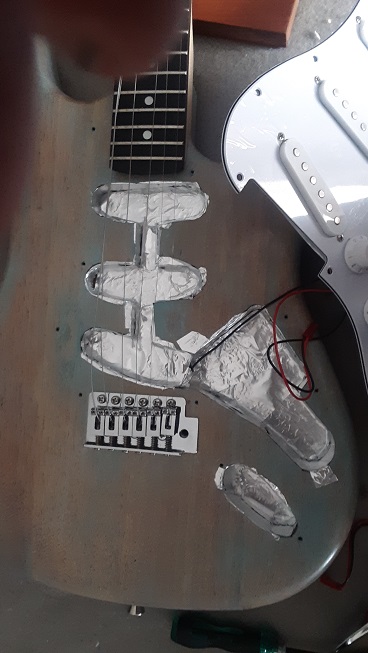
Once finished, I put the guitar back together and tested it out. Dang! No signal at all! It turns out that within the jack housing, the area is so tight that there is a small indentation in the wood for the plug to insert all of the way, and I had covered it with foil, Once I cleaned out that area, I reinstalled the jack and tested it again, this time getting a signal.
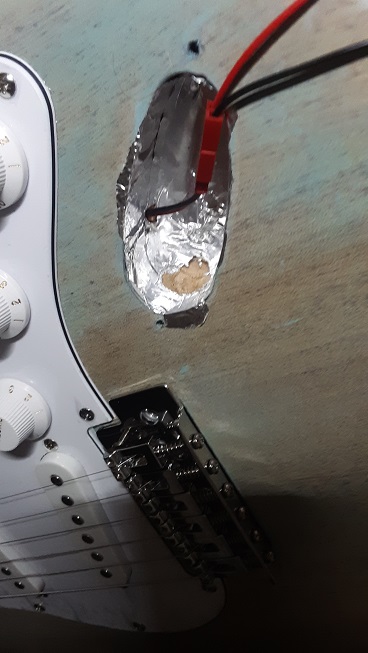
The result? The buzzing hum was cut out probably 80%. Not bad, really. Because the single-coil pickups on this guitar kit were cheaply made in Asia somewhere, they won’t have the same quality output as a Dimarzio, EMG, or even a stock Fender pickup. However, I was happy that most of the RF noise was cut out, and this guitar is definitely playable through any amplifier without much buzz. As far as the roll of aluminum tape, I used only about half of it, so I can shield another guitar when needed. Not bad for $2.50 in supplies and a few hours work while watching football on TV.

If you have an electric guitar that is kicking out RF buzz when plugged into an amp, especially when flourescent lights or other appliances are on, I recommend this inexpensive project to help out. There are plenty of videos on YouTube that show how easy it is to do. If too afraid of taking apart your guitar, a good guitar repairman should have no problem handling it.

Chew on it and comment.
Categories
Electric Guitars

The Fender Meteora Has Arrived!

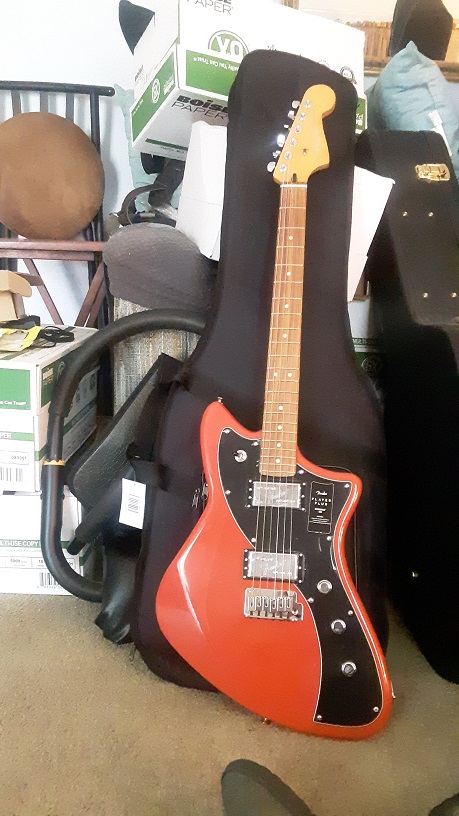
Well, the Fender Meteroa that I ordered directly from the company a few weeks ago finally arrived. I should have been here last week, but FedEx kept making up excuses on the delay.

So let’s get to the guitar. It came with a durable gig bag, which I would expect from Fender, as the Squier line usually does not, unless it’s the higher end models. When I pulled off the wrapping, the high E string was broken, so I had to replace that. It was already factory set up, so the string height and intonation were excellent (although I prefer my string height a bit higher from years of endurance). The neck has a good feel, but the fingerboard is made of Pau Ferro, which looks like rosewood but has a density of maple. I am assuming that it is an inexpensive alternative, as Fender and other guitar manufacturers are using it more often.

The tuning gears are locking, which I have never used before, and can be confusing, but other users tell me that they are great to have. The alder body has that non-traditional shape, sort of a more-radical Jazzmaster style. It gives the overall appearance a longer look, even though it is the standard 25.5-inch scale most Fender guitars carry. One review video on YouTube that I saw states that this is comfortable, but as for me, it will take getting used to after years of playing Stratocasters and Telecasters.

The pickups are Fender exclusive Fireball humbuckers. They have a great sound as-is, but what makes them special is a push-button switch on the volume control (more on that to follow) that changes both humbuckers into single-coils. This gives it a hot Telecaster-like sound when needed. However, I would have liked to see individual coil-tap switches for each pickup to gve even more choice of sounds. The pickup selector switch is a three-way toggle similar to that found on Gibson guitars, and is positioned similar to where it is located on most Les Paul models.

The controls are a bit confusing at first. With three knobs, I would have assumed that it would be two-volume/one tone like that found on a Fender Jazz Bass. Instead, it is configured as one-volume/two tone (one for each pickup). The volume knob has that push-button coil-tap switch built into it, which is flush on top and there is no way of telling if it is on or off unless you are listening to the change through the amplifier.

Finally, the bridge is a six-saddle tremolo found on the modern Stratocasters. I have seen on online discussion groups that some players would have liked to see a Jazzmaster/Jaguar style whammy bar bridge, but in my opinion, those are not as easy to maintain, not as reliable for heavy whammy bar use, and would not bode well with the style of the guitar.

Sound-wise, this guitar has a lot going for it. The pickups in the humbucker settings are high output and clean throughout, although you can get some drive from them when the volume pot is on 10 and the amp being used is set right. In single-coil setting, the bridge pickup has a great bit to it, like a Tele or Strat. One thing that sounds good is that, when adjusting the tone pots to be more bassy, there is no drop in the high-end bite that happens with most passive-wired guitars. Overall, this is a worthwhile Fender guitar, especially for its going rate under $700 direct from Fender.

A little history regarding the Meteora model. It was originally designed in 2011 by Fender designer Josh Hurst. It first appeared as a limited-edition model in the Parallel Universe series. Jim Root of the band Slipknot played one, but it never really received any heavy artist endorsement. In 2018 it was introduced as part of the Player Plus series (made in Mexico), and is also available as the American Ultra II model as well (made in USA).

I have seen talk of either discontinuing the model, or a large overstock, leading to the recent cut in price of the Player Plus models. I would not be surprised with a discontinuing, as I do not see a lot of these being played by well-known artists (I may be out of the loop, though). It probably would have been a big success if it came out 20 years earlier, grunge bands and nerd-rock bands like Weezer would have played them easily. It is a great guitar, but I definitely do not see it as a competitor to the Strats, Teles, or even Les Pauls. Like I mentioned in my blog a few weeks back (https://luegra.design.blog/2025/05/24/fender-meteora-hh-on-sale-this-weekend/), it may go the way of the Marauder or Muiscmaster, and could be more collectible in a decade. I will be honest, I purchased it with that primarily on my mind, as I don’t play electric much at all any more, and have my Strats and other electric guitars to band around instead.

I didn’t do any test-drive video of the guitar, as there are plenty of them on the web. Here are a few of them for viewing

Chew on it and comment.

Categories
Electric Guitars

Fender Meteora HH – On Sale This Weekend!

It’s Memorial Day weekend, so most of my free time is being spent at local cemeteries planting flags at military graves. I just wanted to post a quick note of what I saw and purchased this past week.

Although I am pretty much ingrained in bluegrass and acoustic music these days, I still appreciate the history and sound of the electric guitar. I played electric for 20+ years, and tried my hands at starting a collection years ago that ultimately crashed during my unemployment and recession years. I have sold off much of my collection of electric guitars and amplifiers, but I still keep my eye out for a deal, even if it means keeping it for a while in hopes of increased value.

We come to this past week. I’m on the Fender email list, so every time the company has some type of new edition or sale, I get word of it in my email inbox. Currently, Fender is having a Memorial Day Sale, and I decided to check it out. While most of the guitars are still either out of my price range or not of interest, I came upon the Player Plus Meteora HH for $579.00. Fender started producing these unique guitars about five years ago, and they do not seem to have a big following amongst notable guitarists in any genre. It has a body that looks to be a melding of a Jazzmaster and a Gretsch Thunderbird. Why I didn’t just blow this one off was that it is a Fender guitar made in Mexico, not a Squier product. There are other Meteora models made in Japan that are much more pricey.

The pickup configuration is two humbuckers, similar to what is found on the Telecaster Deluxe model. The pickups have a coil tap with the switches mounted in the volume controls. The pickup selection switch is also like the Tele Deluxe (which is like the Gibson Les Paul), and the controls are two volume pots and one tone pot, similar to a Fender Jazz Bass. The tremolo bridge looks to be similar to the more common Strat type. The fingerboard is made of Pau Ferro, which is a cheaper version of rosewood, and the body is Alder, so the weight is probably less than a Strat or Tele.

Like I said, I haven’t seen any guitarists of nominal fame performing with this model, so it may be why they are selling at an affordable price. Since it is a Fender, there is a quality level that one can expect will be more than satisfactory. As it is not a Telecaster or Stratocaster, or even a Jazzmaster or Jaguar, it may disappear within a few years from production. Looking back on the history of Fender guitars, even failed models such as the Marauder, Coronado, Musicmaster and Swinger are now demanding high resale prices. So who knows? Perhaps these Meteora models will increase in value in a decade due to rarity, or maybe a much-needed endorsement will make them gain value.

I should be receiving my Meteora within the next week, so I hope to do a blog about it when it comes and I have done a test-run on it. In the meantime, If you really want to own a true Fender guitar and cannot fork over the cash for a Strat or Tele, you may want to consider picking up one of these guitars, especially now that it is on sale.

https://www.fender.com/products/player-plus-meteora-hh

Chew on it and comment.

Categories
Electric Guitars Guitar Amplifiers

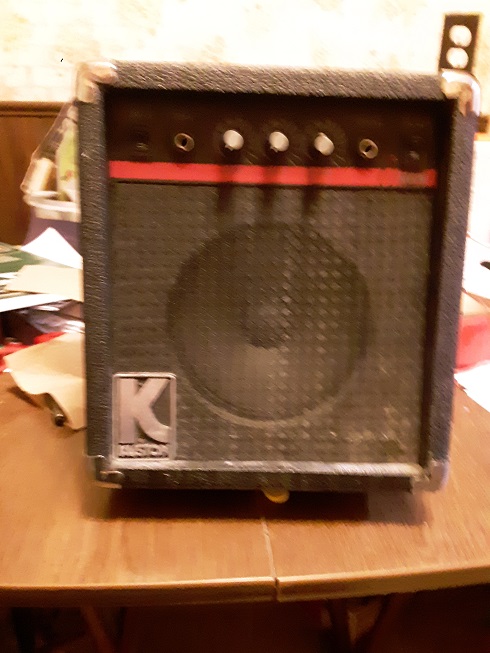
Kustom KLA10 Practice Amp

So this past August when I went to the US 12 Longest Yard Sale (https://luegra.design.blog/2024/08/11/longest-yard-sale-old-time-fiddler-covention-2024/), I mentioned that I picked up a Kustom KLA10 guitar practice amplifier and that I would talk about it in a later blog. Well, here we go!

Small practice amps are aplenty and can be purchased at some reasonable prices. Kustom has always made smaller practice amps since its inception back in the 1960s. For a long period, it was the only thing that they were producing, as its trademark roll-n-tuck padded monster solid-state amps were becoming unpopular. Recently, the company has gone back to making larger amps, even some retro padded ones, but they still mostly produce the small practice varieties.

Kustom has always had a mediocre reputation at best. While the roll-n-tuck models were what every garage band had back in the 60s, they proved to be cumbersome (they were housing large transformers meant for tube amps, using them on the tiny transistor circuits), and the “naugahyde” covering would tear easily. Solid-state circuitry fell from grace during the 70s and never gained much of a following afterwards except for smaller practice amps.

Through the years, Kustom built a number of different smaller amps, usually no more than 20 watts, at cheaper prices than Fender or Marshall could do, so they were popular with beginning musicians (and cost-conscious parents). The KLA10 is probably the most popular practice amp that Kustom has put out for a long time. It has seen different stylings and trim colors, but has remained pretty much the same as far as features and performance.

What you get with this amp is the basics. From left to right on the front panel, there is the Drive switch, input jack, gain control, voice control (a fancy way to say tone control), volume control, headphone jack, LED power indicator, and power switch. The open back exposes the rear of the six-inch speaker, and the power cord is coming out of the circuitry casing. Nothing else, just covered in Tolex and pseudo-chrome corner guards. For the beginning guitarist, it is a fun amp to use. The overdrive/distortion is decent sounding. It’s not Marshall stack or other tube overdrive, but can give a good distorted sound, especially with a humbucker pickup. The headphone output allows playing without disturbing others.

The KLA10, however, is no longer manufactured, replaced by Kustom with the KG1 with very similar specifications and features. The KLA10 can be found on eBay or Reverb for under $40.00. If you can snag one for under $25.00 in good condition, you may want to get it. I will be honest, I picked up mine, with some dirt on the covering, surface rust on the chrome corners, and some scratchy pots, for only $6.00! A little elbow grease and some TV tuner cleaner in the pots should make it sound great. In short, it is a great practice amp, be it headphone or through speaker. Moreover, it will serve as a satisfactory recording amp if using a regular guitar amp proves too loud and disruptive. HINT: Make sure that the guitar is in tune. One string out of tune through a solid-state amp sounds horrible!

Chew on it and comment.

Categories
Electric Guitars Lutherie

Inexpensive Guitar Kits

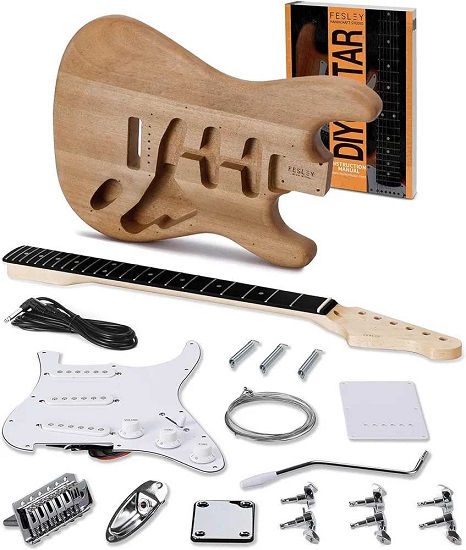
A few weeks ago, I was watching a video from one of my YouTube subscriptions called The Bald Shredder. He is one of the many guitar experts (i.e., nerds) that reviews guitars, amplifiers and effects. This particular video has him reviewing a Strat guitar kit from Fesley, available on Amazon for $89.00.

His opinion was what I figured. For the price, it is a good way for the beginning guitar builder or luthier to learn the basics. The actual finished guitar is in no way comparable to a Fender Custom or other US-manufactured Strat. He had the Amazon link for the kit in his video description, so I took the plunge and ordered one for myself. With shipping and taxes, it came out to just under $100.00.

The kit came in the mail a few days ago, and it was everything that the Bald Shredder stated. All of the parts are there, the neck and the body are both unpainted (there are painted versions of the kit available) with a clear coat on them, so they have a great smoothness to them. The neck back is smoother than a lot of other guitars that I have used. Like the Bald Shredder, I plan to keep the body in its natural clean finish. The grain is nice, nothing outstanding but not fake looking either.

The kit comes with a great manual for assembling the guitar, as the instructions are easy to follow and extremely useful photos. I haven’t started putting the guitar together yet, as I just got it a few days ago and have a lot to get to around the house before this. Maybe during a rainy day or perhaps during the winter when I am forced to stay inside.

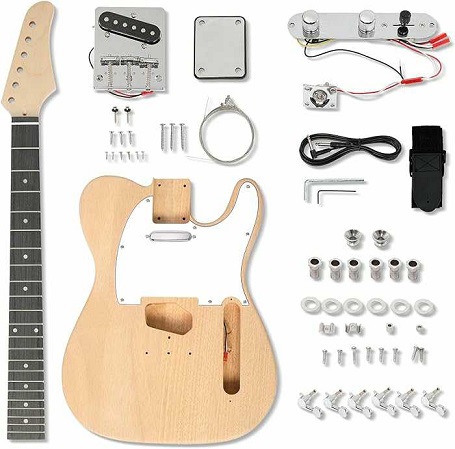
While ordering this kit, I also came across Tele and Strat kits from Ktaxon for $59.99 each. For kicks, I decided to order the Tele kit, which after taxes and shipping came out to a little over $80.00. I found this kit on my porch yesterday (thank God there are no porch pirates in my neighborhood, and luckily I have two larger shrubs that block the view of my porch from the street), and was also what I expected for the money. The body and neck are rough sanded, so will definitely need some final sanding before I do any finishing. The pickguard/neck pickup are already mounted, so that will need to be removed for any body finishing. The instruction manual is practically useless, so fortunately I have some experience with working on electric guitars. It does have everything needed, including a cheap guitar cord and strap.

Again, I don’t plan on working on this kit for a while, and this one I do plan on putting on some finish to the body. Once I get the final sanding in, I may attempt to stain it with a unique transparent color before clear coating. I also need to check out the tuning gears for their quality, as they may need replacing. However, I don’t want to invest too much, as I don’t play electric guitar much (and have better guitars for any time that I do), and am looking at these kits for more lutherie experience than playing.

NOTE: The Fesley kit sold out a few days after I ordered mine and is currently unavailable. If interested, keep checking Amazon for re-stocking. The Ktaxon kits are still available as of this writing.

https://amzn.to/44n3McG

(Sorry, WordPress wouldn’t let me upload the Ktaxon link. Go to Amazon and search “Ktaxon Guitar Kit TL”. I’ve also seen this kit on eBay.)

Chew on it and comment.

Design a site like this with WordPress.com
Get started