Categories
Guitars Rock Music

Steve Cropper RIP

On December 3rd, one of the coolest rock and R&B musicians passed away. Steve Cropper was was 84, but he gave the music world enough joy to come from four or five lives. He was a guitarist, songwriter, and producer during a time when pop music was exploding in the 1960s, and his stamp can still be heard in the grooves of modern performances.

My first experience (as well as many others) was seeing and hearing him play guitar with John Belushi and Dan Ackroyd in the Blues Brothers Band. When they were forming the band originally as a skit for Saturday Night Live, Belushi wanted to have the best available R&B studio musicians to re-establish that original powerful sound. Thus, he nabbed Cropper and bassist Duck Dunn, who were two of the most stable musicians from the Stax Records studio.

After hearing the band’s version, I sought out the original version performed by Sam &Dave. Belushi even copied the “play it, Steve” shout to Cropper that’s on the original. That Sam & Dave song got me to look more into Stax artists, and with Otis Redding, Wilson Pickett, Rufus Thomas and others, Cropper laid down the guitar tracks on almost all of them.

Cropper, along with Dunn, Al Jackson, and Booker T. Jones, made up the instrumental supergroup Booker T and the MG’s, which not only served as the basic Stax studio band, but also had a number of instrumental hits, including, “Green Onions” and “Time is Tight.” They also worked with the Memphis Horns as the moniker the Mar-Keys. Cropper was so influential during the mid-1960s that the Beatles wanted to record with him in Memphis at the Stax studio. Unfortunately, manager Brian Epstein put a halt to that due to security reasons. Ringo Starr would have Cropper appear on a number of his solo albums during the 1970s.

Besides his guitar skills, Cropper was also a prolific songwriter. His best-known writes and co-writes include Eddie Floyd’s “Knock on Wood,” Wilson Pickett’s “In the Midnight Hour,” and Otis Redding’s “(Sittin’ on) the Dock of the Bay” (which also includes some of the most beautiful guitar licks Cropper ever performed).

Stax was highly influential, as it was one of the few record companies that had both black and white musicians working together to create a unique R&B sound. Unfortunately, by the end of the 60s, tensions grew within the organization, and in 1970 Cropper had left Stax to open his own TMI Studios in Memphis. There he would work with Starr, Rod Stewart, and Jeff Beck among others.

In 1975, Cropper moved to Los Angles for continued studio work, and was in the works to re-form Booker T and the MG’s until drummer Jackson was murdered. In 1978 he and Dunn would work with Levon Helm. This soon led to the duo becoming members of the Blues Brothers Band, and appearing in the two films (The Blues Brothers and Blues Brothers 2000, playing themselves).

In 1992, Booker T and the MG’s were inducted into the Rock & Roll Hall of Fame, and Cropper would then tour with Bob Dylan for Dylan’s 30th Anniversary Tour. In 1996, Mojo Magazine named him ‘the greatest living guitar player. Keith Richards was quoted as saying that Cropper was “Perfect, Man!” In 1998, Cropper made a video autobiography entitled The Interview – Play It, Steve! In 2004, he and Dunn worked with Eric Clapton at the Crossroads Guitar Festival in Dallas. The following year, he was inducted into the Songwriters Hall of Fame.

Over the following two decades, Cropper would continue to produce albums for other artists and perform live. At this time, the cause of his death is unknown, but the music world had definitely lost one of its star performers.

For any musician, especially guitarists, wanting to know how to perfectly blend rock, blues, country and R&B, I implore you to seek out recordings that Cropper was on, most notably his guitar work on those early Stax sessions., He was one of the few guitarist to take the Fender Telecaster beyond its twangy country roots and give it an all-encompassing sound. He will surely be missed, but he has left us a truckload of music to enjoy and learn from.

Chew on it and comment.

Categories
Christmas Guitars

My Christmas Gift to Myself

I hope that everyone had a wonderful Christmas and will have a safe and pleasant New Year. This was my first Christmas alone, as mom passed away last January and I was not in the mood to spend the day with anyone. I basically sat home, did a little writing, and watched some football games.

I did, however, buy myself a Christmas present. Since I had no one to spend some money on, I decided to spend it on myself. I didn’t want to break the bank, but I did want to get myself something that I would enjoy. About two weeks before Christmas, Fender had an online sale for a few of its guitars at 40% off. I looked at the list, and saw that there was a Squier Affinity Stratocaster, regularly $249.99, going on sale for $149.99!

Now, I haven’t played much electric guitar in the past 10 years or so, and have been selling off a lot of my unused equipment, including guitar amplifiers. I have two electric guitars left in my collection (a 70s-era Guild Starfire hollowbody and a 90s-era made-in-Mexico Fender Strat that was my workhorse during my final electric band days). The Affinity series for Squier/Fender used to be the low-budget line back in the 90s. I had an Affinity Telecaster from that period that was OK at best, as the tuners and bridge/saddles were cheap and the body was cheap plywood with hollowed out cavities that were filled with styrofoam. I paid about $100.00 new for it and junked/modified it for a few years until I sold it off with my house cleaning. However, the Affinity series seems to have been upgraded by Fender, with its Sonic series being the new lower-cost series.

The Affinity Strat looked to be a bargain for the price, and they had it available in a cool Surf Green color. Total cost was $158.99, and it came via US Postal to my PO Box in a little over a week.

I have to say that I am really impressed with the workmanship. Yeah, it’s made in China, so that probably has a lot to do with the lower cost. The body is solid and has some heft to it. The hardware is good, and the pickups are typical Strat sounding — not hot but not weak either. The neck has a matte finish to the back of it, which needs a buffing with some OOOO steel wool to smooth it out a bit. The fingerboard looks like rosewood, but is Indian Laurel, most likely a cheaper wood that the Asian market uses on mass-produced guitars.

I have always loved the sound of a Stratocaster, especially that switch position of neck/middle or middle/bridge pickup selection. It’s a glassy tone that Stevie Ray Vaughan used so well (although he had some hot-rodded pickups). Plus, I always enjoyed playing around with surf instrumentals by The Ventures and Dick Dale. I haven’t tried out the tremolo bar yet. The bridge looks a bit different from other Strat whammy bar systems, so I hope that it doesn’t crap out after a few bends.

All in all, it is a really good guitar for the price. Checking the Fender website, this guitar is on sale again at 20% off, or $199.99, until supplies last (https://www.fender.com/en-US/8-days-deals/affinity-series-stratocaster/0378000557.html). That leads me to believe that they may be getting rid of either this model or the Affinity series completely. So I would recommend that, if you are looking for a solid beginner electric guitar, or a reliable backup, you order this model while you can. It is backed by Fender, so it does have some good reputation.

Chew on it and comment.

Categories
Guitars Music Therapy

Three Items Tested for the Arthritic Guitarist Hand

A few weeks back, I blogged about working on my rhythm guitar skills for jamming at the upcoming SPBGMA conference (https://luegra.design.blog/2023/11/11/1255/). I also briefly mentioned that I am feeling slight arthritic pain in my left index finger (the hand that I fret with on guitar). I have tried putting pain-relief creams on the finger, but they are either too messy or just don’t work.

So the next step for me was trying some light therapy at home and at work. I purchased the following three items to see how well they would help.

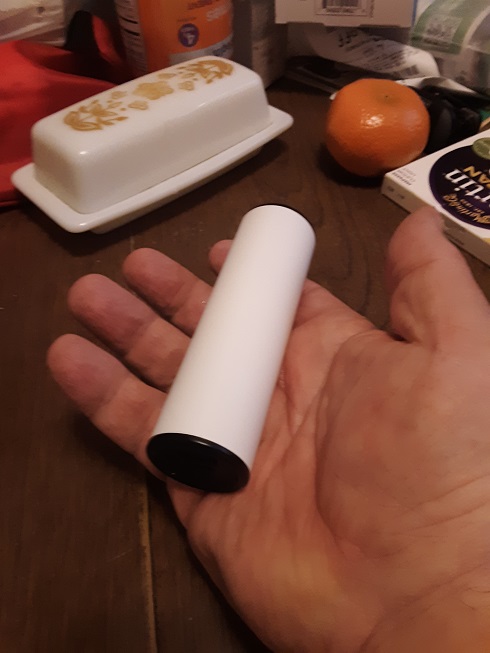
The first is a small, rechargeable hand warmer. I picked it up through Amazon for about $10.00. It is about the size of the roller on a toilet paper dispenser and is charged through a USB connection, either with your computer or an AC outlet adapter. It took a while to first charge it up, and because it is manufactured in some foreign country, the English directions for using, charging, and storing it made absolutely no sense. Once I figured the thing out, it proved to be quite useful. It has three heat settings, which you control by pushing a small button that is embedded into the end. Good luck at controlling it if you have fat fingers. You can see what settings are on by the small LED light next to the switch (which also has the USB port there). Anyway, the low (blue) and medium (green) settings are great, but the high (red) setting is almost too hot to touch. While it seems to be designed to be gripped by the whole hand, I roll the warmer on my finger for a few minutes for fast temporary relief. It re-charges pretty quickly (the heat lasts for about three hours), and can also be used to charge up a low-battery cell phone. People at my workplace have seen it and ordered it for themselves. Overall, a good purchase.

Next, we have the Musician’s Practice Glove, which advertised as being a therapeutic glove for arthritis. It looked to be sort of like the compression socks that I wear for my diabetes condition, but for the hand. Once I put it on, I knew that it was next to useless. While there is a small amount of compression around the palm of the hand, the fingers are loose, and there is stitching at the finger tips. So, trying to press your fingers on the fretboard is troublesome. If you form a chord with your fingers, the cloth on the glove tends to muffle any open strings next to that finger. Moreover, forget any type of solo fingering, as you have to press down even harder to not muffle the plucked string. I think that I paid about $8.00 for this through Amazon, and I would advise anyone to pass on this product.

Lastly, there are the Copper Fit Hand Relief Gloves. I picked up these at the local CVS Pharmacy using a coupon. They regularly go for about $20.00, but I paid about $15.00. These are compression-style gloves that fit tight all along the hand and fingers, while leaving the fingertips bare. The palm area has a rubberized grip to it for non-slipping. These are not designed with the guitarist in mind, of course. Trying to move your fretting hand along the back of the neck smoothly is impossible. However, they do feel good for compressing on my hands and fingers. The recommendation is to wear these for 6-8 hours. My hands are always doing something messy either at work or home, so I put these gloves on before I go to bed and remove them when I wake up. I do notice that my finger does feel better in the morning, so this was a good purchase as well.

I also have been doing some hand and finger exercises for temporary relief from the pain. My advice is that, if you are still young and playing guitar, check with a doctor on how to remain nimble for the longest time possible.

Chew on it and comment.

Categories
Guitars

Good Ol’ Headphone Amps

A few weeks ago, while continuing to clean out my house, I came across a brand-new, unopened package of an AmPlug Vox Lead headphone amplifier. It looks like a miniature version of a classic Vox amp head from the Beatles days, with a 1/4-inch plug that you can connect to your guitar. I am not sure how I got it, probably as a birthday or Christmas present. I never used it, and it was sitting in that drawer for probably five or so years. Since it is brand-new, I decided to just sell it on Craigslist.

About that same time, I was at a local electronics/radio swap meet and came across two headphone amps for a couple of bucks apiece. I snagged them up, more out of curiosity than necessity.

This got me to thinking about my personal love and history of guitar headphone amps. Back when I first started playing electric bass in the mid 1980s, I was also becoming fascinated with electronics, specifically with music circuits such as special effects. The internet was still in its infancy, so learning about music electronics was limited to books in the library and special editions of magazines like Popular Electronics putting out yearly supplements such as 99 Easy Electronic Projects, which may have one or two music-related circuits such as a transistor preamp or a rudimentary fuzz box.

Dear old Radio Shack was a great source for parts, and actually had a few do-it-yourself electronics kits that were geared to musicians. One was a drum machine, and another was a reverb unit. I remember the IC chip for the reverb unit was sold separately and cost about $40.00 at that time. I did save up a bunch of money at that time and built one, but the results were lackluster. Radio Shack ended up selling a pre-made one soon after, designed for audiophiles to connect through the stereo.

One Radio Shack kit that was popular was a headphone amp. It didn’t require a lot of parts, it was monophonic (not stereo), and cost about $30.00 for all parts. The IC chip was a common one known as LM386. These are still readily available through various electronics surplus shops on the internet, and a schematic for a headphone amp using the LM386 can easily be found online. I have probably built a dozen of these amps for myself and friends throughout the years.

As time has gone on, electronics costs have dropped considerably. So much that it is a lot cheaper to buy a headphone amp from an online source than it is to locate all of the parts and build it yourself. Last year, Fender introduced the Mustang Micro Headphone Amp, which has way too many bells and whistles for me. It charges up instead of using batteries, has Bluetooth compatibility, includes a dozen amp setting and 13 effects choices, and can be plugged into a computer for recording or additional tone shaping. It goes for about $120.00 on Sweetwater. Personally, I am fine with a basic headphone amp to practice with and not disturb the neighbors, and use the saved cash for other things. See what Landon Bailey has to say about it.

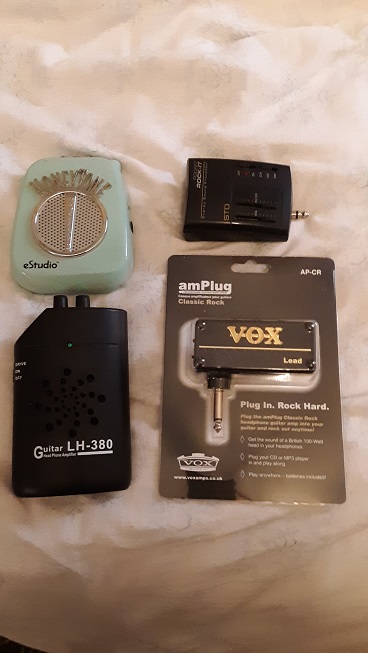
I will take a look at three of the headphone amps that I have on-hand, the two that I got at the swap meet and one that I got about a year or so back when I was talking about bluegrass bass guitar.

First up is the eStudio E-15 Danelectro Honeytone Headphone Amp. This was built to look like the earlier-produced N-10 Mini Amp. While the N-10 had a small speaker and was a small tabletop affair, the E-15 is even smaller, has a similar speaker grille but no speaker, and clips to your belt. It has the normal 1/4-inch guitar input jack and 1/8-inch stereo out headphone jack, along with a useful 1/4-inch out jack for plugging either into a bigger amp to use as a pre-amp or directly into a mixer/recording device. It operates either on a 9-volt battery or connects to a wall-wart transformer. There is a LED power indicator and three push-button switches for power, echo, and distortion. On the side are the volume and distortion level controls. The one I have is seafoam green, and I am aware that there were a few other colors. It has that typical Danelectro flavor to it. The distortion is pretty basic and ratty sounding, and the echo is nothing spectacular. This is a decent headphone amp that if you can pick up used for under $10.00, grab it.

The other headphone amp that I got at the swap meet is a Pocket Rock-it Stereo Sound Processor STD model from CB Labs Inc. About the size of a cigarette pack, I was really impressed with this one. On the back is a 1/4-inch plug that rotates so it can plug into just about any guitar jack at any angle. It has 1/8-inch jacks for headphones as well as an auxiliary jack for plugging in a CD or MP3 player. It uses a 9-volt battery but no power adaptor jack. Controls include the LED indicator, on/off slide switch, a three-way slide switch for clean/distortion/PRX (not sure what it stands for, but it is a shredding distortion sound), and volume and tone filter sliders. What impressed me the most on this one is the distortion sound. Through headphones, this is a killer sound, not ratty at all. Somehow the company created a circuit that makes it sound like a well-driven 100-watt amplifier through the headphones! I am seeing these go for anywhere from $15.00 to $65.00 used online. The one that I have is black, and I have seen some in a gray-metal look and different design. I highly recommend this one if only for the distortion sound, and if you can wire up some sort of adaptor from the headphone output to a line-in to a mixer or recorder for recording purposes, you will not be disappointed.

Finally, there is the Lisheng LH-380 Guitar Headphone Amplifier. I mentioned this one a while back on my blog regarding using a small headphone amp while learning bluegrass bass guitar (https://luegra.design.blog/2020/02/03/bluegrass-bass-part-2/). This one has the belt clip, LED indicator, 1/4-inch input jack, 1/8-inch headphone jack, volume and tone controls, and an off/on/distortion switch. The distortion is passable, but not controllable. This one has a small speaker built in, so you can actually use it as a mini amp, but don’t expect cranking volume. It seems to poorly distort the speaker at half-volume, and in the Distortion mode, it is cringe-worthy. I got this one for about $20.00 off of eBay I believe, and that is about how much it is worth, maybe a few bucks more.

Headphone amps were a lot more valued before the days of software that allowed you to plug into your laptop computer. Building them taught me a lot about electronics, but the field moved way too fast for me to keep up. Perhaps in a future blog I may talk about other special effects pedals that I built for my guitar and bass.

Chew on it and comment.

Categories
Guitars

Guitar Pick Punch: Yes or No?

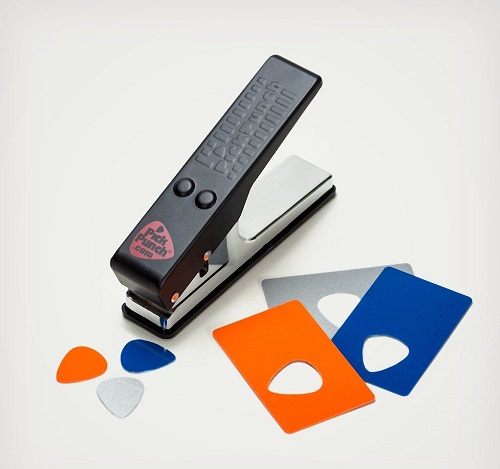
A few years back at a previous job, my boss gave me a guitar pick punch for Christmas. I always thought that it was a unique item, but never would have bought one for myself. It is only recently I have realized how handy this thing is!

If you are not familiar with it, the guitar pick punch looks a lot like a desk stapler. You take old credit cards and expired gift cards, place them in the punch, and Voila! You have instant guitar picks! With practice and a good aim, one can get four picks out of a normal-sized credit card.

About a year ago, I posted a blog related to this. The guys at Casino Guitars had stated that the guitar pick punch was a terrible Christmas gift, and I disagreed with them (https://luegra.design.blog/2022/02/19/musicians-gifts-from-non-musicians/). At the time, I said that you can use it to make guitar picks to give to moochers while you keep your good ones for yourself. Well, I am now learning that these homemade picks are a lot more valuable.

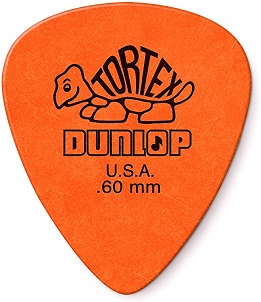
I recently went into a Guitar center to pick up some Tortex guitar picks. My personal choice for playing are the orange .60 mm standard picks (you know, the ones that are shaped like Joe Scarborough’s head).

Anyway, they used to cost about $3.00 for a dozen. Well, now they are over twice that price! Even on a bargain place like Sweetwater, they are going for $5.49 for a dozen. Paying almost 50 cents for a piece of plastic? That is out of line, in my opinion.

So the guitar pick punch will be resorted to a lot more these days. Think about it:

  • Cost effective. You get four picks off of one expired credit card. A quick sand-down of the edges once punched out, and you have saved yourself almost $2.00!
  • Environmentally friendly. You throw a bunch of credit cards and gift cards into landfills, and they just sit there. After punching out picks from them you are recycling over half of that plastic!
  • Endless supply. I have about five or six tobacco dip tins full of homemade picks. I realize now that I will probably never need to buy another guitar pick (that Tortex pack will probably stay unopened for a while).

Of course, every guitarist has his/her preference for pick thickness. Credit cards seem to be a close thickness to those orange Tortex picks, and thinner gift cards tend to reflect the red Tortex (which I use with my mandolin). The purple heavy 1.0 mm Tortex picks that I use with bass guitar will probably still be purchased, since I don’t see much credit cards that thick, and I don’t think that the punch can handle that thickness.

These punches go for about $25.00 at various online shops like Amazon or Sweetwater. Guitar picks are items that always seem to get lost along the way, and you end up needing more at the end of a gig or practice. Why not save yourself some cash in the long run and help out the environment? I leave you with this guy’s view of the guitar pick punch.

Chew on it and comment.