Categories
Home Recording Lutherie Songwriting

My 2025 in Review

Taking a look back at 2025, there are a few things that I learned about what I do related to music, both positive and negative. Here are some thoughts:

Freelance writing – I pretty much confirmed earlier this year that my last regular freelance writing gig dissolved. Fiddler Magazine hasn’t published online in over a year, and the print version left us about two years ago. I still have not heard back from the editor/publisher regarding what has happened, and I received a Christmas card form the former editor Mary Larsen checking in, which I truly appreciated. I am not sure how much more I will keep freelancing, as it is extremely difficult to find paying gigs thanks to AI. So many publications are folding, going online, or just keep their few contributing writers on. I loved writing, interviewing artists, reviewing releases, and networking. However, that outlet is drying up fast, and there is little motivation to pursue it further. This blog will at least keep my writing chops up.

Cirrus Guitars – After 40+ years of playing guitar, bass, and a few other instruments as a hobby and live on stage, it was exciting to have a guitar specially built for me. While my specifications were not elaborate, I loved the fact that it was my choice of what went into that acoustic guitar. The wait of three months was well worth it. Mike Frank at Cirrus was such a great person to work with, keeping me updated on the progress. My Martin D-28 is still my wife, but playing the shorter-scale Cirrus acoustic has got me playing bluegrass flatpicking leads a little easier.
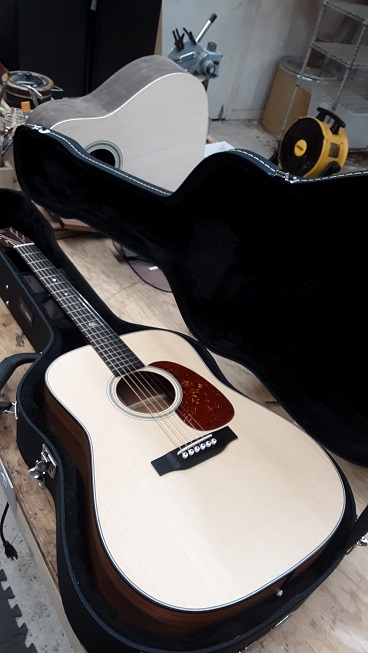
Lutherie – While I’ve always done a lot of basic maintenance on my guitars, and have done simple modifications throughout the years, this year, I did a lot more hands-on work with repairs and building. It started with a major repair to a mandolin late last year that worked out well, and now getting DIY guitar kits that I could finish on my own. My first kit taught me a lot, especially with finishes and knowing that it takes a lot of time to get a good look. I have a few more kits that I got good deals on, including a P-bass kit that I plan to do a pickup modification. Another positive experience from this work is that I motivated a co-worker to get into the guitar-building hobby. She has done previous woodworking, but was so impressed with my last job that she has jumped right in. I got her a simple Tele-style kit, and within days, she was already staining the body. It does my heart good.

Suno.com – Now that I am recording my song demos on an 8-track digital recorder, I can do a lot more instrumental and vocal layering. When I was talking to Brent Baxter from SongwritingPro.com during my last trip to Nashville, he was praising Suno for its AI embellishing simple demos to sound like a studio recording. I joined Suno at their basic $10/month rate. This only allows you to upload a song and do basic editing of length. I decided to go for the Premium Studio rate at $200/year. Well, I downloaded a basic guitar/vocal song, and was not happy with with the results. First off, if you don’t have the most up-to-date computer (you cannot use it on a phone app), you cannot get into the Studio application. Next, it uploaded the lyrics it sensed, which were incorrect in a few places, but there was no way to correct them. Finally, this song is a fast-paced bluegrass number, but the Studio application (when I was able to get in) turned it into a mid-tempo pop-country number. I am totally disappointed with this program, and I am out $200 unless I get a better computer, which isn’t likely for a while. In short, Suno seems to be set up for people who write lyrics and need a ready-made studio band to put music on his/her words.
For 2026, I plan to do more guitar-kit building, songwriting and recording, hopefully more co-writing, and as a non-related goal, find another full-time job that is not as stressful as my current one.

I hope everyone had a wonderful Christmas, and that 2026 will be prosperous for all. Chew on it and comment.

Categories
Home Recording

My Recent Experiences With Demo Recording

Last weekend I was in the process of recording a demo of a song that I recently wrote. I was finishing up on a guitar track when the recorder, a Zoom MRS-4 4-track digital recorder, crapped out on me. It had been my primary songwriting demo tool for probably the past 10 years if not more. The STOP button had dislodged slightly a few months back, but I was still able to use it. Well, this time, it completely broke and I could not stop the recording. I even took it apart to see if I could get in there and re-set the button. No luck! So into the trash it went.

I really valued that MRS-4, mainly for its ease in recording simple song demos with minimal instrumentation (all the better for me, who is a hack on most instruments, anyways). It had it’s pros and cons, such as:

Pro
-Again, ease of use. With simple Zero Return and marking of punch-ins/outs
-Built-in metronome that was easy to set and did not bleed into the recording
-Nice amount of mixdown effects such as EQ, multiple reverb settings, compression and chorus
-Portability. Smaller than the old Yamaha and Tascam cassette recorders

Con
-Use of SmartMedia cards, which are pretty much obsolete. Even when you can find them, they are a hefty price. Moreover, the machine limited the card capacity to 256 megabytes, so even if you used a 1- or 2-gigabyte disc, it only allowed 256 mB. That would limit it to about 5 demos per card. I had a SmartMedia-to-XD card adapter that worked for a while, but that somehow got destroyed and trying to find a replacement for that was even more difficult than finding SmartMedia cards
-Trying to set up some of the effects was a hassle. I was still having to refer to the torn-up manual to figure things out, which you could tell was originally written in a foreign language and translated to English

To be honest, though, if I could find a used working one for under $40.00 or so, I would probably grab it, as it was a convenient machine.

So I ended up pulling out the Tascam DP-02CF 8-track digital recorder that I purchased used at the US-12 Longest Yard Sale two years ago. I got it for a measly $25.00, but had to hunt down and purchase a power supply online for $35.00 more. It was a coin toss if it actually worked, and it did when I checked back then. I purchased a gigbag style carrying case for it and stored it away for those two years, never even testing it out.

I uploaded the manual a few months back, and going over it, it had way more technical stuff going than the MRS-4. I figured that I would have to sit down for a week or so to study it before even turning the power button on again. There are actually two versions of this recorder. The DP-02CF uses a Compact Flash memory card, and had a 2 gB card already with it. Again, these are not the easiest to find, but a bit more common that SmartMedia cards. This is designed for someone who will use it as a recorder/mixer, then connecting an outside source for the final mixed recording (stereo tape machine, MP3 recorder, etc.). The DP-02 model, instead of using the CF card, has a built-in CD recorder. This allows for someone to use the recorder as an all-in-one recorder and mixdown machine. This model also has a few other features such as built-in reverb that are not found on my model. Both models feature only two-input recording at a time, MIDI connections, and an effects loop for adding an external effect. More knobs and faders than what I was used to with the MRS-4, but it was not a problem to handle from my experience with analog recording and live PA during my younger days.

I hit the power switch, and the small LED screen had a lot more information than the MRS-4 ever did. I set my mind to what I wanted to do, and then thumbed through the manual to find related information. With no internal metronome (at least, not that I could see, it relies on the MIDI interface for that), I had to connect the metronome app on my phone to Track 1. The mic for the acoustic guitar was then set to Track 2. After adjusting some knobs and checking the meters, I hit the RECORD button. The result was much better than I expected. The sound was just like the MRS-4, but the replay feature made it easier to check out the results.

After laying down the guitar and bass tracks, I looked at my options. With the MRS-4, I would have two tracks left. I could record the lead vocal, then decide what to do with the remaining track, either a second instrument or harmony vocals. I could do some bouncing to lay down the guitar, bass and vocal to one track, but that meant having to really pre-judge the levels of the three recordings to one track. I usually kept the demo then to guitar/bass/lead vocals/harmony vocals.

With the DP-02CF, after guitar and bass (and metronome), I still had five tracks to work with. I laid down the lead vocals and harmony vocals, then laid down a second guitar part on Track 6. On playback, the first half of this second guitar was great, but I screwed up in the second half of the song. So Track 7 received a guitar part that replaced that flubs on Track 6. Track 8 was used for a rhythm mandolin part.

Listening to the results, I am quite pleased. If I wanted to get more creative, I could use Track 1 and record over the metronome with another instrument or second harmony vocal. If I had time to sit down and experiment, I probably could have done some punch-in with the second guitar to clear up another channel. Perhaps as I get used to this 8-track recorder more, I can get some more professional results. For the present, my first work with the DP-02CF has made a much more professional recording than what I was getting with the MRS-4.

I still need to do a mixdown of the results, and will be plugging in a small outboard reverb unit for a better demo. I hope to post the demo on my ReverbNation page in the next few days. I also plan to keep an eye out for a used working MRS-4, as I still value its usefulness, as well as having a lot of demos still on SmartMedia cards.

Chew on it and comment.

Design a site like this with WordPress.com
Get started