Categories
Acoustic Guitars Lutherie

Tone Traveler/ToneRite – Are They Worth It?

Have you ever heard of the Tone Traveler? How about the ToneRite? While these products have been around for a few years, they (especially the Tone Traveler) have been in the acoustic guitar news as of late.

Their purpose is to “break in” a brand-new acoustic guitar so that it has the sound and characteristics of a well-worn model. The device basically vibrates the strings by attaching it to the bridge/saddle, let it run for a few hours (even days), which is supposed to translate into months/years of breaking in the guitar so that the wood stretches in its expected way in relation to the strings. The Tone Traveler looks like a microphone head capsule or a small Bluetooth speaker, with the ToneRite module is a square piece about the size of a large pack of gum. Both are plugged in to a power source to operate.

There are a number of reviews of these devices on YouTube, mostly with positive reviews. The player will leave them on for a few hours, then proceed to show before and after video clips. Some show the devices working, which vibrates all six strings by self-vibrating or producing specific tones. Think about how it sounds when you pluck all six strings without forming a chord. Now imagine that dissonant sound going for hours, even days! A few reviewers have said that they put it in another room (or in the basement) with the door closed so as to muffle the irritating sound.

With that said, by listening to the before/after results on both my laptop and phone speakers, I heard absolutely no differences. I don’t plan on hooking up the computer ot a stereo sound system to try and decipher the changes. I guess that one would have to be sitting in front of the guitar’s soundhole to shear any differences.

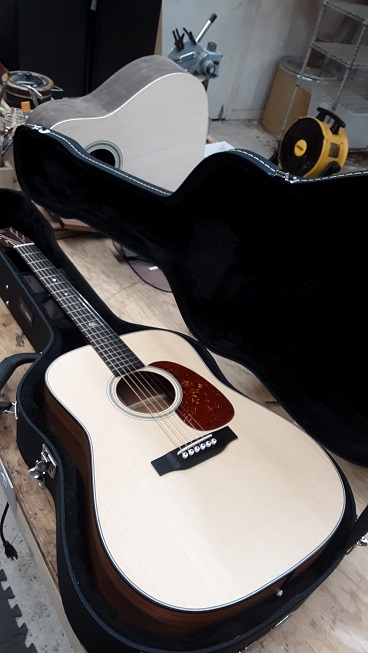
As readers may know, I recently purchased a Cirrus acoustic guitar. I also have a 1991 Martin D-28, the Sevillana 2208 dreadnought, my Blueridge dreadnaught dating probably from the late 1980s, and a few other lower-cost models. Each has its own distinct tone, but not as diverse as, say, a Gibson Les Paul humbucker and a Fender Stratocaster single-coil played through the same amp. However, there are differences in the woods used, the scale length, and size of the body. Even the string gauge can affect the sound.

The argument for one of these products is that a new guitar sounds too new, not broken in. Yes, that may be true, but is spending $150-$250 just to break in the guitar more important instead of actually playing it for a few months? With my new Cirrus, I want to break it in myself, like raising my son or daughter. The change in sound will be subtle over the months/years, and it will be your work, not some plug-in device.

If the “aging” is that important to anyone, I can perhaps see a guitar dealer or luthier using one of these products to break in the new guitars in their showrooms. It can be a selling point to a customer. However, customers rarely buy more than one guitar at at time, and don’t trade in or buy another for years. It seems to buy one of these for a one-time use and put it away for years may not be worth it. It’s not like a tuner or string winder that will be used often.

I plan to spend a bit more time researching these items and what they actually do. If vibrations is their main purpose, I am wondering if the use of a vibrating hand or body massager laid over the bridge/saddle can serve the same purpose for a lot less money (and has another use, of course). If it is tone generator-oriented, perhaps building a cheap tone generator (there are kits out there) may work.

Chew on it and comment.
Categories
Electric Guitars Lutherie

Shielding an Electric Guitar Body

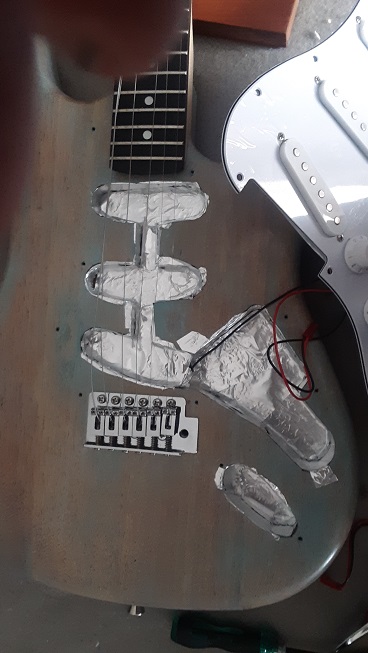
So after cleaning up the residue from the gigbag on the Ambertone Strat, I let the solvent dry for a few days and the proceeded to put shielding into the body cavity in order to get rid of some of the RF (radio frequency) noise generated by single-coil pickups.

A very short explanation: Just about every electronic device generates RF noise in some way or another. Televisions, appliances, calculators (fun trick – if you have an old working LED calculator, turn on an AM radio, tune it to the lower end frequencies, then hold to calculator next to it and start hitting keys, you should hear some weird noises from the radio), and electric guitars all give off some RF noise. You may hear that 60 Hz buzz through your amp if the amp is not properly grounded. Most guitars with humbucker pickups cancel out much of that hum (along with a quality guitar cord), hence the name. Single-coil pickups do not have the same kind of pickup winding, so the noise is much more apparent, and is why many guitarists like to install a metal cage in the cavity to cancel out much of that noise.

There are two popular ways to shield the cavity. The first is coating the cavity with a conductive paint, available through guitar part supply shops such as Stewart-McDonald. This is a very easy way to do it, just paint the entire cavity, let it dry, and it is done. This method is a bit more expensive, cannot be used on plastic parts, and can be messy if you are not careful with the paintbrush.

The second way is to line the cavity with thin metal strips. Conductive tape is available in copper and aluminum, and the adhesive backing has some conductive quality, so overlapping the pieces will create a continuous contact. I went this route and purchased a roll of Reflectix aluminum tape from Lowe’s for about $5.00. Note, I saw a YouTube video that one luthier shielded a guitar with simple aluminum foil and 3M adhesive spray, which seems a lot cheaper but one has to make sure that there is still conductivity between pieces as the spray adhesive is not conductive. There is also available aluminum sheets, which can cover the entire back of a pickguard, but is harder to mold into the cavity.

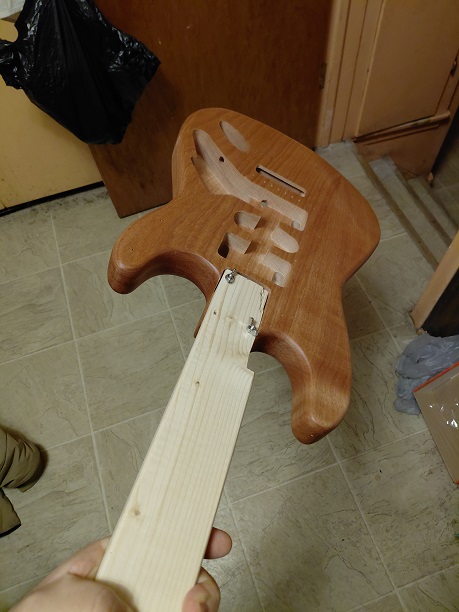
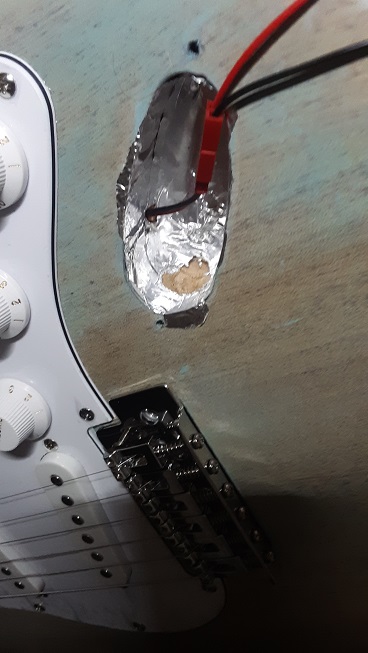
If attempting this job, it is wise to detatch the neck from the body, as I tried to do the project with the neck attached but could not remove the pickguard properly due to a lip on the fretboard where it attached to the body. After getting that out of the way, I first shielded the back of the pickguard. Fortunately, there was already some metal shielding on the underside where the controls are installed, so cutting pieces that eventually contacted this shield would mean a good metal cage effect. I covered as much of the pickguard as possible, making sure to keep it away from the wiring so as to not risk shorting.

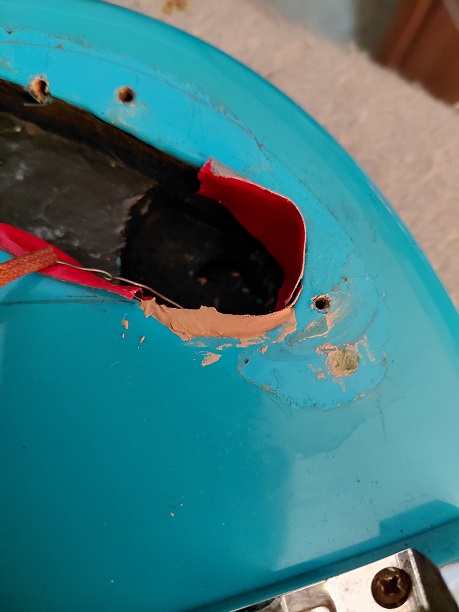
I followed up with shielding the Strat jack housing, then proceeded to the pickup/wiring cavity. While it may seem like cutting one or two big pieces and molding them in might be easier, it is not. With the many curves and crevices in the cavity, it was better to cut small pieces and pressing in/overlapping each piece. Press the pieces in firmly so that it stays put. In a few spots, I left a lip of foil come over so that it comes in contact with the foil on the pickguard.

After shielding the pickguard and cavity, I checked for conductivity with a multimeter tester. I recommend anyone doing guitar work to get one of these, which small consumer ones can be had for less than $20.00. Besides checking for conductivity, it can be used to check battery and house wall outlet voltage when needed. The entire shielding checked out as solid.

Once finished, I put the guitar back together and tested it out. Dang! No signal at all! It turns out that within the jack housing, the area is so tight that there is a small indentation in the wood for the plug to insert all of the way, and I had covered it with foil, Once I cleaned out that area, I reinstalled the jack and tested it again, this time getting a signal.

The result? The buzzing hum was cut out probably 80%. Not bad, really. Because the single-coil pickups on this guitar kit were cheaply made in Asia somewhere, they won’t have the same quality output as a Dimarzio, EMG, or even a stock Fender pickup. However, I was happy that most of the RF noise was cut out, and this guitar is definitely playable through any amplifier without much buzz. As far as the roll of aluminum tape, I used only about half of it, so I can shield another guitar when needed. Not bad for $2.50 in supplies and a few hours work while watching football on TV.

If you have an electric guitar that is kicking out RF buzz when plugged into an amp, especially when flourescent lights or other appliances are on, I recommend this inexpensive project to help out. There are plenty of videos on YouTube that show how easy it is to do. If too afraid of taking apart your guitar, a good guitar repairman should have no problem handling it.

Chew on it and comment.
Categories
Lutherie

The Fesley Guitar is Finished!

A day late, but I have a few excuses. First off, because of the holiday weekend and I chose to stay home, a friend asked me to watch her dog while she went to her cottage. A big dog, so I couldn’t bring her to my house, so I was over there a few times each day to feed her and take her outside.

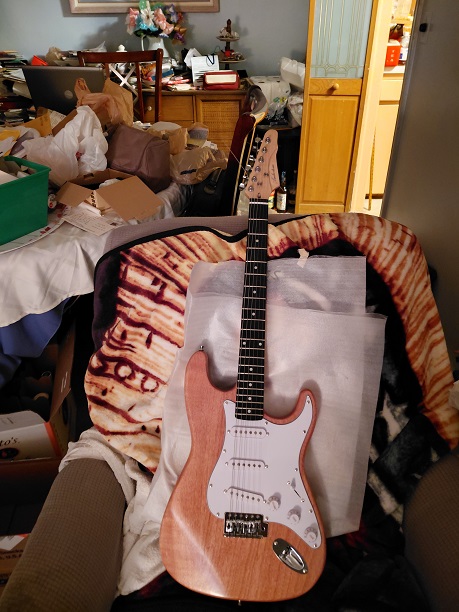
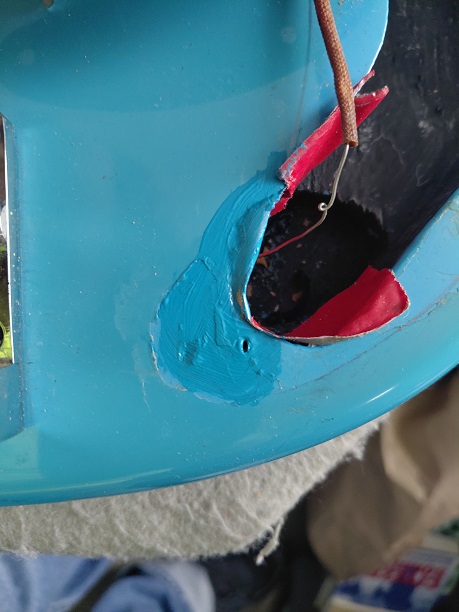
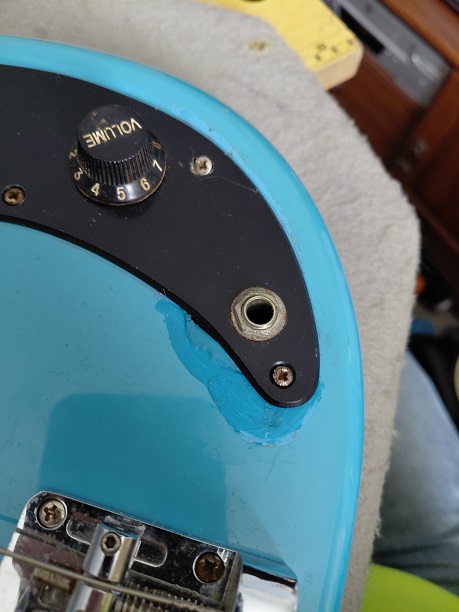
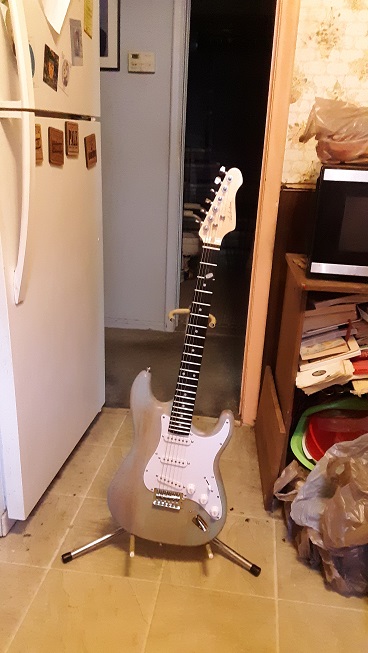
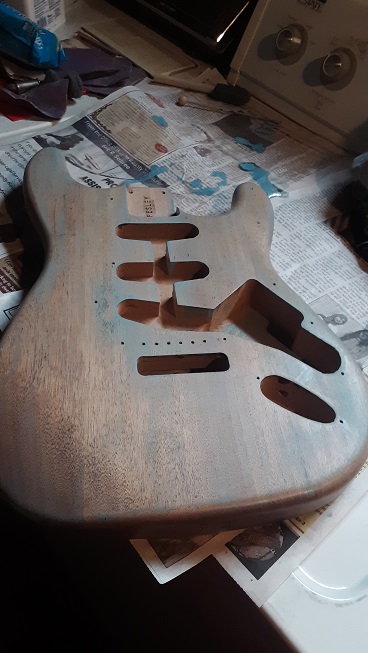
Secondly, I spent the little bit of free time to finish my kit guitar. Yes, after months of plodding along doing a little at a time each weekend, this weekend I put all of the hardware on, mounted the neck to the body, and did the whole set up. This was the Fesley Stratocaster kit I purchased back in May of 2024. I really didn’t start working on it until this past January, and had a few bumps in the road with finishing the body. The final finish has a distressed look with shades of light blue.

After putting the hardware on, which was relatively easy, especially with Fesley providing a thorough instruction manual, I got into the set-up, which I have always enjoyed doing with all of my guitars since I started playing over 40 years ago. For anyone starting off playing guitar or any other stringed instrument, you will never realize how important a good set-up is until it is performed. On an electric guitar, this includes neck bowing adjustment, string height, and intonation/adjusting the bridge saddles. I have discussed guitar maintenance before, and I highly recommend anyone even a little bit interested in playing guitar regularly to be familiar with what goes on, Watch YouTube videos as well as secure a good guitar maintenance/repair book like Guitar Setup & Maintenance by Chad Johnson (Hal Leonard Publishing ISBN 978-1-4584-1824-1).

Once fully set up, I plugged her into an amp to test her out. This kit happened to be pre-wired, so the pickups, switch, volume/tone controls and wiring was already complete – all I had to do was drop the wired pickguard into place. The pickups give off a good Strat sound, although are a bit noisy when a single pickup is switched on. I plan to take the pickguard off soon and line the body cavity with some aluminum foil tape to hopefully suppress some of the buzz. In the 2 and 4 switch positions, which combines either the neck/middle pickups or the middle/bridge pickups, the noise cancels out, and it was a nice warm sound. These two settings have always been my favorite on a Strat, giving off a glassy tone.

Speaking of which, I have never really been a fan of the volume/control configuration for most Strats. This consists of one volume and two tone controls (one for the neck/middle pickup and one for the bridge pickup). Tone controls on most electric guitars are passive, meaning no amplification is there, and the controls only act as cutting back on the tone, namely the high end. Rarely do guitarists mess with the control and usually keep it at 10, since cutting back on the treble also means cutting back on the output of the pickup. In my younger days when I really experimented with guitar wiring, I would often mess with the tone control by re-wiring it to a low-cut control or adding a switch to turn the tone control completely off. Perhaps with a later kit, but this one I just wanted to get it together and see/hear the finished product.

As an added touch, I named the project an Ambertone. I always like the color of ambertone (sort of a honey color, just slightly darker than a natural finish), and Amber is also the name of a co-worker that does a lot of woodwork who has taken some interest in this project.

I may jump into the next kit soon. I have another Strat, a Telecaster, and a Precision Bass kit waiting in the wings. I know that for the bass, I plan on doing a lot more customizing by adding a second pickup, so that one may have to wait for a while. For either the Strat or Tele, I am interested in finishing the entire body with only the Tru-Oil finish (https://luegra.design.blog/2025/05/10/tru-oil-for-guitar-finishing/). I also still want to attempt to finish one of the guitars with a special green stain dye that I ordered sometime back.

Chew on it and comment.

Categories
Classical Music Lutherie

The 15th International Henryk Wieniawski Violin Making Competition

This past week was the 15th International Henryk Wieniawski Violin Making Competition held in Poznan, Poland. I love watching and listening to the competing violins, seeing if I can tell any nuances that make them the best. Of course, I am far from an expert compared to those that are judging the instruments.

I wish that I could enjoy the entire competition live, but there are a lot of factors that are against me. First, it is during the evening in Poland, so it is broadcast in the afternoon here in Detroit, so I can only catch bits and pieces while I am at work, Fortunately, the entire stream is posted on the Wieniawski Society YouTube channel (https://www.youtube.com/@WieniawskiSociety). When I do catch a bit at work, I have to keep it really low volume, as earphones are frowned upon.

I had talked a lot about this competition in a blog four years ago (https://luegra.design.blog/2021/05/15/the-14th-international-henryk-wieniawski-violin-making-competition/), so I will not go into details here. This year, 85 violins from 18 countries were in competition. Polish luthier Paweł Kubaca won both First and Second Place with his Sona and Luna violins, respectively. Third Place went to Liu Zhaojun from China for the Sunrise violin.

There are two longer videos on the YouTube channel showcasing the finalists and winners, as well as a third video highlighting a quartet performance of the winners. Even if you are not into classical music, you may enjoy listening to the instruments and why each one was put into the finalist positions. It is truly amazing to see how such intricacies can make or break a choice when most of us just see a simple violin. Musicians who base their life on a quality instrument to continue their careers are stringent, and as a guitar player for over 40 years, I can understand.

The next competition for violin making will be in May of 2029. In the meantime, the 17th International Wieniawski Violin Performance Competition will be scheduled within the next wto years. I recommend that you continue to check both the YouTube channel and the Wieniawski Society website (https://www.wieniawski.com/) for updates.

Chew on it and comment.

Categories
Lutherie

Tru-Oil For Guitar Finishing

This week’s blog will be short due to a busy schedule. I wanted to talk briefly about my continued work on the guitar building project.

The neck that was in the Fesley guitar kit had an extremely light finish coating on it. It left the neck smooth, but I could tell that it would wear down to the bare wood after some playing and may cause some unneeded damage from sweat and grime. I wanted to put another coating of finish on it, but not with the polyurethane that I would be spraying on the body.

After doing some research on the internet, I found that there were a few recommendations to use Tru-Oil. This is a varnish-like liquid that is primarily used on rifle and shotgun stocks. It is very easy to apply with a cloth or sponge, and if applied thinly with a few repeats, will give a smooth finish as well as protective coating.

A small bottle usually goes for about $10.00. I had a tough time finding it in my area. I went to three gun shops, and none of them had it. I finally found it at a Dunham’s sporting goods store. According to internet searches, it seems to be available at Wal-Mart and Cabela’s as well, and can be ordered from a number of sources. I just wanted to get my hands on it right away, so I drove around until I found it.

The neck is maple with a rosewood-like fretboard Fesley calls “Techwood.” If anything like rosewood or ebony, it is best to keep unfinished (and oiled with lemon oil during cleaning or changing of strings), so I taped it off (along with the plastic/bone nut) before finishing. I applied three coats total, letting each coat dry 24 hours before the next. Tru-Oil is extremely thin, almost like water or a thin furniture polish, and I applied it with a soft cloth. A little goes a long way, and after the three coats, I still had about 3/4 of the 3-ounce bottle left. Once the third coat was dry, I hand rubbed the neck with OOO-grade steel wool.

I am pleased with the result. The back of the neck is just as smooth as before, yet you can see that varnish-like sheen to offer protecting from sweat and grime. I made sure to apply each coat thinly so as not to have any drips.

I would highly recommend the use of Tru-Oil for this type of finishing on a guitar neck or even a bare wood guitar body (I have seen a few examples online, and I may try it on one of the other solidbody kits that I have), especially if you do not want to fully spray polyurethane or do not have the equipment to do full spraying. It is easy to apply, and gives a great protective finish.

Chew on it and comment.
Categories
Bluegrass Music Lutherie

Getting Ready for SPBGMA/Fesley Body Finishing

I leave for Nashville in less than two weeks for the SPBGMA conference, and I am getting ready in more ways than one. Packing clothes and medicines will get done a few days before, but what I am doing now is getting things done for my networking down there.

I have already posted two new songs on my ReverbNation page, and I may tag on one more before the week is over. I have learned that it is easier and less cumbersome to upload songs on the ReverbNation page and hand out business cards than making a bunch of demo CDs and handing them out. My problem is still getting the nerve to approach artists that I don’t already know.

I really didn’t do any jamming last year, so I plan to try and get into it more this year. I’ll take the Sevillana guitar down with me. Last year I took way too many guitars and a bass with me, and hardly opened up a case let alone jammed. Plus, It takes up way too much room in my small car.

I have already set up some time with one songwriter to hopefully do some co-writing. The conference ends Sunday, but I’ll be sticking around Monday just for the reason of possible songwriting work.

I’m not sure if I will be doing any contacting for article writing. I haven’t heard back from my editor at Fiddler Magazine in a long while. I sent in an article recently, and ever since the magazine went online-only, It has been hard to stay in touch.

I’m also taking down a lot of 12-packs of Vernors Ginger Ale. This is a Detroit staple, and I know a lot of friends down there that crave it and can’t get it in Nashville.

If the weather is behaving, I will probably hit Rosine, Kentucky on the way down and pay my respects to Bill Monroe. It is a time-consuming detour, but I feel it has to be done when the opportunity arises.

Of course, I have to hit the Waffle House, Jack’s BBQ, and I hope to visit another Nashville eatery institution, Prince’s Hot Chicken. The original location is just a few miles from my hotel down there, so I don’t have an excuse. While I’m not a big fan of hot chicken, I do like to try places that are featured on food-related television shows and YouTube channels. I’ve seen some great stories about Prince’s, so it is a must!

Changing topics, I decided to get started on finishing one of the guitar bodies. I’m starting with the Fesley Strat body, since it was the best set-up already smooth sanded. I buffed it a bit more with OOOO grade steel wool. It is too cold to do spray painting outside, and I don’t have good ventilation for spraying inside the house, so I’m trying my hand at stain/finishing it with a combination stain and polyurethane coating and a brush. It is a lot more difficult to work with than I imagined, as the stain does not seem to go on that even, perhaps due to the polyurethane. I will probably end up doing at least five or six coats and sanding between them. I do like the color that came out. I am using a stain labeled Mahogany, and on the mahogany body, it darkens it nicely. The label says you can do sanding and re-coating after an hour, but I plan to let it dry for a day and see what happens.

Chew on it and comment.

Categories
Lutherie Music

Unique Stamps and Wood

A couple of crazy things happened to me this past week. Crazy as in “good” crazy, and both are music related.

First, I went to my local post office a few days ago to pick up some stamps. I happened to be wearing a t-shirt with some fiddle bows on it forming the stripes of the US flag. Anyway, he hands me a small sheet of ten Forever stamps. They happened to be ones dedicated to bluegrass music, complete wit guitar, banjo, fiddle and mandolin. I asked if he purposely got me these stamps, and he said that they just happened to be on top of the pile.

I’m not using these. This sheet is going into a frame.

Next, I was talking to a co-worker that does some woodwork, While I dabble in lutherie, she is more into making furniture. We are talking about places to get wood, and she mentioned a small store near where I live called Homestead Hardwoods. The place deals with special woods like mahogany, walnut, and other pricier choices that craftsmen like to use for furniture, shelving, and wall covering. I do not have a Facebook account, but the store does, and I checked out a recent posting that stated “Reject Wood from Gibson.” I was curious to find out what Gibson they were referring to. The store is mostly by appointment only, but are open for a few hours on Friday and Saturday, so I went after work this past Friday.

I had passed the place hundreds of times on my way home, but never thought to venture in. This time, I entered to be greeted by the friendly co-owner. Before I could finish asking my inquiry, he confirmed that the small slabs of mahogany (roughly a 2×4 about 18 inches long) came from the Gibson Guitar factory in Nashville. These particular pieces were meant for the bodies of Les Paul Junior models but rejected by the factory inspectors. The guy at the shop told me that he occasionally gets wood meant for guitars and stays in touch with area luthiers. He also told me that he makes banjos on the side. I will definitely be keeping in touch with him.

Just the fact that they were from Gibson made me giddy. This was no ordinary wood – this was potentially going to be a solid-body guitar! I snagged a few that day, and went back today (Saturday) for more. Another co-worker who is also a guitarist told me that he would be interested in a few pieces for his curious collection.

I plan on saving a few for a possible guitar project, but I am also thinking of making a table out of a few, with perhaps the Gibson logo on the face. I am just fascinated with the background of this wood. While it is not a piece of unique history (I actually have a piece of the floor from the Grand Ole Opry that I cherish), this wood does hold a small place in my musical heart. I hope to make good use of it.

In the meantime, I‘ll still be working on guitars and such, thinking of great ways to use this great wood.

Chew on it and comment.

Categories
Bass Guitar Bluegrass Music Lutherie

Leo Jaymz Guitar Kit/Amazon Scam/Larry Sparks

So even though I haven’t even started on the two guitar kits I already have, I purchased a third kit. This kit comes from Leo Jaymz, and is pretty similar to the Fesley kit I purchased a few weeks ago (https://luegra.design.blog/2024/05/19/inexpensive-guitar-kits/).

The big difference with the Leo Jaymz kit is the Strat-style body. They have routed it for the customizer, with spaces for humbucker pickups in the neck and bridge positions. The pickguard is still set up for three single coils, and wiring has connectors, so no soldering is needed. The instruction manual has no text, only pictures showing how to install each component. It really could not get any easier, I guess.

I had to take a second look at the body, though. As pretty much with all electric guitar bodies for this low price, it consists of poplar pieces glued together, then cut with a computer-controlled router. The grain of all of the pieces should be running length-wise from bridge to horns. However, this particular body seems to have a slight angle to the grain. It’s not drastic, but is noticeable to someone looking a little closer.

I still want to stain one of these guitars a unique transparent color, so I have to look all three bodies over. As stated previously, the Fesley body is ready for finishing, while the Ktaxon Tele needs a lot of fine sanding before any finish work. This Leo Jaymz body is sort of in between the two as far as surface texture. It is somewhat smooth, but could probably use a buffing with some super-fine steel wool to get it ready.

I am still interested in looking at and reviewing some bass guitars for young students to work with. I did order through eBay a really short-scale (25.5-inch) mini bass put out by Glarry. I plan on reviewing it here, and possibly on my YouTube channel, once it comes in. I was going to purchase the Ktaxon Fender Bronco copy bass that I briefly discussed in a blog three weeks ago (https://luegra.design.blog/2024/05/25/ktaxon-the-latest-cheap-guitar-brand/). I had recently won a gift card for Amazon, and when I went to the Amazon website, I saw that the bass had a price cut from $59.99 to $49.99. A nice incentive to purchase, so I clicked on the order. Well, shipping for the sale-price bass was $29.99, while shipping for the regular-price bass was $19.99, so there was no difference in the final cost. I wrote to Amazon about this, but have not heard back from them. Hopefully, no one fell for this hidden scam.

Finally, this past Thursday I went to see a bluegrass legend perform at the Kentuckians of Michigan hall in Romulus, MI. Larry Sparks, who has been performing for over 61 years as a solo artist, as well as with the Stanley Brothers, Ralph Stanley, and the Lonesome Ramblers, has had to cancel a few previous performances due to health concerns. I figured that I better go to this show, even though it was on a weeknight, because The Man may stop touring altogether. I was even able to talk by bluegrass buddy Ken to go, as he keeps missing local bluegrass shows for numerous reasons.

Larry was just doing a few shows, no festivals booked, with a small combo. No banjo player at this show, so we actually got to hear his smooth vocals and distinct guitar playing a lot better. He is definitely old school, playing a three-minute song, then bantering for 10 minutes more. However, he is a legend, and you listen to every word he has to say because he has great stories to tell and is somewhat of a rural philosopher. I am so glad that I got to see Larry perform, and it was worth going to work Friday morning on about four hours sleep.

Next week’s blog will probably be a bit late, as I will be at the Charlotte (MI) Bluegrass Festival all weekend.

Chew on it and comment.

Categories
Electric Guitars Lutherie

Inexpensive Guitar Kits

A few weeks ago, I was watching a video from one of my YouTube subscriptions called The Bald Shredder. He is one of the many guitar experts (i.e., nerds) that reviews guitars, amplifiers and effects. This particular video has him reviewing a Strat guitar kit from Fesley, available on Amazon for $89.00.

His opinion was what I figured. For the price, it is a good way for the beginning guitar builder or luthier to learn the basics. The actual finished guitar is in no way comparable to a Fender Custom or other US-manufactured Strat. He had the Amazon link for the kit in his video description, so I took the plunge and ordered one for myself. With shipping and taxes, it came out to just under $100.00.

The kit came in the mail a few days ago, and it was everything that the Bald Shredder stated. All of the parts are there, the neck and the body are both unpainted (there are painted versions of the kit available) with a clear coat on them, so they have a great smoothness to them. The neck back is smoother than a lot of other guitars that I have used. Like the Bald Shredder, I plan to keep the body in its natural clean finish. The grain is nice, nothing outstanding but not fake looking either.

The kit comes with a great manual for assembling the guitar, as the instructions are easy to follow and extremely useful photos. I haven’t started putting the guitar together yet, as I just got it a few days ago and have a lot to get to around the house before this. Maybe during a rainy day or perhaps during the winter when I am forced to stay inside.

While ordering this kit, I also came across Tele and Strat kits from Ktaxon for $59.99 each. For kicks, I decided to order the Tele kit, which after taxes and shipping came out to a little over $80.00. I found this kit on my porch yesterday (thank God there are no porch pirates in my neighborhood, and luckily I have two larger shrubs that block the view of my porch from the street), and was also what I expected for the money. The body and neck are rough sanded, so will definitely need some final sanding before I do any finishing. The pickguard/neck pickup are already mounted, so that will need to be removed for any body finishing. The instruction manual is practically useless, so fortunately I have some experience with working on electric guitars. It does have everything needed, including a cheap guitar cord and strap.

Again, I don’t plan on working on this kit for a while, and this one I do plan on putting on some finish to the body. Once I get the final sanding in, I may attempt to stain it with a unique transparent color before clear coating. I also need to check out the tuning gears for their quality, as they may need replacing. However, I don’t want to invest too much, as I don’t play electric guitar much (and have better guitars for any time that I do), and am looking at these kits for more lutherie experience than playing.

NOTE: The Fesley kit sold out a few days after I ordered mine and is currently unavailable. If interested, keep checking Amazon for re-stocking. The Ktaxon kits are still available as of this writing.

https://amzn.to/44n3McG

(Sorry, WordPress wouldn’t let me upload the Ktaxon link. Go to Amazon and search “Ktaxon Guitar Kit TL”. I’ve also seen this kit on eBay.)

Chew on it and comment.

Categories
Lutherie Musical Instruments

Amnon Weinstein RIP

On Friday of this week, I learned of the death of Amnon Weinstein at the age of 84. He was a luthier living in Tel Aviv and had run his violin repair shop there since 1986 when he took over the business with the passing of his father. Like his father, the trained his own son to become a luthier as well. He was known internationally for his repair work, but it was his special work over the past four decades that brought him his highest acclaim.

Amnon’s parents left Lithuania (part of the Soviet Union) in 1938 and moved to then Palestine. They left almost all of their relatives behind, most of whom would perish in concentration camps during the Holocaust. His father was a violinist, but found better work as a luthier, and trained Amnon to do the same. He did not know much about his relatives that died in the Holocaust, as his mother was very subdued about that information.

In the 1980s, as he started taking an interest in learning about his ancestry, a survivor of Auschwitz came to his shop for a violin repair. As Amnon took the violin apart to assess damage, the body had ashes inside. It turned out that this man had played the violin at the camp to prisoners that were being led to the gas chambers, and these ashes were remnants from the air near the crematoriums. It moved Amnon so much that he went on a quest to locate violins that had been played by Jews either imprisoned or used as slave labor.

The book Violins of Hope by James A. Grymes covers the stories of these musical instruments, as well as what happened to the owners. Amnon restored over 60 of these violins, and founded an organization, also called Violins of Hope, that loans out these instruments to professional musicians to perform with at concerts and educational programs. His work was highlighted in a 2016 PBS documentary.

I happened to come across the above-mentioned book through a clearance house and ordered it. The stories within the text of prisoners, slave laborers, and resistance fighters who relied on the violin to provide comfort was so moving, I was brought to tears. While I have read dozens of books on various aspects of World War II, including the Holocaust, this book was especially moving, due to my love of music as well.

The Violins of Hope collection has toured all over the world and has received enormous praise. Amnon’s work in restoring violins that were close to disintegrating from age and lack of care is extraordinary. I implore you to read more about Amnon Weinstein in this New York Times article (https://www.nytimes.com/2024/03/21/arts/music/amnon-weinstein-dead.html), as well as find a copy of the Violins of Hope book. You will learn how important music is to a culture, even in the the most tragic of times.

Chew on it and comment.
Design a site like this with WordPress.com
Get started