Categories
Guitars Rock Music

Steve Cropper RIP

On December 3rd, one of the coolest rock and R&B musicians passed away. Steve Cropper was was 84, but he gave the music world enough joy to come from four or five lives. He was a guitarist, songwriter, and producer during a time when pop music was exploding in the 1960s, and his stamp can still be heard in the grooves of modern performances.

My first experience (as well as many others) was seeing and hearing him play guitar with John Belushi and Dan Ackroyd in the Blues Brothers Band. When they were forming the band originally as a skit for Saturday Night Live, Belushi wanted to have the best available R&B studio musicians to re-establish that original powerful sound. Thus, he nabbed Cropper and bassist Duck Dunn, who were two of the most stable musicians from the Stax Records studio.

After hearing the band’s version, I sought out the original version performed by Sam &Dave. Belushi even copied the “play it, Steve” shout to Cropper that’s on the original. That Sam & Dave song got me to look more into Stax artists, and with Otis Redding, Wilson Pickett, Rufus Thomas and others, Cropper laid down the guitar tracks on almost all of them.

Cropper, along with Dunn, Al Jackson, and Booker T. Jones, made up the instrumental supergroup Booker T and the MG’s, which not only served as the basic Stax studio band, but also had a number of instrumental hits, including, “Green Onions” and “Time is Tight.” They also worked with the Memphis Horns as the moniker the Mar-Keys. Cropper was so influential during the mid-1960s that the Beatles wanted to record with him in Memphis at the Stax studio. Unfortunately, manager Brian Epstein put a halt to that due to security reasons. Ringo Starr would have Cropper appear on a number of his solo albums during the 1970s.

Besides his guitar skills, Cropper was also a prolific songwriter. His best-known writes and co-writes include Eddie Floyd’s “Knock on Wood,” Wilson Pickett’s “In the Midnight Hour,” and Otis Redding’s “(Sittin’ on) the Dock of the Bay” (which also includes some of the most beautiful guitar licks Cropper ever performed).

Stax was highly influential, as it was one of the few record companies that had both black and white musicians working together to create a unique R&B sound. Unfortunately, by the end of the 60s, tensions grew within the organization, and in 1970 Cropper had left Stax to open his own TMI Studios in Memphis. There he would work with Starr, Rod Stewart, and Jeff Beck among others.

In 1975, Cropper moved to Los Angles for continued studio work, and was in the works to re-form Booker T and the MG’s until drummer Jackson was murdered. In 1978 he and Dunn would work with Levon Helm. This soon led to the duo becoming members of the Blues Brothers Band, and appearing in the two films (The Blues Brothers and Blues Brothers 2000, playing themselves).

In 1992, Booker T and the MG’s were inducted into the Rock & Roll Hall of Fame, and Cropper would then tour with Bob Dylan for Dylan’s 30th Anniversary Tour. In 1996, Mojo Magazine named him ‘the greatest living guitar player. Keith Richards was quoted as saying that Cropper was “Perfect, Man!” In 1998, Cropper made a video autobiography entitled The Interview – Play It, Steve! In 2004, he and Dunn worked with Eric Clapton at the Crossroads Guitar Festival in Dallas. The following year, he was inducted into the Songwriters Hall of Fame.

Over the following two decades, Cropper would continue to produce albums for other artists and perform live. At this time, the cause of his death is unknown, but the music world had definitely lost one of its star performers.

For any musician, especially guitarists, wanting to know how to perfectly blend rock, blues, country and R&B, I implore you to seek out recordings that Cropper was on, most notably his guitar work on those early Stax sessions., He was one of the few guitarist to take the Fender Telecaster beyond its twangy country roots and give it an all-encompassing sound. He will surely be missed, but he has left us a truckload of music to enjoy and learn from.

Chew on it and comment.
Categories
Jazz Music Rock Music

Ozzy/Hulkster/Chuck Mangione RIP

I will keep the first two brief, as the press and internet have been covering them abundantly, and I wanted to spend a little time on the third.

First, Ozzy Osbourne passed away on July 22 at the age of 76. He died just a few days after his final show with a reunion of Black Sabbath in Manchester UK. He had been battling Parkinson’s Disease, as well as having suffered a number of other ailments over the years. He was eccentric to say the least. He lived up to his nickname “Prince of Darkness” throughout his professional career. He was pretty much the ambassador of the heavy metal genre, and became a visual representation of the music when MTV was launched in the 1980s. His wife/manager Sharon help elevate his career even more through television appearances and working with his family on a reality show, The Osbournes. Add to that starting up the Ozzfest concert series, along with tons of other productions, Ozzy had his moniker on just about everything imaginable.

His passing will continue to have some controversy, as his death was not in either the US or UK, but in Sweden. All that I know is that “Paranoid” is still one of the greatest rock songs I have ever heard, and one of my go-to riffs when I pick up an electric guitar is the opening to “Crazy Train.”

Second, Hulk Hogan (born Terry Gene Bollea) passed away on July 24 at the age of 71. He was a larger than life character, bringing the world of professional wrestling entertainment to a level never before seen. Just seeing his massive muscular physique made one know that you should never mess with him. His extroverted image was just that, as he was a cordial and respectful gent when not showboating. He was a hero to so many kids in the 1980s and 90s, and could still draw a gigantic crowd of fans up until his passing just by showing up somewhere. The constant theatrical abuse throughout the years in the ring gave him tons of health issues, especially with his back and spine, which after a number of surgeries shortened his overall height by about four inches. His last major appearance was at the Republican National Convention in 2024, where he helped to nominate Donald Trump to the ticket, and motived the conventioneers with his performance just he had done with fans at the wresting arenas.

My wresting fan experience was from a generation before. My heroes were Bobo Brazil, The Mighty Igor, The Sheik, Pompero Firpo, and Dick the Bruiser. By the time the WWF/WWE/WCW came to own the cable television airwaves, I had lost much interest in the stuff. However, there was no denying that The Hulkster, along with his cohorts like Andre the Giant, Jake the Snake, and Randy “Macho Man” Savage brought professional wrestling to a level never seen before. Hulk Hogan was at the helm, and with his appearances in other television and movies, he was the reigning king of the sport.

Now, I wanted to talk about jazz musician Chuck Mangione, who passed away on July 22 at the age of 84. He was best known for his flugelhorn-laced crossover hit “Feels So Good” in 1978. His parents were jazz fanatics while he was growing up, taking him to jazz concerts and inviting many big players of the 1950s back to their house for an Italian dinner. From his experiences, he soon learned the trumpet and piano, along with his brother Gap, and they formed a jazz band in high school.

In the 1960s, he played with Art Blakey’s band, and with his own sextet. During that time, he began writing music, which caught the ear of Cannonball Adderley. He attended the Eastman School of Music, where he took an interest in the flugelhorn. He recorded a number of album during the 1960s and 70s (30 in all of his career), and won his first Grammy in 1977 for Best Instrumental Composition with “Bellavia.”

By 1978, his song “Feels So Good” gained giant recognition, reaching Number 4 on the Billboard Hot 100. His song “Give It All You Got” became the theme for the 1980 Winter Olympic Games in Lake Placid, New York, performing it live at the closing ceremonies. He also composed the soundtrack for the film The Children of Sanchez starring Anthony Quinn, which won him his second Grammy. He worked for many charities, including raising over $50,000 for the St. John’s Nursing Home in his hometown of Rochester, NY from his 60th birthday concert.

He also made a number of appearances on television, including Magnum P.I., and was not afraid to laugh at himself by appearing on the cartoon King of the Hill as a spokesperson for the Mega Lo Mart store. From that work, he wrote a song in 2000 entitled “Peggy Hill” for his Everything For Love album. He pretty much retired from the music business in 2015, around the time of the passing of his wife Rosemarie. He sold his music copyrights in 2024.

When I heard “Feels So Good” for the first time in my junior high school days, I was floored. Jazz to me was either the elementary stuff they forced on school bands, or the crazy compositions that had no continuity. It was cool, something that made you slowly rock your head back and forth. I am sure high schoolers and young adults found it to be a great make-out song (I was a bit too young for that at the time). But the song carried on in my heart for a long while. I bought a number of Mangione cassettes during my younger days (which have long since died), appreciating the music even though my musical expertise and performing interests were more rock and alternative. You knew that you could throw on a Mangione album for a relaxing few minutes. Even today, hearing “Feels So Good” puts me in a very good mood, and makes me reflect back to a time when my life was a lot more innocent.

Chuck, I hope that you are in Heaven playing your music on the trumpet that Gabriel has lent you.

Chew on it and comment.

Categories
Rock Music

Rick Derringer RIP

When my buddy Ken texted me last week that Rick Derringer passed away, I was floored with sadness. He was always one of my music heroes, not just guitar heroes. Yes, he could play guitar, but he had such an ear for music, he was a top producer in the pop and rock genres.

Rick left us on May 26th at the age of 77. Ironically, a few days earlier, I had just finished setting up a Fender Stratocaster and the first thing I played on it was the opening chords to “Free Ride,” which he recorded with Edgar Winter. He was with Winter’s band during its heyday in the early 1970s when “Frankenstein” was also getting heavy airplay on rock stations.

His first big break came when his band The McCoys had a huge garage-band hit with “Hang On Sloopy” in 1965. That song was a Number 1, keeping The Beatles’ “Yesterday” off of the top spot for a few weeks. As that band started to lose its drive, Rick and a few members soon became the backup band for Johnny Winter. It was during this time that his songwriting skills came into play when he wrote the classic “Rock and Roll, Hoochie Koo” for Johnny as a rock/blues crossover song to help boost Johnny’s career.

Due to Johnny Winter’s increasing drug problem, Rick moved to working with Edgar Winter, appearing on the aforementioned hits as well as handling production duties. In 1974, he decided to go solo, and re-recorded “Rock and Roll, Hoochie Koo” for his first album, All American Boy. The song had a much more rock feel to it, and it became his biggest solo hit, reaching Number 23 on the Billboard Hot 100 and becoming a staple on classic rock radio stations. For me, it is the production that he did on that song. He played all of the guitar parts, as well as the bass and tambourine. He layered each guitar perfectly to have this perfect wall of sound. The riffs and licks on that are what every young aspiring rock guitar player wants to emulate.

Throughout the 1970s and 1980s, he produced or played guitar for a number of artists, including Steely Dan, Todd Rundgren, Air Supply, Meat Loaf, Cyndi Lauper and Barbra Streisand. Through his work with Lauper, he produced The Wrestling Album for the World Wrestling Federation in 1985. He also wrote several of the album’s theme songs, including the theme song for Hulk Hogan, “Real American.” The song was used for a number of campaign stops by Barack Obama, Hillary Clinton, and Donald Trump.

He was also well known for producing six of “Weird Al” Yankovic’s comedy albums, receiving his only Grammy award during that time. He began to step away from the production end, claiming that he did not want to be thought of as a comedy record expert.

In 1997, Rick became an Evangelical Christian, and with his wife and children, produced four Christian music albums. He also worked for a while in the early 2000s with bassist Tim Bogert and drummer Carmine Appice. During his later years in the 21st century, he toured with Ringo Starr & His All-Starr Band and Peter Frampton’s Guitar Circus.

Just last week, he died peacefully in his sleep after being taken off of life support from medical complications.

There is so much that Rick had his hands in when it came to music. You could tell from his history that he was passionate about it. His production work aside, I think that his guitar work was rock and roll perfection, the way that Keith Richards’ work is perfection. Nothing flashy, but just enough movement to make the solo fit perfectly into the song.

I could go on, but I leave this with one last thought. I remember seeing a photo of Rick on stage, probably taken in the late 1970s, where he is playing a BC Rich Mockingbird guitar. I thought that he looked so incredibly cool, and to this day, I would love to get myself a Mockingbird guitar specifically because of that photo.

Rick, I know that you and Johnny Winter are now jamming out up there in the sky. You will always be one of my guitar heroes.

Chew on it and comment.

Categories
Rock Music

Clem Burke RIP

Sadly, another musician that I admired greatly has passed away. Clem Burke, best known as the drummer for Blondie, passed away last Sunday at the age of 70.

While Blondie was best known for the gorgeous lead singer Debbie Harry, the band had some amazing musicians as well. Especially amazing was Burke, who was definitely a drummer’s drummer. He knew exactly what kind of rhythm was required for each song. When I first heard “Dreaming” from Eat to the Beat, I was knocked out! The drumming was out of this world. Keith Moon would have been proud. If one heard it for the first time, one would think that it could not be done by one person. Then the band appeared on Saturday Night Live, and Burke showed that he had the chops and energy to play the song live.

(Apologies for the poor sound quality, I really just wanted to showcase Burke’s drumming)

Then listening to the other cuts, one can hear beats from disco, roots-rock, even jazz-influenced. Burke could do it all. He was influenced by so many drummers, and he soaked all of them in. One would think that, listening to those early Blondie albums, there were different studio drummers on the recordings.

Burke was an original member of the band, and remained with it form its beginning in 1975 until his death. When the band took a long hiatus, he continued working with a number of other artists who held him in high regard. He drummed for a few years with the Romantics, and would later work with Wally Palmer in the garage-rock band The Empty Hearts. Other artists he either recorded with or played live with included The Ramones (his moniker was Elvis Ramone), The Go-Gos, The Fleshtones, Dramarama, The Eurythmics, Pete Townsend, The Plimsouls, and Iggy Pop.

The one time that I got to meet Burke was at The Ritz in suburban Detroit. I am not sure what band was performing, this was in the early 1990s, and he was there with Wally Palmer. I knew Palmer from his hanging out at the Hamtramck bar Paycheck’s occasionally (A story for another time). Anyway, Burke was a great person, who truly loved music. Whatever time period he would have been born in, he would have been a musician of some sort.

His drumming may be copied in the future, but he will never be replaced.

Chew on it and comment.

Categories
Drummers Rock Music

Rick Buckler RIP

It is getting depressing that, every week, it seems that I am writing a personal eulogy for some musical artist that passed away the previous week. This past week was no different, but hurt a bit more because of the band the man was in as well as how long it took for the internet press to announce the death.

Rick Buckler was the fantastic drummer for the British punk-rock band The Jam. He passed away at the age of 69 on February 17. Unfortunately, I did not learn of his passing until a few days ago. This is the sad state of the modern press, especially with the speed that news can travel on the internet. Music news outlets like Rolling Stone are too worried about what today’s stars are wearing now instead of teaching today’s youth about where the music came from.

Buckler was an amazing drummer to say the least. Coming out of the mid-1970s British punk-rock boom, The Jam was not the typical three-piece unit. While most trios were just making basic beats and heavy distorted guitars with Neanderthalic thumping bass lines, The Jam gave groove to its speed. I have already praised the work of bassist Bruce Foxton in a previous blog (https://luegra.design.blog/2024/04/06/underrated-punk-rock-bassist-bruce-foxton/). Buckler made the drum kit an actual third musical instrument, not just the sound of someone banging on garbage cans. His fills were perfect, and he accented guitar and bass lines with perfection. Great examples are the band’s songs “In the City” and “Down In the Tube Station At Midnight.”

As the 1970s moved into the 1980s, The Jam’s sound matured, being influenced less by punk attitude and more into The Beatles and Motown. Buckler’s drumming style moved right along with the stylings, from the simplicity of “That’s Entertainment” to the R&B textures of “Town Called Malice.” One could be floored by Buckler’s continuous drum roll in “Funeral Pyre.”

Sadly, guitarist/vocalist/songwriter Paul Weller chose to disband The Jam in late 1982, which shocked Buckler. He didn’t speak to Weller for over 20 years, despite a number of public photo and television exhibitions dedicated to the band that they both made appearances. He performed in a few other bands in the 1980s and 1990s, some being semi-tribute bands to the original The Jam. By the year 2000, he pretty much retired from the music scene to become a carpenter and cabinet maker.

The Jam was one of my first loves of the punk-rock movement. They didn’t dress the part, instead going for the suit-and-tie look onstage that was heavily influenced by the 1960s bands The Who and The Kinks. As a bassist, I was enamored by Foxton’s bass playing, and as a frustrated hack drummer, I was blown away with what Buckler was doing on his kit. While I would have loved to see a Jam reunion, it was not in the cards. For Buckler, I am glad that he was able to leave his love of drumming behind and take on another love of woodworking.

Thank you, Rick Buckler, for giving me some of the best musical memories in my youth.

Chew on it and comment.

Categories
Rock Music

David Johansen RIP

I just got the news this morning that David Johansen, the lead singer for the band the New York Dolls, succumbed to cancer on February 28 at the age of 75. While I was never a big fan of the band, I do realize how much of an influence it had on the oncoming punk rock scene in England, as well as the cult following it had on the wild New York music scene of the mid-1970s.

The band was out to make a statement. They combined R&B rhythms with straight-ahead overdriven guitars and overpowering drums and bass. Their songs were about rebellion, not politically but socially. With that, the members decided to dress to shock, wearing women’s clothing and makeup. The result was indeed shock value, but perhaps for the wrong reasons. Music critics loved the music, but art and entertainment critics looked at it as campy parody. Johansen was often compared to an exaggerated version of Mick Jagger.

The band produced a few albums, and had a memorable single with “Personality Crisis,” but quick, ill-directed fame had the members diving heavily into drugs, which caused the demise. The band broke up in 1975, but would be listed as influential to many bands after that, including the Ramones and the Sex Pistols, as well as graphically influencing dozens of hair-metal bands in the 1980s.

Johansen was too much of an entertainer to just walk away from even the dimmest of spotlights. He also enjoyed listening to jazz vocalists and cocktail lounge music, so around 1980 he took on the pseudonym of Buster Poindexter and performed lounge music around New York City. The persona became a hit, and with early MTV programming taking him and his videos on, including songse like “Hot, Hot, Hot!” and “Is That You, Santa Claus?”, Johansen received much of the recognition that his talent deserved.

He also delved into acting, appearing as the Ghost of Christmas Past in the Bill Murray comedy Scrooged, and co-starring in a remake of Car 54, Where Are You? Johansen’s over-the-top personality fit in with so many comedic roles that he performed, he could have easily worked in the acting end of showbiz a lot sooner than he did.

In the early 2000s, he announced that he was being treated for cancer. In 2004, at the urging of Morrissey, he partially reformed The Dolls for a performance in London. Year by year, members of the band had passed away, with this reunion including only three original members. Johansen was the last remaining living member.

I am currently finishing up reading a book entitled Please Kill Me by Legs McNeil. It consists of interviews with musical artists and scenesters from the late 1960s (Iggy Pop, MC5, Velvet Underground) through the 1970s (the Dolls, Patti Smith, the Ramones, Television) and how the drug-infested, crime-riddled, crazy music scene of that time had an impact on what was to come with the punk-rock and new-wave movement that was to come in the late 1970s/early 1980s. There are a number of quotes from members of the Dolls, and in just a few pages, one can see that the band imploded on itself due to drugs and personality differences. I recommend the book to anyone interested in the rock music movement of that time period.

Sleep well, David. While you may not have had the same impact as the Beatles or the Rolling Stones, you definitely were an influence on the music that was to come after you.

Chew on it and comment.

Categories
Rock Music

Memories …

I spent much of today cleaning out closets and the attic of clothes, mostly belonging to my deceased parents, to pack up and donate to charity. I also threw in a few things of mine that I either no longer fit in or don’t have the interest in continuing to wear.

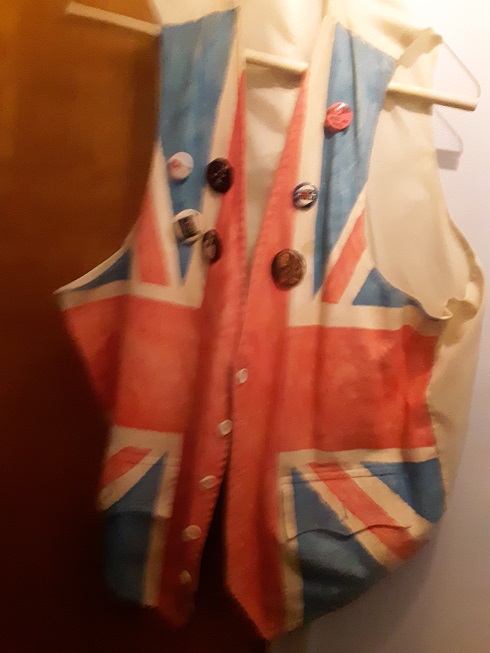
Then I came upon this – an old vest that I used to wear when I played in my first punk bands. Holy cow! I vaguely remember finding this white vest at a Salvation Army store, then attacking it with red and blue markers to create a Union Jack. I was totally into the Mod look at the time, listening to The Jam, The Who, The Kinks, and The Small Faces.

I also put a few badges on it, relating to punk, Mod, reggae, and ska bands. Boy, did this bring back tons of memories:

  • the Peavey T-20 bass, my first real bass. That thing weighed a ton, but it was full-scale, and I felt like a real musician. I sold it after a few years, got some better basses, but a couple of years back I purchased another one before they started being considered “vintage” and going up in price.
  • the mid-70s Fender Bassman amplifier and a homemade speaker cabinet. Unfortunately, I gave that amp head to a female bass player that I had a crush on, but I still have the speaker cab. Loaded with a 15-inch Eminence and covered in polka-dot carpeting. An ex-friend borrowed it for a while and let her cat scratch its claws all over it.
  • the dozens of musicians that I worked with back in the early to mid-80s. Bands were everywhere, so you seemed to cross paths with just about everyone in Detroit. I laugh now that, in bluegrass bands, it is nothing to hear that members come from three or four different states. Back then, bands in the Detroit music scene rarely had members that were more than a few miles from each other. I can even remember there was this big East vs. West thing, where rarely did you work with someone on the other side of Woodward Avenue.
  • the Venues. Hamtramck was the epicenter. Besides Lili’s 21 and Paycheck’s Lounge, there were at least a dozen other bars in that two-square-mile city that bands could play. Even the most talent-less band could find a gig on a weeknight somewhere. Plus the dozens more bars in the suburbs, attempting to cash in on the burgeoning new-wave scene that ended up never really happening.
  • the Metro Times. Everyone grabbed a copy on Wednesday afternoon to see what bands were playing where. If you were a musician, you always checked out the “Musicians Wanted” classified ads to see who was looking for a guitarist/bassist/drummer into the music that you were into. Keyboardists were a hot commodity. Even if you couldn’t play one, if you had a synthesizer, you were in!

I could go on, but there’s way too much to talk about. I’m glad that time was a part of my life, especially my musical life. I learned a lot about music and the business back then, and realized that dreams are usually just that. Everyone at the time thought that they were going to be the next Beatles. It didn’t happen, but we had some fun trying to get there.

Chew on it and comment

Categories
Bluegrass Music Rock Music

Tidbits #7: Wonder Woman/Microphone Shock Mount/Hamilton Book Finds

I had a crazy Thursday this past week. I took the day off to get the oil changed in my car. After that, I went to see a friend that works at a local gas station. My car has manual transmission, so when I park and turn off the engine, I usually put it in 1st gear to lock it. Well, I must have put it in a higher gear (which doesn’t lock the drivetrain), so as I was walking into the station, I noticed that my car was rolling away, heading to the street. I started running to catch it, but one other man was ahead of me, and like a super-heroine, a young lady literally jumped (practically flew) through the open window of my car and pulled the parking brake. So thank you sir (I didn’t catch his name), but a special big thanks to Jessica, not only for stopping the car, but doing it in an amazing manner. Free guitar lessons to her if she ever wants to take it back up again!

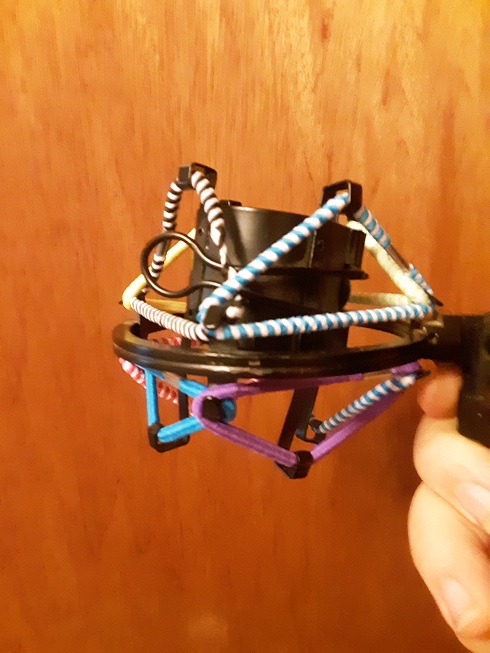
For anyone using a shock mount on a large-diaphragm condenser or ribbon microphone, you know that the rubber bands used for holding the clip to the mount will stretch and wear out after a year or so. If you purchase these bands through a music store or online, they can cost around five dollars apiece. I have instead used women’s hair bands for the same job for a lot less money. You can usually pick up a bag of these at local dollar store or pharmacy. As these are smaller than the normal shock mount band, so you will need to use about eight of them to fully secure the mic clip. However, They do the exact same job, will last about the same amount of time, and will be a lot less on the wallet.

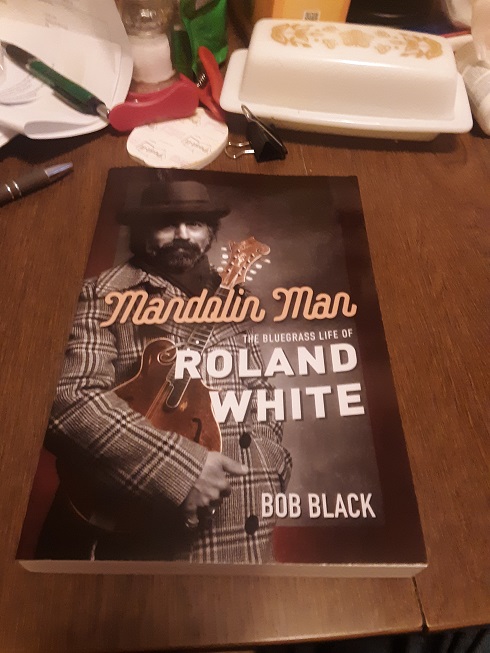
I made a purchase with Hamilton Books recently and found a few gems. First, I got Mandolin Man: The Bluegrass Life of Roland White by Bob Black. I have wanted to read this book ever since it came out in 2022, right about the time the man passed away. I met him a few times, and even went to a last-minute workshop he was hosting at The Ark in Ann Arbor about 20 years ago. He was extremely humble about his career, and was always promoting the legacy of his brother, guitarist Clarence White. I cannot wait to dive in.

The other gem is the CD Punk & New Wave: The Ultimate Collection, put out by a company called Union Square. This company issues a lot of these compilation packages from the looks of the inside cover, including Rock Anthems, Driving Songs, Northern Soul and Running Songs to name a few. I took a chance on getting this one, and WOW, I am glad that I did! Five CDs containing 100 original recordings from The Jam, The Damned, X-Ray Spex, The Buzzcocks, Joe Jackson, Squeeze, and many others from the late 1970s/early 1980s. I was practically crying when listening to the first disc, as it was a bunch of songs that I remember from my youth. I will be listening to this set over and over again!

Chew on it and comment.

Categories
Folk Music Rock Music

John Mayall/Duke Fakir/Happy Traum RIP

Three important names in music passed away this past week, with two of them being big influences on my musical life.

First, let’s look at the passing of John Mayall. He was a student of the blues long before the British Invasion that gave us the Rolling Stones, the Animals, and the Yardbirds. He, along with Alexis Korner, brought Chicago-style blues to young Brits in the early 1960s. His proteges included Eric Clapton, Mick Taylor, Mick Fleetwood, and John McVie among many others. His 1966 album John Mayall & The Bluesbreakers, often called the Beano album as it featured Clapton reading the Beano comic book on the cover, is considered legendary. He had many chances to gain great success in the US if he would dilute his strict blues style, but he refused. He became a cult hero among blues purists, and his original material was off kilter, not writing about usual blues subjects such as drinking and infidelity, but instead choosing political and environmental themes. He was active until very recently, passing away at the age of 90.

Next, we look at Abdul “Duke: Fakir, tenor singer and last original member of the Four Tops. Motown was a big part of my growing up, and much of that came from the smooth vocals from the talented groups on the label. The Supremes, the Temptations, Smokey Robinson & the Miracles, and Martha & the Vandellas were all top notch, but my favorite of them all was the Four Tops. Lead singer Levi Stubbs was amazing to say the least, but the icing on the cake was the tight and timely harmonies provided by Lawrence Payton, Renaldo Benson, and Duke Fakir. Listen to classics such as “I Can’t Help Myself (Sugar Pie, Honey Bunch).” “Bernadette,” “Reach Out I’ll Be There,” and “It’s the Same Old Song.” These four guys were bridging doo-wop with R&B energy.

Then there was the look. The four members, especially Fakir, had absolute class and style in the way that they presented themselves. In the beginning, they wore tailored, matching suits that gave them a gentlemanly look. As the 60s progressed on into the 1970s, they began to make individual fashion statements. Even after leaving Motown, they still had hits with “Ain’t No Woman (Like the One I’ve Got)” on ABC and “When She Was My Girl” on Casablanca. One has to remember that these four performed together from 1953 to 1997, the longest tenure for any band with original members.

Fakir never left Detroit long-term, He owned much property in the city, and ran a successful restaurant on the Detroit River. He passed away on July 22 of heart failure at the age of 88.

My other big influence that we lost this past week as acoustic guitarist Harry Peter “Happy” Traum. Born in 1938 in the Bronx, he was part of the Washington Square/Greenwich Village scene during the early 1960s, where he would become friends with a young Bob Dylan. Along with Dylan, Pete Seeger, and the Freedom Singers, they recorded Broadside Ballads Volume 1 for Folkways Records. He actually cut the first version of Dylan’s “Blowing in the Wind.”

However, Traum is best known by many, including my introduction to him, for his work in creating guitar instructional books, tapes, and videos through his Homespun Music company. As a guitar teacher in New York City, he first wrote the book Fingerpicking Styles for Guitar in 1965. He was soon making tapes for his students based on transcriptions in the book. Due to the popularity, he formed Homespun with his wife and began advertising in various music magazines. Soon he was releasing instructional tapes from fiddler Kenny Kosek and banjo whiz Bill Keith.

By 1983, Homespun was releasing VCR lessons, which was eventually followed by DVD and online downloads. In 1995, Hal Leonard Corporation took over the massive distribution job. Other artists that Traum recorded for lessons included Chet Atkins, Norman Blake, Rick Danko, Donald Fagen, Jerry Douglas, John Hartford, Bill Monroe, Sam Bush, Doc Watson, even musical comedians Steve Martin and Steve Allen. Each video was produced by Traum, starting off in his living room and eventually in a small studio. Many of these videos featured Traum interviewing the presenters, offering insightful questions that would pique the artist’s curiosity and make the student truly interested in the information beyond fingering and picking technique.

While Homespun was Traum’s main passion, he still continued to record his own material, releasing his final recording, “Just for the Love of It,” in 2015 and appearing on Dylan’s Another Self Portrait a year earlier. He passed away on July 17 at the age of 86.

All will be missed. Chew on it and comment.

Categories
Bass Guitar Rock Music

Underrated Punk Rock Bassist: Norman Watt-Roy

I was vaguely familiar with Norman Watt-Roy during the 1980s, more of just seeing his name on a lot of albums that I had back then. As I have done more reading and researching on my favorite music from back then, I have come to realize that he was an unsung hero from the punk/new-wave era.

Watt-Roy started put playing in a number of rock bands during the late 1960s and early 1970s with his brother Garth. Later that decade he met up with Ian Dury and played on the Blockheads first album, New Boots and Panties!! on the Stiff label in 1977. Watt-Roy would later join up in Wilko Johnson’s band in 1985.

However, it is his guest appearances on other albums that let me know how great he was. He plays on Nick Lowe’s album Jesus of Cool (known in the US as Pure Pop for the Now People), giving memorable bass lines on “Nutted by Reality.” However, my favorite of his bass work appears on The Clash’s album Sandinista! Watt-Roy laid down some of the greatest grooves on the most memorable songs, “The Magnificent Seven” and “Hitsville UK,” along with “The Call Up.” Charlie Don’t Surf,” and “Something About England.” Those first two songs have always been held in high regard with me, and when I was playing bass during that time, those were two songs that I had to learn. It was painstakingly difficult, as I was using a pick, while Watt-Roy plucked with his fingers. It was only recently that Clash drummer Topper Headon stated that Watt-Roy played the bass groove on the band’s biggest hit, “Rock the Casbah” from Combat Rock.

Watt-Roy also worked with The Selecter, and laid down bass work on Frankie Goes to Hollywood’s “Relax” in 1983, although the final mix didn’t have his playing. He did session work with Roger Daltrey and Wreckless Eric, and during the early 2000s, he performed with a later incarnation of Madness. Recently, he has been appearing with reincarnations of The Blockheads.

I urge any bass player in pop and modern rock/punk bands to search out Watt-Roy’s bass work. The man had a way of making average songs get a dance able groove without going too pop. I hope that he also gets more recognition for his amazing work.

Chew on it and comment.

Design a site like this with WordPress.com
Get started