Categories
Bluegrass Music

IBMA 2023 Award Ballots

Well, it’s that time of year again. The International Bluegrass Music Association sends out its first round balloting for the 2023 awards. Since I am no longer a member, I don’t get to nominate or vote, but I am still on the Association’s email list, so I get the announcements. Also, my inbox gets inundated with dozens of emails from artists, managers, booking agents and record companies with “For Your Consideration” in the subject line.

For anyone not familiar with the IBMA’s process, the first round consists of any member can write in anyone that they want for any category (bands, musicians, vocalists, songs, albums) and send it back. The second round usually lists about 10 names in each category, from which you select five. The final round lists five or so nominees, for which you choose one. There are other awards given out during the business days at World of Bluegrass that are usually chosen by the board members, such as the Momentum Awards and Hall of Fame recipients.

I have always been disillusioned by the IBMA awards, much like my apathy towards the Grammys. The mass membership does not critically look at the past year, especially when it comes to the nominations of vocalists and musicians. In each category, easily 80% of the names are repeats from the previous years, whether or not those artists have put out any recorded material during the year. Songs and albums are pretty much current, but that has a lot more to do with how well the record companies and publicists have done their job rather than how innovative that song or recording is.

When I was a lot more involved with the IBMA, as well as subscribing to Bluegrass Junction on Sirius/XM and talking more with artists, I could tell throughout the year who would win an award without doubting myself. I honestly do not pay much attention now. I am glad that some younger artists such as Billy Strings, Molly Tuttle, and my good friend Bronwyn Keith-Hynes are getting recognized without too much prejudice from the traditionalists. However, I was never really interested in award ceremonies, even when some of my work was nominated at the Detroit Music Awards years ago. They may look good on a resume, but personally, I appreciated a positive comment from someone that I didn’t know more than a plaque or statuette.

As for the Momentum and Hall of Fame Awards, that is even more political, so to speak. While I was a member of Leadership Bluegrass, I was part of a small group that was petitioning to get Hazel Dickens to be a member of the HOF. She was already a recipient of the Distinguished Achievement Award back in the 90s, but we felt that she belonged in the HOF due to her extensive work in songwriting. She was finally inducted in 2017 with her early performing partner Alice Gerard, right before I resigned from Leadership Bluegrass due to its political involvement.

I know that the Society for the Preservation of Bluegrass Music in America (SPBGMA) has similar awards at its conference in January, but I have never paid too much attention to it. Perhaps this upcoming year I will, as I do plan on attending the 2024 conference (Please, no family tragedies!). While SPBGMA is not as influential as IBMA, and it does value the more traditional side of bluegrass, I have some faith that SPBGMA values its membership’s thoughts and opinions more than the IBMA. And it has great jam sessions just like IBMA.

Chew on it and comment.

Categories
Guitars

Good Ol’ Headphone Amps

A few weeks ago, while continuing to clean out my house, I came across a brand-new, unopened package of an AmPlug Vox Lead headphone amplifier. It looks like a miniature version of a classic Vox amp head from the Beatles days, with a 1/4-inch plug that you can connect to your guitar. I am not sure how I got it, probably as a birthday or Christmas present. I never used it, and it was sitting in that drawer for probably five or so years. Since it is brand-new, I decided to just sell it on Craigslist.

About that same time, I was at a local electronics/radio swap meet and came across two headphone amps for a couple of bucks apiece. I snagged them up, more out of curiosity than necessity.

This got me to thinking about my personal love and history of guitar headphone amps. Back when I first started playing electric bass in the mid 1980s, I was also becoming fascinated with electronics, specifically with music circuits such as special effects. The internet was still in its infancy, so learning about music electronics was limited to books in the library and special editions of magazines like Popular Electronics putting out yearly supplements such as 99 Easy Electronic Projects, which may have one or two music-related circuits such as a transistor preamp or a rudimentary fuzz box.

Dear old Radio Shack was a great source for parts, and actually had a few do-it-yourself electronics kits that were geared to musicians. One was a drum machine, and another was a reverb unit. I remember the IC chip for the reverb unit was sold separately and cost about $40.00 at that time. I did save up a bunch of money at that time and built one, but the results were lackluster. Radio Shack ended up selling a pre-made one soon after, designed for audiophiles to connect through the stereo.

One Radio Shack kit that was popular was a headphone amp. It didn’t require a lot of parts, it was monophonic (not stereo), and cost about $30.00 for all parts. The IC chip was a common one known as LM386. These are still readily available through various electronics surplus shops on the internet, and a schematic for a headphone amp using the LM386 can easily be found online. I have probably built a dozen of these amps for myself and friends throughout the years.

As time has gone on, electronics costs have dropped considerably. So much that it is a lot cheaper to buy a headphone amp from an online source than it is to locate all of the parts and build it yourself. Last year, Fender introduced the Mustang Micro Headphone Amp, which has way too many bells and whistles for me. It charges up instead of using batteries, has Bluetooth compatibility, includes a dozen amp setting and 13 effects choices, and can be plugged into a computer for recording or additional tone shaping. It goes for about $120.00 on Sweetwater. Personally, I am fine with a basic headphone amp to practice with and not disturb the neighbors, and use the saved cash for other things. See what Landon Bailey has to say about it.

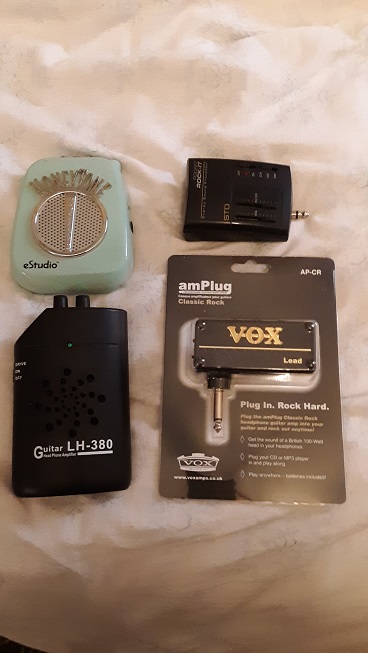
I will take a look at three of the headphone amps that I have on-hand, the two that I got at the swap meet and one that I got about a year or so back when I was talking about bluegrass bass guitar.

First up is the eStudio E-15 Danelectro Honeytone Headphone Amp. This was built to look like the earlier-produced N-10 Mini Amp. While the N-10 had a small speaker and was a small tabletop affair, the E-15 is even smaller, has a similar speaker grille but no speaker, and clips to your belt. It has the normal 1/4-inch guitar input jack and 1/8-inch stereo out headphone jack, along with a useful 1/4-inch out jack for plugging either into a bigger amp to use as a pre-amp or directly into a mixer/recording device. It operates either on a 9-volt battery or connects to a wall-wart transformer. There is a LED power indicator and three push-button switches for power, echo, and distortion. On the side are the volume and distortion level controls. The one I have is seafoam green, and I am aware that there were a few other colors. It has that typical Danelectro flavor to it. The distortion is pretty basic and ratty sounding, and the echo is nothing spectacular. This is a decent headphone amp that if you can pick up used for under $10.00, grab it.

The other headphone amp that I got at the swap meet is a Pocket Rock-it Stereo Sound Processor STD model from CB Labs Inc. About the size of a cigarette pack, I was really impressed with this one. On the back is a 1/4-inch plug that rotates so it can plug into just about any guitar jack at any angle. It has 1/8-inch jacks for headphones as well as an auxiliary jack for plugging in a CD or MP3 player. It uses a 9-volt battery but no power adaptor jack. Controls include the LED indicator, on/off slide switch, a three-way slide switch for clean/distortion/PRX (not sure what it stands for, but it is a shredding distortion sound), and volume and tone filter sliders. What impressed me the most on this one is the distortion sound. Through headphones, this is a killer sound, not ratty at all. Somehow the company created a circuit that makes it sound like a well-driven 100-watt amplifier through the headphones! I am seeing these go for anywhere from $15.00 to $65.00 used online. The one that I have is black, and I have seen some in a gray-metal look and different design. I highly recommend this one if only for the distortion sound, and if you can wire up some sort of adaptor from the headphone output to a line-in to a mixer or recorder for recording purposes, you will not be disappointed.

Finally, there is the Lisheng LH-380 Guitar Headphone Amplifier. I mentioned this one a while back on my blog regarding using a small headphone amp while learning bluegrass bass guitar (https://luegra.design.blog/2020/02/03/bluegrass-bass-part-2/). This one has the belt clip, LED indicator, 1/4-inch input jack, 1/8-inch headphone jack, volume and tone controls, and an off/on/distortion switch. The distortion is passable, but not controllable. This one has a small speaker built in, so you can actually use it as a mini amp, but don’t expect cranking volume. It seems to poorly distort the speaker at half-volume, and in the Distortion mode, it is cringe-worthy. I got this one for about $20.00 off of eBay I believe, and that is about how much it is worth, maybe a few bucks more.

Headphone amps were a lot more valued before the days of software that allowed you to plug into your laptop computer. Building them taught me a lot about electronics, but the field moved way too fast for me to keep up. Perhaps in a future blog I may talk about other special effects pedals that I built for my guitar and bass.

Chew on it and comment.

Categories
Religion

The Chosen

This is the Easter weekend, when Christians around the world lament the death and celebrate the resurrection of Jesus. As well, the Jewish are currently participating in Passover, and those of the Islamic faith are practicing Ramadan. It is truly one of the most holy and religious times of the year.

This week, there will be no talk of bluegrass, nor of music in general. I just wanted to reflect on this time of year. It was one of my mother’s favorite times of the year, in that the family would be getting together at her house to celebrate. As she passed on in January, it is my first Easter without her. Yes, I have been feeling depressed a bit, but I have found solace in an unusual way.

There is a program called The Chosen, which has been streaming on a few services over the past few years, and promised to continue for a total of seven seasons of programming. It is the story of Jesus of Nazareth, from his birth to his death on the cross and his resurrection from the dead. However, unlike many previous films and television mini-series telling the story of the Messiah, this series expands on a number of the tales told in the Bible. It does not stray away from any message in the Book, but instead views the same story from a number of different viewpoints.

A great example is the story of Jesus and the woman at the well (John 4:1-29). While the scene covers all of what is described in the Bible, we also see a bit of why the woman has acted the way she has with her multiple husbands. In a way, it is very similar to what a Catholic does when confessing sins to a priest. It is so moving to watch. The woman is a Samaritan, which does not associate with Jews (and is a recurring theme in the series), yet as the scene proceeds, we see how prejudicial barriers are broken down when communication is forthcoming.

There are so many scenes tike this that are human reactions to what God and Jesus calls upon us. The stress of Simon Peter choosing to leave his wife and family to follow Jesus. The abrupt way that Matthew leaves his comfortable lifestyle to become a disciple. Even the way that the story of the Good Samaritan is woven into the storyline. The production is remarkable, and Jonathan Roumie’s portrayal of Jesus is beyond amazing.

I will get back to talking music next week. I ask now that if you are in doubt of any thing, be it personal, religious, or moralistic, please spend some binge-watching time to watch The Chosen.

Chew on it and comment. Happy Easter!

Categories
Guitars

Guitar Pick Punch: Yes or No?

A few years back at a previous job, my boss gave me a guitar pick punch for Christmas. I always thought that it was a unique item, but never would have bought one for myself. It is only recently I have realized how handy this thing is!

If you are not familiar with it, the guitar pick punch looks a lot like a desk stapler. You take old credit cards and expired gift cards, place them in the punch, and Voila! You have instant guitar picks! With practice and a good aim, one can get four picks out of a normal-sized credit card.

About a year ago, I posted a blog related to this. The guys at Casino Guitars had stated that the guitar pick punch was a terrible Christmas gift, and I disagreed with them (https://luegra.design.blog/2022/02/19/musicians-gifts-from-non-musicians/). At the time, I said that you can use it to make guitar picks to give to moochers while you keep your good ones for yourself. Well, I am now learning that these homemade picks are a lot more valuable.

I recently went into a Guitar center to pick up some Tortex guitar picks. My personal choice for playing are the orange .60 mm standard picks (you know, the ones that are shaped like Joe Scarborough’s head).

Anyway, they used to cost about $3.00 for a dozen. Well, now they are over twice that price! Even on a bargain place like Sweetwater, they are going for $5.49 for a dozen. Paying almost 50 cents for a piece of plastic? That is out of line, in my opinion.

So the guitar pick punch will be resorted to a lot more these days. Think about it:

  • Cost effective. You get four picks off of one expired credit card. A quick sand-down of the edges once punched out, and you have saved yourself almost $2.00!
  • Environmentally friendly. You throw a bunch of credit cards and gift cards into landfills, and they just sit there. After punching out picks from them you are recycling over half of that plastic!
  • Endless supply. I have about five or six tobacco dip tins full of homemade picks. I realize now that I will probably never need to buy another guitar pick (that Tortex pack will probably stay unopened for a while).

Of course, every guitarist has his/her preference for pick thickness. Credit cards seem to be a close thickness to those orange Tortex picks, and thinner gift cards tend to reflect the red Tortex (which I use with my mandolin). The purple heavy 1.0 mm Tortex picks that I use with bass guitar will probably still be purchased, since I don’t see much credit cards that thick, and I don’t think that the punch can handle that thickness.

These punches go for about $25.00 at various online shops like Amazon or Sweetwater. Guitar picks are items that always seem to get lost along the way, and you end up needing more at the end of a gig or practice. Why not save yourself some cash in the long run and help out the environment? I leave you with this guy’s view of the guitar pick punch.

Chew on it and comment.

Categories
Bluegrass Music

Chris Jones & The Night Drivers @ 20 Front Street

A few weeks back, I went to see Chris Jones & The Night Drivers at a small club in Lake Orion, Michigan. The place is called 20 Front Street, and it was quite a drive to get to from my place in Hamtramck. I was actually closer to Flint than I was to Detroit. However, I had a bit of a quest, and I hadn’t seen a good bluegrass show in a while, so off I went on a Saturday night.

Chris Jones is a great flatpicker, and has a low-lonesome sound, one not often heard in bluegrass. The band is a minimal four piece. Included in the lineup is Marshall Wilborn, a legendary bluegrass bassist, and Grace Van’t Hof, a great banjoist who also brings in the baritone ukelele into some of the songs. Along with Mark Stoffel on mandolin, this is what I consider “comfortable bluegrass.” There is nothing too flashy, nothing too mellow, nor nothing too loud and fast.

As for the venue, this was the first time I experienced it. The 20 Front Street is a combination small theater/coffee shop that is run by some volunteer staff. The performance room itself is quite small, with a stage that rally could not fit more than four or five bluegrass musicians, and I do not see any electric band more than a three-piece there. The seating capacity is only about 90, with a semi-circular theater-style. The sound system is perfect for the space, very small and controlled just enough to bring a slight volume to what is on stage. Looking at the venue’s schedule, a large majority of the acts performing are lone singer-songwriter types or folk duos or trios. In short, it reminds me of a miniature version of The Ark in Ann Arbor.

Lake Orion is a small town between Detroit and Flint that one can see it going for the trendy atmosphere. Lots of micro breweries and upscale restaurants, with narrow, clean streets and parking lots that fill up quickly. Those public parking lots are pretty small in size as well as spaces (the Dodge Ram Pickup that I was driving barely fit in the space that I found, and was difficult to maneuver out!).

The two sets performed (plus one encore) were enjoyable, and Chris, being a DJ on Sirius/XM, knows how to talk to a crowd. The place was packed, which when talking to regulars there, happens almost every show. I guess that being that far away from Detroit, some people would rather see a local show than drive out an hour. Fair enough. On the flipside, I would only venture out that far out from Detroit if there was a band or artist that I really wanted to see. It might be considered more now that I have my Chevy Spark compact back.

So I wanted to get Chris to try out the Sevillana 2208 dreadnaught guitar that I received last year from my friend Cherry in China (https://luegra.design.blog/2022/07/16/this-dreadnought-needs-to-come-to-the-u-s/). He jammed on it for about 15 minutes after the show and seemed to enjoy the tone, which made Cherry happy when I sent her the news.

With bluegrass festivals drying up, especially in the Michigan area, touring bluegrass bands may have to find alternate places to play. The 20 Front Street may be a perfect fit for acts similar to The Night Drivers. While A-list acts such as Billy Strings and The Del McCoury Band are too big to be playing such a venue, there are a number of bluegrass bands that would fit in here if they were willing to travel.

Chew on it and comment.

Categories
bluegrass bass

I Now Own an Upright Bass!

Well, last weekend, I bought myself an upright bass. I have wanted one deep down for over 20 years, but always figured that I did not have the room in either house for one, and I could not find even a used one that I could afford. Add to that for the past 20 years, I have been driving around in subcompact cars, so I wouldn’t know how to transport it anyway.

That is why I always stuck to the electric and acoustic basses. It has limited me to who I could jam with as a bassist, so I usually went to jams with a guitar instead (along with a dozen other jammers). Knowing the cost of an upright bass, I have always promoted the use of an electric bass in bluegrass music. Go to my YouTube channel for a few lessons on playing bluegrass with an electric bass.

https://www.youtube.com/channel/UC0ID9z7AR8-0WWGDM-TrsIA

Then last week, everything seemed to fall into place. On the local Craigslist, there has been a seller of a 1/2-size upright bass for the past year or so, but every time I was tempted to contact him, the ad was pulled, so I figured that he sold it. This time, it was up, and for a fair price that I could afford! With my car in the shop for bumper/fender repair, I was using my brother’s pickup truck while he was on vacation. I contacted the seller, and last Sunday, I became the owner of a doghouse bass!

Now, most uprights in the bluegrass, folk, and rockabilly are of the 3/4-size variety. The 1/2-size upright is about 6 inches shorter overall, as well as about 4 inches narrower and 2 inches thinner. I haven’t tried yet, but after measuring the bass, it should be able to fit in my Chevy Spark with the passenger seat pulled back and folded down.

The doghouse bass does take some getting used to as far as switching over from electric bass. I’ll be putting tape on the side of the neck for fret reference, and building up the callouses on my fingers. But I have fallen in love with it, and will pretty much be only playing that instrument for the next few weeks, then switching around after that. I’ve already been scouring YouTube for upright bass lessons. I hope that by the end of summer I’ll be able to have enough practice to take it to jam sessions.

Wish me luck! Chew on it and comment.

Categories
Musicians Rock Music

David Lindley RIP

After posting last week’s blog, I then learned of the death of David Lindley. Even if you don’t recognize the name, you have definitely heard his definitive work on classic rock radio over the years.

David was a true character in the rock-n-roll world. He could play just about any stringed instrument that was handed to him, but his forte was lap steel guitar. His distinctive long curly hair and muttonchop sideburns were as obvious as his taste in clothing, always seen with colorful Hawaiian-style shirts and clashing pants. His bandmates and the music press tagged him “Prince of Polyester.”

However, it was his playing that made him legendary. While he did work with Warren Zevon, Dolly Parton, Linda Ronstadt, David Crosby, and Bruce Springsteen, it was his lap steel guitar playing for Jackson Browne during the 1970s that David is best known. And his best known work during this time was the solos on “Running on Empty.” It is a great song, indeed, but those lap steel solos truly make it a classic. Upon first hearing it, you question what kind of instrument it is. It doesn’t sound like a guitar, a keyboard, or any horn instrument. That sliding-note fill fits the mood of the song perfectly. Only one man could have created that sound, it was David Lindley.

I had the pleasure of seeing David once at The Ark in Ann Arbor about a decade ago. The man was a true wizard on stringed instruments. To make matters even more crazy, he never played the common Fender Stratocaster or Gibson Les Paul for an electric guitar choice. No, it was usually some off-the-wall Japanese or Korean clunker from the 1960s that he straightened out and hot-rodded.

The music world needed someone like David to chuckle at itself occasionally. We can take ourselves seriously with our top-notch equipment and poetic songwriting, but there needs to be that point where we realize that we are human as well, and do silly things. David could do that, but with professionalism. He was equal Paco De Luca and Spike Jones. He knew what sound fit in at the right time, but could make you laugh at a dissonant but intended note.

There will never be a rock-n-roll character like David Lindley, so seek out an album of his (El-Rayo-X and Win This Record are good choices) and put a smile on your face.

Chew on it and comment.

Categories
Bluegrass Guitar Bluegrass Music

Happy 100th Birthday, Doc Watson!

On March 3rd, it was Doc Watson’s 100th birthday. The man left us in 2012, but his amazing legacy has remained with us since then, and with the bluegrass community having such young amazing guitarists as Billy Strings and Molly Tuttle, Doc’s influence will continue for years to come.

His story is legendary, so I’ll keep it short. You can find a biography on Doc on dozens of internet sources.. Born in 1923 in Stony Fork, North Carolina, his family was full of old-time musicians and singers. He became blind at a very early age, but still learned to handle farm chores as well as learned a number of musical instruments.

His forte, of course, was guitar. He started out professionally playing country and rockabilly guitar with a band in Johnson City, Tennessee. Folklorist Ralph Rinzler discovered him and recorded an album of Doc playing fiddle tunes on acoustic guitar for Folkways Records in 1961. It was the start of a 50-year career as a folk guitar icon.

There isn’t a bluegrass guitarist that hasn’t been influenced by Doc. Clarence White, Tony Rice, Norman Blake, Dan Crary, the list goes on. Each generation of bluegrass guitarists have no problem naming Doc as a favorite influence. Every one of them has at least one Doc Watson album. Even though he never considered himself a bluegrass guitarist, but bluegrass bands held his work in high esteem. When he toured with his son Merle, his grandson Richard, or Jack Lawrence, the duo would often headline festivals that had A-list bluegrass bands.

He loved playing with other musicians, always claiming that he continually learned form jamming with others. A beautiful moment can be found on Gather at the River: A Bluegrass Celebration. Doc jams with a young Michael Cleveland, with bluegrass musicians Tim O’Brien, Pete Wernick, and Dan Crary looking on. It is a magical moment in the bluegrass world.

There are two albums that never leave my playlist. The first is Doc Watson’s self-titled 1964 release. Raw and minimal, it is how Doc sounded best, just his voice and guitar working together. The other album is Blake & Rice 2. Doc performs on three songs with Norman and Tony that is simple wizardry.

Finally, there was the great performance called Three Pickers, in which Doc performed with Ricky Skaggs and Earl Scruggs. While each performer has a solo or band set, it is when the three of them are together that the best music is laid down. I still love watching the DVD, but here it is on YouTube.

Happy birthday, Doc! I know that you are up there making the Good Lord smile.

Chew on it and comment.

Categories
Bluegrass Music

Why I Respect Billy Strings

I don’t buy too many CDs any more. Mainly because I don’t get around to seeing/hearing who is out there. However, I do try to keep my ear to the ground when it comes to bluegrass. And I have been pretty vocal in my previous blogs about my admiration of Billy Strings.

A few days ago, I went out and purchased a copy of Me/And/Dad, Billy’s latest release that he recorded with his stepfather Terry Barber. Terry was the man that got Billy into playing guitar. Granted, there were some demons in both men’s lives over the years, namely addictions, that have had an impact on their lives’ direction. As for Billy, growing up in a drug-infused part of Western Michigan didn’t help, but his love for music helped him overcome much of those demons along with an understanding patriarch.

We all know how Billy has become a rising star, not only in the bluegrass community but in the live music spectrum, drawing humongous crowds from traditionalists to Deadheads. One of the things that I admire about him so much is that, to paraphrase Lester Flatt, he never got above his raisin’. His humility has always shown through, and this album is just a sample of that. He recorded a number of bluegrass and old-time country standards with Terry, and share vocal duties throughout. The album has a stellar cast of backup musicians, including Ronnie and Robbie McCoury, Michael Cleveland, Mike Bub, Jason Carter, and Jerry Douglas.

You can feel the family warmth throughout the song selection. It truly feels like Billy and Terry jamming with some friends in the living room on a Friday night. With all of the flash that Billy can have on stage at one of his sold-out shows, one can tell that this is where he is most comfortable.

I talked briefly a few weeks ago that Billy was at SPBGMA in Nashville last month (and how I missed it). You can take it for granted that he drew an amazing crowd. However, what I failed to mention is that he went there with a 13-year-old mandolin player named Wyatt Ellis. Billy knows that people come to see him play his chops, but he is very giving in wanting to showcase other talent, especially young kids coming up in the bluegrass community. Perhaps he is serving as a big brother/mentor to Wyatt, and hopefully he can keep Wyatt on the right track in life as well.

Cheers to you, Billy, it is an attitude such as yours that helps keep bluegrass going!

Chew on it and comment.

Categories
Americana Music

The Jubalaires: Grandfathers of Rap

I have always been a fan of The Mills Brothers. Those great harmonies that would only need a archtop guitar for accompaniment. They were cool, to say the least, and I have spent a lot of time on YouTube watching their vintage videos.

While YT surfing, I came across The Jubalaires. Wow! Same set up (four guys singing together, accompanied by a guitar), but where The Mills Brothers had a slightly jazz feel that kept them popular with the big band crowd, The Jubalaires had some gospel influences, but could also be considered the Grandfathers of Hip-Hop/Rap. They talked a lot of their lyrics in a lot of songs, with hard rhymes that would put many modern rappers to shame.

One video of The Jubalaires has them performing a song called “Brother Bill.” This is one of those black cinema shorts popular in the African-American community in the 1930s-40s. I like the one comment stating “Guns, groupies, dollar sign on suit, they are truly the pioneer of gangsta rap.”

I won’t go on about these guys, I’ll just post these videos for you to enjoy.

Chew on it and comment.

Design a site like this with WordPress.com
Get started