Categories
Music Instruction Old-Time Fiddle

Applefest 2025 / First Guitar Lessons

Last week I went to the 2025 Michigan Old-Time Fiddler Contest, held annually at the Huron Township Applefest in New Boston. I’ve gone to this contest for years and have blogged about it many times. Last year, only two contestants showed up to compete, and I thought that it could not be worse than that. Well, this year proved me wrong.

Yes, only one person showed up to compete. Dave Langdon, who has participated in the event many times and is well-known in the state’s old-time fiddle base, was the only competitor. He received the $200 first-prize award after going through the expected contest performance of playing a waltz, schottische, jig and reel. If I would have known, I would have brought my fiddle (which I haven’t picked up in months), hacked my way through four tunes, and still made second place and gotten $100 pocket money.

Speaking with Jim McKinney of the Michigan Fiddler Association, he stated that each year it gets more difficult to have competitors, as this time of the year finds fiddlers doing fall dances and other activities. It also seems hard to find younger people interested in the old-time fiddle tunes. From my experience, this is completely true, as I talk to young fiddlers and parents that won’t commit to heading down to this festival for a few hours.

To save the day, host Tom McKinney and contest judge Trae McMaken joined Dave on stage for a jam session to use up the time allotted for the competition.

GEDSC DIGITAL CAMERA

I have a co-worker that is interested in learning guitar, and I told her that I would let her try out some of the acoustic guitars that I have for sale to see if she would like to purchase one. Out of curiosity, I went on YouTube to see what videos were available on the search “Beginner Guitar Lessons.” Of course, a number of videos popped up, but as I went through watching them, I noticed that pretty much all of them have no concept of making the easiest way possible to learn basic chords.

Anyone who has started out on guitar knows that there are a few relatively easy chords, such as G and C, that will get the student learning simple folk songs. About half of the “beginner” videos I watched showed the first two chords to try as Em and Asus2. Yes, these are easy to finger on the fretboard, but there are very few songs that a beginner can regularly practice with them.

Go going back to the G and C chords, one of the reasons that these are popular is that playing these two chords can open up a world of simple folk and popular songs to play. I found some videos implementing the G chord as the first chord a beginner should learn, but another problem I saw is that these instructors are making the student finger across the entire fingerboard and strumming all six strings. I remember from my experience over 40 years ago at first learning guitar chords that it takes a long time to perfect even the open G chord, as placing the pads of the fingers correctly without muffling strings is a difficult task for a beginner to acquire.

Next weekend I will be in Lansing to help out at a musical instrument “petting zoo” that the Southeast Michigan Bluegrass Music Association sponsors throughout the year. When I show young kids how to play a guitar and get a good sound from it the first time, I take the instructional route that I learned from a book that I had years ago – that you do not need to pluck all six strings of the guitar to get a good chord sound. With that, you don’t need to reach across the fingerboard to with your whole hand and start off uncomfortably to try and get a good sound. These are young kids often looking for instant satisfaction, so making them contort their hands will only dull their interest.

Instead, I show them that since the guitar’s 2nd, 3rd and 4th strings are tuned to a G chord, they can strum just those three strings to play a chord, and if they want to change the chord, they can just drape a finger across another fret, holding down those three strings, and strum just those three stings again. I also show them to finger the 1st (high E) string at the 3rd fret with the ring finger and strum the four strings to make an even bigger sounding G chord. If they are motivated by that, then we can work on just those four strings to finger a C chord with two fingers. If they become comfortable and motivated enough, I can show them a simple folk song such as “Tom Dooley” to let them know that it is possible to play a complete song in a matter of minutes.

If they are still interested and motivated, that is when I talk to the parents with recommendations of instructional books or teachers, and that once these basic shapes of chords is perfected, the student can expand on implementing the 5th and 6th strings. The idea is to get the student motivated to move on for the next task, NOT to make the first task hard enough to not want to move forward.

I won’t even bother showing any of the videos that I saw on YT for beginner guitar lessons, as watching them just irritated me. I plan to stick to my method when showing youngsters the guitar. I know that not every kid who I show these simple chords on a guitar will stick with it, but in my experience, it did brighten some young eyes when they strummed that chord and it didn’t sound bad.

Chew on it and comment.

Categories
Electric Guitars Lutherie

Shielding an Electric Guitar Body

So after cleaning up the residue from the gigbag on the Ambertone Strat, I let the solvent dry for a few days and the proceeded to put shielding into the body cavity in order to get rid of some of the RF (radio frequency) noise generated by single-coil pickups.

A very short explanation: Just about every electronic device generates RF noise in some way or another. Televisions, appliances, calculators (fun trick – if you have an old working LED calculator, turn on an AM radio, tune it to the lower end frequencies, then hold to calculator next to it and start hitting keys, you should hear some weird noises from the radio), and electric guitars all give off some RF noise. You may hear that 60 Hz buzz through your amp if the amp is not properly grounded. Most guitars with humbucker pickups cancel out much of that hum (along with a quality guitar cord), hence the name. Single-coil pickups do not have the same kind of pickup winding, so the noise is much more apparent, and is why many guitarists like to install a metal cage in the cavity to cancel out much of that noise.

There are two popular ways to shield the cavity. The first is coating the cavity with a conductive paint, available through guitar part supply shops such as Stewart-McDonald. This is a very easy way to do it, just paint the entire cavity, let it dry, and it is done. This method is a bit more expensive, cannot be used on plastic parts, and can be messy if you are not careful with the paintbrush.

The second way is to line the cavity with thin metal strips. Conductive tape is available in copper and aluminum, and the adhesive backing has some conductive quality, so overlapping the pieces will create a continuous contact. I went this route and purchased a roll of Reflectix aluminum tape from Lowe’s for about $5.00. Note, I saw a YouTube video that one luthier shielded a guitar with simple aluminum foil and 3M adhesive spray, which seems a lot cheaper but one has to make sure that there is still conductivity between pieces as the spray adhesive is not conductive. There is also available aluminum sheets, which can cover the entire back of a pickguard, but is harder to mold into the cavity.

If attempting this job, it is wise to detatch the neck from the body, as I tried to do the project with the neck attached but could not remove the pickguard properly due to a lip on the fretboard where it attached to the body. After getting that out of the way, I first shielded the back of the pickguard. Fortunately, there was already some metal shielding on the underside where the controls are installed, so cutting pieces that eventually contacted this shield would mean a good metal cage effect. I covered as much of the pickguard as possible, making sure to keep it away from the wiring so as to not risk shorting.

I followed up with shielding the Strat jack housing, then proceeded to the pickup/wiring cavity. While it may seem like cutting one or two big pieces and molding them in might be easier, it is not. With the many curves and crevices in the cavity, it was better to cut small pieces and pressing in/overlapping each piece. Press the pieces in firmly so that it stays put. In a few spots, I left a lip of foil come over so that it comes in contact with the foil on the pickguard.

After shielding the pickguard and cavity, I checked for conductivity with a multimeter tester. I recommend anyone doing guitar work to get one of these, which small consumer ones can be had for less than $20.00. Besides checking for conductivity, it can be used to check battery and house wall outlet voltage when needed. The entire shielding checked out as solid.

Once finished, I put the guitar back together and tested it out. Dang! No signal at all! It turns out that within the jack housing, the area is so tight that there is a small indentation in the wood for the plug to insert all of the way, and I had covered it with foil, Once I cleaned out that area, I reinstalled the jack and tested it again, this time getting a signal.

The result? The buzzing hum was cut out probably 80%. Not bad, really. Because the single-coil pickups on this guitar kit were cheaply made in Asia somewhere, they won’t have the same quality output as a Dimarzio, EMG, or even a stock Fender pickup. However, I was happy that most of the RF noise was cut out, and this guitar is definitely playable through any amplifier without much buzz. As far as the roll of aluminum tape, I used only about half of it, so I can shield another guitar when needed. Not bad for $2.50 in supplies and a few hours work while watching football on TV.

If you have an electric guitar that is kicking out RF buzz when plugged into an amp, especially when flourescent lights or other appliances are on, I recommend this inexpensive project to help out. There are plenty of videos on YouTube that show how easy it is to do. If too afraid of taking apart your guitar, a good guitar repairman should have no problem handling it.

Chew on it and comment.

Categories
Musical Instruments

Do Not Buy Cheap Guitar Gigbags!

After finishing my Ambertone guitar, I ordered a low-cost gigbag for it, as I was not expecting to take it out for playing, it was just going to be stored in the corner of a room for a while, perhaps to be sold when I needed a few bucks. I purchased a Chromacast electric guitar gigbag from either eBay or Amazon (I can’t remember), got it a few days later, and put the thing in my spare bedroom.

That was about a month ago. A few days ago, I wanted to do some finishing work on the Ambertone (basically, lining the body cavity with copper shielding, I’ll cover that in a future blog) and pulled the gigbag out of the corner. As I was unzipping the bag, I found that the flaps were not opening up properly. Then I started feeling a sticking as I opened the bag a bit more. Sure enough, the inside of the gigbag had adhered to the guitar itself in a number of places on the front and back of the body.

The inside of the gigbag was made of a really cheap vinyl, not cloth that I find on most other gigbags. Now I knew this wasn’t a great gigbag, not much better than a heavy-duty trash bag with a zipper and pocket on it, but I would think that it would at least not stick to the guitar finish after only a month.

Years ago, I pulled my Peavy T20 bass out of storage. It had been in its hardshell case for a few years without opening, and was in a closet that did not have great temperature/humidity control. The foam padding had stuck to the guitar and strings, and it took me a full day to clean it off. This Ambertone situation was quite similar, only that it had been in the bag for only a month, and the bedroom was temperature and humidity controlled.

Anyone who works with guitars a lot knows that vinyl does not work well with various lacquers used on guitar finishes, especially older guitars and mandolins. This is not supposed to be the case with polyurethane finishes. In fact, I googled “vinyl and polyurethane guitar finish” and found very little stating that there was a risk. Anyway, I spent about an hour last night with Goo Gone and a plastic paint scraper getting the residue off. Some spots required a little bit of elbow grease.

I have other gigbags around the house, and I checked the lining on them. Almost all had some form of cloth lining. I may have talked about this before in a previous blog, but there was a time (remembering Mars Music again) when you could get a quality gigbag for around $10.00. Yeah, they were most likely made in China or Vietnam, but they served the purpose. Today, gigbags are more the norm than hardshell cases, fully padded and with some durability. Of course, one can expect to pay well over $60.00 for a decent bag. When the guitar is not even worth that, why pay that much?

Well, in this case, I know that I shall invest a little more for a gigbag. Even if the guitar is not worth much, investing in a gigbag for more than $40.00 should be considered. If purchasing in-store like at Guitar center, open the bag up to see what the interior is made of.

Chew on it and comment.

Categories
Bluegrass Music

IBMA World of Bluegrass 2025 – I’m Not There Again This Year

The International Bluegrass Music Association World of Bluegrass convention is being held this week in Chattanooga. I chose not to attend again this year, as the IBMA is still too political for me to tolerate. Once the organization realizes that bluegrass has never been that political, but has left-leaning officials and board members that force their political and social views and rids these vermin, then I may consider attending.

With that said, let’s take a quick look at what has been reported so far.

For the awards on Thursday evening, my “kid sister” Vickie Vaughn won Bass Player of the Year for the third year in a row. Billy Strings took home Entertainer of theYear (no argument here), and the fiddle partnership of Jason Carter and Michael Cleveland took away three wins (Album of the Year, Song of the Year, and Collaboration of the Year). Most of the other awards were predictable, although Strings did not win Guitarist of the Year, that went to Trey Hensley.

Strings also was seen jamming with a number of elder Bluegrass statesmen, including opening the convention with a performance joining Junior Sisk. Ever since they first performed together back at the Charlotte Bluegrass Festival in June, there seemed to be a budding friendship. The best jam had to be when Strings joined Joe Mullins in the exhibit hall and sang a duet with the legendary Paul Williams.

Strings also provided the opening keynote address. He has had the biggest impact on bluegrass in the last 20 years, so it should be expected that sooner or later he would present this address at WOB. He talked about how music has always been a part of his life, and that bluegrass has helped him through his toughest times. He also talked about how traditional and progressive bluegrass artists and fans have to be more accepting of each other. While he has helped the format gain a humongous fanbase, I am not sure the full picture is visible to him and many others.

I’ve walked away from the IBMA (as well as the Americana Music Association) for non-musical reasons. Both groups have taken on a lot of political stands, which turned me off. The biggest one was supporting Black Lives Matter. IBMA never said anything about the vandalizing of the Bill Monroe statue during the George Floyd protests. And now that we are learning how corrupt the BLM officials were, using monetary donations to purchase mansions for themselves, there are no apologies.

One of my co-writers emailed me earlier in the week asking if I was attending. When I told him I was not but that he should still do as much to enjoy the week, he stated that he was sorry that I was not there but would check in with me in a few days. I don’t see spending hundreds of dollars on a conference that I don’t agree with politically just so I can do some jamming and possible networking. I actually enjoy attending SPBGMA in January much more because there is no politics, just people having good conversation as well as jamming in a much smaller area.

Chew on it and comment.

Categories
News

Charlie Kirk RIP

No bluegrass or other music-related talk today. I am just saddened by news from the last week.

On Wednesday, September 10th, conservative podcaster/speaker Charlie Kirk was assassinated while holding one of his outdoor rallies at a college in Utah. I won’t get into any of the details here, as there is so much of the coverage on news websites. In short, Kirk passed away a few hours after being shot, and two days later, the suspect was captured through turn-in by his father. Evidence is almost overwhelmingly showing that the suspect is guilty, but I am sure that the judicial process will go for months.

Charlie Kirk was an amazing person. He never went to college, but was more well-read than a large majority of college students, even professors. He formed Turning Point USA while in his teens, which became one of the biggest conservative organizations to ever see life. His right-wing stand on the Constitution, freedom of speech, gun rights, and right-to-life topics made him a hero to many, but also a villain to others.

The media, especially left-leaning news programs and podcasts, had no problem calling him a fascist, misogynist, Islamiphobe, and transphobe. This was far from the truth. At his rallies, he usually set aside a large amount of time debating anyone that disagreed with him, even telling them to come to the front of the line. His choice to do this was innovative, as no other speaker, left- or right-leaning, had ever done this before. YouTube videos show these confrontations, and each time, Kirk’s intelligence as well as patience always prevailed.

As his reputation grew, Kirk’s influence with right-wing politicians, including President Trump, became immense. Political analysts agree that Kirks’ influence over getting young voters to consider the Republican ticket is one of the big factors in getting Trump elected. However, the rhetoric of the far-left progressives have gone too far. Yes, last year, Trump was nearly assassinated at an election rally in Pennsylvania. The media toned down the “Hitler” comparisons out of respect, but that was only for a few months. As soon as he was in office, the dangerous name-calling returned. In fact, the rhetoric only increased to include his staff, administration, and celebrities that supported Trump such as Kirk.

There are a lot of insane people out there that are walking the streets, and when you have mainstream media calling anyone that is not fully on the left a fascist, these crazy people will take matters in their own hands. The result is the death of Charlie Kirk. Of course, the left will blame gun laws instead of its rhetoric influence. The media did not pull the trigger, but basically gave the killer his proverbial bullets.

If there is any positive reaction to this tragic event, it is seeing not only other conservative activists such as Ben Shapiro, Benny Johnson, and Dave Rubin stand up and show the courage to continue the fight. Moreover, more liberal leaners are washing their hands of the left and reconsidering what the stand is of the progressive Democratic party as well as leftist activist groups. Kirk’s widow, only three days after the tragedy, has spoken in public that she will continue to fight for what he believed was the Constitutional and moral right of America and its citizens.

I am not married, and have no children, but if I were to ever have had a son, I would have wanted him to be just like Charlie Kirk. Yesterday I came across a YouTube video of a young lady asking AI (something that I am not a fan of at all, but I digress) the question, “What would Charlie say?” It is a moving piece, and brought me to tears.

Chew on it and comment.

Categories
Home Recording

My Recent Experiences With Demo Recording

Last weekend I was in the process of recording a demo of a song that I recently wrote. I was finishing up on a guitar track when the recorder, a Zoom MRS-4 4-track digital recorder, crapped out on me. It had been my primary songwriting demo tool for probably the past 10 years if not more. The STOP button had dislodged slightly a few months back, but I was still able to use it. Well, this time, it completely broke and I could not stop the recording. I even took it apart to see if I could get in there and re-set the button. No luck! So into the trash it went.

I really valued that MRS-4, mainly for its ease in recording simple song demos with minimal instrumentation (all the better for me, who is a hack on most instruments, anyways). It had it’s pros and cons, such as:

Pro
-Again, ease of use. With simple Zero Return and marking of punch-ins/outs
-Built-in metronome that was easy to set and did not bleed into the recording
-Nice amount of mixdown effects such as EQ, multiple reverb settings, compression and chorus
-Portability. Smaller than the old Yamaha and Tascam cassette recorders

Con
-Use of SmartMedia cards, which are pretty much obsolete. Even when you can find them, they are a hefty price. Moreover, the machine limited the card capacity to 256 megabytes, so even if you used a 1- or 2-gigabyte disc, it only allowed 256 mB. That would limit it to about 5 demos per card. I had a SmartMedia-to-XD card adapter that worked for a while, but that somehow got destroyed and trying to find a replacement for that was even more difficult than finding SmartMedia cards
-Trying to set up some of the effects was a hassle. I was still having to refer to the torn-up manual to figure things out, which you could tell was originally written in a foreign language and translated to English

To be honest, though, if I could find a used working one for under $40.00 or so, I would probably grab it, as it was a convenient machine.

So I ended up pulling out the Tascam DP-02CF 8-track digital recorder that I purchased used at the US-12 Longest Yard Sale two years ago. I got it for a measly $25.00, but had to hunt down and purchase a power supply online for $35.00 more. It was a coin toss if it actually worked, and it did when I checked back then. I purchased a gigbag style carrying case for it and stored it away for those two years, never even testing it out.

I uploaded the manual a few months back, and going over it, it had way more technical stuff going than the MRS-4. I figured that I would have to sit down for a week or so to study it before even turning the power button on again. There are actually two versions of this recorder. The DP-02CF uses a Compact Flash memory card, and had a 2 gB card already with it. Again, these are not the easiest to find, but a bit more common that SmartMedia cards. This is designed for someone who will use it as a recorder/mixer, then connecting an outside source for the final mixed recording (stereo tape machine, MP3 recorder, etc.). The DP-02 model, instead of using the CF card, has a built-in CD recorder. This allows for someone to use the recorder as an all-in-one recorder and mixdown machine. This model also has a few other features such as built-in reverb that are not found on my model. Both models feature only two-input recording at a time, MIDI connections, and an effects loop for adding an external effect. More knobs and faders than what I was used to with the MRS-4, but it was not a problem to handle from my experience with analog recording and live PA during my younger days.

I hit the power switch, and the small LED screen had a lot more information than the MRS-4 ever did. I set my mind to what I wanted to do, and then thumbed through the manual to find related information. With no internal metronome (at least, not that I could see, it relies on the MIDI interface for that), I had to connect the metronome app on my phone to Track 1. The mic for the acoustic guitar was then set to Track 2. After adjusting some knobs and checking the meters, I hit the RECORD button. The result was much better than I expected. The sound was just like the MRS-4, but the replay feature made it easier to check out the results.

After laying down the guitar and bass tracks, I looked at my options. With the MRS-4, I would have two tracks left. I could record the lead vocal, then decide what to do with the remaining track, either a second instrument or harmony vocals. I could do some bouncing to lay down the guitar, bass and vocal to one track, but that meant having to really pre-judge the levels of the three recordings to one track. I usually kept the demo then to guitar/bass/lead vocals/harmony vocals.

With the DP-02CF, after guitar and bass (and metronome), I still had five tracks to work with. I laid down the lead vocals and harmony vocals, then laid down a second guitar part on Track 6. On playback, the first half of this second guitar was great, but I screwed up in the second half of the song. So Track 7 received a guitar part that replaced that flubs on Track 6. Track 8 was used for a rhythm mandolin part.

Listening to the results, I am quite pleased. If I wanted to get more creative, I could use Track 1 and record over the metronome with another instrument or second harmony vocal. If I had time to sit down and experiment, I probably could have done some punch-in with the second guitar to clear up another channel. Perhaps as I get used to this 8-track recorder more, I can get some more professional results. For the present, my first work with the DP-02CF has made a much more professional recording than what I was getting with the MRS-4.

I still need to do a mixdown of the results, and will be plugging in a small outboard reverb unit for a better demo. I hope to post the demo on my ReverbNation page in the next few days. I also plan to keep an eye out for a used working MRS-4, as I still value its usefulness, as well as having a lot of demos still on SmartMedia cards.

Chew on it and comment.

Categories
Bluegrass Guitar Bluegrass Music

Billy Strings & Bryan Sutton “Live at the Legion”

In last week’s blog, I talked about a bluegrass album that I was not too thrilled about. This week, I will be raving about an album that is absolutely fantastic!

Last April, bluegrass flatpickers Billy Strings and Bryan Sutton performed an intimate duet show at Nashville’s American Legion Post 82. They did two sets in one day consisting of bluegrass and old-time standards that have been a part of most parking lot jams over the past few decades. They have each performed some of them at their own shows, and almost all are recognized as being previously recorded by the likes of Doc Watson, Tony Rice, Clarence White and Norman Blake.

A few months back, I got word that the concerts were recorded and would soon be released as a double album by Reprise Records. I immediately put in a pre-order, and finally received the package a few weeks ago, I have been thoroughly enjoying these discs, going through each one at least five times over the past few days, and am just now sitting down to tell you about it.

Strings and Sutton are geniuses on the acoustic guitar. Everyone who reads my blogs know how much I love and appreciate Strings’ work. Sutton has been a go-to bluegrass guitarist for about 30 years, starting with his tenure in Ricky Skaggs’ Kentucky Thunder, being on the A-list in the Nashville studios, and serving as guitarist in the re-formed Hot Rize, replacing the greatly missed Charles Sawtelle. Both gentlemen kept meeting up with each other at various bluegrass festivals, and would partner in after-hours jams as well as sit in on each other’s performances. Last year, when both of them had a break in touring, they decided to quickly book a venue for a day and do some picking together for a live audience.

Two of my favorite albums of all time, of any genre, have been the two Blake & Rice recordings released by Rounder records several decades ago. The sound of two acoustic guitars in the hands of masters working off of each other is Heaven to my ears. Live at the Legion has been that for me, with the added enjoyment of it being performed in front of a live audience. There is that beautiful intimacy that comes from a live acoustic performance, along with the between-song banter that is most definitely charming. It is the next best thing to being there.

A large majority of the songs are standards with bluegrass musicians, particularly guitarists and fiddlers. There are wonderful interpretations of “Nashville Blues,” “Walk On, Boy,” “Salt Creek/Big Sandy River,” and “Gonna Lay Down My Old Guitar.” Also included are some folk standards such as “Tom Dooley” and “Darling Corey,” as well as the Bob Dylan classic “Don’t Think Twice, It’s Alright.”

Both players give it their best, and never try to outdo each other. There is no need to, as they ave both proven themselves to be the best at their work, and hold each other in high esteem as musicians. Both have always paid musical tribute to the aforementioned greats of bluegrass guitar, and both also have set up their own original expertise. Working off of each other on these discs is something that every guitarist, be they bluegrass or other genre, should listen to and pay attention. While the songs and even presentation have been performed and recorded similarly before, this album is so amazingly fresh to the ear of anyone wanting to hear what true bluegrass musical collaboration can be.

Chew on it and comment.

Categories
Bluegrass Music

A Recent CCR Bluegrass Tribute Album: Tepid at Best

A few weeks back, I heard one of the most mediocre tribute albums that I have ever heard, and it is a bluegrass tribute to a rock band.

CMH Records has released tribute albums for years, mostly through its Pickin’ On series. These have mostly been instrumental recordings paying tribute to artists from the Beatles to Metallica. I have never had much interest in these albums, but there must be enough of a paying audience for them to keep the series and the record company going.

Its most recent release takes a departure from the norm, as this latest includes vocals. Pickin’ On Creedence Clearwater Revival: Bluegrass Rising has an established bluegrass band named Iron Horse performing 12 CCR classic rock tunes. The result is hardly earth-shattering, and while some bluegrass fans may take some interest, it seems to be more of a boring jam session with players that are looking to do some songs outside of the parking lot standards.

The biggest disappointment with this album is the vocals. As a long-time fan of CCR, one of the charms of the band was John Fogerty’s voice. It was gritty without being obnoxious. It fit the songs, which had that Southern Rock feel (even though the band was from California). The singer for Iron Horse attacks (?) the lyrics with the energy of a 9-volt battery that has used up 8.5 volts. There is nothing motivating in the singing, and it is more disheartening when the instrument backing is halfway decent.

Other than “Looking Out My Backdoor,” which has a 2/4 time bounce common with bluegrass songs, most of the CCR original songs were in straight 4/4 time. These types of songs are hard to make into strong bluegrass numbers, unless an artist is purposely keeping the 4/4 signature like what Alison Krauss and Dale Ann Bradley. These then become simply acoustic pop songs, but are enjoyed by bluegrass fans because of the artist. However, Iron Horse does not have the clout to pull a whole album of these arrangements.

I don’t want to gloat on this too much. I was just very disappointed hearing this album when it was played on a local bluegrass radio program in its entirety. If you go to the CMH website (https://www.cmhrecords.com/products/pickin-on-ccr-cd-mp3), you can decide for yourself.

Chew on it and comment

Categories
Acoustic Guitars

My Cirrus Guitar is Here!

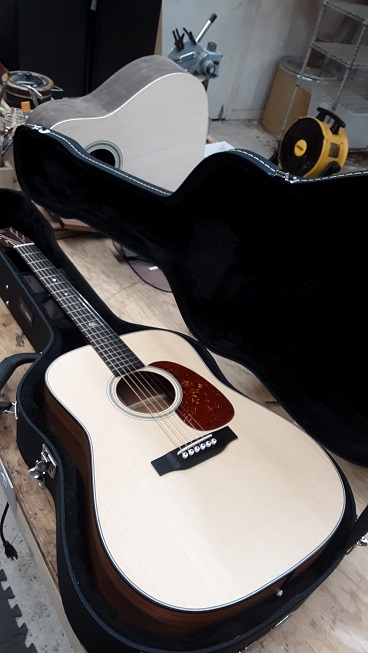
Well, here she is! My new Cirrus guitar, and she is ALL MINE! It is the model CD Dreadnought, basically standard features except that I ordered it to have a slightly shorter 24.9-inch scale fretboard.

She sounds great to be sure, a heavy lower midrange that will cut through as a rhythm guitar during a bluegrass jam without being too boomy. The shorter scale seems to fit perfectly with my smaller hands, as I was playing “Wildwood Flower” without any fretting difficulty. The finish is the way that I like it – semi-gloss, so it’s not too shiny but not dull matte looking either.

It was so worth the 3+ month wait for it, as I know that it is truly my personal guitar, not one that I bought either used or off the rack at a store. I cannot wait to start taking her out for jams. I already have three people at my workplace asking me to bring it in so that they can try it out.

Mike Franks, the owner of Cirrus Guitars, has his shop here in suburban Detroit, so it was great that I could go directly and pick it up instead of waiting for shipment. I have talked about his shop in a previous blog (https://luegra.design.blog/2025/03/29/i-ordered-a-cirrus-guitar/), and he is a big bluegrass fan. He’s made guitars for the Grascals, the Rhonda Vincent Band, and a few other acts. He is also contracting with Gallagher Guitars in making some of their fretboards.

It is great to see a fantastic luthier here in my backyard, so to speak. I will definitely be promoting his work whenever and wherever I can. I plan on taking this guitar to the SPBGMA conference in January. Hopefully I can get some of the artists there to try it out and take an interest.

I’m keeping this one short, as I want to get back to playing my new love. Now I just need to give her a name (all of my other regularly played acoustics have names, all women that have meant a lot to me). I highly recommend you check out Cirrus Guitars at http://www.cirrusguitars.com/ .

Chew on it and comment.

Categories
Bluegrass Music Musical Instruments

US-12 Yard Sale 2025/SEMBMA Picnic 2025/Misc.

This weekend was the US-12 Heritage Longest Yard Sale, so I took Friday off from work and did the drive. This year, I started driving west from Dearborn, but as expected, the set-ups really weren’t available until I reached Saline. I went as far as Allen, Michigan and turned around. Of course, I had to hit Randy’s BBQ in Brooklyn, MI for the famous Godzilla Sandwich (Google it!).

I didn’t get many bargains, as there was not a lot offered as far a music-related stuff. I got a gig bad and an empty Gibson hardshell acoustic guitar case, but the only real bargain (maybe) was a Dean electric bass.

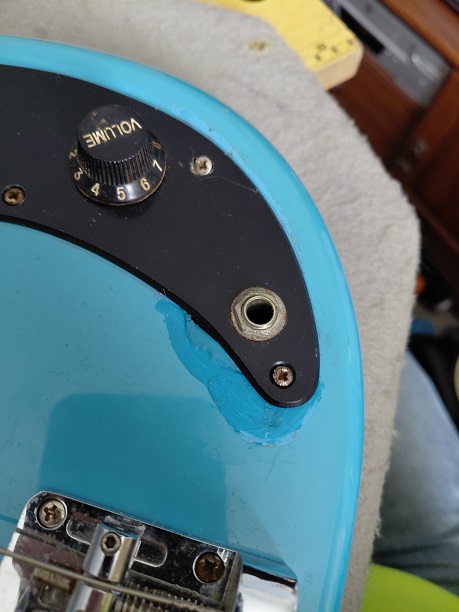
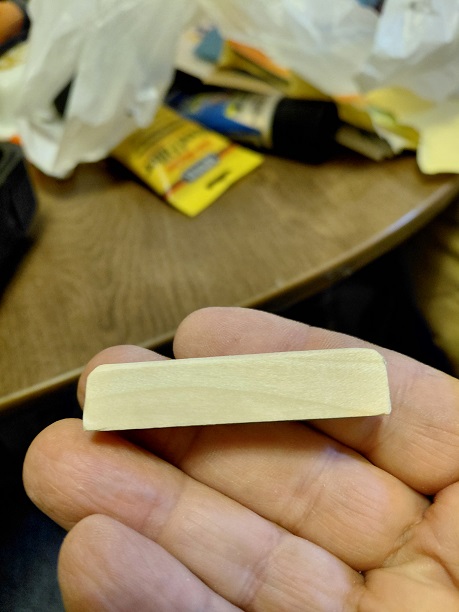
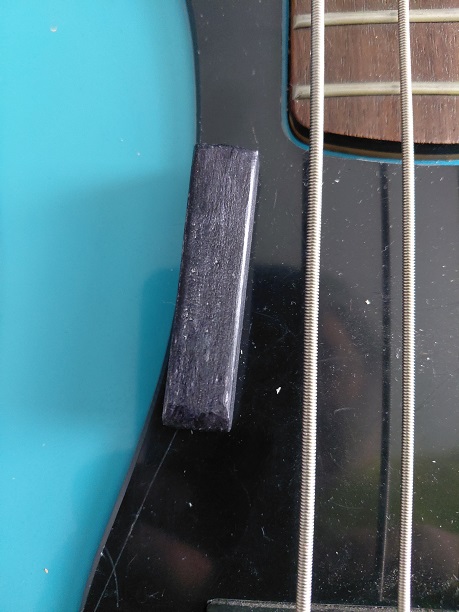
I purchased it on the way back home and didn’t really look at it closely. For what I paid ($60.00), just about any cheap bass would be a decent buy. Once I got it home, I took a better look. The neck, body, and hardware are definitely a Dean model, but it looks like the pickguard and pickup were replaced with a generic setup, which doesn’t properly fit the body. I’ll most likely patch it up in places (like removing some stickers on the back of the body) and sell it off.

The Southeast Michigan Bluegrass Music Association had its annual picnic and Hall of Honor ceremony Saturday. Not much to talk about here, only that we are still in need of young pickers to receive scholarships. Two current recipients showed up for the afternoon jam session, along with a few older members. I have never been much of a jamming enthusiast for myself, but I know how others enjoy it.

I received a nice email from my friend Sister Clare Marie of the Sister Servants of the Eternal Word convent in Alabama (https://luegra.design.blog/2020/08/07/nuns-performing-bluegrass-and-diversity/). It seems that they are in need of some more material. Looks like I need to get finished with some of my incomplete bluegrass gospel songs.

This morning I got the new Billy Strings/Bryan Sutton live CD. I cannot wait to throw it on the player and give a review, which will come probably next week. Also, I got the call that my Cirrus guitar is finished, so I’ll be picking it up next weekend.

Short and sweet for this week, Chew on it and comment.

Design a site like this with WordPress.com
Get started