Categories
Electric Guitars

Fender Meteora HH – On Sale This Weekend!

It’s Memorial Day weekend, so most of my free time is being spent at local cemeteries planting flags at military graves. I just wanted to post a quick note of what I saw and purchased this past week.

Although I am pretty much ingrained in bluegrass and acoustic music these days, I still appreciate the history and sound of the electric guitar. I played electric for 20+ years, and tried my hands at starting a collection years ago that ultimately crashed during my unemployment and recession years. I have sold off much of my collection of electric guitars and amplifiers, but I still keep my eye out for a deal, even if it means keeping it for a while in hopes of increased value.

We come to this past week. I’m on the Fender email list, so every time the company has some type of new edition or sale, I get word of it in my email inbox. Currently, Fender is having a Memorial Day Sale, and I decided to check it out. While most of the guitars are still either out of my price range or not of interest, I came upon the Player Plus Meteora HH for $579.00. Fender started producing these unique guitars about five years ago, and they do not seem to have a big following amongst notable guitarists in any genre. It has a body that looks to be a melding of a Jazzmaster and a Gretsch Thunderbird. Why I didn’t just blow this one off was that it is a Fender guitar made in Mexico, not a Squier product. There are other Meteora models made in Japan that are much more pricey.

The pickup configuration is two humbuckers, similar to what is found on the Telecaster Deluxe model. The pickups have a coil tap with the switches mounted in the volume controls. The pickup selection switch is also like the Tele Deluxe (which is like the Gibson Les Paul), and the controls are two volume pots and one tone pot, similar to a Fender Jazz Bass. The tremolo bridge looks to be similar to the more common Strat type. The fingerboard is made of Pau Ferro, which is a cheaper version of rosewood, and the body is Alder, so the weight is probably less than a Strat or Tele.

Like I said, I haven’t seen any guitarists of nominal fame performing with this model, so it may be why they are selling at an affordable price. Since it is a Fender, there is a quality level that one can expect will be more than satisfactory. As it is not a Telecaster or Stratocaster, or even a Jazzmaster or Jaguar, it may disappear within a few years from production. Looking back on the history of Fender guitars, even failed models such as the Marauder, Coronado, Musicmaster and Swinger are now demanding high resale prices. So who knows? Perhaps these Meteora models will increase in value in a decade due to rarity, or maybe a much-needed endorsement will make them gain value.

I should be receiving my Meteora within the next week, so I hope to do a blog about it when it comes and I have done a test-run on it. In the meantime, If you really want to own a true Fender guitar and cannot fork over the cash for a Strat or Tele, you may want to consider picking up one of these guitars, especially now that it is on sale.

https://www.fender.com/products/player-plus-meteora-hh

Chew on it and comment.

Categories
Classical Music Lutherie

The 15th International Henryk Wieniawski Violin Making Competition

This past week was the 15th International Henryk Wieniawski Violin Making Competition held in Poznan, Poland. I love watching and listening to the competing violins, seeing if I can tell any nuances that make them the best. Of course, I am far from an expert compared to those that are judging the instruments.

I wish that I could enjoy the entire competition live, but there are a lot of factors that are against me. First, it is during the evening in Poland, so it is broadcast in the afternoon here in Detroit, so I can only catch bits and pieces while I am at work, Fortunately, the entire stream is posted on the Wieniawski Society YouTube channel (https://www.youtube.com/@WieniawskiSociety). When I do catch a bit at work, I have to keep it really low volume, as earphones are frowned upon.

I had talked a lot about this competition in a blog four years ago (https://luegra.design.blog/2021/05/15/the-14th-international-henryk-wieniawski-violin-making-competition/), so I will not go into details here. This year, 85 violins from 18 countries were in competition. Polish luthier Paweł Kubaca won both First and Second Place with his Sona and Luna violins, respectively. Third Place went to Liu Zhaojun from China for the Sunrise violin.

There are two longer videos on the YouTube channel showcasing the finalists and winners, as well as a third video highlighting a quartet performance of the winners. Even if you are not into classical music, you may enjoy listening to the instruments and why each one was put into the finalist positions. It is truly amazing to see how such intricacies can make or break a choice when most of us just see a simple violin. Musicians who base their life on a quality instrument to continue their careers are stringent, and as a guitar player for over 40 years, I can understand.

The next competition for violin making will be in May of 2029. In the meantime, the 17th International Wieniawski Violin Performance Competition will be scheduled within the next wto years. I recommend that you continue to check both the YouTube channel and the Wieniawski Society website (https://www.wieniawski.com/) for updates.

Chew on it and comment.

Categories
Lutherie

Tru-Oil For Guitar Finishing

This week’s blog will be short due to a busy schedule. I wanted to talk briefly about my continued work on the guitar building project.

The neck that was in the Fesley guitar kit had an extremely light finish coating on it. It left the neck smooth, but I could tell that it would wear down to the bare wood after some playing and may cause some unneeded damage from sweat and grime. I wanted to put another coating of finish on it, but not with the polyurethane that I would be spraying on the body.

After doing some research on the internet, I found that there were a few recommendations to use Tru-Oil. This is a varnish-like liquid that is primarily used on rifle and shotgun stocks. It is very easy to apply with a cloth or sponge, and if applied thinly with a few repeats, will give a smooth finish as well as protective coating.

A small bottle usually goes for about $10.00. I had a tough time finding it in my area. I went to three gun shops, and none of them had it. I finally found it at a Dunham’s sporting goods store. According to internet searches, it seems to be available at Wal-Mart and Cabela’s as well, and can be ordered from a number of sources. I just wanted to get my hands on it right away, so I drove around until I found it.

The neck is maple with a rosewood-like fretboard Fesley calls “Techwood.” If anything like rosewood or ebony, it is best to keep unfinished (and oiled with lemon oil during cleaning or changing of strings), so I taped it off (along with the plastic/bone nut) before finishing. I applied three coats total, letting each coat dry 24 hours before the next. Tru-Oil is extremely thin, almost like water or a thin furniture polish, and I applied it with a soft cloth. A little goes a long way, and after the three coats, I still had about 3/4 of the 3-ounce bottle left. Once the third coat was dry, I hand rubbed the neck with OOO-grade steel wool.

I am pleased with the result. The back of the neck is just as smooth as before, yet you can see that varnish-like sheen to offer protecting from sweat and grime. I made sure to apply each coat thinly so as not to have any drips.

I would highly recommend the use of Tru-Oil for this type of finishing on a guitar neck or even a bare wood guitar body (I have seen a few examples online, and I may try it on one of the other solidbody kits that I have), especially if you do not want to fully spray polyurethane or do not have the equipment to do full spraying. It is easy to apply, and gives a great protective finish.

Chew on it and comment.

Categories
Bluegrass Music

Billy Strings Proves He is Cool, …, Again!

The Flatt & Scruggs song “Don’t Get Above Your Raisin’” has a message followed by many in the bluegrass field. Basically, the theme is do not forget where you came from, and do not forget who helped you achieve any success that you have had along the way. Billy Strings proves once again that he is a true follower of this sentiment.

Last September, Strings and his wife Ally were blessed with the birth of a son. Unfortunately, due to immediate health concerns, the infant was placed in the neonatal intensive care unit (NICU) at the Helen DeVos Children’s Hospital in Grand Rapids, Michigan. Through 24-hour monitoring and care, his son gained normal health and was able to leave the hospital after some time.

Last week, to show his appreciation to the staff at the hospital, Strings not only visited the hospital, but also participated in a video for the facility’s music therapy program, as well as performed mini-concerts on each of the floors for the patients, including at the NICU floor.

The video performance is part of the Corwell Health’s Blue Glass Studio program that broadcasts pertinent information related to music therapy. Of course, for this particular video, the name was changed to Blue Grass Studio to honor Strings.

While many entertainment figures take time out of their careers to do charitable acts, most of these actions are usually done on off-time or when the career is in a lull. Billy Strings is at the height of his career, selling out concert venues and working with some of the biggest musical artists in the bluegrass, country, and rock worlds. While his adolescent past has been filled with a number of demons, he has fought them off and offered thanks to the people and prayers that have been there with him.

This incident shows that Strings is grateful for everything good that has happened to him, be it in the music field or his personal life. For that, I continue to have a great respect for him.

For more information on this wonderful hospital visit, including photos, go to https://www.mlive.com/news/2025/05/grammy-winning-billy-strings-pays-visit-to-grand-rapids-childrens-hospital.html .

To conclude, here is a recent interview with Strings about his respect for all of the music that he grew up with. Pardon his French.

Chew on it and comment.

Categories
Bluegrass Fiddle

Farewell to Fiddler Magazine, I Guess

Back in 2012, I wanted to help my friend, fiddler Becky Buller, promote her solo career. I had become aware of Fiddler magazine about a year earlier, grabbing a copy from the rack at Elderly Instruments in Lansing, Michigan. I emailed the editor Mary Larsen if she would be interested in an article on Becky, along with inlcuding my writing resume. Mary got back to me with a request, and it was the start of a decade-long positive relationship with the publication.

I was extremely pleased that the Becky Buller article became the cover story for that issue, and had proceeded to provide an article nearly every quarterly issue since then. While primarily interviewing bluegrass fiddlers, I also produced articles on klezmer, Quebecois, and country music fiddlers, as well as numerous album reviews and survey articles on teaching, instruments, and even handling COVID.

Back in 2022, Mary decided to retire from the editor/publisher end of the publication, and the magazine was purchased by a freelance writer named Narielle Living. The contributing writers of Fiddler were happy that the magazine would continue. Narielle had a strong publishing background, and made the overall look of the magazine receive a more modern appearance. She also had a good business sense when it came to magazine publishing. Unfortunately, Fiddler was meeting the same fate as many other print publications, in that, paper costs and postage were making boutique magazines non profitable, so the decision was made to go online only in 2023.

For some more mainstream publications with a wider scope of readers, online-only magazines can prove survivable, maybe even decently profitable. However, Fiddler was not one of those fortunate ones. The majority readership of Fiddler seemed to prefer print format, particularly since there was tablature for fiddle tunes printed, and it was easy to just put the magazine onto a music stand to practice. Moreover, there is something about print that makes it more comfortable and welcoming to read anywhere at any time, rather than pulling out the laptop, tablet, or iPhone.

It seemed that only one or two online issues of Fiddler were published. I continued to send in my interview and review articles to Narielle. However, by early 2024, I was not seeing any notice in my email inbox that a new issue was being uploaded online. She had updated the magazine website (www.fiddlermag.com/) with cleaner graphics, but nothing to announce the new issue date. Available merchandise consists of different stickers, but no available back issues.

I have attempted to contact Narielle at least a dozen times to get some information on the magazine’s current and future status, but have not received any reply. I have even contacted Mary to see if she has heard anything, but she gets the same non-response. A number of online chatboards dealing with the violin and fiddle have numerous postings about the magazine’s existence, and all answers lead to dead ends.

This is a sad state indeed. I can understand if there is a need to discontinue the publication for any one of a number of reasons, but not providing a statement as to its closure to the contributors and readers is not good. For me, it was an easy outlet for my freelance writing. While the pay vs. time spent interviewing and writing was not that great, it was rewarding to get to know many fiddlers in different genres, as well as keep my writing chops fresh. For readers, this was one of the truly few resources for roots-music fiddlers to learn about the many aspects of fiddling. While there are other magazines that cover roots music in general, and even one or two publications that center on the violin, none covered the subject of fiddling like Fiddler.

This may have been my last opportunity for freelance writing, in particular in the music scene. Fiddler was the perfect outlet for my writing. I will have to re-evaluate my time and commitment to part-time writing, if I should decide to continue. Freelance writing is truly a dog-eat-dog world. Moreover, with print magazines disappearing one by one, online publishing does not provide a steady income, if any income at all. Taking a look at the writing of some online publications, the editorial work is horrendous, and articles look like they were written by a 5th grader.

I so much hate to see Fiddler go, and I keep hoping and praying that this hiatus is temporary, and someone will see how valuable this publication has been to so many fiddlers, both beginners and old-timers, and help to bring it back to life.

Chew on it and comment.

Categories
Bluegrass Music Country Music

Recommended Book: Highways and Heartaches: How Ricky Skaggs, Marty Stuart, and Children of the New South Saved the Soul of Country Music

The 1970s through 1990s were a struggling time for traditional country and bluegrass music. Movies like Urban Cowboy were bringing rock, pop, and even disco influences into the country music vein. It was the start of moving country music stars from honky tonks to arenas, with overdriven guitars and light shows becoming the norm. There were a few sparkles of traditional country lights within the realm, but they were few and far in between. The Grand Ole Opry began to lose its charm, with old stalwarts re-hashing past hits to a senior citizen crowd for nostalgic purposes.

The tail end of the punk/new wave movement did show a lot of respect to the spirits of Hank Williams and Patsy Cline, as well as some near forgotten legends like Johnny Cash, Porter Wagoner, and Loretta Lynn with speed-driven covers and originals that paid musical tribute. However, it would be at least a decade until the fledgling cow-punk and alt-country sub-genres would blossom into what we now know as Americana music.

So during those dry times, there were a few performers that kept the flame going because their hearts were in the right place. Highways and Heartaches: How Ricky Skaggs, Marty Stuart, and Children of the New South Saved the Soul of Country Music provides a decent chronicle of that time by looking at the musical lives of Skaggs, Stuart, and a number of other musicians from that era and group.

The first chapter is a bit too politically correct for my taste, as while it looks at Skaggs’ poor upbringing in Kentucky, it looks at Stuart’s upbringing as being heavily influenced by the racial tensions in his hometown of Philadelphia, Mississippi. While I am sure that there was a lot more bigotry around back in the 1950s, the author Michael Streissguth narrates it as if it was in the blood of every white person in the South. There is way too much coverage of segregation, lynchings, and other racially motivated happenings that have very little to do with the musical influences of Stuart.

Later chapters cover the legacy of Ronald Reagan and the influence of the Moral Majority. Again, it all passes as the author trying to be politically correct and apologetic for being white.

Once the reader gets past that, the flow if the book is quite interesting. Even if you are familiar with both Skaggs’ and Stuarts’ early careers, there are a few things that you may still learn. We all know of Skaggs’ work with Keith Whitley and Ralph Stanley, but there were a lot of inner struggles that he was having to move out on his own, as well as wanting to be known as a serious go-to musician and arranger. For Stuart’s part, his early teen years with Lester Flatt would cement him as a bluegrass prodigy, but the downside is that he really never got to live life as a normal teenager. He spent almost all of that time surrounded by older bluegrass musicians that had their ways of drinking, carousing, and occasional fighting, and his studies were spent in a tour bus instead of a normal high school.

While the gist of the book follows the career of these two modern legends, there is also ample coverage of other artists from that time. These include Jerry Douglas, Emmylou Harris, Larry Cordle, and Linda Ronstadt. Bluegrass coverage includes extensive mentions of J.D. Crowe, Doyle Lawson, the Seldom Scene, and the many festivals that were popping up due to the public’s interest in roots music from both the liberal and conservative teams.

If you can get past the PC talk, this book makes for an interesting read, learning how much Skaggs and Stuart were able to keep traditional country and bluegrass alive during this dark time, and become the highly respected statesmen that they are.

Chew on it and comment.

Categories
Rock Music

Clem Burke RIP

Sadly, another musician that I admired greatly has passed away. Clem Burke, best known as the drummer for Blondie, passed away last Sunday at the age of 70.

While Blondie was best known for the gorgeous lead singer Debbie Harry, the band had some amazing musicians as well. Especially amazing was Burke, who was definitely a drummer’s drummer. He knew exactly what kind of rhythm was required for each song. When I first heard “Dreaming” from Eat to the Beat, I was knocked out! The drumming was out of this world. Keith Moon would have been proud. If one heard it for the first time, one would think that it could not be done by one person. Then the band appeared on Saturday Night Live, and Burke showed that he had the chops and energy to play the song live.

(Apologies for the poor sound quality, I really just wanted to showcase Burke’s drumming)

Then listening to the other cuts, one can hear beats from disco, roots-rock, even jazz-influenced. Burke could do it all. He was influenced by so many drummers, and he soaked all of them in. One would think that, listening to those early Blondie albums, there were different studio drummers on the recordings.

Burke was an original member of the band, and remained with it form its beginning in 1975 until his death. When the band took a long hiatus, he continued working with a number of other artists who held him in high regard. He drummed for a few years with the Romantics, and would later work with Wally Palmer in the garage-rock band The Empty Hearts. Other artists he either recorded with or played live with included The Ramones (his moniker was Elvis Ramone), The Go-Gos, The Fleshtones, Dramarama, The Eurythmics, Pete Townsend, The Plimsouls, and Iggy Pop.

The one time that I got to meet Burke was at The Ritz in suburban Detroit. I am not sure what band was performing, this was in the early 1990s, and he was there with Wally Palmer. I knew Palmer from his hanging out at the Hamtramck bar Paycheck’s occasionally (A story for another time). Anyway, Burke was a great person, who truly loved music. Whatever time period he would have been born in, he would have been a musician of some sort.

His drumming may be copied in the future, but he will never be replaced.

Chew on it and comment.

Categories
Bluegrass Music

Russell Moore Joins AKUS

Unless you are bluegrass fan that has been living under a rock the past few years, you well know that Alison Krauss and Union Station have released its first album in 14 years, Arcadia, and will be touring to support to album, the band’s first tour in over 10 years.

Most of the AKUS member are returning to the fold, including Jerry Douglas on dobro, Barry Bales on bass, and Ron Block on banjo along with Krauss. One big piece of the missing puzzle is guitarist/vocalist Dan Tyminski. After having a solo side project for a number of years, Tyminski has decided to bow out and concentrate on The Dan Tyminski Band full time.

So who could replace Tyminski? After all, it was his voice that made the O Brother, Where Art Thou? soundtrack so successful with his two unique renditions of the bluegrass classic “Man of Constant Sorrow.” For years afterwards, it was mandatory that AKUS perform that song in concert and on numerous television appearances. The song became a staple with bluegrass jam circles, and helped AKUS gain an even larger following of fans not necessarily into bluegrass music.

When I first found out that AKUS was releasing another album and touring, I saw a photo of the band as it is today, and noticed that the one guy did not look like Tyminski. In fact, he looked a lot more like Russell Moore, the guitarist/vocalist for the bluegrass band IIIrd Tyme Out. Reading the accompanying article, I was correct in my thought.

For anyone who is not familiar with Russell Moore, he has been a stalwart in the bluegrass field for decades. He first came onto the notable scene as a member of Doyle Lawson & Quicksilver. He then formed IIIrd Tyme Out in 1991 with former Quicksilver members Ray Deaton and Mike Hartgrove. Since then, the band has earned seven IBMA Vocal Group of the Year Awards, and Moore has won the IBMA Male Vocalist of the Year Award six times. In 2007, as sole remaining original member and long-time head of the band, the name for the group was updated to Russell Moore & IIIrd Tyme Out. If you want to know how good this band is, get one of its live albums, Live at the Mac or Back to the Mac.

So with the opportunity to snag just about any great bluegrass guitarist/vocalist in the format, and there are plenty, why would AKUS choose Moore. My response would be, “Why not?”. Moore is an amazing bluegrass singer, who could easily float between baritone and tenor when needed. While he sang lead exclusively with IIIrd Tyme Out, he also is a genius at harmonizing, learned from his work with Doyle Lawson. He has never really showcased his lead guitar abilities with his band, but from seeing him live (I have, four or five times) he can throw in some tasty licks when required. Mot importantly, as both a band leader and sideman, Moore knows exactly what is needed to make the band sound the best that it can be. He is a workhorse when it comes to personal discipline, and every recording he has been on, as well as every live appearance, he gives it his all.

Will Dan Tyminski be missed? Of course, but all bands in every genre at every level experience personnel changes. AKUS made a wise decision to ask Moore to join the fold. They have already mutually agreed that he will be able to continue work with IIIrd Tyme Out as well. The AKUS tour will continue through early autumn, so while it means intensive touring for the next six months, it also means that all of the AKUS members, including Moore, can bet back to solo projects before the year’s end.

I look forward to seeing AKUS in September when it arrives on the Detroit area. I alo look forward to hear how Moore’s soulful voice will fit in with the band. I am sure that it will sound fantastic as usual.

Chew on it and comment.

Categories
Acoustic Guitars Bluegrass Music

I Ordered a Cirrus Guitar!

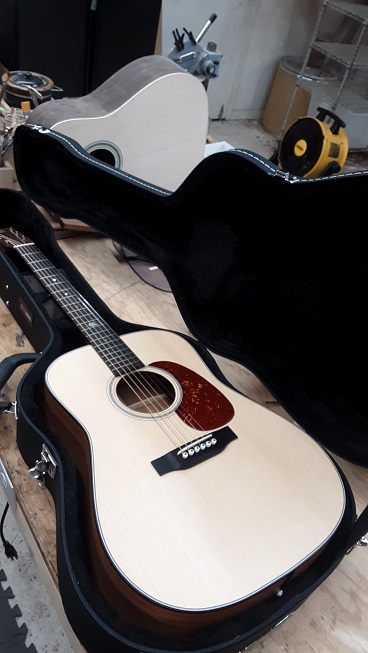
I can mark off another item on my bucket list. This morning, I went to the Cirrus Guitars shop and ordered myself an acoustic guitar made to my specifications!

I had blogged about Cirrus Guitars previously (https://luegra.design.blog/2023/10/28/cirrus-guitars/), and have been thinking about getting a guitar from there ever since. With money that could have spent on a bigger TV or some other item that does not really strike my fancy, I love guitars so much that it was what I wanted to treat myself to. I contacted Mike Franks, owner/luthier for Cirrus, a few weeks back, we scheduled a meeting this morning, and I went to the shop in Sterling Heights, Michigan.

Mike was extremely friendly, and was grateful that I paid for the guitar in full rather than just a down payment. The shop is Heaven if you are a guitar enthusiast like me. Acoustic guitars in every stage of construction line the walls and workbenches. He has a special paint booth, and the whole shop is well ventilated and humidified. He also has a room set up for taking photos of his finished guitars, and a space where he holds small house concerts.

The best part of his tour was seeing some of the guitars that he is making for bluegrass artists. One guitar is a special left-handed model under his M.J. Franks brand of guitars for Jamie Johnson of The Grascals. He is also making a custom dreadnaught for John Bryan of The Grascals as well.

He related a great story of how he once heard an Osborne Brothers tune on the radio that moved him deeply, then fast forward two decades, and Joe Miller of Bobby Osborne and the Rocky Top Xpress requested a guitar made for him. When it was finished, Franks took it to Nashville to present it to Miller at the Grand Ole Opry. He was then sitting on stage at the Opry when Miller performed with the band, and had that song dedicated to him that evening.

Franks knows how special bluegrass artists are, not only with the care and concern they have with acoustic instruments, but how much they appreciate the people around them, be they fans, promoters, or luthiers. You can see in all of the work he puts in every guitar that his respect goes equally back to the artist.

My guitar should be ready in about three months, and I am in no big rush. I know that I will fall in love with the guitar, simply because I see the quality work that goes into Cirrus guitars. Franks has stated that I should stop by the shop in a few weeks to see the progress. Despite the rainy weather going on today, the day was fantastic for me!

http://www.cirrusguitars.com/

Chew on it and comment.

Categories
Bluegrass Mandolin Bluegrass Music

David Grisman at 80

I was reading an article online about a show that David Grisman was doing in Seattle to celebrate his 80th birthday. I had to look twice and research the information, and yes, on March 23rd, David “Dawg” Grisman will be turning 80 years old. Grisman has always been one of my favorite people in the bluegrass field, especially as he loved to push the boundaries of traditional bluegrass to include rock, jazz, blues and klezmer, which critics and fans alike labeled as Dawg Music.

The way that young girls follow Taylor Swift’s every action, my buddy Ken and I always had a keen interest in the bluegrass musicians that gathered in other musical influences to create the Newgrass movement that began in the early 1970s. Along with New Grass Revival, John Hartford, Tony Rice and the Seldom Scene, Grisman made a name for himself with other musical formats while still keeping one foot in bluegrass.

Somewhat of a musical prodigy on the mandolin, though he also played piano and saxophone in his early age. He grew up in the Jewish community of Passaic, New Jersey, but discovered folk and bluegrass while attending New York University. He was a member of Red Allen’s band The Kentuckians, and also recorded with Hazel Dickens & Alice Gerrard on their early beautiful Folkways recordings. He delved into rock music with former Blue Grass Boys guitarist/vocalist Peter Rowan to form the short-lived Earth Opera. The two would also form the legendary bluegrass band Old & In The Way with Vassar Clemens and Jerry Garcia. His friendship with Garcia lasted for decades. He recorded on the Grateful Dead’s American Beauty album, with standout work on the songs “Ripple” and “Friend of the Devil.” During this time, he also worked with Rowan, Richard Greene, and Clarence White in the band Muleskinner, which disbanded due to the untimely death of White. Only weeks prior to White’s death, the band performed on a local television show in California, meant to be a warm-up for an appearance of Bill Monroe which did not happen. Fortunately, a video of the band’s performance was saved and is available as Muleskinner Live.

In the 1970s, Grisman formed the David Grisman Quintet, which had a revolving membership that included Darol Anger, Tony Rice, Mark O’Connor, and Todd Phillips among others. He recorded a number of Dawg Music albums during this time, which were critical favorites, and are cherished mainly by Deadheads.

The Garcia/Grisman collaborations continued throughout the years, with gems such as Jerry Garcia/David Grisman and Not For Kids Only. A wonderful documentary on their relationship was released in 2001 called Grateful Dawg, directed by Grismans’s daughter Gillian. The film includes a number of live performance by the duo which are near perfection. Probably the best storied collaboration was with the two and Tony Rice. During two evenings in February 1993, the three musicians sat down in Grisman’s home studio and recorded a number of standard folk and bluegrass tunes. A copy of the tape somehow got into the hands of a pizza deliveryman, and within months, the songs form the recording were being bootlegged across the country to thousands of Deadheads. At first angered, including confiscating bootlegged CD, Grisman eventually released some of the recordings in 2000 as The Pizza Tapes (an extended version was release online in 2010).

In 1990, Grisman formed Acoustic Disc, a record label that would specialize in unique bluegrass, folk, and jazz recordings, particularly live performances. Along with The Pizza Tapes, the label has released other recording by Grisman, Rice, Jesse McReynolds, Old & In The Way and Doc Watson. The label’s catalogue is a wealth of great acoustic music, and I personally have at least a dozen releases from there.

Grisman was FINALLY inducted into the International Bluegrass Music Association’s Hall of Fame in 2023. This was an honor that should have been given decades before, as his music was what was getting many younger musicians and fans into bluegrass. He never strayed away from bluegrass music, as his love was so deep that he names one of his children Monroe after the great Bill Monroe.

I saw Grisman only once, and it was at an Ann Arbor Folk Festival many years ago when he performed with Doc Watson. There were a number of bands performing at that festival, but that to me was the highlight, as two legends were trading licks and presenting an acoustic format that forced you to pay attention and appreciate it. My only other connection with Grisman is that we both had music played on the NPR program “Car Talk.” His composition “Dawggy Mountain Breakdown” was the shows theme song.

I totally recommend that you get some of Grisman’s recordings. Traditional bluegrass fans will want a copy of one of the Old & In The Way live discs. Acoustic music fans will love The Pizza Tapes or just about any other album on Acoustic Disc (www.dawgnet.com), and I encourage you to check out the documentary Grateful Dawg as well as the performance of Muleskinner Live.

Happy Birthday, Dawg! You have made my musical life, as well as thousands of others, so much more rewarding and enjoyable!

Chew on it and comment.

Design a site like this with WordPress.com
Get started