Categories
Music Instruction

When I Used To Teach Bass Guitar

As I continue to clean out my house to sell it off (probably some time next year), I continually come across stuff that makes me think back to my younger days. A few days ago, I came across a load of guitar and bass instructional books. I used to teach guitar and bass as a sideline, but that faded away as family issues overtook my time.

As for guitar, I was not much better than teaching beginner stuff. Open chords, timing/tempo, simple bluegrass/country/blues lead work, and recommending someone else if the student wanted to go further. In most cases, it was the student that lost interest after a few lessons. With bass guitar, I provided more experience. While I was very basic when it came to slap bass and fretboard tapping (I am still an amateur when it comes to that stuff), I loved stressing the importance of the bass within the band. Knowing the root of the chords, where to move comfortably along the frets, feeling the beats, setting the groove without being flashy and obnoxious, and being a reliable anchor were part of my syllabus.

While I was not big on teaching theory and more about playing by ear and feel, there was always one bass guitar instructional book that I felt was essential. Mel Bay’s Electric Bass Method–1 by Roger Filiberto. Mr. Filiberto was a stringed-instrument teacher in the New Orleans area from the 1940s until his death in 1988. He wrote this book, originally titled Mel Bay Presents The Electric Bass, back in 1963 when the bass guitar was relegated to either a lackluster guitarist or an upright bass player that needed to expand his/her worth. This was just before Beatlemania, so when that hit, the bass guitar became cool like Paul McCartney. Thus, this book became extremely popular.

I remember getting a copy around 1981 when I got my first bass. The original editions had a pink cover with 60s-era drawings. By the 1980s, when the title changed, the cover sported a photo of a modern-style bass. However, the inner pages had not changed. They still showed Filiberto playing weird Hagstrom bass with strange controls, as well as graphics that were definitely not computer-generated. The thing is, this book provided (and still provides) a wealth of information to the beginner bassist. Looking through it now, probably 10 years since I last opened it, I still see how valuable the lessons are, especially with basic note and sight reading.

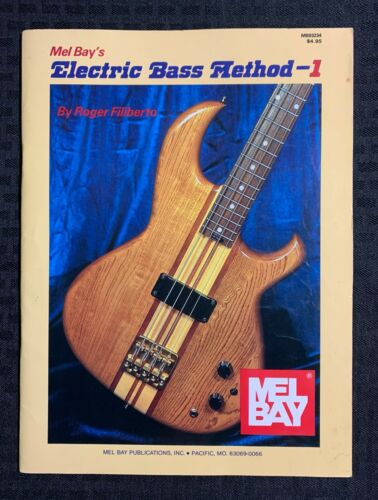
I wish that I still had my copy of this book
The newer version

I also found a few other Mel Bay bass books. The company put out a Value Line of instructional book/CD combinations back in the 1990s that unfortunately they have discontinued. These were geared more toward specific styles of music and consisted of just a few pages of examples to copy. These usually sold for less than $10.00, and the funny thing is, I have seen them going on eBay or Amazon for a lot more, or being sold out fast.

One other book that I found was The Everything Bass Guitar Book. This was one of those “Dummies” type of books that were popular a few years back. While it did provide a decent amount of instruction, much of the book is dedicated to other factors related to the bass guitar, including famous players, what type of bass/amp to purchase, practice tips, and how to audition for a band. In other words, the book for someone who says to him/herself, “I want to be a bass player” and doesn’t know where to start. I probably picked this book up at a cheap price just for the heck of it.

Which leads me to my next thought. Whenever I was teaching bass or guitar, or just talking to someone about practicing their instrument, I would always recommend that, if you were at a rummage sale or used bookstore and you came across some instructional books or videos on the cheap, buy them! While I wouldn’t pay full price for a video on heavy metal guitar if I’m playing bluegrass music, if there is a video in the bargain bin for a buck or two, go ahead and get it. Watching the video, you may learn a thing or two about your current playing. I have a library full of books and videos for guitar, bass, banjo, fiddle, mandolin, and dobro that I can always reference if need be. And it didn’t cost me that much.

While my teaching days are pretty much over, I still enjoy seeing younger people, or even older people starting out, having fun learning a musical instrument. The pandemic forced a lot of people to stay at home and, in turn, find new things to do like learn a musical instrument. I hope that most of them chose to continue to play now that we can get back out and mingle with other people.

Chew on it and comment.

Categories
Music Musicians Songwriting

Perfect Song #5: A Taste of Honey “Boogie Oogie Oogie”

I have been debating for the past few days as to list this song as part of the Perfect Song series, or simply a guilty pleasure. It is both for me, so let’s proceed.

A Taste of Honey was one of many flavors of the disco era. Record companies were looking for anything that they could throw out on vinyl that would get people dancing at the discotheques. However, this band was different. The band actually had been around since the early 1970s doing USO tours and corporate shows in the Los Angeles area. The core of the band was bassist/singer Janice Marie Johnson and keyboardist Perry Kibble. The original guitarist Carlita Dorhan left in 1976, and Helen Payne replaced her. It was these three musicians (along with producers Fonce and Larry Mizell) that made “Boogie Oogie Oogie” the classic song that it is today, over 40 years after its release.

On the surface, the song is typical disco. Basic 4/4 beat with a dance tempo, moving bass line, and simple lyrics. However, there is a reason (in fact, a few reasons) why “Boogie Oogie Oogie” is still relevant today while thousand of other disco songs gather dust in the used vinyl bins at the local record store. First off, this was performed by the band, not a bunch of studio musicians backing a molded and shaped singer. When you have musicians that have worked together for a number of years, whether it is a tight-knit studio ensemble or a group like The Beatles, a good listener can distinctly tell that groove.

Turning to the song itself, it was written by Johnson and Kibble. Again, no record company tampering here. In the pop music world, having a team of songwriters is the norm. However, the Mizells and the A&R people at Capitol Records had a good ear this time.

Now, let’s look at probably the most important piece of this song – the bass line. Johnson laid it down herself. There was no bringing in a studio pro bassist for the recording, and that is a good thing. This bass line is beyond the disco dance groove. It is a line so catchy, that any beginning bass player HAS to learn it! For anyone that studies music production (like me), it is so damned refreshing to know that she got carte blanche with her bass playing. It is beyond a groove – it is a statement. I also love that, at the end of the second chorus, she sings, “listen to my bass, now!” Yes, I am listening!

Next, let’s check out the rhythm guitar. Again, laid down by Payne, not some studio guitarist. The intro has that slide that is sensual, then once the song kicks in, the staccato picking followed by the jangly Bb chord. What makes this sound so special is that the guitar sound is so clean. No distortion, delay, or dated effects like phasing or flanging. Just the guitar straight into the amp. Yes, there is that heavy-fuzz lead at the end of the first chorus, but it can be expected to create a different kind of tension. But Payne makes playing rhythm guitar sexy.

As for the lyrics, there is nothing that is literary here. Simple words that people can sing along to. Johnson has a sweet voice that makes the verses flow smoothly. Then, when the chorus kicks in, Payne’s gritty backup harmony singing is beautiful. The vocal climax here is at the end of the chorus, when the words “more — boogie” is sung, it goes from two-part harmonies to a full, lush sound. THAT is a great production ear!

The band had another hit with a cover of “Sukyaki” in the early 80s, as well as a few more Top 20 hits. But nothing has had the long-term impact that “Boogie Oogie Oogie” has had. The song is sexy without being sexual. The arrangement is timeless, and again, that bass line makes anyone that picks up an electric bass want to learn that groove. Because the disco era was not kind to most artists, a group like A Taste of Honey felt the wrath of the recording industry. Fortunately, knowing that the song is still being played on classic R&B radio stations as well as appearing in a number of commercials and soundtracks, royalties are still going to Johnson and Kibble’s estate (he died in 1999). A wonderful thing would be to see Janice Marie Johnson receive more recognition for her amazing bass playing.

Chew on it and comment (and listen to her bass, yeah!).

Categories
Americana Music

Dusty Hill RIP

Late last week one of the great rock-n-rollers passed away. Dusty Hill, the bassist and co-vocalist for ZZ Top, died in his sleep. What can one say about that band? For 50 years they provided some of the best music on classic rock radio.

Visually, the band had its forte. Dusty and guitarist Billy Gibbons had those extra-long beards (Texas goatees), which ironically, the band’s drummer Frank Beard didn’t have one. Early in the band’s tenure the boys would wear either Nudie suits or dirty coveralls. From the time the band released its iconic album Eliminator in 1983, Dusty and Billy were often seen with some visually creative and cartoonish guitars and basses on stage and on the popular videos (who can forget the white furry guitars that spun around in the video of “Legs”?). That album (as well as some successful videos on MTV) took ZZ Top from arena rock to pop music realm.

But even before that, it was a band that every fan of rock-n-roll loved. They could fit in with Southern Rock, Hard Rock, Pop Rock, and even some aspects of Punk Rock. It had that Texas sound. And Dusty was a big part of that. His slightly distorted bass guitar sound helped fill out the three-piece situation amazingly on stage.

Live shows were legendary. The band would often bring out farm animals on stage, and the shows would go on for hours. After the 80s success, it became a lot more flashy on stage, but still kept the music close to its Texas blues-rock roots.

Before Eliminator, ZZ Top had some classic rock gems. Think about it: “Tush,” Cheap Sunglasses,” and “La Grange” are continually played on classic rock radio, and has inspired so many to take up the guitar or bass. Dusty’s bass sound on those cuts were raw, heavy, and in-your-face! I always loved that he preferred the Fender Telecaster Bass, which is a bit different from the standard Precision Bass. The Telecaster bass was not contoured, had a Telecaster-style headstock, and was wired with a single-coil pickup, which was centered on the body. It gives a more midrange sound to the bass, which allows for those distorted harmonics without sounding muddy. Perfect for what ZZ Top ways doing as a three-piece band.

Dusty cited Jack Bruce of Cream (another classic three-piece rock band) and Jazz bassist Charles Mingus as influences, and it showed in his playing. He wasn’t content with just thumping on the tonic note, but wasn’t flashy either so that it conflicted with the lead guitar. Just listen to that guitar/bass crawl from E to G on “Tush.” Everyone recognized that as a ZZ Top move, even though it had been done dozens of times before. Dusty had an amzing ear for what his bass playing should do.

In the late 1970s, the band took a haitus, and Dusty actually took a regular job at the Dallas Airport. People would often ask if he was the guy from ZZ Top, and he would deny it. He had some difficulties along the way. In 1984 he accidently shot himself with a small derringer gun. In 2002 he was diagnosed with Hepatitis C, and in 2014, he had an accident in the tour bus, which forced him to bow out of a performance, and the band’s guitar tech Elwood Francis sat in on. Dusty had later told Billy that if something should happen to him, Elwood should take his place. The band is currently planning on continuing with Dusty’s wishes.

I cannot count the number of times that I have strapped on my bass guitar, put on one of my ZZ Top albums, and played bass along with the record. Dusty had a groove that controlled the way the song would go, yet still letting Billy go all out on lead guitar. The “thump” of those fingers on the strings was like a sledgehammer. It was hard, forcing the beat along with Frank’s bass drum. I always found myself bopping my head while soaking in the bass line of “Tush” and “La Grange.” In short, THAT is how a rock bassist should play! If you have any questions, get a copy of 1973’s Tres Hombres, Fandango from 1975, or Deguello from 1979 and pay attention.

Thank you, Dusty, for keeping rock-n-roll in my blood all of these years. Your bass playing will be missed.

Chew on it and comment.

Categories
bluegrass bass Bluegrass Music

My Charlie Daniels Memory /Bluegrass Bass Part 4.1

Last week, the music world lost a legend when Charlie Daniels passed away from complication of a stroke on July 6. There have been hundreds of blogs and tributes on Charlie, so I hope that you don’t mind if I throw in my thoughts and history.

I can still remember hearing “The Devil Went Down To Georgia” on just about EVERY radio station in Detroit! Country stations, rock stations, and Top-40 stations were all playing it. You could not help but love the song. It was a great storyline, the fiddle playing was plain crazy, and that gravelish voice was one that cut through skin. Charlie was the true connection between country and rock music, more than Hank Jr or Skynyrd. You knew that there was a good time when a Charlie Daniels show was scheduled. I went to one and was drained afterwards. I still remember the baseball caps and T-shirts that were in every truck stop during the 70s: “I party with the Daniels – Jack and Charlie!”

My sort-of connection with Charlie came in the mid 90s. I was sending out some demos of my band at the time to various record companies. Back in the day, you sent out a query letter, included a return postcard that they could reply with a yes or no on your stamp, and if they said yes, you sent off a cassette. I sent off probably a hundred or so, and one of the few that wrote back with interest was Blue Hat Records, Charlie Daniels’ private label. They were interested in hearing us, so I sent off a tape. A few weeks went by, and I got back a letter saying that they were not interested, signed by Charlie. I wish that I could find that letter, I know that I kept it.

Charlie was a true gentleman, and he will be missed. His first love was bluegrass music (his first band as a kid), but his long-time love was the USA. I hope that he knows that there are still people out there playing the fiddle breaks from “Devil.” He will never be forgotten.


I was looking over my bluegrass bass blogs a few days ago, and I forgot to mention what can be used for an amplifier until you secure a proper one.

Since most of us listen to music through our iPhones or computer, we have most likely relegated the old home stereo system to storage in the basement or garage (if it wasn’t thrown out in the garbage). If you still have it, then put it to use again! Check the back of the receiver/amplifier to see if there is an input marked AUX, TAPE IN, or PHONO. If so, you can plug your guitar cord into one of these inputs by using an adapter that converts a 1/4-inch plug to an RCA phono plug. You can probably get one of these from an audio store, I’m sure you can order one off of the internet (I do miss the old Radio Shack stores). Check which channel you plug into, Left or Right, and that should coincide with that channel’s speaker output.

NOTE: Turn the volume all of the way down before plugging in or turning the stereo on. The speakers for home stereos are not designed for musical instruments, and you could blow the speaker. Also, you will notice that the overall volume is quite low unless you are using a PHONO input that has a built-in preamp. You may also need to cut back on the bass tone control so as not to distort the speaker. You can also use the headphone jack to listen without disturbing others.

This setup should suffice for a while until you secure a decent portable amp. BTW, if you have the proper cords and adapters, you may be able to run the bass through one channel and plug your iPod/iPhone or even a CD player through the other channel and play along with songs.

Chew on it and comment.

Categories
Bluegrass Music

Bluegrass Bass: Part 4 (Final?)

Happy Easter, everyone! It’s not as exciting of a holiday as it should be, what with the Coronavirus “stay home” situation, and there’s not much to gripe about in the bluegrass world, since we are all in the same boat. So I figured that I will talk a bit more about using the electric bass guitar in a bluegrass setting and try to finish up this topic.

I have covered the bass, amplifier, accessories, and some pointers on learning to play bluegrass-style. These few remarks will deal with getting your electric bass to sound more like an upright bass. The first two tips cost nothing or next to nothing, but the others will mean investing a little cash.

Tip #1 – Put a small piece of sponge (the cheap nylon type that you can get at the dollar store) and slip it under the strings right where the strings meet the saddles at the bridge. This will cut the sustain on the strings when plucked as well as get rid of some of the high-frequency overtones. The magnetic pickups in a guitar work off of electrical vibrations from the string movement, and in turn, allow the sound of the string to sustain longer. Muffling the strings a little will cut back a bit on that, which means the vibrations will be less, like the plucking of an upright bass string. In the 1950s and early 1960s, bass guitars from Fender and Gibson actually came equipped with a muting device at the bridge so that the sound was close to an upright, which was still in demand on recordings. A good example of a P-bass using a mute is James Jamerson’s bass playing on early Motown records. It really wasn’t until the late 1960s that the bass sound came into its own and those devices were discontinued. Be sure that the sponge is not too big as to muffle the strings completely, and as close to the bridge as possible.

Tip #2 – Where you position your plucking hand makes a difference in the sound. DON’T USE A PICK! You are going to want to pluck the strings the way a standup bass player does. They usually have the plucking hand right where the fingerboard ends at the body. The strings have much more play and less high end at this position. You can use your thumb (early electric basses had a finger rest on the pickguard for use of the thumb to pluck to get a standup bass feel, while today the rest is used by the thumb for finger plucking), or bring your hand up toward the fingerboard, bend it down at the wrist, and pluck with the index finger or index/middle fingers pressed together. Don’t play modern finger plucking, where the index and middle fingers work in tandem (John Entwhistle made it famous, Jaco Pastorius made it an art form). No, stick with the thumb or single-touch finger, the way a standup player does. You will get used to the callouses.

Tip #3 – Consider using either flatwound or tapewound bass guitar strings. Roundwound strings, especially when new, give off a lot of high-frequency harmonics, sounding like the lower notes of a piano. Flatwound and tapewound strings will cut some of that high end, yet will still give a clean sound, even when using thumb and fingers instead of a pick. The downside to this is that flatwound and tapewound strings are expensive, usually running about $30 per set, which is about twice as much as a set of roundwound strings. You can check out a number of videos on YouTube where players are comparing flatwound and tapewound strings to roundwound strings, although most of them are playing rock or funk grooves to showcase. If you are using a short-scale bass (usually those with a 30-inch scale), finding flatwounds is extremely difficult, and finding tapewounds is near impossible (which is a little strange, since the Hofner 500-1 “Beatle Bass” is a 30-inch scale and was designed for flat- and tapewounds).

Tip #4 – Try an acoustic simulator guitar effect pedal. These pedals are primarily designed for electric guitar players who want to get a near-acoustic sound for a song or two at a gig without having to pull out an actual acoustic guitar. Acoustic guitarists who plugged into the PA system found that these pedals gave them a much more natural sound with a little tweaking of knobs. The first one was produced by Tom Scholz’s Rocktron company. I had one of these, and it did have some great tone control, but was a bit noisy, so forget using it in a recording situation. I also had one of Behringer’s early acoustic simulator pedals, which was also quite noisy. Pedals available today range in price from about $30 to over $150. It’s more of a gimmick than a necessity, to be honest, but if you have money to blow, go ahead.

There are a number of videos discussing similar techniques on YouTube. One technique that is covered on some of the vids that I don’t recommend is “palming” the strings, This involves muting the strings at the bridge with the side of your hand on the pinky side. While it deadens the strings, you are plucking near the bridge, which has more bite than bass.

Play with the tone controls, both on the bass and amplifier, and listen to what sounds the best. Also listen to bluegrass recordings for the upright bass, and see how you can get as close to it. It won’t sound exact, but it will be close, and a lot less money spent overall than even a cheap standup bass. The only problem will be (and continue to be) convincing the stubborn traditionalists that there is no place in bluegrass for an electric bass.

Chew on it and comment.

Categories
Bluegrass Music

Bluegrass Bass: Part 3

OK, so you’ve been practicing the bass for a while on your own and you would like to take a chance at jamming with some other bluegrassers. I haven’t gone into discussing bass guitar amplifiers yet, so let’s do that.

Before we go any further, make sure you are purchasing an amplifier for bass guitar. A regular guitar amplifier has different circuitry, and the speakers cannot handle the low end of a bass guitar, which will mean they will get blown out pretty quickly.

When purchasing a bass amp, there are three main things to consider: Power output – this means the wattage kicking out through the speaker, so to speak. You can get anything from a 5-watt practice amp to a 1,000-watt thunder-creating mammoth! Since you will be working with three or four acoustic musicians at this time, a 20- to 25-watt bass amp should be sufficient. You could probably get away with something as low as 10 watts, but you may find that you are turning up the volume to distortion levels just to be heard at times. Anything more than 50 watts, and you are paying for wattage that you don’t need at this time (unless you also plan to play in a rock band), plus you have to consider the size of the amp with that much wattage (covered later). Take a look at Guitar Center and Sweetwater websites and see what they have in that area. Remember to be looking at power output wattage. Some of the off-shoot and unfamiliar name brands of amplifiers will list an amp as a 25 watt, but the back panel of that amp will show a 25-watt “power consumption,” which is the power it is taking in, so it may be only putting out 10 watts. Buying one brand new, expect to pay about $100 for a reputable brand (Fender, Acoustic, Ampeg) 25-watt bass amp. You may find one a lot less used on eBay or Craigslist, or a lesser-known brand (be sure to test it out before buying).
Portability – Everyone at a jam will be walking in with his/her instrument in its case – except YOU! You will also be carrying in an amplifier (as well as necessary cords, more on that later), so think about that. You don’t want to be needing a hand cart to move your stuff, and others will be irritated if they have to help you with your equipment for a simple jam. A typical P-bass weighs about 10 pounds, and more depending on if you are using a gig bag or hard case. As an example, the Fender Rumble 25 bass amp weighs about 21 pounds, and that is one of the lighter 25-watt amps! This amp (and comparable ones) use an 8-inch speaker and are solid state circuitry. A bigger speaker will mean more weight, as well as tube circuitry. On the flip side, you may find a bass amp using smaller speakers, but because of the ultra-portability, you are paying extra. One thing to mention here: get a combo amp, which means the amp and the speaker are in one unit. Buying the amp and speaker cabinet as separate units (known in the rock world as a “stack”) does not make sense for a small-wattage amp. Again, shop around a bit, and if you are able to test them out at a music stores, pick the amp up to test the weight as well as plugging in to test the sound.
Features – An input jack, volume and tone controls, and a speaker are obvious. However, there are a lot of features on amps that you may or may not need.

  • Multiple inputs. Some amps have two input jacks, which is fine, but not necessary.
  • Advanced tone control. This can range from a single tone control on off-brand amps to slider graphic equalizer controls. While shaping the tone, like cutting some of the high end, is useful, a graphic EQ may not be worth to price in features, especially if you are playing live, and the room shapes the sound as much as the amp. A single tone control is sufficient, but a two- or three-knob tone control circuit is perfect.
  • Headphone out jack. If you don’t already have a headphone amp and want to hear yourself practicing, this is useful.
  • Auxiliary input jack. This is if you want to run a CD or MP3 player into the amp so you can play along to songs. Useful for some, not for others.
  • Line output jack. Used if you are using the amp as a pre-amplifier to a larger amp. This is actually a good feature if you are playing a larger venue and they are using a PA system. The soundman can tap into that jack and mix the bass into the house PA without miking your amp. These are usually 1/4-inch high impedance jacks, but some amps actually have the XLR low-impedance microphone jacks, which are better for the soundman.
  • Effect loop jacks. Meant to plug in a special effect guitar pedal or rack unit to mix it in through the amp. Definitely not needed unless the amp is a good price.
  • Fuse holder. Some amps will have a small fuse wired into the system to protect the circuitry. A good feature.


The thing to remember is that, with more features, the higher the cost. Reputable brands such as Fender and Ampeg are going to cost more than some unknown brand, and buying brand new from a reputable dealer will be a bit safer if something needs fixing.

If for some reason you decide to surf eBay or Craigslist for a bargain, be cautious. That doesn’t mean that there are no great buys there (I recently purchased a Fender BXR-100 100-watt bass amp in great shape, only two knobs missing, off the local Craigslist for $50! That’s less than half of what it is worth on the used amp market), but you are not going to have the same warranty coverage that you would get from buying at Guitar Center. As for eBay, if you don’t know much about amplifiers, stay away from anything used, even if it is a great price. Check the reputation score of the seller, then don’t be afraid to email questions. If buying from Craigslist, try to take someone with you that can at least listen to the amp with you. Make sure that the person will allow you to plug the amp in and try it out. If not, skip that person altogether! A lot of people will say that they got it in an estate sale and don’t know if it works, then skip that person as well. Make sure to take a guitar cord and power cord with you as well as the bass.

If testing a used amp, check for a few things. Turn each knob and listen for scratching noise. This means the controls are dirty. If it’s slight, a shot of contact cleaner spray can help once you get it home. However , if the scratching is loud and all over the spin, that pot will need replacing, which is costly if you don’t know how to do it yourself. Also listen for speaker distortion at higher volume. Wiggle the guitar jack at the input slightly to hear if there is any loose contact. Also, look for physical abuse, like massive duct tape patches or hot glue spots. This may mean that the amp was kicked around a lot and one more knock may do permanent damage to the inside wiring.

One final note on this matter: Make sure to invest in a good-quality guitar cable. The cables that sometimes come when purchasing a new bass guitar are poor quality, not even good in an emergency situation. A decent 25-foot cable should cost about $20, but it’s worth it. The more you pay, in all honesty, the better quality it will be. Also, get yourself a good extension cord, a heavy-duty one (not an appliance type) if you don’t have one already.

This ran longer than I thought. The next blog will be about tips to make the electric bass sound a bit more like a stand-up bass. In the meantime, chew on it and comment.

Categories
Bluegrass Music

Bluegrass Bass: Part 2

So you thought about what I said last month. You went and got yourself a beginner electric bass to start off practicing bluegrass bass. Good for you! If you got the bass at a really cheap price because it was all that you could afford, and are ready to buy a small amp, let’s hold off on that for a while. I would hate to see you buy an amp that turns out to be not what you needed. Save your money and get a good 20-watt bass amp made by a reputable company.

So what do you do in the meantime? Well, you could buy one of those headphone amps. Since you want to practice a bit on your own before trying out with a group. However, many of these headphone amps are about as much in cost as a small regular amp, so consider that. I wouldn’t spend more than $20.00 on one of these, since the money that you save can be put into the regular amp. If you check on eBay, there are a few out there by NUX and Lisheng that can do the job. The Lisheng LH-380 comes with a built-in speaker, but I would advise not using it at all and go straight for the headphones. The speaker is cheap and will blow out at the first plucked note. NOTE: Make sure that you are using over-the-ear headphones (you can probably get a decent pair at a Five Below stores) and not earbuds. Earbuds will not handle the low frequencies of a bass guitar. Also, make sure that your volume control on the bass is not maxed out at 10. In order to cut out distortion, bring it down to 8 or 9, then adjust the volume on your headphone amp.

If you want to save that money for the amp, there is a way to play your bass and hear it at no cost at all. While playing the bass, take the headstock (where the string tuning gears are) and lean it gently up against a wall or large piece of hardwood furniture (like a large chair or bed frame). Voila! You just boosted the sound of the bass to twice as much. The low frequencies of the bass can reverberate better than high frequencies. This is sort of like when a low-flying airplane rattles your house or when some schmuck driver has his bass speakers loud enough to vibrate his whole car. It won’t be THAT loud, but you will be able to hear it much better than the bass alone. And this amplifications didn’t cost you a cent!

Now let’s talk about your first lessons. I won’t talk about getting a teacher here. If you feel that is the route you want to go, then make sure you let him/her know that you are looking to learn bluegrass bass. Otherwise, you may be paying for lessons into jazz and rock that you may not want.

As for books, Mel Bay (the patron saint of beginning musicians) puts out a number of quality choices. Probably the most popular book is Electric Bass Method Volume 1 by Roger Filiberto (ISBN 1-6097-4843-3). While the photos may look dated, the information is still relevant, and it shows the very basics of playing bass as well as introduces the player to a number of genres and the basics of music theory. There are a number of other books from Mel Bay (www.melbay.com) as well as Hal Leonard (www.halleonard.com). You can probably find these at Guitar Center or any local musical instrument store. There are also bass guitar books in the Dummies and Idiot’s Guide series, but these usually lean more towards learning rock and beginner jazz styles.

The same goes for videos. Mel Bay and Hal Leonard both put out some quality beginner bass guitar vids (most of these are online, although you still may find some DVDs available). There are also some good videos from Watch & Learn Inc. as well as Alfred Books. Just make sure that you are getting one that teaches the basics and not going into Rock or Jazz (you really do not need to work on slapping and popping at this time). For the cheapest route, there are always a bunch of beginner bass videos on YouTube. Go ahead and search until you find one that you actually like and can learn from.

Once you have the basics and a little theory under your belt, you probably want to be a little more skilled at being a bluegrass bass player. Unfortunately, almost all books and videos dedicated to bluegrass bass deal with the upright bass. However, there are a few books and videos out there that deal with country music bass guitar that can be of use. One of the best is The Lost Art of Country Bass by Keith Rosier from Hal Leonard (ISBN 9780793569922). The thing to remember is that playing bluegrass bass is not so much knowing technique of the instrument, but to know the song itself. A bluegrass band relies on the bassist to move the song in the right direction and at the right pace/tempo. Once you have the idea of root/fifth movements and walk-ups, you need to know about the Nashville Numbering System, Circle of Fifths, and the chord structures for the most popular bluegrass songs. Don’t worry, this comes with time. You won’t get there right away, but you WILL get there with the right amount of patience and determination.

The best teacher is your ear. When you have the basics down, start playing along with bluegrass records. Listen to where the bass is going, what key the song is in, and get used to the tempo. Those recordings by Bill Monroe, Flatt & Scruggs, The Stanley Brothers and Reno & Smiley are the best teachers you could ask for when it comes to learning bluegrass music.

I will get more into getting a good bass guitar amplifier in a future blog. In the meantime, chew on it and comment.

Categories
Bluegrass Music

Bluegrass Bass: Part 1

One of my biggest pet peeves regarding the bluegrass music scene is the disdain for the electric bass guitar in a typical ensemble. A good-sized chunk of the bluegrass pack, be they fans or musicians, feel that the electric bass has no place in bluegrass music, and the upright doghouse bass is the only choice. Some stalwarts even go as far as to claim that they would rather have a washtub bass in the group than an electric bass (check out some bluegrass chat groups online if you don’t believe me).

The reasons these critics put forth are numerous, but can be easily rebutted:

  1. There should be no electric instruments in a bluegrass band. Well, then the band shouldn’t be using microphones and speakers of an electric PA system. Additionally, many bluegrass musicians are using
    transducer pickups on their guitars, mandolins, banjos and fiddles.
  2. No good bluegrass band would use an electric bass. Did you know that one of the first recorded uses of an electric bass was with a bluegrass band? Reno & Smiley recorded in the 1950s with an electric Fender bass. In the 1960s and 1970s, the Osborne Brothers as well as Jimmy Martin used the electric bass. In the 1980s, two of the most influential bluegrass bands, Hot Rize and New Grass Revival, used an electric bass in their arsenal, as well as the Seldom Scene when Michael T Coleman was in the band (he also used an electric during his tenure with Doc Watson). Lately, bands such as Doyle Lawson & Quicksilver, Lonesome River Band, and Lou Reid & Carolina regularly have an electric bass.
  3. It doesn’t have the upright bass sound. Yes, and??? The main job of a good bluegrass bass player is to keep the rhythm and tempo (as long as the banjo player doesn’t get too crazy with the Scruggs rolls). He/she can do that with the simple 1-5 note progression and some walk-ups/downs to set a groove. Bass solos in a typical bluegrass band are a rarity, and mostly seem to be done as a courtesy to
    the musician (I am not referring to great acoustic bands such as The Punch Brothers and Hawktail that are occasionally lumped into the bluegrass fold). True, the upright has that woody, non-sustaining sound when the string is plucked. But Jaco Pastorius is not the intent here. With the correct playing technique and instrument set-up (I will cover that in an upcoming post), the electric bass will come close to the upright sound and to the job.

If you check the chat groups discussing the bluegrass bass and using an electric, most comments are coming from adults discussing the sound of the upright versus the compact carrying of an electric with a small amplifier. What is agreed upon by all is the cost of an upright bass. That is my biggest concern, particularly if we as a bluegrass community want to see this music continue with future generations.

Ten years ago, it was hard to find a playable acoustic instrument under $250 unless you lucked out with a garage sale find. Today there are plenty of quality beginner guitars, mandolins, and fiddles for under $100. A good starter banjo can be had for under $200, and the same goes for dobros. However, an upright bass cannot be had for under $500, and it will surely need a set-up that will cost about that much more. What is there in that situation that will convince a young bluegrass enthusiast (as well as his/her parents that are fronting the money) to consider pursuing the bass? Surfing eBay, one can find a decent electric bass with gig bag for about $80, and adding in a small amplifier and cord will cost another $50. These can all be found cheaper if you shop around. Replacing strings on an electric bass can be done for under $25 easily, and that is less than the price of one string for an upright.

Then there is the acoustic bass route. You know, those bass guitars that have a bass neck on an acoustic guitar body. These start at about $150, and vary in quality from horrid to great, but will still require a small amp if played with a group. However, jamming with one or two others should cut through without amplification. Some brands like Martin charge almost as much as a good upright for their models. Tacoma used to make some great acoustic basses, as well as quality ones under the Olympia name, until it ceased operations around 2008. If you can find one of these used under $300 and it is not beaten up, get it. I still have mine and record my demos with it unplugged with a microphone at the soundhole for a great upright sound. Dean also makes a decent acoustic bass guitar (model EAB) that can be had for well under $300, even less if on sale at Guitar Center or if you can find a used one.

My point here is that the argument to not allow an electric bass into the bluegrass setting is foolish. Professional bluegrass bands can make the choice because of their status. Jam sessions and amateur bands copping such an attitude only discourages beginning musicians, especially of the young generation, and will make the bluegrass community look offish with the rest of the music scene. I plan to talk more about the bass in bluegrass in future posts, so stay tuned.

Chew on it and comment.

Design a site like this with WordPress.com
Get started