Categories
Music Instruction Old-Time Fiddle

Applefest 2025 / First Guitar Lessons

Last week I went to the 2025 Michigan Old-Time Fiddler Contest, held annually at the Huron Township Applefest in New Boston. I’ve gone to this contest for years and have blogged about it many times. Last year, only two contestants showed up to compete, and I thought that it could not be worse than that. Well, this year proved me wrong.

Yes, only one person showed up to compete. Dave Langdon, who has participated in the event many times and is well-known in the state’s old-time fiddle base, was the only competitor. He received the $200 first-prize award after going through the expected contest performance of playing a waltz, schottische, jig and reel. If I would have known, I would have brought my fiddle (which I haven’t picked up in months), hacked my way through four tunes, and still made second place and gotten $100 pocket money.

Speaking with Jim McKinney of the Michigan Fiddler Association, he stated that each year it gets more difficult to have competitors, as this time of the year finds fiddlers doing fall dances and other activities. It also seems hard to find younger people interested in the old-time fiddle tunes. From my experience, this is completely true, as I talk to young fiddlers and parents that won’t commit to heading down to this festival for a few hours.

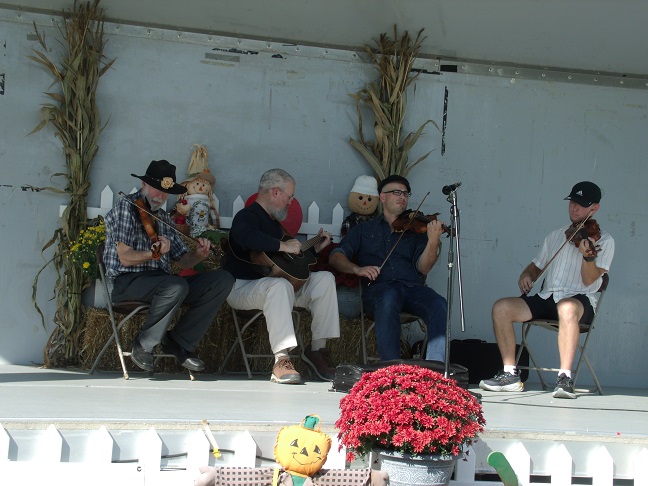
To save the day, host Tom McKinney and contest judge Trae McMaken joined Dave on stage for a jam session to use up the time allotted for the competition.
GEDSC DIGITAL CAMERA

I have a co-worker that is interested in learning guitar, and I told her that I would let her try out some of the acoustic guitars that I have for sale to see if she would like to purchase one. Out of curiosity, I went on YouTube to see what videos were available on the search “Beginner Guitar Lessons.” Of course, a number of videos popped up, but as I went through watching them, I noticed that pretty much all of them have no concept of making the easiest way possible to learn basic chords.

Anyone who has started out on guitar knows that there are a few relatively easy chords, such as G and C, that will get the student learning simple folk songs. About half of the “beginner” videos I watched showed the first two chords to try as Em and Asus2. Yes, these are easy to finger on the fretboard, but there are very few songs that a beginner can regularly practice with them.

Go going back to the G and C chords, one of the reasons that these are popular is that playing these two chords can open up a world of simple folk and popular songs to play. I found some videos implementing the G chord as the first chord a beginner should learn, but another problem I saw is that these instructors are making the student finger across the entire fingerboard and strumming all six strings. I remember from my experience over 40 years ago at first learning guitar chords that it takes a long time to perfect even the open G chord, as placing the pads of the fingers correctly without muffling strings is a difficult task for a beginner to acquire.

Next weekend I will be in Lansing to help out at a musical instrument “petting zoo” that the Southeast Michigan Bluegrass Music Association sponsors throughout the year. When I show young kids how to play a guitar and get a good sound from it the first time, I take the instructional route that I learned from a book that I had years ago – that you do not need to pluck all six strings of the guitar to get a good chord sound. With that, you don’t need to reach across the fingerboard to with your whole hand and start off uncomfortably to try and get a good sound. These are young kids often looking for instant satisfaction, so making them contort their hands will only dull their interest.

Instead, I show them that since the guitar’s 2nd, 3rd and 4th strings are tuned to a G chord, they can strum just those three strings to play a chord, and if they want to change the chord, they can just drape a finger across another fret, holding down those three strings, and strum just those three stings again. I also show them to finger the 1st (high E) string at the 3rd fret with the ring finger and strum the four strings to make an even bigger sounding G chord. If they are motivated by that, then we can work on just those four strings to finger a C chord with two fingers. If they become comfortable and motivated enough, I can show them a simple folk song such as “Tom Dooley” to let them know that it is possible to play a complete song in a matter of minutes.

If they are still interested and motivated, that is when I talk to the parents with recommendations of instructional books or teachers, and that once these basic shapes of chords is perfected, the student can expand on implementing the 5th and 6th strings. The idea is to get the student motivated to move on for the next task, NOT to make the first task hard enough to not want to move forward.

I won’t even bother showing any of the videos that I saw on YT for beginner guitar lessons, as watching them just irritated me. I plan to stick to my method when showing youngsters the guitar. I know that not every kid who I show these simple chords on a guitar will stick with it, but in my experience, it did brighten some young eyes when they strummed that chord and it didn’t sound bad.

Chew on it and comment.

Categories
Musicians

Violin vs. Fiddle: It’s All About Attitude

When I’m asked what is the difference between a violin and a fiddle, my usual answer is, “With a violin, you drink wine; with a fiddle, you drink whiskey.” It’s a rather silly question, because they are both the same instrument. “Fiddle” is just a moniker that was given due to the slang of one playing the violin was sometimes referred to as “fiddling” with it.

However, there is generally a big difference between violinists and fiddlers:

  • Violinists want perfection
  • Fiddlers work with what they have

I won’t get into the performance of music. There are tons of videos on YouTube showing classical violinists being exact with their playing, while bluegrass and country fiddlers are being improvisational, going where they feel like.

What I am looking at here is the choice of instrument. From what I have seen, classical violinists (as well as other classical musicians) feel the need to have the most perfect instrument in order to do their job. Now granted, their careers depend on having the right equipment, just as a carpenter needs the best tools to build a house. But I have seen so many examples of mid-level classical performers wincing and getting frustrated about making a mistake and blaming it on the instrument. Now I have never seen someone like Itzhak Perlman do this (that man can make a Fisher-Price toy violin sound like Heaven!), but I have seen a number of other classical musicians pull this, especially string players.

I recently watched this YouTube video of violinist Rob Landes comparing five violins ranging in price from $70.00 to $10 million.

After one listen, one can easily tell which one was the $70 cheap model. It sounded boxy, like one was listening to it through a paper towel tube. Yes, the others sounded better. However, he was still able to perform the three songs on that cheap violin without difficulty. He then proceeded to talk to the shop owner, who recommended the $450 model as a starter. Sorry, but I’m sure that there are a number of kids who would love the learn the violin but cannot afford even $450, let alone millions of dollars.

On the flipside, I rarely see someone playing roots-based music blame any mistakes on the equipment (although it does happen, especially with the male and female divas). I have seen old bluesmen make a pawnshop guitar sound like the Earth shaking. I have heard beautiful sounds from instruments that look like they were pulled from the trash. Yes, a 50s-era Gibson Les Paul Goldtop plugged into a 60s-era Fender Twin Reverb is going to sound a lot better than a Hondo LP copy plugged into a solid-state practice amp when you strum that open G chord. And the same can be said about violins to be sure. But how are words like this going to motivate the kid in the inner-city who actually has an interest in playing music to pursue it when they cannot afford it?

The past few years have seen tremendous improvements on beginner instruments of all sorts – guitars, violins, drums, even some wind and brass instruments. The problem is that many professional performers look their noses down on such products without even trying them, or go in with a pessimistic attitude trying the instruments out and refuse to change. It is as if they either do not want someone to start playing an instrument because it will eventually be competition, or they enjoy belittling those people who cannot afford an expensive instrument.

There are brands out there such as Glarry, Mendini, Paititi and Bailando that are producing decent-quality violins for the beginner. Yes, these are made in China or some other Asian country where the factories are paying terrible wages and are mass-producing these instruments to keep the costs down. However, this has been going on for decades, ever since someone figured out that every kid in America would want to play guitar just like Elvis. Fortunately, not all classical violinists and luthiers take the bad attitude toward these beginner models.

Esther Abrami is a French model/violinist who has a YT channel and often posts about product reviews. She is an absolute sweetheart to watch. Here is one where she reviews a Glarry violin:

Rosa String Works is a luthier shop in Missouri that works on all kinds of string instruments. In this video, owner Jerry Rosa reviews a Glarry violin and shows what he does to improve on its playability before donating it to a school:

This is a review of three different violins available on Amazon for under $100 (Mendini, Bailando and Paititi), which when played by a professional violinists, shows that they are great starters:

The Piano & Violin Tutor is a popular British instructor/reviewer. While I do not agree with most of what she says regarding beginner violins, she does have one good video on how to improve the sound and playability of a $100 violin:

I could go on, but I don’t want to get long-winded and start rambling. The truth is, there is very little to argue about a $100 violin not being a good beginner violin. Bluegrassers work with what they have when starting out. Not every beginner guitarist gets to start off with a Martin. Not every beginner banjo player can afford a Gibson or Huber. And not every beginner fiddler can have an Amati or Stradivarius at his/her disposal. Those of us already performing with quality instruments need to be as supportive as possible to those who are just starting out. Whether it is assisting with modifications, lessons, or just some advice, it should not be tolerated to lose a young person interested in music from discouraging words from an elder.

Chew on it and comment.

Design a site like this with WordPress.com
Get started