Categories
Bluegrass Music

Billy Strings Is At It Again (+ Bluegrass At Work)

Next weekend is the Charlotte Bluegrass Festival, so my blog may be later than usual or shorter, or both. I have enjoyed going to this festival west of Lansing for a few years now, but this year will be extra special.

Last week, there was an announcement that the Thursday evening concert will be headlined by Billy Strings. His touring schedule had a few days gap, and he has stated in a press release that Charlotte was the first bluegrass festival that he ever attended when he was a lad, and that he wanted to perform at it one day. I am not sure if he will be playing solo, with his band, or with his dad. It doesn’t matter, you can guarantee that it will be an amazing show.

Pretty much just hours after the announcement, tickets for the Thursday show were sold out, and the three-day pass sold out soon after. Of course, I purchased my tickets a few months back, so I was safe for getting in. However, I did contact my hotel and reserve Wednesday night as well, mainly so that I can get to the fairgrounds extra early on Thursday to set up my lawn chair.

I have tried talking friends into going to this festival for years, and as expected, no one has followed up. Now a few of them, including my nephew, are asking if there is a possibility of getting tickets. I have to tell them that these festivals are not like other concerts that you can maybe find a scalper to get a ticket from. You buy the pass and get registered online at most of these festivals, and the pass can only be used by you. I expect that with this show, it will be followed even more carefully.

I am sure that next weekend’s blog will be filled with highlights of the festival, especially with Billy’s performance. I apologize that it seems that every other blog has something to do with Billy, but you have to admit, he is in the music news a lot, he is a humble guy, and he has put bluegrass music on the map again, the first time it has been this popular in over 20 years, since the release of the O Brother, Where Art Thou? soundtrack.

In related news …

Two people at where I work are now getting into bluegrass music (sort of), which was quite a surprise to me.

First, my supervisor, who unfortunately just secured a promotion in another city and moved away, was someone who listened mostly to hard rock and metal-oriented rock, as well as bands like Dave Matthews Band. A few days before he left, he asked me if I ever heard of Bela Fleck & The Flecktones. I just about fell off of my chair!

I explained to him that I have been following Bela for decades, as he played banjo in one of my all-time favorite bands, New Grass Revival. He told me that it came up on his Dave Matthews Spotify playlist, and was knocked out by the banjho playing. So I made a suggestion for him to delve into other jamgrass bands like Leftover Salmon, Yonder Mountain String Band, and String Cheese Incident. Well, he can’t seem to get enough of Leftover Salmon, and I followed up with more artists that were early jamgrass purveyors, such as NGR, Tony Rice, and David Grisman.

I told my buddy Ken about this, and his response was, “Well, it’s a start.”

Another co-worker and I were recently talking. She and I both do a lot of woodworking, though mine is lutherie while she builds and refinishes furniture. I told her that I would be on vacation for a few days for the bluegrass festival, and that Billy Strings would be headlining one day. Her response was, “Billy Strings! I love his song ‘Dust In a Baggie’!”

I got right into it, telling her if she’s into his music, she would be into a lot of other bluegrass artists such as Molly Tuttle, Tony Rice, and a few others. She never heard of the other names that I mentioned, so I quickly showed her a short video of Tony Rice performing “Church Street Blues,” and she seemed hooked. The next day I gave her a bunch of duplicate CDs that I had of Alison Krauss, Sam Bush, and the OBWAT soundtrack. We shall see how she reacts. I have invited her a few times to hit local bluegrass shows with me, but while interested, she never seems to follow up. Perhaps when she gets more into the music, she’ll change her mind.

Chew on it and comment.
Categories
Bluegrass Mandolin Bluegrass Music

David Grisman at 80

I was reading an article online about a show that David Grisman was doing in Seattle to celebrate his 80th birthday. I had to look twice and research the information, and yes, on March 23rd, David “Dawg” Grisman will be turning 80 years old. Grisman has always been one of my favorite people in the bluegrass field, especially as he loved to push the boundaries of traditional bluegrass to include rock, jazz, blues and klezmer, which critics and fans alike labeled as Dawg Music.

The way that young girls follow Taylor Swift’s every action, my buddy Ken and I always had a keen interest in the bluegrass musicians that gathered in other musical influences to create the Newgrass movement that began in the early 1970s. Along with New Grass Revival, John Hartford, Tony Rice and the Seldom Scene, Grisman made a name for himself with other musical formats while still keeping one foot in bluegrass.

Somewhat of a musical prodigy on the mandolin, though he also played piano and saxophone in his early age. He grew up in the Jewish community of Passaic, New Jersey, but discovered folk and bluegrass while attending New York University. He was a member of Red Allen’s band The Kentuckians, and also recorded with Hazel Dickens & Alice Gerrard on their early beautiful Folkways recordings. He delved into rock music with former Blue Grass Boys guitarist/vocalist Peter Rowan to form the short-lived Earth Opera. The two would also form the legendary bluegrass band Old & In The Way with Vassar Clemens and Jerry Garcia. His friendship with Garcia lasted for decades. He recorded on the Grateful Dead’s American Beauty album, with standout work on the songs “Ripple” and “Friend of the Devil.” During this time, he also worked with Rowan, Richard Greene, and Clarence White in the band Muleskinner, which disbanded due to the untimely death of White. Only weeks prior to White’s death, the band performed on a local television show in California, meant to be a warm-up for an appearance of Bill Monroe which did not happen. Fortunately, a video of the band’s performance was saved and is available as Muleskinner Live.

In the 1970s, Grisman formed the David Grisman Quintet, which had a revolving membership that included Darol Anger, Tony Rice, Mark O’Connor, and Todd Phillips among others. He recorded a number of Dawg Music albums during this time, which were critical favorites, and are cherished mainly by Deadheads.

The Garcia/Grisman collaborations continued throughout the years, with gems such as Jerry Garcia/David Grisman and Not For Kids Only. A wonderful documentary on their relationship was released in 2001 called Grateful Dawg, directed by Grismans’s daughter Gillian. The film includes a number of live performance by the duo which are near perfection. Probably the best storied collaboration was with the two and Tony Rice. During two evenings in February 1993, the three musicians sat down in Grisman’s home studio and recorded a number of standard folk and bluegrass tunes. A copy of the tape somehow got into the hands of a pizza deliveryman, and within months, the songs form the recording were being bootlegged across the country to thousands of Deadheads. At first angered, including confiscating bootlegged CD, Grisman eventually released some of the recordings in 2000 as The Pizza Tapes (an extended version was release online in 2010).

In 1990, Grisman formed Acoustic Disc, a record label that would specialize in unique bluegrass, folk, and jazz recordings, particularly live performances. Along with The Pizza Tapes, the label has released other recording by Grisman, Rice, Jesse McReynolds, Old & In The Way and Doc Watson. The label’s catalogue is a wealth of great acoustic music, and I personally have at least a dozen releases from there.

Grisman was FINALLY inducted into the International Bluegrass Music Association’s Hall of Fame in 2023. This was an honor that should have been given decades before, as his music was what was getting many younger musicians and fans into bluegrass. He never strayed away from bluegrass music, as his love was so deep that he names one of his children Monroe after the great Bill Monroe.

I saw Grisman only once, and it was at an Ann Arbor Folk Festival many years ago when he performed with Doc Watson. There were a number of bands performing at that festival, but that to me was the highlight, as two legends were trading licks and presenting an acoustic format that forced you to pay attention and appreciate it. My only other connection with Grisman is that we both had music played on the NPR program “Car Talk.” His composition “Dawggy Mountain Breakdown” was the shows theme song.

I totally recommend that you get some of Grisman’s recordings. Traditional bluegrass fans will want a copy of one of the Old & In The Way live discs. Acoustic music fans will love The Pizza Tapes or just about any other album on Acoustic Disc (www.dawgnet.com), and I encourage you to check out the documentary Grateful Dawg as well as the performance of Muleskinner Live.

Happy Birthday, Dawg! You have made my musical life, as well as thousands of others, so much more rewarding and enjoyable!

Chew on it and comment.

Categories
Bluegrass Mandolin Bluegrass Music

Frank Wakefield RIP

Last week, a great bluegrass mandolin player passed away. Frank Wakefield was a bluegrass character to be sure, and seems to be forgotten be most modern bluegrass musicians. Where Bill Monroe was the Elvis Presley of bluegrass, and the Stanley Brothers were the Everly Brothers of bluegrass, Frank Wakefield was the Johnny Rotten of bluegrass.

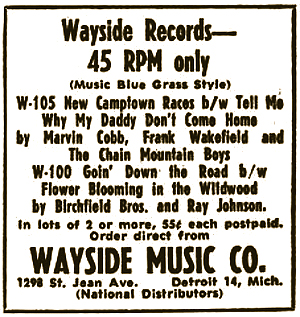
He was always pushing the boundaries of the mandolin in bluegrass, which turned off many traditionalists. He started off playing with Red Allen in the early 1950s, then moved up to Detroit to audition for Jimmy Martin. While Martin at the time did not need a mandolin player, he recommended that Wakefield contact Marvin Cobb, leader of the Chain Mountain Boys. Wakefield played with the band for a while, then joined up with the Stanley Brothers. However, Ralph Stanley and Wakefield did not get along musically, so Wakefield went back to the Chain Mountain Boys.

Wakefield’s style was boundary-pushing to say the least. The Chain Mountain Boys recorded the single “Tell Me Why My Daddy” with the B-side of the classic “New Camptown Races” for a small Detroit label, Wayside Records, that specialized in country and bluegrass. In fact, an advertisement in Billboard in 1957 is considered the first use of “bluegrass” to describe the music.

The Chain Mountain Boys disbanded in late 1957, and Wakefield continued to record for Wayside with Buster Turner. He also toured with Jimmy Martin for a time, then moved to Washington, DC to work again with Red Allen. With Allen, Wakefield would play such venues as Carnegie Hall, and he began to teach mandolin to future luminary David Grisman. He would later work with the Greenbriar Boys, and began to write classical-influenced instrumentals for the mandolin. This work would eventually get him invited to perform with the New York Philharmonic and the Boston Pops.

Wakefield would spend the 1970s recording solo work, being backed up by banjoist Don Reno and fiddler Chubby Wise. He would also tour with Jerry Garcia’s solo projects and warm up for Grateful Dead shows. His last notable recording was on the 1999 Grammy-nominated Bluegrass Mandolin Extravaganza, which also featured Grisman, Sam Bush, Ricky Skaggs, Ronnie McCoury, Jesse McReynolds, and Bobby Osborne.

The best description of Wakefield comes from Grisman: “He split the bluegrass mandolin atom. Some of us, obviously, will never be the same again.”

While I never got a chance to meet Wakefield or see him perform, I always had a soft spot for him in my bluegrass heart due to his time in the Detroit area when he really began to use the mandolin as a bluegrass weapon. Those early Wayside Records recordings were released in 1976 by Rounder Records called Early Days of Bluegrass, Volume 2, so if you can ever find that album, be sure to get it.

Frank, you will be missed by those who truly appreciate no0t allowing bluegrass to become stale.

Chew on it and comment.

Design a site like this with WordPress.com
Get started