Well, the Fender Meteroa that I ordered directly from the company a few weeks ago finally arrived. I should have been here last week, but FedEx kept making up excuses on the delay.
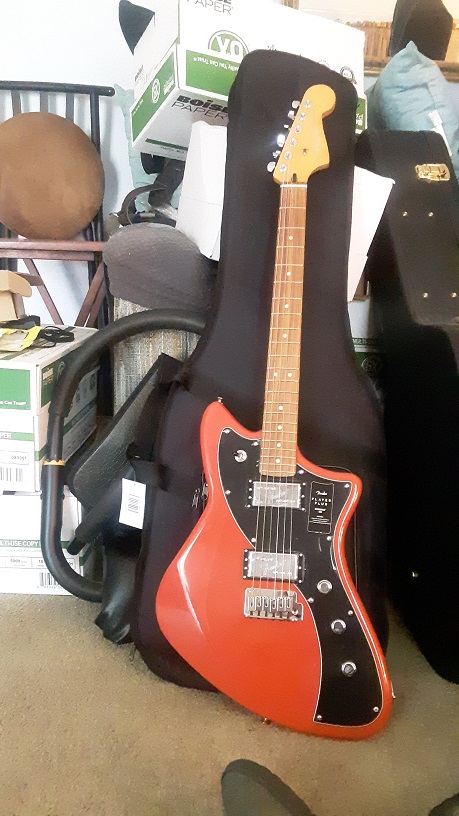
So let’s get to the guitar. It came with a durable gig bag, which I would expect from Fender, as the Squier line usually does not, unless it’s the higher end models. When I pulled off the wrapping, the high E string was broken, so I had to replace that. It was already factory set up, so the string height and intonation were excellent (although I prefer my string height a bit higher from years of endurance). The neck has a good feel, but the fingerboard is made of Pau Ferro, which looks like rosewood but has a density of maple. I am assuming that it is an inexpensive alternative, as Fender and other guitar manufacturers are using it more often.
The tuning gears are locking, which I have never used before, and can be confusing, but other users tell me that they are great to have. The alder body has that non-traditional shape, sort of a more-radical Jazzmaster style. It gives the overall appearance a longer look, even though it is the standard 25.5-inch scale most Fender guitars carry. One review video on YouTube that I saw states that this is comfortable, but as for me, it will take getting used to after years of playing Stratocasters and Telecasters.
The pickups are Fender exclusive Fireball humbuckers. They have a great sound as-is, but what makes them special is a push-button switch on the volume control (more on that to follow) that changes both humbuckers into single-coils. This gives it a hot Telecaster-like sound when needed. However, I would have liked to see individual coil-tap switches for each pickup to gve even more choice of sounds. The pickup selector switch is a three-way toggle similar to that found on Gibson guitars, and is positioned similar to where it is located on most Les Paul models.
The controls are a bit confusing at first. With three knobs, I would have assumed that it would be two-volume/one tone like that found on a Fender Jazz Bass. Instead, it is configured as one-volume/two tone (one for each pickup). The volume knob has that push-button coil-tap switch built into it, which is flush on top and there is no way of telling if it is on or off unless you are listening to the change through the amplifier.
Finally, the bridge is a six-saddle tremolo found on the modern Stratocasters. I have seen on online discussion groups that some players would have liked to see a Jazzmaster/Jaguar style whammy bar bridge, but in my opinion, those are not as easy to maintain, not as reliable for heavy whammy bar use, and would not bode well with the style of the guitar.
Sound-wise, this guitar has a lot going for it. The pickups in the humbucker settings are high output and clean throughout, although you can get some drive from them when the volume pot is on 10 and the amp being used is set right. In single-coil setting, the bridge pickup has a great bit to it, like a Tele or Strat. One thing that sounds good is that, when adjusting the tone pots to be more bassy, there is no drop in the high-end bite that happens with most passive-wired guitars. Overall, this is a worthwhile Fender guitar, especially for its going rate under $700 direct from Fender.
A little history regarding the Meteora model. It was originally designed in 2011 by Fender designer Josh Hurst. It first appeared as a limited-edition model in the Parallel Universe series. Jim Root of the band Slipknot played one, but it never really received any heavy artist endorsement. In 2018 it was introduced as part of the Player Plus series (made in Mexico), and is also available as the American Ultra II model as well (made in USA).
I have seen talk of either discontinuing the model, or a large overstock, leading to the recent cut in price of the Player Plus models. I would not be surprised with a discontinuing, as I do not see a lot of these being played by well-known artists (I may be out of the loop, though). It probably would have been a big success if it came out 20 years earlier, grunge bands and nerd-rock bands like Weezer would have played them easily. It is a great guitar, but I definitely do not see it as a competitor to the Strats, Teles, or even Les Pauls. Like I mentioned in my blog a few weeks back (https://luegra.design.blog/2025/05/24/fender-meteora-hh-on-sale-this-weekend/), it may go the way of the Marauder or Muiscmaster, and could be more collectible in a decade. I will be honest, I purchased it with that primarily on my mind, as I don’t play electric much at all any more, and have my Strats and other electric guitars to band around instead.
I didn’t do any test-drive video of the guitar, as there are plenty of them on the web. Here are a few of them for viewing
Chew on it and comment.

 Luegra