Categories
Guitars Lutherie

Lansing Guitar Show

Yesterday I hit the Lansing Guitar Show. It was nice, but nothing spectacular. As expected, about 90% electric guitars and amps (I’m not complaining, it’s just that I don’t play electrics that much any more). And of course, everything was way too pricey for me. I am still wondering if it was worth the three hours total drive back-and-forth to attend. I actually got through the entire show in a little over an hour, walking through it three times. It was set up in two separate rooms that were far apart, and there were not good signs pointing to the rooms.

I got to talking to a gentleman who was selling a late 1960s Guild Starfire II semi-hollowbody double cutraway. The thing was not completely original, as the bridge, tailpiece, and one pickup were replacements. He was asking $900.00, basing it on the harmonica-style bridge (it is wider, and looks like a harmonica) being a rare item. Dealers were passing on his offer (I totally understand), but it got me to thinking about a guitar that I have.

It’s a 1971 Guild Starfire I, which is a true hollowbody, with a single cutaway and a Bigsby-designed vibrato tailpiece. The pickups are original, but are quite microphonic, meaning that they act like a microphone (I actually used to talk through them at shows) and they feedback terribly. The thing needs some minor work, particularly the headstock plate needs gluing. The one dumb thing that I did to it was have a girl that I wanted to date paint a skull on it, as I was into rockabilly back then and thought it would be cool. Well, her skull looked more like a white tadpole. I remember my bass player at the time used to call it “the Happy Sperm Guitar.” I also remember that, playing the guitar though my Fender Twin Reverb, was absolute magic. With the right overdrive, that was the perfect-sounding rock-n-roll rhythm guitar. I guess that is why I still have not parted with it, but at least the talk gave me somewhat of an idea on how I could sell it just in case.

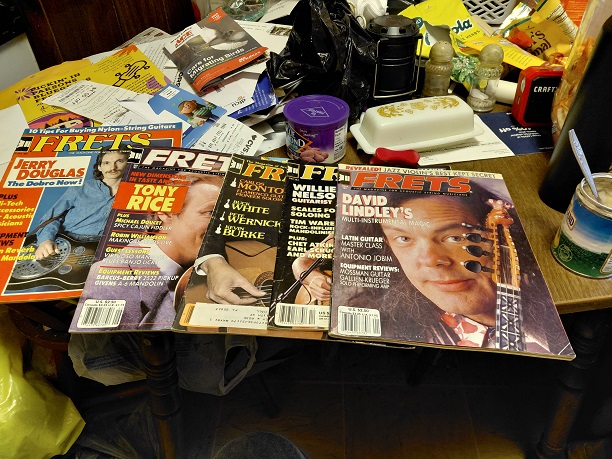
I talked a while back about how much I miss some out-of-print music magazines (https://luegra.design.blog/2021/06/06/the-print-magazines-that-i-miss/), particularly the Frets Magazine from the 1970s and early 1980s. This was an offshoot of Guitar Play Magazine, focusing on all acoustic instruments. Besides acoustic guitar, coverage included banjo, fiddle, mandolin, autoharp, dobro, sitar, and just about any other acoustic stringed instrument. It discontinued for a few years, but was brought back in the 2000s, but stuck to mostly acoustic guitar. The older issues covered artists that I thought were the best in bluegrass. So when I saw one vendor has a bunch of old guitar magazines, I had to thumb through to see if there were any treasures. I was able to snag his few copies of Frets. I love reading those old articles (just look at how young and skinny Jerry Douglas was back in 1986!).
One of the reasons that I went was to get a replacement nut for the Leo Jaymz Strat that I just finished building. The nut that was on the neck was horrendous! It was cut way too high, and even filing down the slots didn’t help. Plus it was made of a cheap plastic, so I picked up a bone one for a few bucks.

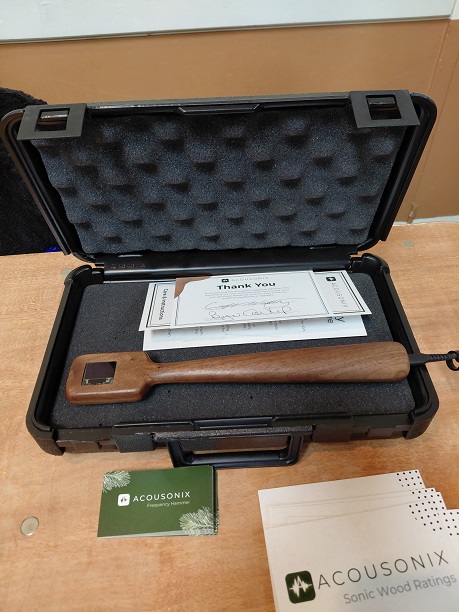
As I was leaving, I got to chatting with Cooper Wentz, who operates Galloup Guitars out of Big Rapids, Michigan. Besides building guitars, he runs lutherie classes out of his shop, which consists of programs ranging from eight to 24 weeks of intensive research and building of guitars, both acoustic and electric. For more information, go to galloupguitars.com .

But what struck me as very interesting was the lutherie tool that he recently developed. It is part of an online system that he has set up called Acousonix. The main aspect is a hammer-like object that has a small plunger on one side of the head, and a LED screen on the other side. This idea is to hit a piece of wood that is mounted on the body of the acoustic instrument (or before mounting) with the plunger, and the LED screen will display what that piece is tuned to acoustically for the best tone and stability of the guitar to be built. It is an amazing concept to be sure, and I hope that he has great success with this project. For more information, go to acousonix.com .
The next nearby show is in Toledo in June, so that gives me time to decide if I want to go, considering that I start my new job tomorrow and need to find out when I can take time off.

Chew on it and comment.

Categories
Music Industry

The Print Magazines That I Miss

I love writing for a music magazine! I currently am a regular contributor to Fiddler. I work with a great editor (Mary Larsen), I have learned to appreciate the violin more, so much so that I have gone from a disgruntled beginner to a disgruntled intermediate player, and most important, I have become friends with a number of musicians in the bluegrass, klezmer, folk, and Americana folds.

I have written for a number of other magazines over the years, but that has dropped off due to a number of reasons such as difficult editors/not getting paid, financial situations ceasing publication, or the decision to go strictly online (which results in lack of pay many times as well).
Hitting the magazine rack at Barnes & Noble is pathetic. The choice for music-related magazines is minimal, and what is there is more trendy/gossipy than intellectual or industry oriented (with a few exceptions like Guitar Player).

Yes, times change, and perhaps the current young generation is content with getting its information from the web instead of a hard-copy magazine. When I was a young and easily influenced beginning musician, I salivated over the numerous music magazines that were available, either as intelligent criticism of the current music trends or as helpful mentoring in becoming a better musician. One can get any lesson for any instrument on YouTube, as well as personal reviews of equipment. However, it just isn’t the same as relying on that monthly music ‘zine that either came to your door or was waiting for you at the bookstore to get valued information and advice.

I have been thinking lately of some of the print magazines that I miss getting my hands on over the years. Here are a few of them, and I hope that it may bring back some fond memories for you.

Blitz – As a teenager in the early 1980s, I was getting into the punk/new wave scene both as a listener and musician. When I discovered Blitz, I thought that I had found the Holy Grail! It hailed itself as “The Rock and Roll Magazine for Thinking People,” and it was. This was more than the local fanzine, even though it covered musicians primarily from California. However, those were the bands that I was into at that time. The Plimsouls, The Blasters, X, The Long Ryders, Green on Red, The Dream Syndicate, The Bangles, Blood on the Saddle, the list goes on. They also covered a lot of European bands that were making a name for themselves in the US, as well as bands from the 1960s that still had a cult following. I remember the first issue that I got. Josie Cotton was on the cover. The writing was not pretentious like Rolling Stone, more down to Earth without being moronic. There were three or four artist articles, then a ton of album reviews that I relied on heavily. It started in 1975, but was no longer being printed by the mid 1990s. There is a Facebook page run by the old staff, but I don’t do FB, so I pass.

Frets – This was (and still is, I believe) a sister publication to Guitar Player (which also had another sister called Keyboard for those interested in that instrument family). Started in 1979, this was a magazine for those interested in acoustic music, no matter what the genre. While most of it seemed to lean toward bluegrass artists, there was also ample coverage of jazz, international, acoustic pop, and folk. Also in variance were the musical instruments covered. Besides guitar, there were regular articles on players of mandolin, banjo, fiddle, even autoharp, sitar, and bouzuki. That may have been its weakness, as it is very hard to find a large readership that is into many acoustic instruments from many musical formats. By 1985, the content seemed to lean mostly with acoustic and acoustic-electric guitars, although there were some great stories on the New Grass Revival and Mark O’Connor. The original magazine folded in August 1989, but was brought back about a decade later covering almost only acoustic guitars, most likely to compete against Acoustic Guitar magazine and to keep that audience that wasn’t interested in electric guitars satisfied (like the original publication in 1979). I haven’t seen hide nor hair of this magazine in over a decade, and the website (www.fretsmag.com) has information dating from 2006.

Bluegrass Now – This was an alternative to Bluegrass Unlimited when it was alive. It was bi-monthly, so it was not as timely as BU. During its last few years in the early 2000s, I wrote a few articles for it. I got along great with the editorial staff, but there were some financial difficulties within the magazine. In 2003, it chose to go online-only, but could not garnish enough interest from the bluegrass community to survive (trust me, this community will always love its hard-copy reading). There were one or two other bluegrass-centric magazines that dropped by the wayside as well. BU was fortunate to partner with the Bluegrass Hall of Fame to ensure its continuance. BN was more in-depth with its interviews, a quality that BU seems to be moving toward. However, snagging an authorship in BU is nearly impossible, as it has its regular contributors. So I do wish that there were more bluegrass print publications out there, but I can understand the financial reasons why there are not.

These are just three of the many magazines that I miss. Getting information off of the internet is not the same. I enjoyed getting a different magazine each week and reading it cover-to-cover, keeping it with me so that I could read a little at school, at a restaurant, at home, waiting in the car, or a dozen other situations. Surfing on your phone is irritating.

Chew on it and comment.

Design a site like this with WordPress.com
Get started