So after cleaning up the residue from the gigbag on the Ambertone Strat, I let the solvent dry for a few days and the proceeded to put shielding into the body cavity in order to get rid of some of the RF (radio frequency) noise generated by single-coil pickups.
A very short explanation: Just about every electronic device generates RF noise in some way or another. Televisions, appliances, calculators (fun trick – if you have an old working LED calculator, turn on an AM radio, tune it to the lower end frequencies, then hold to calculator next to it and start hitting keys, you should hear some weird noises from the radio), and electric guitars all give off some RF noise. You may hear that 60 Hz buzz through your amp if the amp is not properly grounded. Most guitars with humbucker pickups cancel out much of that hum (along with a quality guitar cord), hence the name. Single-coil pickups do not have the same kind of pickup winding, so the noise is much more apparent, and is why many guitarists like to install a metal cage in the cavity to cancel out much of that noise.
There are two popular ways to shield the cavity. The first is coating the cavity with a conductive paint, available through guitar part supply shops such as Stewart-McDonald. This is a very easy way to do it, just paint the entire cavity, let it dry, and it is done. This method is a bit more expensive, cannot be used on plastic parts, and can be messy if you are not careful with the paintbrush.
The second way is to line the cavity with thin metal strips. Conductive tape is available in copper and aluminum, and the adhesive backing has some conductive quality, so overlapping the pieces will create a continuous contact. I went this route and purchased a roll of Reflectix aluminum tape from Lowe’s for about $5.00. Note, I saw a YouTube video that one luthier shielded a guitar with simple aluminum foil and 3M adhesive spray, which seems a lot cheaper but one has to make sure that there is still conductivity between pieces as the spray adhesive is not conductive. There is also available aluminum sheets, which can cover the entire back of a pickguard, but is harder to mold into the cavity.
If attempting this job, it is wise to detatch the neck from the body, as I tried to do the project with the neck attached but could not remove the pickguard properly due to a lip on the fretboard where it attached to the body. After getting that out of the way, I first shielded the back of the pickguard. Fortunately, there was already some metal shielding on the underside where the controls are installed, so cutting pieces that eventually contacted this shield would mean a good metal cage effect. I covered as much of the pickguard as possible, making sure to keep it away from the wiring so as to not risk shorting.

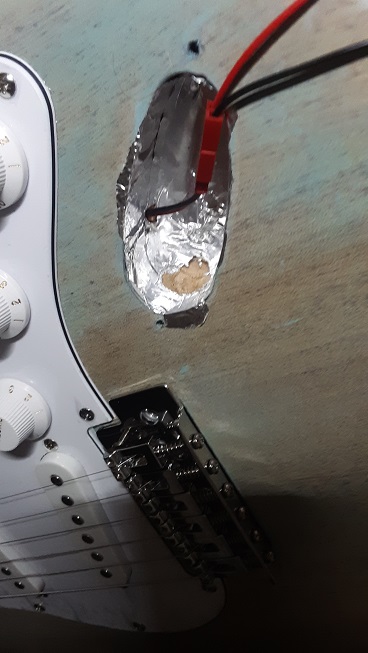
I followed up with shielding the Strat jack housing, then proceeded to the pickup/wiring cavity. While it may seem like cutting one or two big pieces and molding them in might be easier, it is not. With the many curves and crevices in the cavity, it was better to cut small pieces and pressing in/overlapping each piece. Press the pieces in firmly so that it stays put. In a few spots, I left a lip of foil come over so that it comes in contact with the foil on the pickguard.

After shielding the pickguard and cavity, I checked for conductivity with a multimeter tester. I recommend anyone doing guitar work to get one of these, which small consumer ones can be had for less than $20.00. Besides checking for conductivity, it can be used to check battery and house wall outlet voltage when needed. The entire shielding checked out as solid.

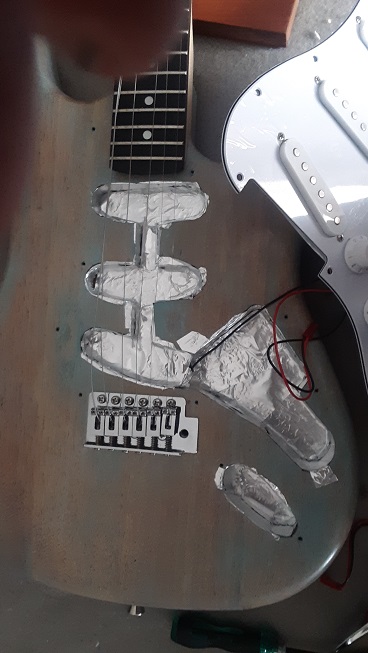
Once finished, I put the guitar back together and tested it out. Dang! No signal at all! It turns out that within the jack housing, the area is so tight that there is a small indentation in the wood for the plug to insert all of the way, and I had covered it with foil, Once I cleaned out that area, I reinstalled the jack and tested it again, this time getting a signal.
The result? The buzzing hum was cut out probably 80%. Not bad, really. Because the single-coil pickups on this guitar kit were cheaply made in Asia somewhere, they won’t have the same quality output as a Dimarzio, EMG, or even a stock Fender pickup. However, I was happy that most of the RF noise was cut out, and this guitar is definitely playable through any amplifier without much buzz. As far as the roll of aluminum tape, I used only about half of it, so I can shield another guitar when needed. Not bad for $2.50 in supplies and a few hours work while watching football on TV.
If you have an electric guitar that is kicking out RF buzz when plugged into an amp, especially when flourescent lights or other appliances are on, I recommend this inexpensive project to help out. There are plenty of videos on YouTube that show how easy it is to do. If too afraid of taking apart your guitar, a good guitar repairman should have no problem handling it.
Chew on it and comment.
 Luegra