Categories
Bluegrass Dobro

A Little Bit About the Dobro

First off, I hope that everyone here in the US had a good and safe Thanksgiving!

So because I do a lot of web searching for both musical instruments and bluegrass-related material, I get a lot of pop-ups on items for sale that (by a long shot) have some connection to these two areas due to my algorithms. I usually just delete them and move on, but recently I got one that piqued my curiosity.

It stated that a bluegrass resonator guitar was on sale for $159.00. Now reso guitars, better known with the bluegrass crowd as a dobro (one of the original manufacturers was a company called Dobro, formed by the Dopyera brothers), are not as “affordable” as beginner acoustic guitars. Even low-end dobros are rarely under $300.00, and many of them are used models. So I clicked on the ad.

It turned out to be what I expected. This was round-neck reso guitar set up for guitar players. Some blues and folk guitarists like to play a reso guitar to get a swampy sound from it, courtesy of the metal cone that replaces where the soundhole would be on a regular acoustic guitar. They have a brighter, more metallic tone, but can be louder than a normal acoustic. Players like to use a bottleneck-style slide on them to get that bluesy slide sound. The brand name is Pyle, better known for high-fidelity and guitar amplifier speakers, so I am sure it is just contracted with them. I am also certain that these are probably made in some Asian country with very cheap labor. The funny thing is, the actual item is listed as an acoustic-electric guitar with built-in preamp.

The dobro models that are used by bluegrass players almost always have a square neck. This is for stability, but also serves as a better anchor for a dobro capo. This type of capo, rather than clamping down on the fretboard, rests solely on the strings. The string height on a dobro is much higher than a regular guitar so that the slide will move freely along the strings and not come in contact with the frets (which only serve as a note marker). While it is easily possible to play a round neck by raising the strings at the nut with a special nut (available from sources like Elderly Instruments, Guitar Center or Sweetwater for under $20.00), you are still limited if you want to play upon strings in a different key than the standard G tuning on a Dobro.
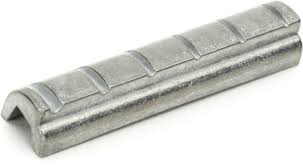
Another aspect of a bluegrass dobro player is that they almost always use fingerpicks and a thumbpick, similar to a banjo player. Tut Taylor was one of the few dobro players that used a flatpick, but he is an exception. The finger/thumb combination allows for rolls on the strings like a banjo player, but with the different G tuning than a banjo, the rolls sound much different.

I have seen a few bluegrass dobro players use a round-neck model, but again, they were usually having to stick to playing barred strings when in different keys. Now I am not saying that a round-neck reso guitar would be a good starter model for the beginner, especially if one of those raised nuts is installed over the regular nut. Most beginner dobro lesson books and videos are going to instruct the basics in the key of G anyways.

When I was working at the musical instrument petting zoo at the Charlotte Bluegrass Festival last June, one young girl was very interested in trying out and playing the dobro. I explained to her parents that while the cost of a good dobro may be high, there are many low-cost alternatives for beginners, including converting a regular acoustic guitar with the nut-raiser and playing it sideways like a dobro. In such a case, if the student takes a true interest in playing the dobro, money can be saved up for a regular square-neck model.

I was fortunate years ago to get my hands on a Regal dobro for a very good price. I still have it, and althoughj I don’t play it as much as I would like, it is a great sounding dobro that I use to embellish some demos of mine. If I ever got the time, I definitely would like to work more on it.

The dobro is often thought of as a minor instrument in the bluegrass field. Josh Graves and a very few others were the purveyors, and the greatest dobro player out there today, Jerry Douglas, has helped to promote it in the bluegrass and country music fields more than anyone. It has a unique sound that does change the overall composition of a bluegrass band, whether you like that sound or not. However, it does make a great bluegrass instrument for beginners to consider if not interested in the sometimes complex fretting of a banjo or mandolin, or the coordination of a fiddle. I would encourage parents to offer the dobro up as a possible instrument to play to their children interested in bluegrass.

Chew on it and comment.

Categories
Bluegrass Music Country Music

Recommended Book: Highways and Heartaches: How Ricky Skaggs, Marty Stuart, and Children of the New South Saved the Soul of Country Music

The 1970s through 1990s were a struggling time for traditional country and bluegrass music. Movies like Urban Cowboy were bringing rock, pop, and even disco influences into the country music vein. It was the start of moving country music stars from honky tonks to arenas, with overdriven guitars and light shows becoming the norm. There were a few sparkles of traditional country lights within the realm, but they were few and far in between. The Grand Ole Opry began to lose its charm, with old stalwarts re-hashing past hits to a senior citizen crowd for nostalgic purposes.

The tail end of the punk/new wave movement did show a lot of respect to the spirits of Hank Williams and Patsy Cline, as well as some near forgotten legends like Johnny Cash, Porter Wagoner, and Loretta Lynn with speed-driven covers and originals that paid musical tribute. However, it would be at least a decade until the fledgling cow-punk and alt-country sub-genres would blossom into what we now know as Americana music.

So during those dry times, there were a few performers that kept the flame going because their hearts were in the right place. Highways and Heartaches: How Ricky Skaggs, Marty Stuart, and Children of the New South Saved the Soul of Country Music provides a decent chronicle of that time by looking at the musical lives of Skaggs, Stuart, and a number of other musicians from that era and group.

The first chapter is a bit too politically correct for my taste, as while it looks at Skaggs’ poor upbringing in Kentucky, it looks at Stuart’s upbringing as being heavily influenced by the racial tensions in his hometown of Philadelphia, Mississippi. While I am sure that there was a lot more bigotry around back in the 1950s, the author Michael Streissguth narrates it as if it was in the blood of every white person in the South. There is way too much coverage of segregation, lynchings, and other racially motivated happenings that have very little to do with the musical influences of Stuart.

Later chapters cover the legacy of Ronald Reagan and the influence of the Moral Majority. Again, it all passes as the author trying to be politically correct and apologetic for being white.

Once the reader gets past that, the flow if the book is quite interesting. Even if you are familiar with both Skaggs’ and Stuarts’ early careers, there are a few things that you may still learn. We all know of Skaggs’ work with Keith Whitley and Ralph Stanley, but there were a lot of inner struggles that he was having to move out on his own, as well as wanting to be known as a serious go-to musician and arranger. For Stuart’s part, his early teen years with Lester Flatt would cement him as a bluegrass prodigy, but the downside is that he really never got to live life as a normal teenager. He spent almost all of that time surrounded by older bluegrass musicians that had their ways of drinking, carousing, and occasional fighting, and his studies were spent in a tour bus instead of a normal high school.

While the gist of the book follows the career of these two modern legends, there is also ample coverage of other artists from that time. These include Jerry Douglas, Emmylou Harris, Larry Cordle, and Linda Ronstadt. Bluegrass coverage includes extensive mentions of J.D. Crowe, Doyle Lawson, the Seldom Scene, and the many festivals that were popping up due to the public’s interest in roots music from both the liberal and conservative teams.

If you can get past the PC talk, this book makes for an interesting read, learning how much Skaggs and Stuart were able to keep traditional country and bluegrass alive during this dark time, and become the highly respected statesmen that they are.

Chew on it and comment.

Categories
Bluegrass Music

2024 IBMA Award Nominees

The 2024 IBMA Award nominees came out earlier this week. The list can be found here at Bluegrass Today (https://bluegrasstoday.com/2023-ibma-bluegrass-music-awards-nominees-announced-2/).

There is not much surprise here. The usual suspects appear in a number of categories, such as Billy Strings, Molly Tuttle, Sierra Hull, Del McCoury, and Sister Sadie. The one category that I am glad to see some fresh faces is New Artist of the Year, even though most of them have been around a while and have great PR. However, I do think that it is time that the IBMA has recognized The Kody Norris Show in that category. After years of endless touring and a number of SPBGMA wins, Kody and his band deserve more “mainstream” bluegrass spotlight.

As far as instrument/vocal awards, the names seem the same as previous years, whether the performer has done any recording or extensive performing. In fact, there is only one name in all of the categories that is brand new (Gaven Largent – Resophonic Guitar Player of the Year). Over the past few years, I tend to lose interest in these categories, and can probably guess who will win way before the show.

As for the Hall of Fame inductees, all three are deserving. Alan Munde has played influential banjo for decades. What can be said about the dobro genius Jerry Douglas that has not been said already. And Katy Daley has been an amazing voice in bluegrass publicity and broadcasting for as long as I can remember.

Not much else to say. Other than hoping my friends in the Kody Norris Show win at least one of the two categories, I really have little interest in the outcome. I only wrote about it this week because I didn’t have any other topic to write about off the top of my head.

Chew on it and comment.

Categories
Bluegrass Music

Today’s Live Sound Engineering Ain’t What It Used To Be (Or Am I Just Getting Old?)

This past Thursday, my buddy Ken and I went to see Bela Fleck and his My Bluegrass Heart touring band at the Detroit Opera House. Bela is a living legend on the banjo, and his touring band is the cream of the crop as well, with Sierra Hull on mandolin, Michael Cleveland on fiddle, and Bryan Sutton on guitar among others. Special guests who warmed up for the show were dobro master Jerry Douglas and mandolin god Sam Bush.

First, the good parts. Having Douglas and Bush warm up with their respective touring bands was phenomenal! Both are beyond professionals as far as musicians, and know how to talk to their audiences. Bush always looks like he’s having fun on stage, and has no problem making light of bad situations, such as when his fiddle was feeding back too much to play properly. Both he and Douglas were on their game as far as soloing, and their band members were just as supportive.

The same can be said about all of the members in Fleck’s troupe. No screw-ups during solos, and everyone worked with each other. One of the personal highlights for me was when Fleck pulled out John Hartford’s banjo to play on a beautiful song. Anyone who knows me knows that I am a John Hartford fanatic, and his banjo has a very distinctive bassy tone that I have never heard from any other five-string.

Now comes my disappointments with the show:

  • Way too long on a weeknight. I’m getting old, and probably 3/4 of the crowd there was hovering around my age as well. The show started just after 7:30 pm, but Ken and I left at 10:30 barely able to keep our eyes open, so we missed the all-star jam at the end with Douglas and Bush joining the band. Those who stayed surely got their money’s worth, but I just cannot sty up late any more on a weeknight, knowing that I have a rough day at work the next morning.
  • Lousy sound mix. I am not sure that the Detroit Opera House is meant for that type of music. Douglas’ and Bush’s bands were mic’d as well as running direct into either amps or the mixing board. Fleck’s band all just used microphones. Either way, everything sounded muddy and awash. The electric guitar in Douglas’ band sounded like a blanket was covering the amp. When Fleck and his band came on stage, the mix was horrible! It was like the sound engineer did not have a clue. Now granted, Ken and I were in the upper balcony, and it could have been mixed for the main floor seating, but there was no clear distinction between soloists and backup playing. I was watching Sutton and Hull, and both of them had the smarts to back off from the mic when not soloing. Still, it was getting stressful to listen to!

Both Ken and I used to do live sound work for bands years ago, back when you manually adjusted volume and EQ by sliding or turning knobs on a mixing board. Most live shows today use computer tablets to adjust levels, which I have find to be a terrible alternative to the ear. Good sound engineers have certain “touch” to the sliders that work. Moreover, many times I feel that the engineers don’t adjust to the rooms. During a soundcheck, the room is usually empty, save the musicians and engineer. However, once the room fills up for the show, the crowd makes the room acoustics totally different. The bodies soak up a lot of the high end of the sound, and reverberations are a scramble from the main floor to the reflections near the ceiling. I truly think that today’s sound engineers do not study the science of acoustics, and just go for one sound, hoping that nothing feeds back.

My ears got burned out years ago doing live sound, and I quit as soon as I realized that all bands sounded the same to me. I would occasionally help out my friends at Rock City Eatery when they had a band play at their restaurant, but that was as a favor and not as a job. Plus, as Ken commented to me at the show, I do not miss doing the roadie work of winding cables and pulling up duct tape from the stage. I know that live sound engineering is not an easy job, but to be good at it, a person has to study it and practice just like a musician has to practice his/her instrument.

Her is a clip from that show someone in the audience recorded (which, by the way, they asked people not to do).

Chew on it and comment.

Design a site like this with WordPress.com
Get started