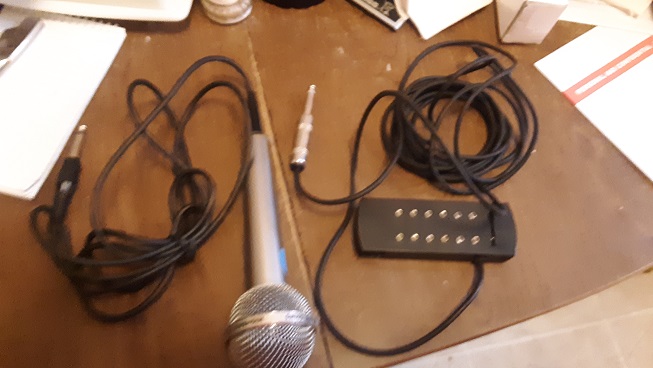
I went to the Livonia Amateur Radio Club Swap Meet this morning. I go every year, and while 90% of the items on sale is related to ham radio, I like to look around to see if there is any guitar/audio stuff I can get cheap, especially vintage microphones. I did pick up an old Radio Shack omnidirectional mic for the collection, as well as a Dimarzio acoustic guitar pickup, both for a few bucks each.
I also picked up an emergency radio, one that powers on solar or hand crank. You never know if you will need it if the power goes out.
I just wanted to cover three bluegrass-related YouTube channels that I came across recently. The first is World Bluegrass Day. This channel has been around since 2012, but for some reason, I only became aware of it recently, despite the number of times I have done searches on YT for bluegrass videos. Over 250 videos of bluegrass performances, interviews, and mini-documentaries are here, all of which are great to watch. One of the most recent uploads is “Jimmy Martin’s Wedding Video (1988).” It’s over an hour long, and the ceremony is strange to say the least. The bride looks young enough to be Jimmy’s daughter, and all of the Sunny Mountain Boys, along with J.D. Crowe and a few other musicians, stood in as his “best man.” More time was spent by Jimmy talking about his touring history than his bride. From what I recollect, Jimmy was never officially married, so this may have been a stunt. Anyone out there want to elaborate? Anyway, the channel is at https://www.youtube.com/@WorldBluegrassDay .
Cody M. Music is another channel that has been around for a while, but I only recently found it. Cody is a graduate of East Tennessee State University of its Old-Time and Bluegrass Music Program. He posts videos of acoustic guitar reviews and beginner lessons, including numerous shorts on easy licks and rhythm patterns. Some of the short lessons are slowed down to half speed so the viewer can learn it a bit more easily. Cody is using this channel to promote his online teaching program that you can purchase as a subscription. Some people wanting to improve on their bluegrass guitar playing may want to check this channel out at https://www.youtube.com/@codymmusic .
Southern Legacy is a true bluegrass supergroup. The members have been in numerous other bands, and get together occasionally for touring. Members include mandolinist Don Rigsby, banjoist Ron Block (of Alison Krauss & Union Station fame), and Josh Williams, my favorite flatpicker, whom I did a previous blog on (https://luegra.design.blog/2023/09/23/josh-williams-bluegrass-instrumental-genius/). The talent here is phenomenal, and I hope that they will be releasing some material soon. They are the cover story of the March 2025 issue of Bluegrass Unlimited. While there are a number of videos of this band performing on YT, they also have their own channel at https://www.youtube.com/@SouthernLegacyMusic .
Last week I was in Nashville for the SPBGMA conference. Once again, I had a great time! I will be hitting there again next January, hoping to make even more connections. As I did last year, here are some of the good and bad points about the conference and Nashville:
QR Code Parking – I see some cities slowly getting rid of this nuisance, but not Nashville. I hit a downtown garage for 20 minutes and paid $7.00. Later in the weekend, I swallowed my pride and went to Elliston Place (more on that later), and the meter stated $1.75 for one hour. So I scanned the QR code, and then was charged another 68 cents for Travel Fee (my out-of-town license plate?). So now it is $2.43. I am in the restaurant for 20 minutes, and my phone shows a text that my time is almost up! I can see how they sucker people into paying more by this tactic.
Band Competition – There were a few good bands, but the one that I was most impressed with was Lake Side out of Madisonville, TN (www.lakesidegospel.com). The quartet performs mostly bluegrass gospel tunes, and it has some great harmonies. The guitarist for the band is Jonathan Manness, an old acquaintance that I knew from his playing with Valerie Smith & Liberty Pike. It was great seeing him after a number of years. I surely thought that they would place at least 2nd if not 1st, but they came in 5th place. For a list of the finalists, go to the Bluegrass Today website link (https://bluegrasstoday.com/2025-spbgma-international-band-championship-results/).
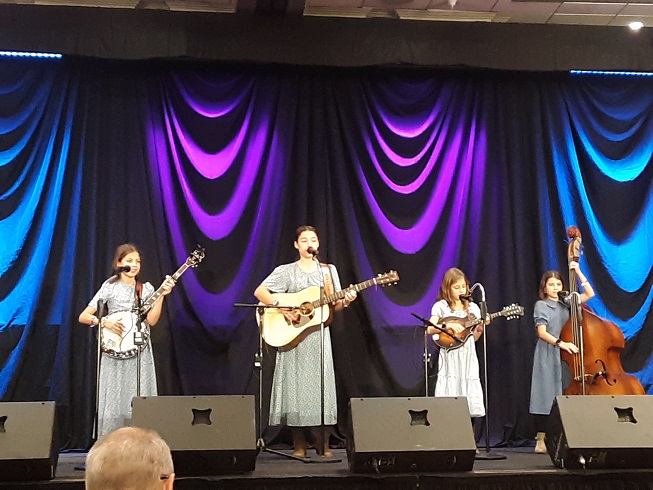
Alaskan Sunnyside Sisters – This band of young sisters was also in the competition, but did not make it as a finalist. Yes, they were still rough sounding and not truly professional, but I absolutely fell in love with them, as did much of the audience. They performed some bluegrass standards, reminding me a lot of The Peasall Sisters who performed for the O Brother, Where Art Thou? soundtrack. They are completely adorable, and are really enthusiastic to get better at their instrument playing and singing. I talked to their mother and told her that I would help in any way that I could to get them better. I also recommended that they listen to Hazel Dickens & Alice Gerrard music for some inspiration and song coverage. They made some good friends at the conference, including Whysper Stephenson, daughter of Larry Stephenson, who was more than happy to jam with them. I highly recommend that you check out some of their videos on their YouTube channel (https://www.youtube.com/@Alaskansunnysidesisters).
Hollace Oakes – I had blogged about this young fiddling prodigy a few months back (https://luegra.design.blog/2024/11/02/two-great-young-fiddlers/). I was hoping that she would show up at SPBGMA, as there are videos on YouTube of her at Galax and IBMA World of Bluegrass. I finally got to talk to her and her father late in the conference schedule, but told them that anything that I could do to help out her fiddling and potential career they should feel free to ask. I told her that it would be great to see her on the band competition stage next year, so hopefully she will be able to form a band to back her by then. She also posted a few videos of the week on her YouTube channel (https://www.youtube.com/@HollaceOakes).
Jamming – As expected, the four days of the conference saw a lot of jam sessions going on in rooms, the lobby and hallways. Because I was doing more networking for my songwriting, I wasn’t able to participate in any true jamming. However, some of what I heard was not only fantastic, but inspired me to write down some song ideas. If you go to YouTube and search “SPBGMA 2025,” I am sure that a few dozen videos will show up showing how great it was. Of course, my old body could not stay up too late to enjoy, so I had my earplugs in when I went to bed earlier than most others.
The Kaintuck Band – So this band was practicing in the room next to mine on Friday. I was in my room thinking that I had not heard any jammers playing one of my favorite songs, “Thirty Years of Farming,” by James King (written by Fred Eaglesmith). Sure enough, God strike me dead, within 10 seconds of that thought, the band next door kicked into it. It was like mental telepathy! Of course, I had to get my shoes on and go to their room and talk to them. Nice guys, the guitarist/singer was from La Grange, KY, where I usually stop on my way to Nashville to have breakfast at the Waffle House. I may have talked about this town before. The Main Street in town has active railroad tracks running right down the center, and there are videos on YouTube showing cars almost getting hit by locomotives. It totally reminds me of Mayberry on The Andy Griffith Show.
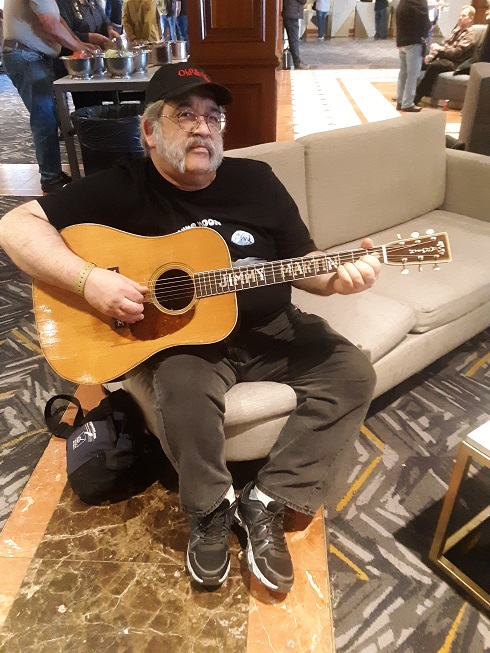
Jimmy Martin’s Guitar – There it was, on a guitar stand in the hotel lobby. I was ready to take a photo of it, but a relative of Martin’s was there, and she asked if I wanted to pick it up and play it. REALLY? I had to! Man, it was like touching a piece of Heaven!
Food – I hit the Waffle House a few blocks away from the hotel every morning. I absolutely love their Signature Bowl, and if you are there, you HAVE to have the waffles at least once! As stated previously, I went to the famous Elliston Place, but it wasn’t the same. It had moved out of its old location in the diner building and built a new, larger restaurant next door. The decor is the same, but not the spirit, The food is still great, but it seems like smaller portions. One thing that hasn’t changed is its selection of shakes and malts. I had a caramel malt, and I was in Heaven! I also visited the famous Prince’s Hot Chicken. There was a location only a few miles from my hotel, but because of construction the entire way, it took me almost an hour to get there. The place has a number of levels of chicken heat, from Mild to XXXHot. I went for the Medium, and one bite of the chicken fingers that I ordered was burning my tongue! Trust me, it was excellent, but if the Medium was that hot, I would NEVER go near anything more hot.
IMG Retail – I am going to do a whole blog about this place and experience next week, but let me say that it was such a fun experience that I plan on going back to Nashville sometime this spring or summer just to re-visit this place.
Bands – Along with the Larry Stephenson Band, other popular bands that performed at the awards show included The Grascals, Junior Sisk, Rhonda Vincent & The Rage, and Nothin’ Fancy. During the week, a number of other bands that performed included Dave Adkins, NU-BLU, Edgar Loudermilk, and my favorite band, The Kody Norris Show. One band that I had wanted to see for a long time was The King James Boys. They are a fantastic bluegrass gospel group, with amazing harmonies. There was a young lady sitting near me that seemed to know every word of every song that they performed. I asked her if she was related to anyone in the band. She said that she was not, just someone that was a big fan of the band. I immediately tagged her as a “Gospel Groupie,” a term that she and the band loved, and have proceeded to start writing a song about the experience.
Sylamore Special – This band won the band competition last year, and tradition is that the winner performs at the closing of the following year’s conference. The band was great back then, but has matured even more to being a fantastic bluegrass band this year. These younger performers have a good chance of being in the high ranks of bluegrass bands within a few years.
Songwriter Workshop/Showcase – I had complained about labeling this event as a workshop last year, and in some of the promotional material, it was deemed a “showcase.” However, some other material still listed it as a workshop. It still consisted of four bluegrass songwriters (Johnny Williams, Jeanette Williams, Donna Ulisse and Rick Stanley) performing some of their compositions to the audience. As I have stated previously, a workshop would be professional songwriters sitting down with aspiring ones and helping them to better their craft.
Well, that was one of my longer blogs, so I will end it there for now. Chew on it and comment.
Last week, a great bluegrass mandolin player passed away. Frank Wakefield was a bluegrass character to be sure, and seems to be forgotten be most modern bluegrass musicians. Where Bill Monroe was the Elvis Presley of bluegrass, and the Stanley Brothers were the Everly Brothers of bluegrass, Frank Wakefield was the Johnny Rotten of bluegrass.
He was always pushing the boundaries of the mandolin in bluegrass, which turned off many traditionalists. He started off playing with Red Allen in the early 1950s, then moved up to Detroit to audition for Jimmy Martin. While Martin at the time did not need a mandolin player, he recommended that Wakefield contact Marvin Cobb, leader of the Chain Mountain Boys. Wakefield played with the band for a while, then joined up with the Stanley Brothers. However, Ralph Stanley and Wakefield did not get along musically, so Wakefield went back to the Chain Mountain Boys.
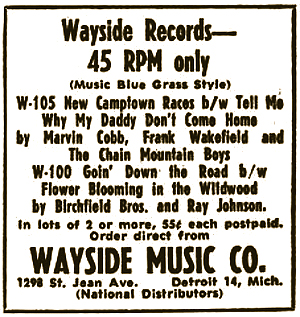
Wakefield’s style was boundary-pushing to say the least. The Chain Mountain Boys recorded the single “Tell Me Why My Daddy” with the B-side of the classic “New Camptown Races” for a small Detroit label, Wayside Records, that specialized in country and bluegrass. In fact, an advertisement in Billboard in 1957 is considered the first use of “bluegrass” to describe the music.
The Chain Mountain Boys disbanded in late 1957, and Wakefield continued to record for Wayside with Buster Turner. He also toured with Jimmy Martin for a time, then moved to Washington, DC to work again with Red Allen. With Allen, Wakefield would play such venues as Carnegie Hall, and he began to teach mandolin to future luminary David Grisman. He would later work with the Greenbriar Boys, and began to write classical-influenced instrumentals for the mandolin. This work would eventually get him invited to perform with the New York Philharmonic and the Boston Pops.
Wakefield would spend the 1970s recording solo work, being backed up by banjoist Don Reno and fiddler Chubby Wise. He would also tour with Jerry Garcia’s solo projects and warm up for Grateful Dead shows. His last notable recording was on the 1999 Grammy-nominated Bluegrass Mandolin Extravaganza, which also featured Grisman, Sam Bush, Ricky Skaggs, Ronnie McCoury, Jesse McReynolds, and Bobby Osborne.
The best description of Wakefield comes from Grisman: “He split the bluegrass mandolin atom. Some of us, obviously, will never be the same again.”
While I never got a chance to meet Wakefield or see him perform, I always had a soft spot for him in my bluegrass heart due to his time in the Detroit area when he really began to use the mandolin as a bluegrass weapon. Those early Wayside Records recordings were released in 1976 by Rounder Records called Early Days of Bluegrass, Volume 2, so if you can ever find that album, be sure to get it.
Frank, you will be missed by those who truly appreciate no0t allowing bluegrass to become stale.
A few disappointments for me over the past 24 hours. The first one was that I missed the John McEuen show at The Ark due to a really bad snowstorm here in the Detroit area Friday night. The second one I just learned about as I was beginning to write this blog.
Audie Blaylock passed away earlier this week at the age of 61. While he was not a household name in the bluegrass industry, he left an indelible mark on the bluegrass music scene. Although born in Texas, he grew up most of his early life in Lansing, Michigan, playing in local bands and being a regular face at Elderly Instruments. Professionally, he started out playing mandolin for Jimmy Martin in the early 1980s, and went on to work with a number of other artists, including Red Allen, Lynn Morris, Chris Jones, and Rhonda Vincent (where I first met him). He then started a solo gig with his band Redline, as well as worked with fiddle master Michael Cleveland.
His home base was Auburn, Indiana, so he was a regular performer at bluegrass festivals in the Indiana/Ohio/Michigan area. I became good friends with his one-time fiddler Patrick McAvinue, whom I still talk to and recently wrote an article on for Fiddler. Audie was always friendly to his fans and fellow musicians. Learning a lot from his time with Jimmy Martin, his band was always tight when it came to performances, especially song arrangements.
His crowning achievement came in 2004, when he helped coordinate the Grammy nominated album A Tribute to Jimmy Martin: The King of Bluegrass. The recording gathered up some of the best in bluegrass, including J.D. Crowe, Sonny Osborne, Paul Williams, Kenny Ingram, and Michael Cleveland. He always had a high regard for Martin, and continued to perform many of Martin’s songs live and on recordings.
I went to see Audie and his band many times, as he was more than happy to do gigs in the Detroit area outside of bluegrass festivals. Talking with him was like talking to your next-door neighbor. He was interested in everything, be it music, musical instruments, automobiles and hot rods, farming, and woodworking. He proved to be a great bandleader, in that his bandmates always had great respect for him even after pursuing other projects.
I am sure now that Audie is performing once again with Jimmy at that bluegrass festival in the sky. You will be missed down here, sir.
I stopped my subscription to the hard-copy of American Songwriter magazine a few years back. The articles were getting way too politically left leaning. It was like the magazine was trying to compete with Rolling Stone.
A few weeks back, an online article popped up on my computer entitled “10 Bluegrass Songs Everyone Should Know” (https://americansongwriter.com/10-bluegrass-songs-everyone-should-know/). The article is written by Peter Burditt, who seems to be a regular contributor to the magazine and/or website. However, I highly doubt that he is a go-to person when it comes to bluegrass music. A Google search did not find any credible information on the man, unless he is also a financial consultant or a lacross player.
The article chooses the following as “must know” bluegrass songs:
“Dueling Banjos” – Eric Weissberg
“Man of Constant Sorrow” – Dick Burnett
“Blue Moon of Kentucky” – Bill Monroe
“Will the Circle Be Unbroken” – Ada R. Habershon & Charles H. Gabriel
“Rocky Top” – The Osborne Brothers
“Foggy Mountain Breakdown” – Flatt & Scruggs
“Nine Pound Hammer” Unknown
“With Body and Soul” – Bill Monroe
“Tennessee 1949″ – Larry Sparks
“Tortured Tangled Hearts” – The Chicks/The Dixie Chicks
OK, where do I start?
In the article, Burditt states that these are 10 bluegrass songs that you should know. As a writer? As a musician? As a band? As a listener of bluegrass? He never defines that. In all instances, he is off target. Speaking for myself as a fan, musician and writer of bluegrass music, I only see three songs that are “must-know” contenders: Numbers 2, 3, and 5. These have been standards in bluegrass bands for a number of years. I could even go to say that “Man of Constant Sorrow” has not been a contender until the release of the movie O Brother, Where Art Thou? back in 2000. It was popular with the Stanley Brothers back in the 1950s and 60s before Carter Stanley passed away, but rarely heard until the movie brought it back to life.
Numbers 1 and 6 are instrumental songs, but “Dueling Banjos” is rarely performed by any bluegrass band. It has become more of a novelty song with bluegrass bands, the musicians joking around when tuning up or between-song banter. There are a lot more popular instrumentals that that one, including “Shucking the Corn,” Orange Blossom Special,” and “Back Up and Push” to name a few.
Number 4: “Will the Circle Be Unbroken” is pretty much a folk standard, and yes, many bluegrass bands perform it. However, it is usually as an unexpected encore or when two or more bands get together on stage to perform. So yes, it is one that bluegrass performers should know, but it is not on a regular set list.
Number 7: “Nine Pound Hammer” is better known by its country-picking version from Merle Travis, and is rarely played among bluegrass bands on stage. Occasionally, you will hear it in jam sessions, so, yes, it is one that you should probably know. That is, if you are looking to do some parking lot jams. If that is the case, then there are a dozen or more jam standards that you should know that are not on this list. I recommend checking out Pete Wernick’s website, where he lists over 100 songs that one usually hears at bluegrass jams (https://wernickmethod.org/jam-favorites).
Number 8: “With Body and Soul” is one that I would consider on a secondary list, not necessarily a “must know.” A few bands do this song justice, and it has a unique chorus, if you can get your tenor singer to do some falsetto on the line That’s how she loves me. Because it is not as common as “Blue Moon of Kentucky,” it does make a nice change of pace when a band does a rendition.
Number 9: Larry Sparks is a modern legend in the bluegrass world. He performed with Ralph Stanley after Carter’s passing, went on his own in the late 1960s, and has been giving us great music ever since. Is “Tennessee 1949” a must-know bluegrass song? Again, probably secondary. Incidentally, this was written by Bill Emerson and Pete Goble, not Sparks. However, Sparks always had a good ear for good songs. When he originally released this song in 1987, it was a bluegrass smash hit, and yes, parking lot jammers started including it in their repertoire. A few bands cover it, but it is not as common as the article makes it out to be. This is a good example of the author trying to make out like he is “in the know” with bluegrass music.
Number 10: Really? REALLY? I have NEVER heard this song played on stage by any bluegrass band, nor have I ever heard it in my years of playing at or listening to multitudes of parking lot jams! Even when jamming with female bluegrass singers, they tend to go for tunes by Alison Krauss, Rhonda Vincent, or Hazel Dickens & Alice Gerrard. Way more common tunes include Dolly Parton’s “Coat of Many Colors” and “Jolene,” or Lucinda Williams’ “Can’t Let Go.” Again, Burditt is trying to look like he is “in the know,” while also being inclusive, which is popular with the Left these days. All that it tells me is that he has probably never attended a bluegrass festival.
So what songs would I include in a Top 10 list? Here are a few: “Hard Hearted” – Jim & Jesse “Sunny Side of the Mountain” – Jimmy Martin “Freeborn Man” – Jimmy Martin “Salty Dog Blues” – Flatt & Scruggs “Doing My Time” – Flatt & Scruggs “Rolling in My Sweet Baby’s Arms” – Flatt & Scruggs “Thirty Years of Farming” – Fred Eaglesmith/James King “Dooley” – The Dillards “Angel Band” – The Stanley Brothers “Dark Hollow” – Bill Browning/Mac Wiseman/Muleskinner “East Virginia Blues” – The Carter Family “Love Please Come Home” – Reno & Smiley “In the Pines” – Bill Monroe “Sitting on Top of the World” – Bill Monroe (among others) “Wabash Cannonball” – Mac Wiseman (among others)
As for instrumentals, before “Dueling Banjos,” I would include standards such as “Bill Cheatham,” “Cripple Creek,” “Whiskey Before Breakfast,” and dozens of other old-time fiddle tunes, as well as the instrumental songs mentioned previously. I am also aware of a few Johnny Cash, Merle Haggard, and Gordon Lightfoot songs that seem a lot more common with jammers than some of what is mentioned by Burditt.
I wrote a blog a few years back on bluegrass fake books (https://luegra.design.blog/2020/07/17/a-brief-look-at-bluegrass-fake-books/). I would recommend checking out Bluegrass Fakebook by Bert Casey for some “must know” bluegrass songs instead of going on the opinion of Peter Burditt. He truly seems like he did very little research on popular bluegrass songs and just googled his way through the article.
This morning, December 24th, we lost one of the greatest and most influential banjo players in bluegrass music. The legendary J.D. Crowe passed away at the age of 84. You don’t know bluegrass if you haven’t heard of him, and if you listen to bluegrass, you have surely heard his work.
Somewhat of a banjo prodigy, Jimmy Martin offered him a job in the Sunny Mountain Boys when J.D. was 17. He declined so that he could finish school, but finally joined in 1956 and stayed for four years. During this time, some of the best recordings from the Sunny Mountain Boys were released, including “Rock Hearts.” “Sophronie,” and “My Walking Shoes.” After his stint with Martin, D.J. formed the Kentucky Mountain Boys, which lasted for 10 years. His next project was The New South, which became somewhat of a bluegrass supergroup that included Tony Rice, Ricky Skaggs, and Jerry Douglas. The group’s Rounder Records self-titled album, affectionately known by its release number “0044,” is considered a bluegrass classic, perfectly mixing traditional and progressive bluegrass sounds. If you haven’t heard it, go and get yourself a copy right away!
Along with the New South, J.D. would also take part in a number of tribute albums with the group The Bluegrass Album Band, which also included Rice, Douglas, Doyle Lawson, Bobby Hicks and Todd Phillips. In 1983, he won a Grammy for his song “Fireball” in the Country Instrumental category.
J.D. slowed down a bit as far as touring during the last decade for health reasons. He had been suffering from COPD the past few years, and went to meet The Lord early this morning. I am sure that there is a bluegrass Angel Band waiting for him up there.
I was able to meet him once at a IBMA World of Bluegrass conference when it was still in Nashville. I saw a bunch of bluegrass “fans” excited to seeing Dailey & Vincent running right past J.D. without a glance. I walked up to him and shook his hand, telling him how much I appreciated his work with Martin and the great 0044 album. He was not very talkative, but appreciated the fact that someone recognized him in the crowd without making a scene.
J.D. will be missed, especially by so many banjo players. More than an influence, he was a guiding light, and his work will last for decades to come.
Chew on it and comment. Merry Christmas to you all.
There’s no doubt, Jimmy Martin was a character. His presence onstage, his banter, his love for hunting, and his being very vocal about not being invited to the Grand Ole Opry are well-known in the bluegrass community. Some say that his brittle attitude rubbed many in the music industry the wrong way, which caused him to not get the recognition he deserved. Whatever the case, there is no denying that his singing was powerful, his songs are timeless in bluegrass, and he was probably the best rhythm guitarist that the genre ever knew.
Jimmy died in 2005, yet he is still talked about by bluegrass fans and musicians alike. Everyone seems to have some crazy Jimmy Martin story. Not many people would have their tombstone made years before death, showing all of his accomplishments, but Jimmy did.
Unfortunately, it seem that even after being departed for 15 years, fate still wants to take a swing at Jimmy. A recent story on the Bluegrass Today website states that during a March storm in the Nashville area, a large tree feel on Jimmy’s old house near Hermitage, which led to the decision that the entire house would be demolished. Nothing is left except the chimney and a pile of bricks. Jimmy’s family sold the property in 2014, and fortunately, no one was home at the time of the storm. An update to the story states that the family didn’t know it was once Jimmy’s house, but later turned it into a daycare center named after his band, The Sunny Mountain Boys.
If you have never seen the documentary on Jimmy, The King of Bluegrass, by all means watch it! You will laugh and cry at the same time. Filmed just a few years before his death, the viewer sees how hurt he is about not being fully accepted by the country music industry, despite all of his success bridging bluegrass and country during the 1950s and 60s. This tragic ending to his house seems like it is just one more nail in Jimmy’s legacy coffin, as if some evil spirit did not want Jimmy to be continually recognized.
Americana singer/songwriter Otis Gibbs has a YouTube channel where he talks about unique and weird happenings in the history of country, folk, bluegrass and Americana music. One highly entertaining video is his interview with Mike Bub, bluegrass bass player who has worked with Del McCoury among many others. Mike tells some amazing stories about Jimmy that will make you smile.
Jimmy did a stint up here in Detroit with Sonny and Bobby Osborne right after he left Bill Monroe. Lord, if I could ever step back in time, I would love to have been able to tune in to WJR and hear them playing live on the radio back in the mid 1950s. Jimmy was a regular on many country music radio shows, including the WWVA Wheeling Jamboree. However, he was never asked to be a member of the Grand Ole Opry, despite performing at the Ryman dozens of times. If the powers-that-be at the Opry followed the same standards now that they followed back then, none of today’s country performers would ever be asked to perform the Opry, let alone become a member.
One could ask any of the number of musicians that worked with Jimmy, and they would probably all tell you the same thing. He was a hard man to work for, but in the end, you became a much better musician. There are tons of other stories about his drinking, creating havoc, and hunting that could fill plenty of music history books. Jimmy Martin should be in the same American Legends category as Davy Crockett, Johnny Appleseed, and Pecos Bill. Our society is much better off because he was once a part of it.
 Luegra