Categories
Acoustic Guitars Musical Instruments

Signature Series Guitars: Are They Worth It?

Earlier this year, Martin Guitars released not one but TWO Billy Strings Signature Dreadnaught guitars, a D-28 and D-X2E. Both have the designs from and backing of Strings himself, and have many similar features while obviously differing in others.

Both guitars have a slightly shorter 25-inch scale, which Strings wanted instead of the 25.4 inch scale, basing it on Tony Rice’s Santa Cruz guitar, along with a 1.72-inch nut. The remaining features on the D-28 are based on Strings’ 1940 model that is his main instrument. This includes the rosewood back/sides, herringbone trim and bone nut/saddle. The D-X2E features a built-in pickup, soundhole string tuner, and high-pressure laminate back/sides. As expected, the prices are drastically different, with the D-28 going for about $3,799.00 and the D-X2E at about $899.00.

Signature series guitars have been around for decades, and Martin is not the only manufacturer to participate. Fender, Gibson, Ibanez, and others have produced numerous signature models. Martin has put out models name plated with artists such as Elvis Presley, Eric Clapton, Johnny Cash, Ed Sheeran, and Judy Collins among others. These are usually in limited edition amounts, and in many cases, become more valuable as the years go by.

However, are they worth it, just because they have a famous guitarist’s name on the label? That is highly debatable. In most cases, the features consist mostly of cosmetic differences. It seems to be a decision for purchase between a player (who will be sweating, picking, and grinding into the fretboard every day) and the collector (who will most likely never play it and just store it for investment purposes). But I highly doubt that getting one will make you play exactly like the artist.

In the case of the D-X2E model, the standard model goes for about $699.00 at various outlets, and an internet search shows them going for as little as $449.00 used. The $200.00 extra for the new Billy Strings model will include the shorter scale and the built-in tuner. Looking at prices for various used Martin X models, they tend to stay the same over the years, if not lowering a bit. I was fortunate enough years ago to sell my DXM model for the same price that I paid. Actually, I see that the DXM is going for more than I paid nowadays, but this could be that the model was still being made at the Nazareth, PA factory. Today’s X models are mostly being produced in Mexico. With Strings’ name on it, we can only wait to see if there will be any collector value on it. However, both Martin and Strings have stated that this is meant as a roadworthy guitar that will see a lot of picking.

As for the D-28, just about all models through the years have gained value, as long as they are well maintained. Prewar models can easily go for over $100,000.00, even if not in tip-top shape. A new model will go for about $3,000.00, give or take a few hundred dollars. The few features on the Strings’ model may not justify the nearly $3,800.00 price tag, but again, while a few players with money to burn may consider buying it, the majority of purchasers will be the collectors.

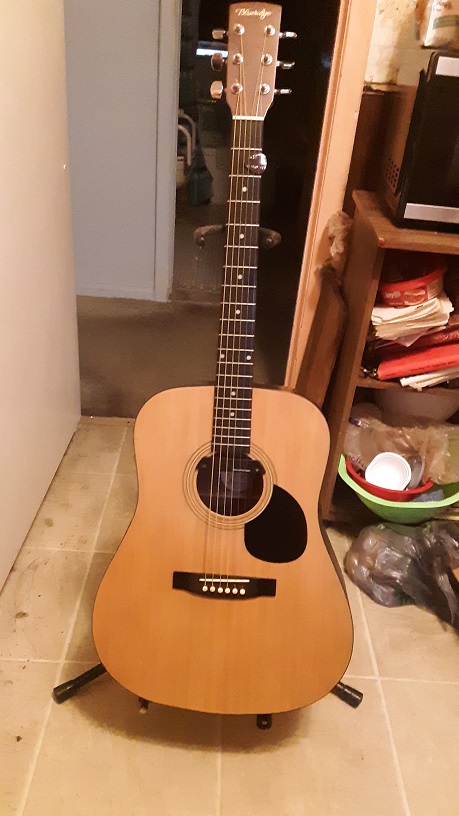
There’s no doubt that Strings has had an amazing impact on the guitar world, especially in the bluegrass field. I am sure that he has inspired hundreds of young people to pick up a guitar and start forming chords. I do see the D-X2E being a decent seller for Martin, and even the D-28 selling some to collectors. As much as I love and respect Strings, would I consider purchasing one of these models? Highly unlikely, unless I got an unbelievable bargain on one. My acoustic guitar arsenal is already packed. I have my treasured 1991 Martin D-28, the Sevillana 2208, and the Blueridge BR-OS that serve as my most-played models, along with a Blueridge BR-OM that has a pickup installed in case I do any solo performances. Add to that a few Yamaha and Jasmine acoustic guitars that I have gotten at garage sales and have fixed up to sell off. I also have the Cirrus dreadnaught that I am having specially built for me with a shorter scale, similar to these Strings models. So another acoustic guitar in the house is right now out of the question. But I won’t say no to anyone wanting to gift me one!

Chew on it and comment.
Categories
Acoustic Guitars

More About Acoustic Guitars: Blueridge

I have very briefly mentioned the Blueridge line of acoustic guitars in my previous blogs. Let me spend this blog covering my experiences with these guitars and why I value the old ones, just like many players value the old Martins (including me, of course!).

Blueridge guitars are marketed in the US by Saga Instruments. During the line’s history, they have been like most imported guitars from Asia, being manufactured in Korea, then in China, and eventually also in Indonesia. The brand has been around since the 1980s, and made a big comeback around 2000, producing a line of acoustics that were re-vamped with extra visual frills (i.e., fancy headstock inlays) to target the bluegrass market.

It was around that time that I started taking an interest in the brand. At the time, I was playing with a Martin DXM, which was the lowest-end Martin that was still being made in the Nazareth, Pennsylvania factory. While it was a good, solid acoustic guitar, it still lacked a lot of tone that one would expect from a Martin. I began seeing on the internet some stories about older Blueridge acoustic guitars that had a great tone comparable to Martins. I spent some time surfing eBay and found a model called the BR-OS going for about $125.00. I took a chance and purchased it.

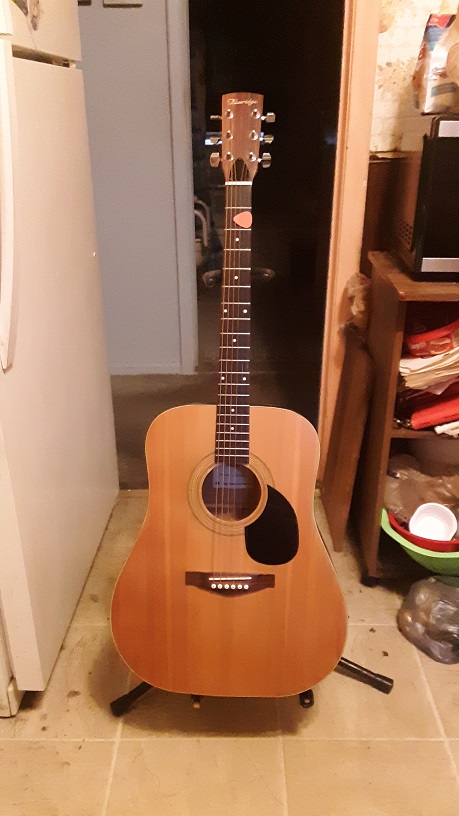
I was amazed at how great the thing sounded! A nice, warm sound, almost too close to a Martin, just a wee bit quieter overall. But this guitar was excellent to say the least, especially for what I paid. It showed some road wear, with a few small dents in the body and a small piece of binding missing along the fretboard. The BR-OS was made in China, based on the Martin D-28, with a solid spruce top along with rosewood back and sides. The inner bracing is also similar, and the headstock is reminiscent of Martin, with a simple cursive logo. I have owned this one now for over 20 years, and it is still one of the best acoustic guitars that I have ever played.

I immediately sought out to purchase more of these models. I came upon another BR-OS for about the same price and grabbed that one up as well. However, it had a lot of differences. It still sounded great, but the neck had a much more “V” cut to it, and the headstock had a curved “V” cut as well, similar to the Dean electric guitars. I kept it for a while, and sold off the Martin DXM for the same amount that I had paid for it a few years back (about $300.00). Side note: While Martin still has the X series of acoustic guitars, they stopped making the DXM long ago. It was a good guitar, and if you can find a decent used one for about the same amount of money, I would recommend it, especially as a back-up acoustic.

I was also checking out the newer models of Blueridge the were coming out at the time. I purchased the lowest-priced model, the BR-40. While it had a decent volume, I was not too satisfied with the tone, and re-sold it soon after, losing a few bucks in the transaction. I also came across a BR-OM on eBay, and snagged that for about $100.00. This is similar to the BR-OS, only with a laminated top, which doesn’t have as rich of a tone. I did like that the neck was very similar in comfort, so I decided to put a pickup in it and use it for my live solo shows.

When I got my 1981 Martin D-28 around 2005, I knew that it would be my main acoustic from that point on. My acoustic collection was a bit big, and I eventually sold off the V-cut Blueridge for the same amount that I paid. It was around that time that I was finding more articles about the old Blueridge acoustics and how great they were compared to the newer models. From my experience with the BR-40, I could attest to that thought. Saga has been putting out much more quality models of Blueridge guitars over the past two decades, including the limited-edition Carter Stanley and Larry Sparks models. I have noticed that the prices for new models have jumped up in price to almost double than what they were going for about 10 years ago. Of course, that is true with just about all guitars today, be it acoustic or electric. Guitar Center and Elderly Instruments are selling the BR-40 for about $645.00. To get at the beginner market, Saga introduced a lower-priced Bristol line of acoustic guitars. This reminded me of when Martin put out the Sigma guitars years ago. These Bristol guitars are good beginner guitars, but do not have that great of a tone, due in part to so much laminated wood being used.

The older Blueridge models have also seen a price jump, probably due to the reputation that they have. Scanning eBay recently, I did see a few V-cut BR-OS models going from $300.00 to $500.00, and a Martin-style headstock BR-OS for $598.00. There was also an early made-in-Korea model labeled BR-O5 going for $350.00. If these were in great shape, it would be worth looking into. However, purchasing a used guitar online without trying it out is a risky chance.

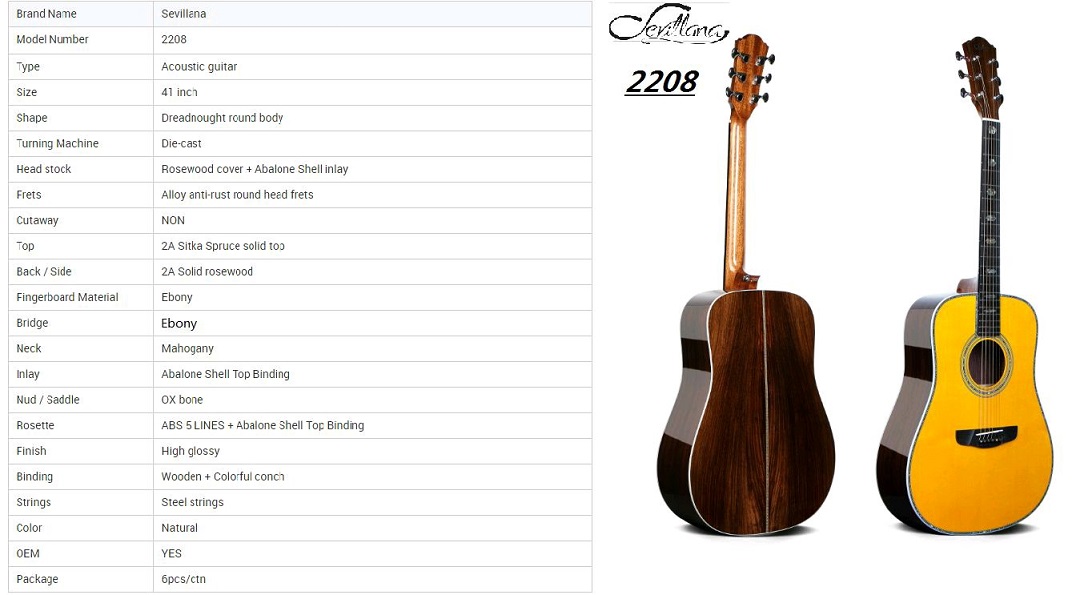
As for the newer Blueridge models, the “Pre-War” and “Historic” models seem to have a great tone and volume, and are a lower-priced alternative to a Martin. Elderly sells these models anywhere from $865.00 to $1,995.00 with a gig bag. Personally, after playing some of these models, I am pleased more with the Sevillana 2208 dreadnought that I secured back in 2022 from a distributor in China (https://luegra.design.blog/2022/07/16/this-dreadnought-needs-to-come-to-the-u-s/). I am still hoping that this guitar can make it to the US before the world sees more international turmoil.

Chew on it and comment.

Categories
Acoustic Guitars

This Dreadnought NEEDS to come to the U.S.!

I network with a lot of musical instrument sales and distributors in Asia, especially China, through LinkedIn. I have been keeping an eye on many of the guitars that they are marketing. There are a few of them that have piqued my curiosity, and I have stayed in contact with these reps to find out if they will be shipped to the US.

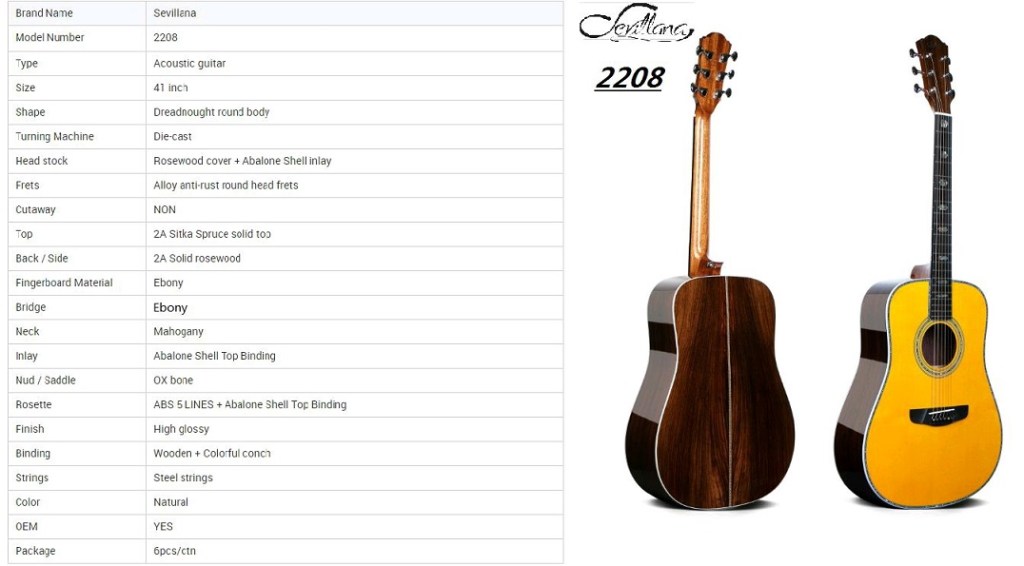
One rep from Deviser Guitars in China named Cherry and I have stayed in contact for over a year now. Recently, the company started making a solid-top dreadnought acoustic that, from the photos, appeared to be a quality product. The Sevillana 2208 “looked” like it could compete with other mid-line dreadnoughts, but a lot of stuff coming out of Asia is a gamble.

I worked with Cherry a bit, and last week, a 2208 was on my doorstep. HO-LEE-COW! This thing is amazing to say the least! Solid top and sides, bone nut and saddle, abalone binding, and a fantastic tone! This guitar would fit in with any bluegrass situation. I did a quick side-by-side test against my Martin D-28, and this 2208 stood up to it!

The only fault that I had was that there was no pickguard. As long as I have played in the bluegrass community, I have never seen a Martin without a pickguard. Cherry informed me that the standard for its company is to ship without a pickguard, but one can be installed at the factory. I do plan on installing one myself on this, preferably a tortoise-shell style.

I have stayed in contact with Cherry regarding getting these guitars to the US, providing her with contact information on wholesale distributors here as well as possible marketing options. From what she tells me, this guitar would retail in the US for about $1,149.00. In my experience with playing and pricing acoustic guitars, that is a good deal, as a sale price would probably bring it down to under $1,000.00. Martin doesn’t have a guitar near that price in its Standard series, and the 2208 has a way better tone than any Martin X series guitar. Blueridge guitars (made in China and distributed through Saga) has a number of comparable guitars in price, but not in tone!

Deviser markets mostly lower-cost guitars, ukeleles and accessories, but I have yet to see them in the US market. This Sevillana line (there are other models, mostly with unique slopes in the lower bouts of the body or strange cutaways) is geared toward more professional players. This 2208 would be a welcome addition in the bluegrass market, particularly with players who cannot afford a Martin or upper-tier Taylor. I cannot see why a US distributor has not looked into this yet. Perhaps Deviser should consider going the route of Glarry and handle its own distribution and sales in the US with strictly mail order.

I hope to have a video review of ths 2208 on YouTube before the end of summer, and plan to take this guitar to a few bluegrass festivals and let some other guitarists try it out. I do feel that there are buyers out there – they just need to be aware of it being available!

Chew on it and comment.

Categories
Acoustic Guitars Bluegrass Music

Martin Guitars YouTube Channel / More on the Sister Servants

Everyone that knows me knows that I love Martin guitars. I have a 1981 D-28 that I call Hazel (after Hazel Dickens) that I traded for with a Fender American Telecaster. She sounds beautiful, and even though my arthritis has been making it a bit difficult to fret, I still rely on her to be my guitar wife.

My first Martin as a DXM model that had a laminated top and was a low-end model. Even so, I was able to sell it years later for the same price that I paid. Over the past few years the lower-end Martins become more valuable as they age just like the higher-priced models. I have five or six other acoustics, some are easier to play, but Hazel is my go-to acoustic when I am recording or playing live.

I have always been a fan of Martin guitars. Partly because many of my country and bluegrass heroes played Martins. They truly set the standard for acoustic guitars, especially dreadnoughts. I recently subscribed to the Martin Guitars YouTube channel. It contains videos of artists performing at the Martin Guitar museum in Nazareth, Pennsylvania, as well as demo videos of Martin guitars and ukuleles. There is also a “Jam on the Road” series, with the most recent upload being country artist Dierks Bentley doing an acoustic jam with some of his bandmates.

There are two newer videos showing the construction of the D-18 and D-28 models at the Nazareth factory. Watch them and tell me what you think that I find wrong about them.

It has nothing to do with what the video is showing. It is great that they can show all of what goes into making a solid, beautiful and legendary acoustic guitar in under five minutes. However, the music is what I find wrong. The background music is electric blues-rock, with distorted electric guitars and heavy drums. Why would someone put this kind of music on an acoustic guitar video? There are hundreds of hard-driving guitar-laden bluegrass recordings out there. A Billy Strings or Molly Tuttle instrumental would work. Or most perfectly, “The D-18 Song (Thank You, Mr. Martin)” by Norman Blake and Tony Rice.

But what do I know?

Changing the topic. Back in August 2020 I blogged about the Sister Servants of the Eternal Word, a sect of nuns currently residing at the Casa Maria Convent in Birmingham, Alabama (https://luegra.design.blog/2020/08/07/nuns-performing-bluegrass-and-diversity/). The Sisters are very musically inclined, performing at various religious functions. Back in August I posted a video of them performing the bluegrass Gospel standard “I’ll Fly Away.” I just came across two more videos of Sister Mary Anthony jamming with fiddler David Morris and his mother. They are performing Bill Monroe’s “Jerusalem Ridge” and the old-time fiddle classic “Tom and Jerry.”

This is so wonderful to watch. Never doubt the power of God and music!

Chew on it and comment.

Categories
Acoustic Guitars Bluegrass Guitar

Yamaha Acoustic Guitars: The Poor Man’s Martin

First off, it was 20 years ago today that the US experienced one of its greatest tragedies. We lost thousands of citizens, the Twin Towers completely disappeared within a few hours, the Pentagon saw heavy damage, and a few dozen ordinary citizens became heroes losing their lives by fighting terrorists and crashing an airplane into a Pennsylvania field instead of the White House. I can remember it like it was yesterday, and it hurts a bit every time that I think about that day. For a few months afterward, we became a true united country. No democrats or republicans, just Americans working together. Let us never forget.

Last year in some earlier blogs, I was talking about the positive aspects of Glarry acoustic guitars and how they would make great beginner guitars, especially for the price. At the time, you could secure a new one directly from Glarry for about $50.00. The price seemed to go up a few dollars with each passing month, to the point now that the GT-502 Dreadnought Cutaway Acoustic is selling for $90.00. While it is still a good guitar, at that price, you may be able to shop around and find a quality used guitar that is much more durable and sounds better.

The Glarry acoustics just don’t have that look about them that makes you want to show up at a jam session with one, even as a beginner. You want to have an acoustic guitar that looks like a true dreadnought. While a Martin D-28 and its sisters are the standard for folk and bluegrass guitarists, new models cost at least $500 for the X series (which do not have that great of a reputation as far as volume or tone), around $1,200 for the made-in-Mexico Road series and 15 series, $1,600 for the 16-17 series, and the Standard series starting at about $2,500 for a D-18 (if you can find one). Don’t even get started with the prices of Limited Edition, Modern Deluxe, and Authentic series models. Used models vary in price, but not by much, due to Martin having a great reputation that the guitars age really well and the company stands by their work.

There are also a number of boutique brands like Collings and Bourgeois that cost even more, and some competitive brands such as Taylor and Guild that float around the same prices as Martin, although they are not as popular tone-wise. Face it, as a bluegrass guitar, Martin is the first choice by many.

Generally, Martins have gone up in price over the past decade or so, even with the lower-end models. My first Martin was a DXM model (which they don’t make any more) that I purchased online with gig bag for $300. It was good, but did not have the true Martin tone. Fortunately, I was able to sell it a few years later for the same price so that I could purchase my current Martin, a used 1981 D-28, which I have had for about 10 years now.

But back to what I am writing this blog about. What about the person that has less than $200 but still wants a decent dreadnought guitar that plays well and has a decent tone? My recommendation is the Yamaha series of acoustic guitars. There is a reason that Yamaha has been around in the music industry for over 50 years. They put out quality products for affordable pricing. We are talking about instruments across the board. Plenty of drummers use Yamaha drums as their regular kit. The DX-7 is a standard with keyboardists. I have had a Yamaha electric bass in my arsenal once and sold it for what I paid for.

A great beginner acoustic guitar is the Yamaha F-325. This is the model sold in the US, while in Europe and Asia the same model is called the F-310, with the only difference being the pickguard (F-310 = black, F-325 = tortoise pattern). This is a standard dreadnought size, with an easy-playing neck and a great full tone. These can usually be purchased for about $170 new. Online dealers like Sweetwater sell a package called GigMaker which includes a F-325 with a gig bag, tuner, and other accessories under $200.

Out of the box, these are set up really well. Mind you, they will not be as good tone-wise or heft-wise as a Martin D-28. They are lighter than your average dreadnought and, due to a laminated top, there’s a little less bottom end to the tone. Also, these models have rosewood fretboards, compared to high-end acoustics that usually have ebony fretboards (which give a more deeper tone when fretted). However, as a quality beginner bluegrass rhythm guitar, the F-325 is well worth it. I know of a few Martin players that have a Yamaha as a backup guitar. Yamaha does produce many other models, but all are more than reasonably priced as new.

As the F-325/F-310 was made for beginners, there are a lot of them out there that were purchased for aspiring youngsters only to be put into a closet when the student lost interest. This can be rewarding to you as the buyer. My winter pastime of working on instruments led me to scout around Craigslist and eBay for some good buys. I have snagged three of these models (two F-325’s, one F-310) used for around $100 each. Only one requires some body work (whoever owned it actually put a few small holes into the backside, either by drill or BB gun), but the other two are pretty solid. I plan to work on getting the tone a bit better with each of them through some basic modifications, which I will cover of the next few months here.

In the meantime, if you can get one of these guitars for a good price, say, $120 or less used, I would recommend at least trying it out. I leave you with a comparison of a Yamaha F-310 versus a Martin D-35 video from YouTube. It is a bit long, but you get the idea. The Martin has a better deep tone, but there is a difference between $200 and $3,200.

Chew on it and comment.

Design a site like this with WordPress.com
Get started