Categories
Music Instruction

When I Used To Teach Bass Guitar

As I continue to clean out my house to sell it off (probably some time next year), I continually come across stuff that makes me think back to my younger days. A few days ago, I came across a load of guitar and bass instructional books. I used to teach guitar and bass as a sideline, but that faded away as family issues overtook my time.

As for guitar, I was not much better than teaching beginner stuff. Open chords, timing/tempo, simple bluegrass/country/blues lead work, and recommending someone else if the student wanted to go further. In most cases, it was the student that lost interest after a few lessons. With bass guitar, I provided more experience. While I was very basic when it came to slap bass and fretboard tapping (I am still an amateur when it comes to that stuff), I loved stressing the importance of the bass within the band. Knowing the root of the chords, where to move comfortably along the frets, feeling the beats, setting the groove without being flashy and obnoxious, and being a reliable anchor were part of my syllabus.

While I was not big on teaching theory and more about playing by ear and feel, there was always one bass guitar instructional book that I felt was essential. Mel Bay’s Electric Bass Method–1 by Roger Filiberto. Mr. Filiberto was a stringed-instrument teacher in the New Orleans area from the 1940s until his death in 1988. He wrote this book, originally titled Mel Bay Presents The Electric Bass, back in 1963 when the bass guitar was relegated to either a lackluster guitarist or an upright bass player that needed to expand his/her worth. This was just before Beatlemania, so when that hit, the bass guitar became cool like Paul McCartney. Thus, this book became extremely popular.

I remember getting a copy around 1981 when I got my first bass. The original editions had a pink cover with 60s-era drawings. By the 1980s, when the title changed, the cover sported a photo of a modern-style bass. However, the inner pages had not changed. They still showed Filiberto playing weird Hagstrom bass with strange controls, as well as graphics that were definitely not computer-generated. The thing is, this book provided (and still provides) a wealth of information to the beginner bassist. Looking through it now, probably 10 years since I last opened it, I still see how valuable the lessons are, especially with basic note and sight reading.

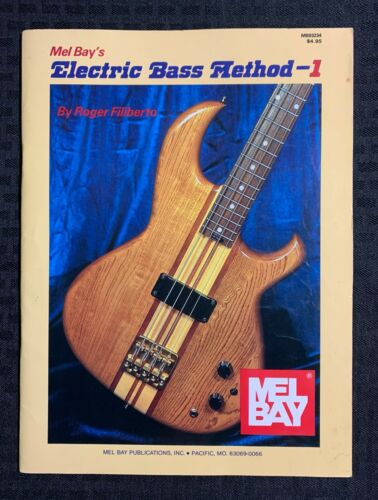
I wish that I still had my copy of this book
The newer version

I also found a few other Mel Bay bass books. The company put out a Value Line of instructional book/CD combinations back in the 1990s that unfortunately they have discontinued. These were geared more toward specific styles of music and consisted of just a few pages of examples to copy. These usually sold for less than $10.00, and the funny thing is, I have seen them going on eBay or Amazon for a lot more, or being sold out fast.

One other book that I found was The Everything Bass Guitar Book. This was one of those “Dummies” type of books that were popular a few years back. While it did provide a decent amount of instruction, much of the book is dedicated to other factors related to the bass guitar, including famous players, what type of bass/amp to purchase, practice tips, and how to audition for a band. In other words, the book for someone who says to him/herself, “I want to be a bass player” and doesn’t know where to start. I probably picked this book up at a cheap price just for the heck of it.

Which leads me to my next thought. Whenever I was teaching bass or guitar, or just talking to someone about practicing their instrument, I would always recommend that, if you were at a rummage sale or used bookstore and you came across some instructional books or videos on the cheap, buy them! While I wouldn’t pay full price for a video on heavy metal guitar if I’m playing bluegrass music, if there is a video in the bargain bin for a buck or two, go ahead and get it. Watching the video, you may learn a thing or two about your current playing. I have a library full of books and videos for guitar, bass, banjo, fiddle, mandolin, and dobro that I can always reference if need be. And it didn’t cost me that much.

While my teaching days are pretty much over, I still enjoy seeing younger people, or even older people starting out, having fun learning a musical instrument. The pandemic forced a lot of people to stay at home and, in turn, find new things to do like learn a musical instrument. I hope that most of them chose to continue to play now that we can get back out and mingle with other people.

Chew on it and comment.

Categories
Bluegrass Fiddle Bluegrass Music

My Favorite Beginner Fiddle Books

When I started writing for Fiddler back in 2012, after two or three articles, I figured that I better actually learn a bit about the fiddle so that I knew what questions to ask and not be confused when an artist or luthier mentioned some strange term. I played guitar, bass, and mandolin at the time, dabbled a wee bit on dobro, and looked at a banjo that I owned more than touched it.

I purchased a student model with soft case off of eBay for about $42.00, and from the stories that I later heard, I lucked out. The 4/4 model was no Strad, but the nut was properly cut, the bridge was satisfactory (I purchased a better one about a year later), and it was definitely playable. While it was able enough to kick out a jig or reel, I sure the heck was not! I picked up some books and videos, then tried my best to hack through a few old-time tunes. I was able to play about a dozen songs without too much squawks, but due to matters beyond my control, I let the fiddle practice slip away a little while after my bridge replacement.

Fast forward to about a year ago. I haven’t been living in my own house due to caregiving my elderly mother. Little by little, I found that I had time on my hands, though not enough to drive back to my house to make use. So among the items I brought over to mom’s place was the fiddle and books. I also started following some YouTube videos for instruction, and found one gent who calls himself Fiddlehed (www.fiddlehed.com) that was quite entertaining with his instruction. One suggestion he made a few months ago stuck with me – pick up your fiddle every day, even if it is just for a minute or two to drag the bow across an open string. That regimen stuck with me, as before I would play for an hour or so once a week. Now, I found myself doing 20 minutes or so every day, and it is part of my daily schedule just as morning exercise or evening dinner is. Plus, it has made me love playing the fiddle!

I pulled out the old lesson books and started from scratch. Lots of rust in many spots, but a few bright spots as well. I want to talk about the four instruction books that I have used for my lessons, which I recommend (in no particular order). I got them years ago when they came with play-along CDs. I believe all are still available, but you have to download the audio tracks from the websites on three of them.

My First Fiddle Picking Songs by Steve Kaufman and Conny Ottway (www.melbay.com) – Very easy to follow. It does not take too long until you start diving into easy songs. The accompanying CD has all of the songs played at a slow speed. Unfortunately, while there are short instructions on the musical notes and where they appear on the fingerboard and music staff, once the songs start appearing, you have to know where to finger as well as the notes on the staff. Also, there is no guitar chord markings on the songs for someone to follow along.

The American Fiddle Method Volumes 1 and 2 by Brian Wicklund (www.melbay.com) – This is probably my favorite of the lot! Wicklund has a good sense of humor, supplementing the lessons with cartoon drawings and witty thoughts. Like the other basic books, it covers the parts of the fiddle and how to position the hands. His instruction mirrors Mark O’Connor’s teaching philosophy, where you jump right into a popular fiddle tune that makes people dance (“Boil ‘em Cabbage Down”). With each new song comes a new technique, and all of the songs are fun (you can conjure up only minimal smiles for perfecting “Twinkle, Twinkle” taught through the Suzuki method). He also covers slides, drones and double stops, which is what makes this style of fiddling unique. Volume 2 continues with even more old-time and bluegrass fiddle tunes for intermediate players. There are also videos available for both books.

Fiddle Primer for Beginners by Jim Tolles (www.cvls.com) – This one is probably the most basic of the books listed. A lot more coverage of the rudiments on bowing and hand positions. It also moves slower, so if you are complete beginner that has no musical experience whatsoever, this may prove to be a good starter. There is also a companion video, and a very similar book (about 90% in content) entitled Violin Primer for Beginners by Tolles as well.

Bluegrass Jamming on Fiddle by Wayne Erbsen (www.nativeground.com) – This is a lot less of a beginner instructional book and more of a fiddle tune compendium and a simple way to play them (it even states in the introduction that this book is for those who have their feet wet, or at least “moist”) . Erbsen is laid back in his presentation, and gives some great information on bluegrass history. The music staff and tablature are a bit confusing compared to other books, so it takes some time to figure out. However, the songs are more bluegrass jam-centric than the other books, and he includes chord charts for the popular fiddle tunes. Erbsen is old school, so he still includes a CD with the book. He does have a beginner book called Old-Time Fiddle for the Complete Ignoramus.

The first three books listed have a lot of the same songs (“Soldier’s Joy,” “Old Joe Clark,” “Cripple Creek”), but it is interesting to see the variants of them. As I have all three books, I like to pull ideas from each one (i.e., whichever looks easiest) and work out my own version. What all of them do have in common is that they shy away from teaching via the Suzuki method, which may be fine for a three-year old but is monotonous to an older student.

I have enjoyed getting back to the fiddle, and still keep in touch with a few former co-workers that were also beginner fiddlers. In many ways, I could kick myself for thinking that the violin was a sissy instrument back in grade school, taking up saxophone instead and failing miserably. Perhaps by the time I was a teen, along with playing in high school orchestra, I would have been skilled at “Jerusalem Ridge” and found a great bluegrass band to work with.

Here’s “Forked Deer,” performed by Brian Wicklund. The music staff and notations appear in The American Fiddler Method Volume 2.

Chew on it and comment.

Design a site like this with WordPress.com
Get started