Categories
Acoustic Guitars Music Stores Old-Time Fiddle

Yard Sales, Fiddle Conventions, Elderly Instruments

Last weekend I did my yearly trek to two of my favorite ventures – the Michigan Avenue World’s Longest Yard Sale and the Michigan Fiddlers Association Fiddlers’ Convention. Before this year, the Fiddlers’ Convention was held in Hillsdale, so I could take Michigan Avenue all the way from Saline to Hillsdale to see the fiddling as well as do some yard sale shopping. This year, the convention was moved to Hastings (west of Lansing), so I ended up taking Friday off of work and doing each activity on separate days. Rain was predicted both Friday and Saturday, so here’s how it went.

Friday: The morning started off sunny, but I was frustrated with being stuck in traffic for an hour due to construction on Michigan Ave. and US-23. Once moving, I was able to stop in a few places that set up tables in quaint towns such as Clinton, Allen, and Quincy. My first stop led me to an old garage full of antique/junk toys, games, and nick-nacks. While I passed on almost all of it, I did get something that brought back memories of a when I was a kid – salt and pepper shakers that look like vintage Squirt soda pop bottles. Totally going up on a shelf in the kitchen.

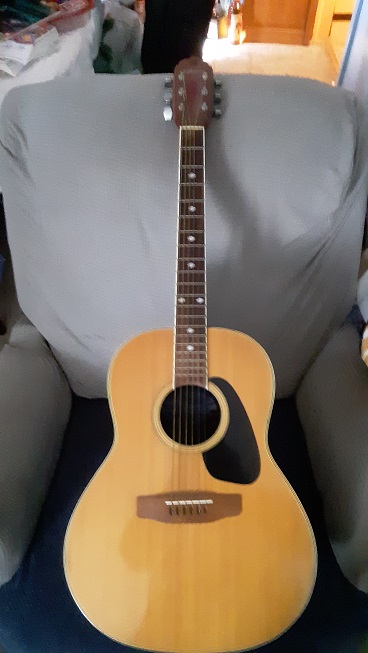
About the time that I reached Quincy (a few miles east of Coldwater), the skies were starting to turn dark, so I figured to head back toward home. I was primarily looking for music-related items, but almost everything that was in that category was priced way too high, even if I was able to barter down some. However, I was able to secure a used Applause AE-32 acoustic/electric guitar for a decent price.. For the unfamiliar, Applause guitars were put out by Kaman in the late 1970s to be a lower-end version of the popular Ovation acoustic guitar series. The main difference was a laminated top instead of a solid top. Other than that, most everything was the same. I was never a big fan of these guitars due to the rounded molded-plastic back/sides that made them difficult to play while balanced on the lap sitting, requiring a strap and standing up to hold. Bringing it home, I tested it out and it still had a good sound unplugged, also being clean and loud when plugged into an amp. While it seems like a good guitar, I plan on just cleaning it up and selling it off, hopefully making a few bucks in the process. Fortunately, I did beat the rain making it home.
And I did make a pit stop at Randy’s BBQ near the Michigan International Speedway in Brooklyn. It is a trailer where they make some of the best pulled pork barbeque you have ever tasted. Every year I stop by and order a Godzilla sandwich, which consists of pulled pork, pulled chicken, brisket, mac & cheese, cole slaw, and pickles on a bun! I literally starved myself all day because I knew that I would be devouring one of these in the afternoon.

Saturday: This day went a lot worse in so many ways. First off, getting to Hastings is not an easy task. I used to go to a park near Hastings every June for a Civil War reenactment. I had forgotten how many two-lane roads with police cars shooting radar there were along the way. No, I didn’t get busted, but I kept my eye on the speedometer almost all of the way there and back.

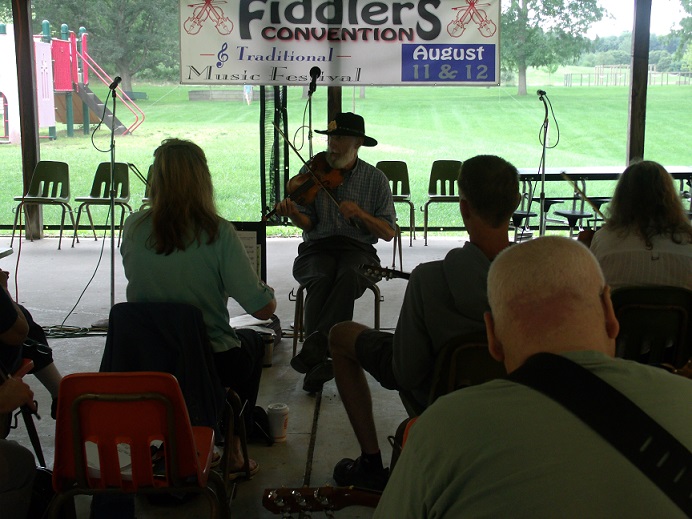
As soon as I pulled up to the campground where the convention was, Mother Nature let out a storm that made you want to start building an ark! It kept going on and off for over an hour. I was able to catch most of the fiddle workshop and jam session under the pavilion. I had attempted to video some of the activities, but the video camera that I was using was brand new and my first time using it, so I was unfamiliar with the set-up. The result was absolute garbage! Live and learn. I have to say that the workshop leader, a left-handed fiddler named Dave Langdon, has a great demeanor with the students, being very patient and hands-on with learning each part of a song.
After some time at the convention, I decided to head to Lansing for a stop at Elderly Instruments. This place used to be a Mecca for me prior to the pandemic. I would either schedule time off from work or make a clean slate on Saturdays to make the trip and spend a few hours testing out guitars and thumbing through the room full of CDs, videos, and music books. When I walked into the store, I was extremely disappointed. A lot has changed at the place in three years. What was once a room full of books and CDs was now limited to two or three bins each. The videos were completely gone, most likely due to the lack of interest in hard-copy videos and the move to online instruction. It was all replaced with walls of ukeleles – not my favorite stringed instrument to be sure. They still had the Martin guitar room, but the violin room was converted to a left-handed instrument room. It just didn’t have the same appeal to me as a whole than it did a few years back. I should have sensed that it would be a disappointment when I checked out the website earlier this year and noticed that there was a lot less being offered. I guess that my trips to the store will be extremely rare, only if I should happen to be in the area and the store is open at that time. No going-out-of-the-way trips for me any more.

Because of that, I will be scouting around for other music stores to make the trips to in the future.

Chew on it and comment.

Categories
Folk Music

Trae McMaken’s Michigan Fiddle Website

Trae McMaken is not necessarily a household name with Michiganders or area fiddlers, but he probably should be. A fiddle enthusiast and Michigan history buff since childhood, he has been combining his two loves over the past few years to make sure that the story of fiddle music in Michigan will not be forgotten.

Trae recently started up an educational website called Michigan Fiddle dot com (www.michiganfiddle.com). The site takes a look at Michigan folklore and how much fiddle music has had an impact on the state. In the Introduction page, he cites that fiddle music played in the past few centuries around Michigan has many ethnic influences. Because the state was continually a location for commerce, from fur trading during the 18th century, logging and copper mining in the 19th century, and the automobile industry of the 20th century, so many people came to the area from many foreign lands and brought their music with them. One characteristic of Michigan fiddling is the stress on use of the music for dance, with less flowering and ornamentation and a dedication to keeping a beat for the dancers.

The site includes many papers and articles written by Trae, as well as links to articles and recordings related to Michigan Fiddlers over the past century. He has assistance from a number of state fiddlers and historians to supplement his work. One such person, Jim McKinney, I have known for a number of years, and have supported his and his son’s work at the annual Michigan Old-Time Fiddle Championship held at the Huron Applefest in New Boston every October.

When one thinks of old-time fiddle music in America, thoughts usually go to the music of the Appalachian Mountains, the hills of Kentucky, or the plains of Texas. Michigan rarely gets a notice. Henry Ford loved fiddle music, and Beaver Island off the west coast of the northern Lower Peninsula has always had a strong fiddle presence. I am keeping this week’s blog short, as I would want you to instead spend some time checking out Trae’s site dedicated to Michigan old-time fiddling (see above link). Also check out this video of him performing some Quebecois music for the dancers.

Chew on it and comment.

Categories
Folk Music

The Fiddler of Beaver Island

Beaver Island is one of the few places in my home state of Michigan that I have not visited, When I was growing up, my next-door neighbor, who was born and raised on the island, would pack up his family and vacation there for two weeks in the summer.

Beaver Island has a unique history. It sits in the upper part of Lake Michigan, about 30 miles off the coast near Charlevoix. Initially inhabited by Irish immigrants, a Mormon group settled on the island in the 1850s, led by a man named James Strang. He ruled his congregation like a tyrant, and was eventually shot by men whom he flogged in public for adultery. He became a polygamist, claimed surrounding islands as part of his kingdom, and often forced his power onto other islanders not part of his congregation. He would eventually die from his gunshot wound, and his congregation soon after disappeared, mostly due to threats from other residents.

It was during the 20th century that Beaver Island gained its more positive and popular notoriety. Due to the rise of Irish and other European immigration, the island became a haven for fiddlers and old-time fiddle folk music. Dozens of fiddlers lived there, and my neighbor learned the fiddle and mandolin there as a child. I can still remember hearing him play the fiddle in the evenings.

The most popular fiddler from the island was a man named Patrick Bonner (1882-1973). He blended his Irish background with styles from other Michigan regions, such as the contra dances around Detroit and the Scandinavian lumberjacks and miners in the Upper Peninsula. He played dances on and off the island, and had a great reputation for unique interpretations of standard fiddle tunes. He came to prominence as a folk music icon during the 1930s through the research and promotion of Ivan Walton, a professor of English folklore at the University of Michigan. National musicologist and folklorist Alan Lomax, along with Walton, would go on to record a number of sessions with Bonner, which remain archived at the Library of Congress and Wayne State University in Detroit.

There were a number of other musicians from Beaver Island that Walton recorded as well. Add to that the multitude of hobbyist musicians (like my old neighbor) and you can imagine what Beaver Island was like. The air was filled with music constantly, and there was always a dance or concert going on in the evenings. I truly miss hearing my neighbor. I sometimes imagine him listening to me playing folk songs on the fiddle and guitar when I am at my mom/s house.

I had nearly forgotten about the island’s fiddle history until a few years ago when I came across the book An Island of Fiddlers: Fiddle Tunes of Patrick Bonner, Beaver Island, Michigan at Elderly Instruments in Lansing (www.elderly.com). Written and self-published by Glenn Hendrix, another fiddler from Michigan. Ringed-notebook in style, it contains a short biography and interview with Bonner done before his passing, as well as a number of tunes transcribed by Hendrix from old recordings of Bonner. Some tunes are variations of standards and public domain samples, while others seem to be semi-original compositions by Bonner. I felt that this was such as treasure of a book regarding the music of Beaver Island that I purchased a second copy and gave it to the daughter of my old neighbor. It turns out she gave his old fiddle to one of his grandchildren who now performs with the Cleveland Symphony Orchestra. Nice ending.


Chew on it and comment.