As I continue to clean out my house to sell it off (probably some time next year), I continually come across stuff that makes me think back to my younger days. A few days ago, I came across a load of guitar and bass instructional books. I used to teach guitar and bass as a sideline, but that faded away as family issues overtook my time.
As for guitar, I was not much better than teaching beginner stuff. Open chords, timing/tempo, simple bluegrass/country/blues lead work, and recommending someone else if the student wanted to go further. In most cases, it was the student that lost interest after a few lessons. With bass guitar, I provided more experience. While I was very basic when it came to slap bass and fretboard tapping (I am still an amateur when it comes to that stuff), I loved stressing the importance of the bass within the band. Knowing the root of the chords, where to move comfortably along the frets, feeling the beats, setting the groove without being flashy and obnoxious, and being a reliable anchor were part of my syllabus.
While I was not big on teaching theory and more about playing by ear and feel, there was always one bass guitar instructional book that I felt was essential. Mel Bay’s Electric Bass Method–1 by Roger Filiberto. Mr. Filiberto was a stringed-instrument teacher in the New Orleans area from the 1940s until his death in 1988. He wrote this book, originally titled Mel Bay Presents The Electric Bass, back in 1963 when the bass guitar was relegated to either a lackluster guitarist or an upright bass player that needed to expand his/her worth. This was just before Beatlemania, so when that hit, the bass guitar became cool like Paul McCartney. Thus, this book became extremely popular.
I remember getting a copy around 1981 when I got my first bass. The original editions had a pink cover with 60s-era drawings. By the 1980s, when the title changed, the cover sported a photo of a modern-style bass. However, the inner pages had not changed. They still showed Filiberto playing weird Hagstrom bass with strange controls, as well as graphics that were definitely not computer-generated. The thing is, this book provided (and still provides) a wealth of information to the beginner bassist. Looking through it now, probably 10 years since I last opened it, I still see how valuable the lessons are, especially with basic note and sight reading.

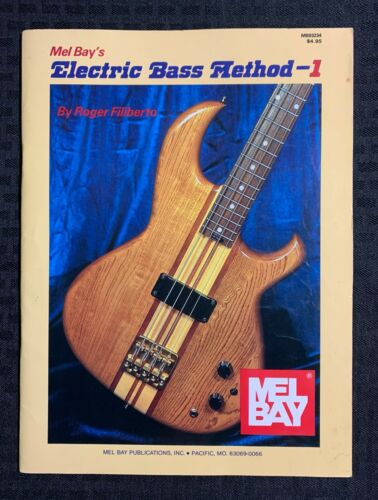
I also found a few other Mel Bay bass books. The company put out a Value Line of instructional book/CD combinations back in the 1990s that unfortunately they have discontinued. These were geared more toward specific styles of music and consisted of just a few pages of examples to copy. These usually sold for less than $10.00, and the funny thing is, I have seen them going on eBay or Amazon for a lot more, or being sold out fast.
One other book that I found was The Everything Bass Guitar Book. This was one of those “Dummies” type of books that were popular a few years back. While it did provide a decent amount of instruction, much of the book is dedicated to other factors related to the bass guitar, including famous players, what type of bass/amp to purchase, practice tips, and how to audition for a band. In other words, the book for someone who says to him/herself, “I want to be a bass player” and doesn’t know where to start. I probably picked this book up at a cheap price just for the heck of it.
Which leads me to my next thought. Whenever I was teaching bass or guitar, or just talking to someone about practicing their instrument, I would always recommend that, if you were at a rummage sale or used bookstore and you came across some instructional books or videos on the cheap, buy them! While I wouldn’t pay full price for a video on heavy metal guitar if I’m playing bluegrass music, if there is a video in the bargain bin for a buck or two, go ahead and get it. Watching the video, you may learn a thing or two about your current playing. I have a library full of books and videos for guitar, bass, banjo, fiddle, mandolin, and dobro that I can always reference if need be. And it didn’t cost me that much.
While my teaching days are pretty much over, I still enjoy seeing younger people, or even older people starting out, having fun learning a musical instrument. The pandemic forced a lot of people to stay at home and, in turn, find new things to do like learn a musical instrument. I hope that most of them chose to continue to play now that we can get back out and mingle with other people.
Chew on it and comment.
 Luegra