Categories
Lutherie

“Fake Neck” for Guitar Finishing

For my next guitar kit build, I plan on finishing the body with only multiple coats of Tru-oil. The Strat body from this kit (from Leo Jaymz) is one piece, and has some great visible grain that I would not want to cover with paint nor stain it a different shade.

On the previous kit, I had a tough time oil finishing the body on a bench, as laying it on one side while trying to coat the flipside meant that you had to let it dry for at least a day before flipping. I attempted to hang the body from a hangman-type device I built. This meant that I could not get a good grip on the body, and I had to do it outside because of the size of the device. As it is now winter, and I don’t want to wait to get started on the build.

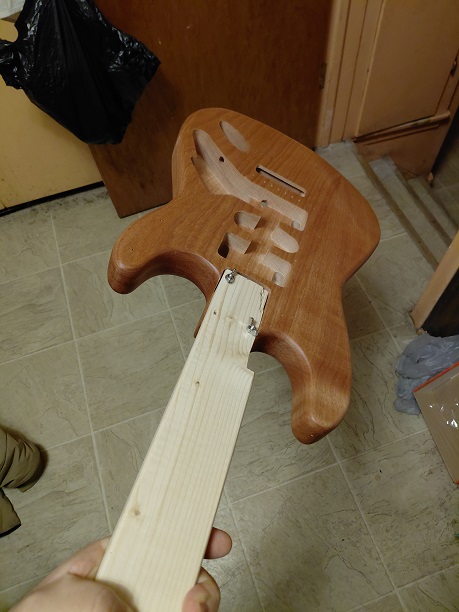
I happened to watch a few YouTube videos on guitar finishing, and on one of them, the luthier had taken a scrap piece of wood, cutting it to fit into the neck slot so that he could clamp it to the workbench. With that, he was able to do the finishing without laying it on the bench, flipping it over, then letting both sides and ends dry with even coats.

I went to a local Home Depot, and since I didn’t find any suitable scrap wood, purchased an 8-foot 1×3 furring strip for under $3.00. I cut a 2-foot piece off (so I can actually make four of these fake necks). I cut a notch on one end 1/2-inch x 4 inches, so that it would fit snug into the neck slot.
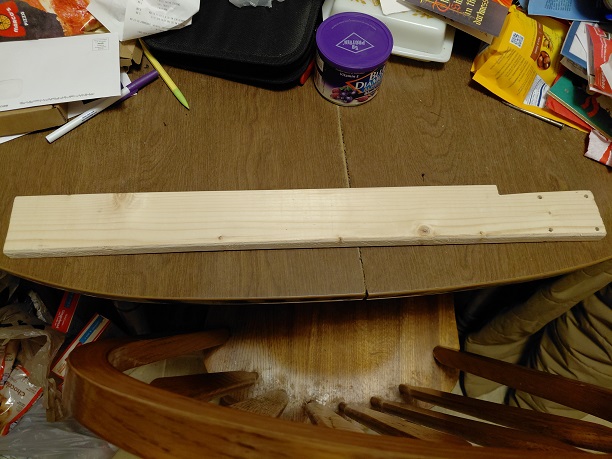
I drilled 1/16-inch holes into the slot section of the board, then for securing the fake neck, I’m using two 6-32×2-inch screws and 6-32 wing nuts. The total cost for this comes to less than $3.00 each for the four that I plan to make (keep two, give the others to fellow kit builders). This will definitely prove to be an extremely useful tool when staining and finishing bolt-on guitar bodies. Since I’ll be using Tru-Oil on this next project, I can do all of the work indoors, as Tru-Oil doesn’t have nasty fumes.
I will be heading to Nashville next weekend for the SPBGMA conference, so the weekly blog may be short and/or delayed. I will have a good summary of the conference when I get back.

Chew on it and comment.
Categories
Lutherie

Tru-Oil For Guitar Finishing

This week’s blog will be short due to a busy schedule. I wanted to talk briefly about my continued work on the guitar building project.

The neck that was in the Fesley guitar kit had an extremely light finish coating on it. It left the neck smooth, but I could tell that it would wear down to the bare wood after some playing and may cause some unneeded damage from sweat and grime. I wanted to put another coating of finish on it, but not with the polyurethane that I would be spraying on the body.

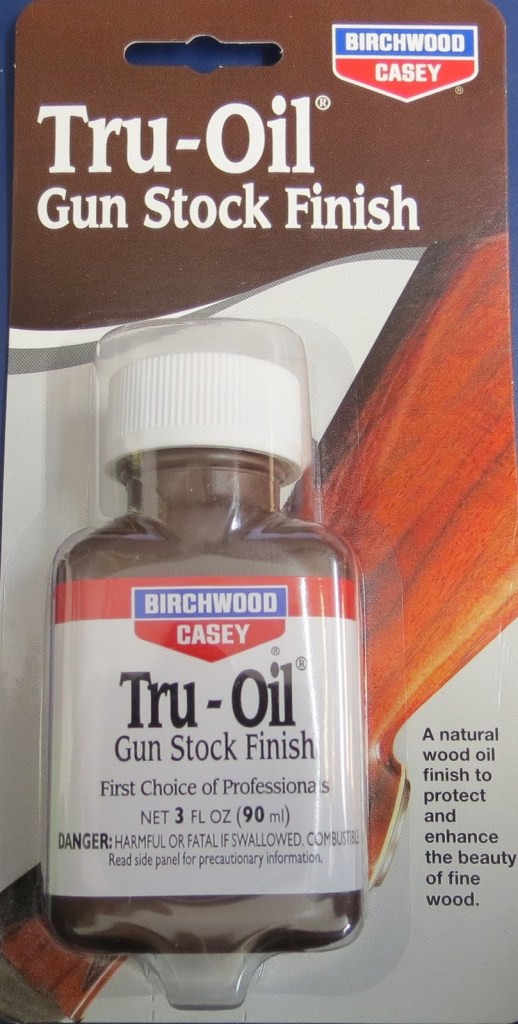
After doing some research on the internet, I found that there were a few recommendations to use Tru-Oil. This is a varnish-like liquid that is primarily used on rifle and shotgun stocks. It is very easy to apply with a cloth or sponge, and if applied thinly with a few repeats, will give a smooth finish as well as protective coating.

A small bottle usually goes for about $10.00. I had a tough time finding it in my area. I went to three gun shops, and none of them had it. I finally found it at a Dunham’s sporting goods store. According to internet searches, it seems to be available at Wal-Mart and Cabela’s as well, and can be ordered from a number of sources. I just wanted to get my hands on it right away, so I drove around until I found it.

The neck is maple with a rosewood-like fretboard Fesley calls “Techwood.” If anything like rosewood or ebony, it is best to keep unfinished (and oiled with lemon oil during cleaning or changing of strings), so I taped it off (along with the plastic/bone nut) before finishing. I applied three coats total, letting each coat dry 24 hours before the next. Tru-Oil is extremely thin, almost like water or a thin furniture polish, and I applied it with a soft cloth. A little goes a long way, and after the three coats, I still had about 3/4 of the 3-ounce bottle left. Once the third coat was dry, I hand rubbed the neck with OOO-grade steel wool.

I am pleased with the result. The back of the neck is just as smooth as before, yet you can see that varnish-like sheen to offer protecting from sweat and grime. I made sure to apply each coat thinly so as not to have any drips.

I would highly recommend the use of Tru-Oil for this type of finishing on a guitar neck or even a bare wood guitar body (I have seen a few examples online, and I may try it on one of the other solidbody kits that I have), especially if you do not want to fully spray polyurethane or do not have the equipment to do full spraying. It is easy to apply, and gives a great protective finish.

Chew on it and comment.

Design a site like this with WordPress.com
Get started