Categories
Consumer Electronics Entertainment Industry

Catherine O’Hara RIP/Antique Radio Swap Meet

A little over a week ago, we lost one of the funniest, most talented comediennes of our lifetime. Catherine O’Hara passed away January 30th at the age of 71. I was so glad to have soaked in her talent since the 1970s.

While most people will remember her as the mother in the Home Alone film series, as well as her Emmy-winning role as Moira Rose in the sitcom Schitt’s Creek, I will always think about her early roles doing sketch comedy for the SCTV program.

She began working with the Second City Comedy Troupe in the mid 1970s in Toronto. The main cast became so popular that they developed a television show for CBC starting around 1976. This is where I was fortunate to witness her talent long befor many others in the US. Being in Detroit, my television viewing included Channel 9 out of Windsor, Ontario. The Second City crew, which included O’Hara, John Candy, Eugene Levy and Joe Flaherty, parodied many commercial and cable television shows. The humor was perfect for a teen like me. O’Hara had some amazing characters, including Las Vegas singer Lola Heatherton, Brooke Shields, Meryl Streep, as well as dozens of housewife roles in commercial spoofs. It was fantastic that NBC picked up the program and aired it as a 90-minute comedy on Friday nights.

O’Hara was supposed to join the Saturday Night Live cast in the late 1980s, but passed because she did not want to live in New York City. She instead moved into film. Along with her Home Alone work, she was in Beetlejuice as well as a few of the Christopher Guest mockumentaries. These were I loved her the most. In Best in Show, she played a dog owner that seemed to have had previous sexual relationships with almost every man she comes across during a Westminster-type dog show. In A Mighty Wind, she plays Mickey Crabbe, the female member of the “famous” 1960s folk duo Mitch & Mickey. In For Your Consideration, she plays Marilyn Hack, an actress who is being considered for an Oscar nomination.

In all of her roles, O’Hara exaggerated the human character, which made them all the familiar to the viewer. She was beautiful, talented, and made each role memorable. The internet exploded with tributes to her, which was well deserved. However, the most beautiful quote that she uttered when asked what her favorite role she has ever performed was “the mother of my children.”

Ms. O’Hara, you brought so much joy into my life with your comedy. You have taken a piece of my heart with you.


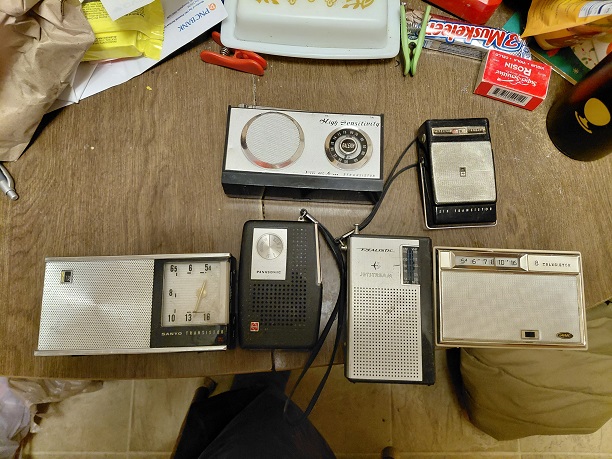
Last weekend I attended an antique radio swap meet in Waterford, Michigan. I go each year, looking for vintage microphones, 60s-era transistor radios, and any music stuff that is interested AND cheap. Most of the items I was interested in was way out of my budget range, but I did find a dealer selling some as-is transistor radios for $2.00 each. I grabbed six of tem, with one being of great interest. Made for Radio Shack and its Realistic brand, it is an AM radio with additional bandwidth to tune in airplane traffic if you are near a large airport. I always wanted one as a kid, but never got one for a gift. I grabbed it, with the intent to just put it on my display shelp of radios. When I got it home, YES, it actually still works! Only one other of the group is working, but I am completely satisfied with that find.
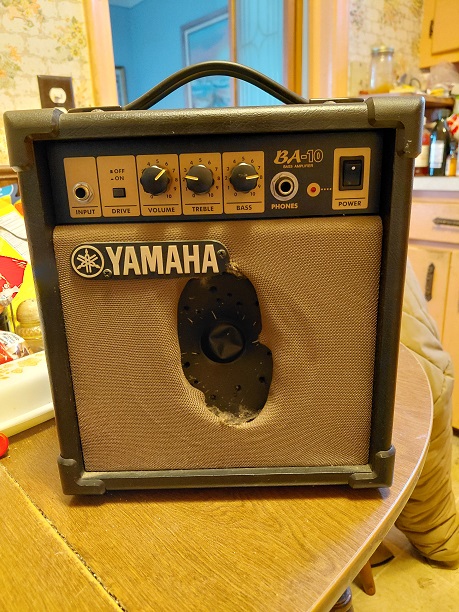
There was also a dealer there selling some guitar-related items. Again, most of it was either not interesting to me or way too pricey. However, I was able to get a Yamaha bass guitar practice amplifier for $15.00. The speaker grille cloth is torn, and whoever previously used it actually poked a few small holes in the speaker cone to get a more ratty sound, probably to use it for guitar. The amp works, although a bit low in volume at regular setting, but when the Drive switch is engaged, it seems to boost the volume considerable. I will probably take the front apart and replace the cloth when I get a chance.
Chew on it and comment.

Categories
Music Technology

A Brief Look at My Home Recording History

Two weeks ago, I did a blog on the Mattel Synsonics Drum Machine and how it was my first drum machine that helped me record demos (https://luegra.design.blog/2023/05/20/the-glorious-mattel-synsonics-drum-machine/). Well, that got me to reminiscing about my personal history of home recording and how much things have changed, as well as how stubborn I still am in a way.

When I was a teen and learning electric bass guitar, home recording was still in its infancy. There were a number of reel-to-reel four-track machines on the market, most notably the Teac 2340 and 3340 models. These retailed well over $1,000, and you could never find one used, Add to that these RTR machines were high maintenance, and tape costs were high. Anyone who had one of these puppies, as well as a basic mixer, could make money recording demos for bands.

I was poor, but I made do with what I could. I used my brother’s stereo cassette and saved up for another deck (Detroiters, do you remember Highland Appliance?) that I would bounce recording back and forth between the two decks. I had lots of homemade audio cables, abused my brother’s headphones, and worked with less-than-quality microphones from budget stores. Forget any type of compression or effects, although if I wanted to get creative, I could get some reverb by miking myself in the bathroom. My bible was Craig Anderton’s book Home Recording for Musicians.

Radio Shack, Olson Electronics, and a few mom-and-pop surplus electronic stores in the Detroit area were my hangouts. I built a basic mixer from plans in a electronics book from the library. Recording was done mostly when I had the house to myself, which was a rarity. However, I learned a lot about audio technology and recording techniques during this time.

In 1979, Tascam (a division of Teac) came out with God’s gift to home recording for musicians. The Tascam 144 was a four-track recorder/mixer that used the readily available cassette tapes. It only allowed recording of up to two tracks at one time, but mixdown of four signals into a mono or stereo demo was now easy to do with a machine the size of a small suitcase! It retailed for just over $500, so only the musicians that had some extra cash laying around could get one. It seemed like a novelty until news had it that Bruce Springsteen recorded his Nebraska album on a 144. Suddenly, every songwriter needed one of these machines. Soon branded under the Portastudio name, Tascam later marketed the 244 model (allowing all four tracks to record at once), and the 234 four-track cassette deck.

A company called Fostex, which had developed a somewhat affordable A-8 eight-track RTR recorder, came onto the market with its own version of the 144 that they called the X-15. Very similar in operation as the 144, it also retailed around $500. However, my local music store Wonderland Music would often have “Crazy Clarence” sales, and I got one of these for $299! This was my pride and joy for a number of years.

During the 1980s and 90s, other companies such as Yamaha, Vestax/Vesta Fire, and Marantz offered variations of the home recorders. I secured a few Yamaha four-tracks over the early years. Their first endeavor was the MT-44, which was an actual tape deck that recorded four tracks instead of stereo. It came with a small mixer that, if I remember correctly, had a crappy reverb/echo built in. I got that set used, and gave it to a singer in one of my old bands so that she could record demos. After the X-15, which I sold to another musician, I purchased the Yamaha MT-100. This machine allowed me to record all four track at the same time, so recording band demos became a breeze.

My thirst for home studio recording could not be quenched, so I saved up and purchased the Tascam 238 Syncaset. This machine recorded eight channels onto a cassette tape. This was as big as a normal cassette deck, but had the capabilities to record all eight tracks at once, so band demos were like the pros! Its only drawback was that bleed-over from adjacent tracks was common, especially when recording loud guitars or drums. I also got myself a Fostex 812 12-channel to 8-channel studio mixer. I was able to make some money back by recording other bands’ cheap demos. I also picked up some rack-mount effects at this time to make my recording much more professional. I used this equipment to record a compilation album on my own record label called Boombacoustic!, which consisted of ten local bands performing an acoustic song at a bar in Hamtramck, That CD was nominated for a Detroit Music Award back in 1998.

Around that time, I was contributing articles about recording and building DIY recording projects like simple mixers and direct boxes for a magazine called Home & Studio Recording. I also put out a quarterly newsletter called Home Recording Quarterly that I distributed around Detroit.

Then, digital recording began to take over, and I actually lost interest in following the trend. I stopped recording bands, and because people were interested in digital recording, my knowledge and interest in analog recording was not popular any more. I also saw that getting chrome cassettes for recording was now difficult, so if I wanted to continue to record even my personal songwriting demos, I would have to get with the program. I eventually purchased a Zoom MRS-4 four-track digital recorder. This machine is basically a digital version of the old X-15, but does have a lot of built-in special effects. For mixdown, I have a Tascam DR-03 hand-held digital recorder, which allows me to record in mono or stereo, as well as in WAV or MP3 format.

Cleaning out the house, I found the MT100, the 238 and the 812 board stored away. I will probably sell them off for a less than they are worth, but other than the mixing board, these machines are pretty much obsolete. Heck, the MRS-4 is close to obsolete as well, since the memory cards that it uses are hard to come by.

Last year, while at a large rummage sale in west Michigan, I came across a Tascam Portastudio DP-02CF digital eight-track recorder/mixer. It didn’t have a power supply, so I took a chance on it and bartered down to $25. I ordered a power supply, and it tests out as working. I have yet found time to record any demos on it, as my time cleaning the house is priority. I also still find the ease of the MRS-4 on the kitchen table to be sufficient. However, I hope to get more into recording with the DP-02CF by the end of the year.

Chew on it and comment.

Design a site like this with WordPress.com
Get started