Musician and writer (both song and print) for over 30 years. Primarily interested in roots music (Americana, bluegrass, blues, folk). Current contributing writer for Fiddler Magazine, previous work with Metro Times (Detroit), Ann Arbor Paper and Real Detroit Weekly, as well as other various music and military publications. As songwriter, won the 2015 Chris Austin Songwriting Contest (Bluegrass Category, "Something About A Train," co-written with Dawn Kenney and David Morris) as well as having work performed on NPR and nominated for numerous Detroit Music Awards.
I was vaguely familiar with Norman Watt-Roy during the 1980s, more of just seeing his name on a lot of albums that I had back then. As I have done more reading and researching on my favorite music from back then, I have come to realize that he was an unsung hero from the punk/new-wave era.
Watt-Roy started put playing in a number of rock bands during the late 1960s and early 1970s with his brother Garth. Later that decade he met up with Ian Dury and played on the Blockheads first album, New Boots and Panties!! on the Stiff label in 1977. Watt-Roy would later join up in Wilko Johnson’s band in 1985.
However, it is his guest appearances on other albums that let me know how great he was. He plays on Nick Lowe’s album Jesus of Cool (known in the US as Pure Pop for the Now People), giving memorable bass lines on “Nutted by Reality.” However, my favorite of his bass work appears on The Clash’s album Sandinista! Watt-Roy laid down some of the greatest grooves on the most memorable songs, “The Magnificent Seven” and “Hitsville UK,” along with “The Call Up.” Charlie Don’t Surf,” and “Something About England.” Those first two songs have always been held in high regard with me, and when I was playing bass during that time, those were two songs that I had to learn. It was painstakingly difficult, as I was using a pick, while Watt-Roy plucked with his fingers. It was only recently that Clash drummer Topper Headon stated that Watt-Roy played the bass groove on the band’s biggest hit, “Rock the Casbah” from Combat Rock.
Watt-Roy also worked with The Selecter, and laid down bass work on Frankie Goes to Hollywood’s “Relax” in 1983, although the final mix didn’t have his playing. He did session work with Roger Daltrey and Wreckless Eric, and during the early 2000s, he performed with a later incarnation of Madness. Recently, he has been appearing with reincarnations of The Blockheads.
I urge any bass player in pop and modern rock/punk bands to search out Watt-Roy’s bass work. The man had a way of making average songs get a dance able groove without going too pop. I hope that he also gets more recognition for his amazing work.
I came across this online article last week from Consequence regarding the 100 greatest bass players (https://consequence.net/2024/04/100-greatest-bassists-of-all-time/11/amp/). The survey tried to cross most genres (rock, pop, blues, jazz, R&B), but like any opinion list or survey, I disagree with much of it. I would probably agree with the top three (James Jamerson, Paul McCartney, Jaco Pastorius), but after that, it is totally off as far as I am concerned. Flea above Geddy Lee and John Entwistle? Dee Dee Ramone even on the list? Pleeeze!
This got me thinking about some of the bassists that influenced me in my early years of playing the instrument in my first band doing oldies with my cousin, my first punk bands, and through today recording my own bluegrass, folk, and Americana songs. Over the next few weeks, I want to look at a few bassists from the punk era that were a lot more expertise on the four-string than the usual punk bass players just plunking eighth notes with down strokes and a pick (like Dee Dee).
The first bassist I will cover is Bruce Foxton of The Jam. From 1976 to the band’s break up in 1983, Foxton handled the bass chores with an intensity that was rarely seen in the first wave of punk bands, let alone any rock/pop band in general. Originally a guitarist, he switched over to bass when the band went from a four-piece to a three-piece. Listening to the band’s first single, “In the City,” instead of following the opening guitar chord progression, Foxton does a descending bass line. Rumor has it that the Sex Pistols borrowed the bass line and used it on their single “Anarchy in the UK” and released the song before The Jam could release their single.
Foxton was never content with just playing the root note on a chord progression. Like most three-piece bands (Cream, Jimi Hendrix Experience, The Who), the bassist provides a melodic line along with a pulse to the song. Foxton was no different. While the debut album In the City has some moving bass lines, it was on the second album This is the Modern World, that he really started to show his prowess. Songs like “The Modern World” and “London Girl” show what talent he had on his Rickenbacker 4003 bass. Be it him or the production, that sound, along with those great bass lines, were distinctive and powerful.
Then comes All Mod Cons. While the entire album is bass-friendly, it is the song “Down in the Tube Station at Midnight” that Foxton is at his best. In fact, the bass line IS the song! I remember thinking that I was a god when I finally got that bass line down pat. He does EVERYTHING on that bass! This is literally one of the best bass recordings ever in rock history!
The following album, Setting Sons, continues with some great bass lines, especially “Smithers-Jones” in which the bass basically carries the entire song, and “Eton Rifles,” with Foxton again working with the vocals instead of the guitar. But it is with Sound Affects in which Foxton, and the whole band for that matter, put aside their Who/Small Faces/Mod influences to use The Beatles as a primary influence. This is blatantly obvious with “Start!”, which definitely rips off the bass line form The Beatles’ “Taxman,” but moves it even further. Another great bass groove comes with “Man in the Corner Shop.” Finally, there is “That’s Entertainment,” which Foxton makes the song move like a bus traveling down a deserted city street at midnight.
The band’s final studio album, The Gift, has Foxton heavily influenced by Motown. One listen to “Town Called Malice” will convince you. Other bass line treasures on the album include “Ghosts” and “Precious.” This was followed by two single releases, Beat Surrender” and “The Bitterest Pill (I Ever Had to Swallow),” both of which show Foxton doing his best Motown/Stax bass work.
After The Jam’s breakup in 1983, Foxton would join Stiff Little Fingers from 1991-2006, as well as play in some other short-lived bands. However, it is his work with The Jam that he is best known. The bass lines were amazing to say the least, and live, he was as animated as a marionette with tangled stings. The Jam were one of the most influential punk rock bands of the late 1970s/early 1980s, but were just a footnote in the US. That is a shame. Yes, while the band’s lyrics were British-centric, the band’s overall musical sound was addictive to say the least. They had a raw energy, pushing the sound of the 1960s to a new height. At the very least, seek out a The Jam compilation, or if you can, any othe original albums. Foxton was a maestro on the bass.
I have two small songbooks that I absolutely treasure. I have had them for years now, and have more than served their purpose for me when researching old-time Gospel songs. I wouldn’t let go of either of these for any money. They both come from the publishing house of Albert E. Brumley & Sons of Powell, Missouri. For those of you who don’t know, Albert Brumley was a songwriter and song collector, much in the vein as A.P. Carter. Some of the most famous and popular Gospel songs come either from his pen or his desk, including “I’ll Fly Away,” “Jesus, Hold My Hand,” and “Turn Your Radio On.”
The first book we’ll look at is Albert E. Brumley’s America’s Memory Valley (orange cover). Back over 20 years ago when I was still playing in the roots-rock/alt-country band Gravel Train, the drummer Mark Kaster gave me this songbook because he knew that I had a strong affection for old-time music. The book contains about 50 folk and country songs from the 1920s through 1950s that were performed by popular acts of the time, including The Carter Family, Bill Monroe, Little Jimmy Dickens, and Uncle Dave Macon. There is also some wee bits of history, either about the song or folk and Gospel music in general. Albert’s father, William Brumley, is seen playing the fiddle on the cover. I can remember around the time that Mark gave me the book, I was working as a proofreader at an advertising agency. One of my co-workers used to perform in Branson, Missouri with Albert’s son, Albert Jr. I showed her the book, and she got very emotional because she remembered both Alberts, as well as performing a number of these songs on stage with Albert Jr.
The other book, the one that I really cherish, is Albert E. Brumley’s All-Day Singin’ and Dinner on the Ground (black & white cover). This contains the musical notation for my favorite Brumley song, “Turn Your Radio On.” I have always loved John Hartford’s rendition, and have wanted to learn the lyrics to perform it (hopefully some day). While this booklet has a lot less songs than the other, they are all Gospel related, which always sound wonderful when a bluegrass band or old-time music ensemble performs them. The other charming thing about this booklet is that it includes a number of recipes for dishes that were popular for Sunday “dinners on the ground.” Back in the early to mid 20th century, many Protestant-based churches would have these picnic-style get-togethers where members of the congregation would prepare food for a potluck lunch, and the preachers and deacons would provide some words of faith while everyone sat on the ground and ate. Many times songs such as those included in the booklet would be sung by the attendees. It was a good, clean time to spend a Sunday afternoon.
A quick Google search shows that a few copies of All-Day Singin’ can still be found at Amazon or on eBay, as well as other Brumley publications. Most seem to be reasonably priced, so it may be worthwhile to pick up a copy, if only to see how people entertained themselves way back when.
With the advancement of society due to technology, it seems that such events are not as popular as they were 50-100 years ago. The youth of today are much less interested in getting together with others for religious outings, and the elders have become apathetic in encouraging the young to a faith-based lifestyle. Western society seems to slightly ridicule its religions, only referring to them when it seems necessary, such as Christmas or Easter, or when convenient, such as the few months following 9/11. While I am a devout Roman Catholic, I show no disdain for other denominations, as well as other faiths such as Judaism or Islam. However, I remember the many church picnics and get-togethers when I was a kid, and that connection seems to have disappeared for the most part. I can only hope that there is a change in that attitude, and it not happen because of a tragic event. Singing old-time Gospel songs does an amazing thing to your heart and soul.
On Friday of this week, I learned of the death of Amnon Weinstein at the age of 84. He was a luthier living in Tel Aviv and had run his violin repair shop there since 1986 when he took over the business with the passing of his father. Like his father, the trained his own son to become a luthier as well. He was known internationally for his repair work, but it was his special work over the past four decades that brought him his highest acclaim.
Amnon’s parents left Lithuania (part of the Soviet Union) in 1938 and moved to then Palestine. They left almost all of their relatives behind, most of whom would perish in concentration camps during the Holocaust. His father was a violinist, but found better work as a luthier, and trained Amnon to do the same. He did not know much about his relatives that died in the Holocaust, as his mother was very subdued about that information.
In the 1980s, as he started taking an interest in learning about his ancestry, a survivor of Auschwitz came to his shop for a violin repair. As Amnon took the violin apart to assess damage, the body had ashes inside. It turned out that this man had played the violin at the camp to prisoners that were being led to the gas chambers, and these ashes were remnants from the air near the crematoriums. It moved Amnon so much that he went on a quest to locate violins that had been played by Jews either imprisoned or used as slave labor.
The book Violins of Hope by James A. Grymes covers the stories of these musical instruments, as well as what happened to the owners. Amnon restored over 60 of these violins, and founded an organization, also called Violins of Hope, that loans out these instruments to professional musicians to perform with at concerts and educational programs. His work was highlighted in a 2016 PBS documentary.
I happened to come across the above-mentioned book through a clearance house and ordered it. The stories within the text of prisoners, slave laborers, and resistance fighters who relied on the violin to provide comfort was so moving, I was brought to tears. While I have read dozens of books on various aspects of World War II, including the Holocaust, this book was especially moving, due to my love of music as well.
The Violins of Hope collection has toured all over the world and has received enormous praise. Amnon’s work in restoring violins that were close to disintegrating from age and lack of care is extraordinary. I implore you to read more about Amnon Weinstein in this New York Times article (https://www.nytimes.com/2024/03/21/arts/music/amnon-weinstein-dead.html), as well as find a copy of the Violins of Hope book. You will learn how important music is to a culture, even in the the most tragic of times.
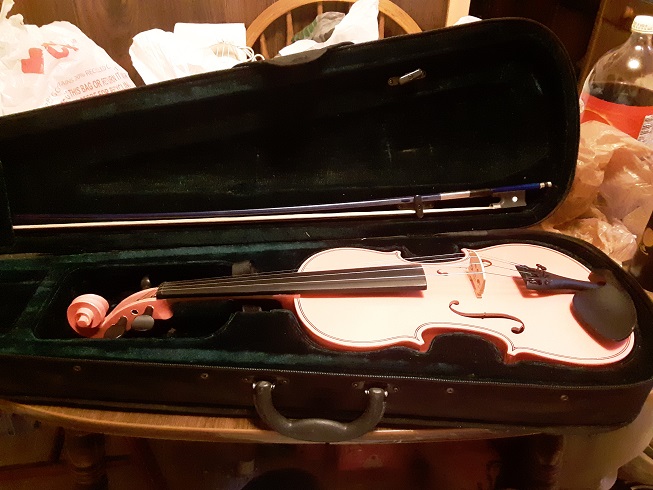
I got around time this past week to work on the pink violin that I talked about a few weeks ago (https://luegra.design.blog/2024/03/02/working-on-a-pink-fiddle/). Basically, it needed a new bridge, strings, and replacing the bow. The results of my work was a bit of a let down, but not a failure.
I purchased a replacement bow through eBay. I didn’t want to spend a lot on one, just around $15 for a student model. One seller had some colorful ones for that price, and I asked for a red one that would go with the fiddle. They sent me a blue on instead. I’m not going to go through the trouble of returning it, as I have had problems with another eBay seller accusing me of stealing from him when I returned a product.
As for the bridge, that was a bit more of a problem. I ordered one bridge from an eBay seller that turned out to be unfinished. As anyone that works with violins knows, the bridge has to be carved a special curvature for the strings, as well as a certain height from the fingerboard.. I tried my best to cut, file and sand the curvature, but was not able to get it correct. I have since then ordered some violin bridge templates, just in case I attempt this job again. With one bridge ruined, I decided to spend a few bucks more and get a finished bridge from Fiddleshop.com in Pompano Beach, Florida along with some rosin. The bridge only requires a little fine sanding before putting in place. Unfortunately, the soundpost inside the body is placed a bit too far back from where the bridge is supposed to rest on the body, so the tone is not that great. I don’t have the tools nor the patience right now to re-adjust the soundpost.
Stringing a violin can be a job to say the least. Unlike a guitar that has a set bridge/saddle and tailpiece, all of the string contact rely solely on the pressure of the strings. That is why when changing strings on a violin or viola, it is usually done one string at a time so that the bridge remains in place. In this case, I had to attached each string to the tailpiece and the tuning peg, making sure that each string was taut but not tight, then fitting the bridge under the strings in the correct position on the body, then correctly tuning each string. Tuning pegs on a violin are not geared like guitar tuners, so any little twist can send the string into a two- or three-note change. The fine tuners found on beginner violins are usually only good enough to adjust a semi-tone. For new strings, you need to work with the tuning pegs a lot just to get the strings stretched.
Finally, getting the strings relatively in-tune, I rosined up the bow and took Ms. Pink for a test-drive. Eeeek! The curve of the bridge is good, and the fingerboard/string contact seemed fine, but the tone was very weak. Granted, this is a cheap, made-in-China violin not meant for concert performances, and as I said before, the soundpost is not in the best position within the body. However, I would have hoped for a little bit better tone given that the violin is in good shape structurally. It is another lesson learned.
I definitely do not plan on keeping this violin, but I do appreciate the lutherie lessons learned while working on it. Hopefully I can find some young girl who is interested in learning the violin and will appreciate having this as her first fiddle.
Well, the Southeast Michigan Bluegrass Music Association will get to showcase some of the young talent we have been supporting with scholarship funds over the past year. Anyone in the southern part of the Lower Peninsula of Michigan is encouraged to keep the afternoon of Sunday, April 21st open.
The Woldumar Nature Center in Lansing hosts folk and bluegrass bands monthly during the spring and summer. On April 21st, they are presenting SEMBMA’s Youth Scholarship Recipients, showcasing the talent and progress that these youngsters have made over the past year. These students were either tutored at one-on-one sessions with an instructor, or received online instruction from a professional bluegrass musician.
As readers may know, I have been an avid supporter of young bluegrass musicians. It goes beyond praising people like Billy Strings, Molly Tuttle, Wyatt Ellis, and Carson Peters. I enjoy seeing very young kids take an interest in playing a musical instrument, especially stringed instruments, and maturing as great players. Being on the SEMBMA Scholarship Committee, I have not only posted flyers up at music stores as well as ads on Craigslist, but I have scouted out events such as the fiddle contest atApplefest in New Boston, Michigan for young players that show promise. SEMBMA has money for these young, motivated musicians to continue on instruction, as part of the organization’s philosophy is to promote bluegrass music in the area by supporting young musicians.
There are not a lot of venues or scheduled events in the area that offer opportunities for people, especially youngsters, to show off their talent. Open mic events are usually offered at bars on a weekday evening, and acoustic music is usually glossed over for electric rock and blues. Even folk and acoustic open mic shows are geared more toward the songwriter crowd. Bluegrass festivals have plenty of parking lot jam sessions, but attention by the attendees leans more toward what performers are on the main stage. Even so, these festivals are beginning to disappear one-by-one due to financial concerns.
The Woldumar Nature Center is a fantastic place for all to visit. While its main purpose it to serve as a nature preserve for everyone to enjoy, it is appreciated that the Center provide other activities such as the Folk and Bluegrass Jam shows. I hope that other people appreciate what Woldumar is doing to give the community so many opportunities for education and entertainment, and I hope to see other places around Michigan to provide such activities.
Again, the SEMBMA Youth Scholarship Recipients showcase is Sunday, April 21st at 3:00 pm. The Woldumar Nature Center is at 5739 Old Lansing Road in Lansing. I hope to see you there!
I’m starting to get back into doing some small repairs on musical instruments again. I have a Yamaha acoustic guitar that needs some work on it that may take some time, so that one is on the back burner. Currently, I am working on getting a violin back into playing order.
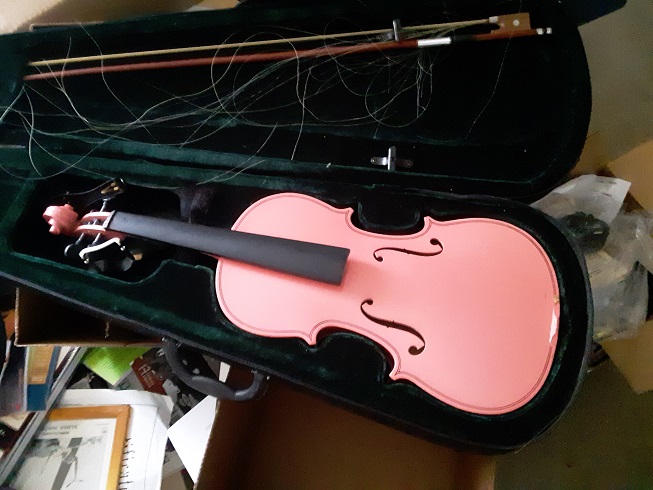
While scanning eBay a few weeks ago, I came across a pink 4/4 size fiddle that needed some TLC. The cool thing was, the seller was actually only a mile or two away from my house. I contacted him to see if I could buy it direct, and we agreed. When I opened up the soft case, I saw that it needed a lot more work than anticipated, but nothing that I couldn’t handle.
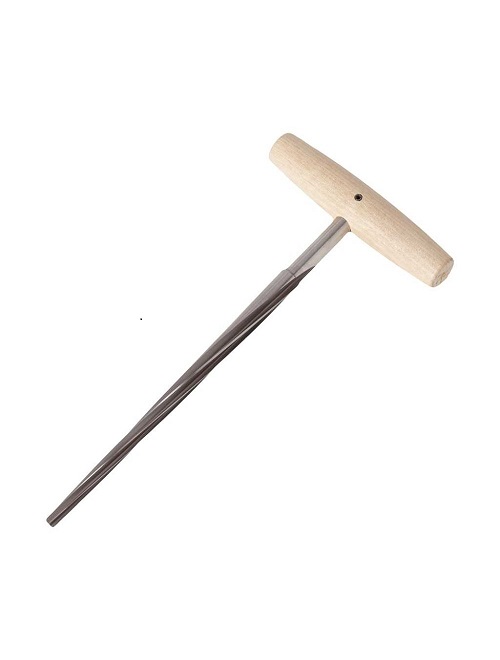
The body and neck are fine, but it was missing the bridge and endpin. The tailpiece and chinrest were there but not attached. The bow was a complete mess and not worth re-hairing, so it will be trashed. I ordered a new bridge and endpin and got them a few days later. The endpin proved to be too large for the end hole, so I ordered a violin peg reamer and got it a few days ago. This tool is a worthwhile purchase for anyone doing work on string instruments, especially the violin family. It is basically a tapered file that slightly widens a hole where a tuning peg or endpin should go into an instrument. I was able to get the endpin here to fit in a matter of seconds with a few twists of the reamer.
The way that the violin is strung up, it relies on each component resting on another to get the best vibration with the wood. With the endpin in place, the tailpiece can be looped over it, but it is not secure unless the strings are attached and wound to the tuning peg. The strings also have to be resting properly on the bridge, which needs to be placed in the correct spot on the top of the body. The bridge is probably the most important part of the actual violin, as it transfers the vibrations of the strings directly to the body, working against the top as well as the soundpost directly underneath inside the body. Bridges found on beginner and student violins are very basic. Professional violinists and fiddlers usually have a luthier carve special bridges that have a certain thickness (as thin as possible), weight, height and curvature to get the best sound.
While I am not concerned with getting a bridge that will cost three or four times as much as what I paid for this violin, I still want to use this as learning experience, so I will be working on making the bridge that I purchased to be better quality than when it came to me in the mail. This will entail thinning the entire piece with sanding, as well as adding a slight curved face to the side facing the neck. Thank goodness that there are a number of videos on YouTube that give some advice on violin repairs.
I already ordered a new bow, just a student one for under $15.00, as again I don’t want to invest too much into this project. I’m not interested in making this thing a professional fiddle, just a playable one that will inspire some young girl to want to play the instrument. It also gives me a chance to learn more about the skill of working on repairing and maintaining stringed instruments, something that I wish I could do as a full time job.
I am not sure how many who read this blog have ever heard of the Foxfire series of books. The concept began in 1966, with a Georgia teacher named Eliot Wigginton having his students write essays on Appalachian culture. The students interviewed relatives and older neighbors about lifestyles and skills from the turn of the last century. The papers were later published in magazine form, then in 1972, The Foxfire Book was published, which received widespread critical acclaim and popularity. The book proved so popular that another edition was published every few years, with the last being Foxfire 12 in 2004.
Subject matter is varied, including home remedies, snake lore, gourd banjos, blacksmithing, religion, soap making, and gardening, along with biographies and histories of unique places. Every story is written by the students, and is extremely enjoyable to read. Along with the twelve volumes, additional books on cooking, Christmas, and toys have been published.
I first came across one of the Foxfire books at a used book sale over 30 years ago, and through the years have picked up an additional volume whenever I came across one at a book or rummage sale. Along with being interesting reads, a few stories have been inspirational to me for writing a bluegrass song or two. I currently own the first nine volumes, and hope to collect Volumes 10-12 in the near future. Note that these books, even used, are not cheap. Used copies in fair to good condition go for around $12.00 or more on eBay. A complete set of new copies can set you back about $400.00!
The Foxfire Organization has a website (http://www.foxfire.org/) where anyone can get more information on the books, magazine, merchandise, membership, and its podcast. The organization encourages high school students from around the country to submit articles containing interviews of relatives that lived in the Appalachian area during its rural history.
Now here is where it gets weird. A few months ago, while I was doing some searching over the internet for Foxfire books I still needed in my collection, I Googled the founder of the program, Eliot Wigginton. He was born in West Virginia in 1942, with his mother passing away 11 days after his birth. He was raised by his maternal grandmother, a professor at Vassar, and his father, a landscape architect. He received master’s degrees from Cornell and Johns Hopkins Universities, and began teaching English at the Rabun Gap-Nacoochee School in northeast Georgia in 1966, where he would begin his Foxfire legacy.
Wigginton was also a social activist. He collected social justice stories and published them in the book Refuse to Stand Silently By: An Oral History of Grass Roots Social Activism in America, 1921-1964 in 1991. However, in 1992 he was convicted of molesting a 10-year-old boy during a camping expedition on the Foxfire grounds. Although claiming innocence, prosecutors were able to gain testimony from over 20 people claiming that Wigginton had molested them as children between 1969 and 1982. He pleaded guilty to one count of child molestation, served one year in jail, and received 19 years probation. He was excommunicated from the Foxfire organization, and is living in Florida as a registered sex offender.
Yes, it seems strange, almost heartbreaking, that someone who had so much wonderful influence on children and young adults to take a passionate interest in the Appalachian culture, would also participate in an evil act with minors. Fortunately, the Foxfire organization and its educational program continue in a positive light. I encourage anyone wanting to learn more about the Appalachian way of life to go to the website, visit the museum, and if you come across a Foxfire book at a garage sale, by all means, buy it!
The March 2024 issue of Bluegrass Unlimited showed up in my mailbox a few days ago, and on the cover was a picture of a young Jerry Garcia playing the banjo. Inside were three articles on him, one dealing with the history of his bluegrass supergroup Old & In The Way, a second looking at his career performing bluegrass and acoustic music, and a third briefly covering the Grateful Dead’s delving into roots music
Ever since the Bluegrass Hall of Fame & Museum took over publication of the magazine, the editor/publisher has been much more varied in its bluegrass coverage. There have been a lot more articles on progressive bluegrass artists, which I find helpful. This coverage of Garcia coincides with the Museum’s upcoming exhibition of Jerry Garcia: A Bluegrass Journey.
Back in May 2020, I wrote one of my early blogs concerning why Garcia hasn’t been considered being entered into the Bluegrass Hall of Fame permanently (https://luegra.design.blog/2020/05/16/why-wont-the-ibma-recognize-jerry-garcia/). More than any other musical artist outside of the bluegrass fold has Garcia been a proponent of bluegrass music. Before his time in the Dead, he was an adamant player of the banjo, despite missing a finger on his picking hand. Even during lulls in the Dead’s recording and touring schedule, he was performing with bluegrass and old-time country music with so many incarnations.
It’s hard not to fathom bands and artists like Molly Tuttle, Billy Strings, Leftover Salmon, Yonder Mountain String Band, and Crooked Still even existing without being influenced by Garcia, if not musically then at least on approach to bluegrass. As much as he was experimental in overall band sound, he was still very loyal to original artists like Bill Monroe, the Stanley Brothers, and Reno & Smiley. Mandolinist Jesse McReynolds was a big supporter of Garcia, recording a number of Dead tunes in bluegrass style.
I can only hope that this exhibition, as well as the dedication of these articles in BU, will push Garcia’s entry into the Bluegrass HOP even closer and sooner. He, through is influence with younger Deadhead audiences and guitar aficionados, helped bluegrass gain a wider and newer fan base than anyone else.
Two greats in the country/Americana music fields passed away this past week. One death got a lot of media coverage, the other went almost unnoticed.
Country great Toby Keith passed away this past Monday from a long-time battle with stomach cancer. I won’t go over his career here, as one can Google it and it is all over the internet. What I will say is that he was a burly guy, and to see his most recent photos made me hurt inside. The cancer was working hard on him, but he was fighting it to his last day. He gave us anthems that were truly appreciated by thousands of fans. He was extremely supportive of the US military, often visiting and performing at bases around the country and overseas.
One thing that bothered me during this past week is that Keith had helped start Taylor Swift’s career. He had her as a supporting performer at a number of his shows, and even signed her to his label Big Machine Records. Yet, as dozens of country stars have posted tributes to Keith, she has not posted anything on her social media sites. Is she more concerned with what she will wear to the Super Bowl? Kudos to John Rich for calling her out on his X account.
Toby, the people who knew you and loved your music will always keep you in their hearts.
This past Wednesday, one of the craziest performers to ever grab a guitar passed away from a heart condition. Mojo Nixon was bigger than life, to say the least. Obnoxious as any person could be, you could not help but laugh when he was around talking his schtick. Nothing was off limits to his insults. I first saw him live back in the late 1980s when he performed with Skid Roper at a dive called Paycheck’s Lounge in Hamtrmack. He packed the place, and I can still remember his 15-minute rendition of his song “Stuffin’ Martha’s Muffin,” an ode to MTV VJ Martha Quinn. His only real hit was “Elvis is Everywhere,” which people my age still sing out loud every time something about Elvis Presley appears on TV or in the news.
He served as a DJ on the Sirius/XM channel Outlaw Country for a number of years, spouting off hillbilly philosophy between songs like a cartoon preacher. Every time he played a Patsy Cline song, he would tell the listeners that she was built like a brick shithouse. He recommended that anyone that wanted to learn rock-n-roll guitar should get a copy of the Rockpile album Seconds of Pleasure and learn from it.
His other project included the alt-country supergroup The Pleasure Barons with Dave Alvin and Country Dick Montana, as well as notable movie roles in the Jerry Lee Lewis biopic Great Balls of Fire and Super Mario Brothers. Whatever it was, he never stopped being Mojo Nixon.
I would run into him every year at the AmericanaFest in Nashville pre-pandemic. He was usually MC-ing a showcase, but would be typical Mojo at the mic or in the green room. Two memorable run-ins with im were giving him a fifth of homemade peppermint schnapps that he worshipped like a goddess, and another time when I had him talk to my buddy Ken over the phone, basically saying to him, “Where the fuck are you? Fuck you!” and hanging up. That was Mojo.
I still have this feeling in the back of my mind that he is not really gone. Like Joe Strummer for me, he will appear again when you least expect it and do something that will make you love him all over again. He had that type of impact on people like me.
Mojo, if you are in Heaven, it’s only because God knows that you can beat the Devil at his own game. You will be missed by so many who grew up during the late punk/early new wave period and took a dump on the synthesizer bands.


 Luegra