Categories
Bluegrass Music

O Brother, Where Art Thou? at 20

Well, O Brother, Where Art Thou? is now 20 years old, and where is the state of bluegrass now? Has it influenced enough people over the years to take an interest in the format in the long run, or was it a fluke?

Since I was around and involved with the roots-music business 20 years ago as well as now, I think that I have a good perspective of what has happened. I was at an Americana Music Association conference in Nashville when there was initial fanfare about the film. Those of us there thought that it would have a small impact on the entertainment industry, primarily due to George Clooney starring in the film. The concert that would eventually become the Down From the Mountain documentary had just been performed a few months earlier. The film had some success, but not anything spectacular at the box office. However, I don’t think any of us would have guessed the soundtrack would become so popular.

We watched as for two to three years afterward, the recording industry was swamped with bluegrass and roots-music releases. Ralph Stanley got a Grammy for his vocal performance, which meant that people were re-discovering Stanley Brothers, Bill Monroe and Flatt & Scruggs recordings. Bluegrass artists such as Del McCoury and Ricky Skaggs were being highlighted on mainstream television programs. Alison Krauss and Gillian Welch became go-to references in the industry.

By 2005, it seemed that the spotlight had faded for the most part. Flavor-of-the-day fans moved on to the next musical craze. However, there was a strong, albeit small, contingent of fans that continued to listen and love bluegrass music. It wasn’t as powerful as, say, the grunge music fandom, but it did keep bluegrass within reach of curious parties.

From that point, we did see a gain in young musicians who took more than a passing interest in the format and strived to become successful. Krauss’ Union Station band became a supergroup in bluegrass, and kids looked up to them the same way aspiring young rock musicians would look up to My Chemical Romance, Green Day, or The White Stripes. I can still remember seeing an 11-year-old Sierra Hull playing mandolin like it was a natural extension of her body. And of course, Nickel Creek probably did more for young people to take an interest in acoustic music than any other band at the time

There were some great young bluegrass bands to come out during this time period. The Steep Canyon Rangers, The SteelDrivers, King Wilkie, Cherryholmes, and The Grascals are the more recognizable names. Then there was the swarm of acoustic bands that had a small foot in bluegrass but were much more experimental. These included The Punch Brothers, Crooked Still, Mumford & Sons, and Trampled by Turtles to name a few. During the past decade, comedian Steve Martin has taken a big interest in bluegrass music, particularly with the banjo’s influence. His solo music work and work with the Steep Canyon Rangers has pushed bluegrass back into the popular music interest for some short spurts. Add to that his annual award to banjo players along with his connections to late-night talk shows gets bluegrass some quick exposure.

Bluegrass has changed. While bands still perform standards (just as local rock bands still perform Chuck Berry, Beatles, and old Rolling Stones songs), but the young performers want to go further. Sierra Hull, Billy Strings and Molly Tuttle can still play those old-time fiddle songs, but they also want to have their own acoustic sound. Same with two of my favorite bands out now: Mile Twelve and Hawktail. What OBWAT has done is pigeonholed a lot of these young artists. Because there is not electric guitars or drums, the passing music listeners tend to list them as bluegrass.

So does that mean that bluegrass as a format has expanded out to where it is hardly recognizable? Has it gone the route that rock-n-roll led to just “rock” music? One thing that I do know is that there are a lot of young bluegrass players out there, both traditional and progressive, that were not even born when the film and soundtrack came out, yet use them as tools to learn about the format.

I leave you with some videos of young bluegrass performers. The band is the Sleepy Man Banjo Boys. They first appeared on the David Letterman show about 10 years ago, and the second being what they are like today.

Chew on it and comment.

Categories
Music Industry

Bruce Swedien and Phil Ramone

I am currently reading Make Mine Music by Bruce Swedien. You probably have never heard the name, but you have definitely heard his work. He engineered hundreds of hit records and albums, with his most famous being Michael Jackson’s Thriller. Bruce has worked with Quincy Jones and dozens of other great producers over the last few decades. Unfortunately, Bruce passed away last year, but his work will live on forever.

The reason I bring up his autobiography is that it does not read like other life stories. This isn’t written like a chronological “this is what I did and what happened to me” type of book. Instead, Bruce presented his chapters as anecdotes of his experience in the recording studios that he worked at during his lifetime. He talks about famous artists he engineered, but from the perspective of how he captured their sounds on tape more so than what they were like as people. He has chapters on what equipment he used over the years, like the changes in technology from cutting wax discs to tape machines to digital trends. He talks about the different microphones he has used, what made them unique, and in what situations he put them through.

This is the type of autobiography that I enjoy reading. Someone listening to Jackson’s “Billie Jean” will like the beat, or the storyline or the groove. I, on the other hand, like to go much deeper. I like to know HOW certain sound were captured, why songs were arranged the way they were, and what was going on in the minds of the people behind the studio glass. Bruce does give some perspective of how he got into the business, his parents’ attitude and where he got his training, but he knows that his audience is interested in more in his actual work and how he created it.

Another great book in this vein is Making Records: The Scenes Behind the Music by Phil Ramone. The record-buying public may consider Michael Jackson the “King of Pop,” but from a production standpoint, Phil deserved that title. Frank Sinatra, Barbra Streisand, Ray Charles, Billy Joel, Quincy Jones and Elton John are just a few of the superstars that he produced or engineered. He passed away in 2013, leaving behind a list of artists that other producers could only dream of working with. His autobiography has a similar take. Instead of the usual childhood-to-success-story movement, each chapter is its own little story of an anecdote that happened in his musical life. Incidents like running sound for John F Kennedy’s birthday party and setting up the microphone for Marilyn Monroe, or his work with Sinatra. People like me who love the behind-the-scenes stories of the music industry, especially from a production standpoint, tend to love these type of books.

The general music-listening public tend to forget, or are apathetic to, the amount of manpower that goes into recording a hit song. We see the artist standing in front of the microphone belting out a vocal treasure and think that is all that needs to be done. It is the heroes behind that artist that intrigue me the most. That is why I rarely download or stream music. I like to have that album in my had to see the whole story. The writers, producers and engineers, which studios were used, guest musicians, the mastering of the album – all of that is important to a listener like me. Skyscrapers were not designed and built by one person, and neither were million-seller records.

I recommend that, if you are into learning about stories of popular music recordings and basic technology, then snag one or both of these books.

Chew on it and comment.

Categories
Bluegrass Guitar Coronavirus Musical Instruments

Tidbits #3: Shure – Part 2, Mandolin Straps, Bluegrass Rhythm Guitar, etc.

A few more ramblin’ thoughts for this week.

For some reason, maybe due to my ordering of the fake Shure SM58 microphone a few weeks ago from Wish.com, I received another microphone in the mail that didn’t cost me anything. This one is labeled a Beta 87a, but it definitely is not a Shure Beta 87a! It came in the same packaging as the SM58, with a faux leather zipper carrying bag, mic clip, cable tie and owner’s manual. Just by looking at the body of the mic, with the poor attempt at engraving the Shure label, one could tell that this was a fake. However, the big giveaway that it was not a true Shure Beta 87a was plugging it in. The 87a is supposed to be a condenser mic, which requires a phantom power of at least 24 volts to operate properly. This fake Shure mic had a dynamic element in it, so it worked without power, and sounded like a dynamic mic. Granted, I got this for free somehow, but true Shure Beta 87a mics list for about $250.00. Wish.com has these advertised for under $30.00. Use common sense when ordering something like this. If you see a Beta 87a under $200.00 new, it is most likely a fake. Unfortunately, some jerks are getting away with selling the fake ones as real. Do yourself a favor if you want a true Shure mic – buy it from a reputable dealer.

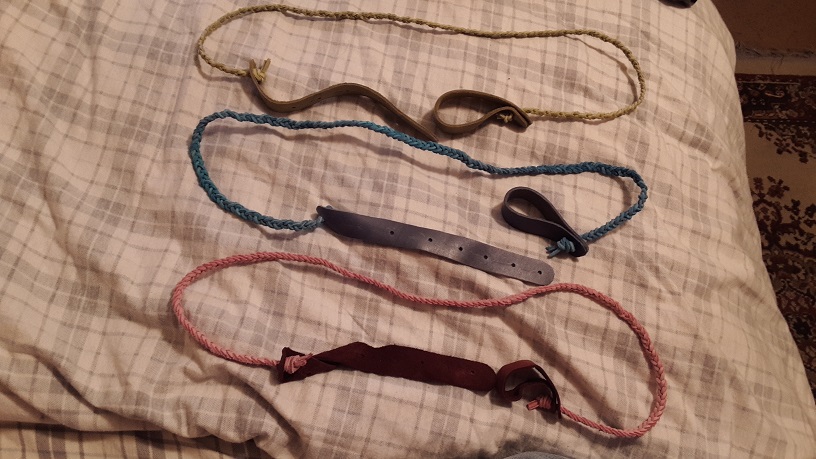
Besides doing some lutherie work, I have also been making braided mandolin straps during the pandemic. I learned to braid from a friend a few years ago, and usually while I am resting up in the evening and watching TV, I like to be a bit industrious by making straps. I started making leather guitar straps a few years back when I was gifted a bunch of nice-sized leather hide pieces. Once that ran out, I started using the leftover scraps and some laces to make mandolin straps. I make them for both A and F models, most are black with a different color ends, but I am making a few pink, blue and green ones. If interested, contact me here and I’ll email you some prices.

This past week I started working on my bluegrass rhythm guitar playing. Man, am I out of shape, musically! Seriously, I forgot how much of a job it is to keep good timing, proper strumming, and make a G run that doesn’t sound lousy, all at the same time! Since I haven’t worked with any band for a number of years, I have used the guitar almost exclusively for songwriting and recording with myself playing all instruments. Now that I’m practicing along with some jam tracks, I recognize what I’ve forgotten and let drift away from my rhythm technique. Lester Flatt and Jimmy Martin knew how important a rhythm guitar was to a bluegrass band, and as phenomenal of a lead player that he was, Tony Rice always stressed the importance of rhythm, and his was like a metronome. Speaking of a metronome, that is what I will be working with for a while.

Well, it looks like the Society for the Preservation of Bluegrass Music in America (SPBGMA) has cancelled this year’s Nashville Convention, which is usually scheduled for the last weekend of January. Yes, it is due to COVID-19, but they are setting the date for 2022 to be January 27-30. Let’s keep our fingers crossed.

One positive note is that the 47th annual Kentucky State Fiddle Championship is scheduled to happen March 20 at the Bluegrass Hall of Fame and Museum in Owensboro. With what little has been available, I am SO tempted to make the trek! Go to https://www.kyfiddler.com/ for more information.

Chew on it and comment.

Categories
Music Industry Musical Instruments

Are You Sure That It’s a Shure?

I guess this has been a problem for a few years, but I only became aware of it recently. While checking out the website Wish.com, I came across something that made me to a double-take. The site was selling Shure microphones for about 20% of their cost at a music store. The famous SM58 vocal mic retails for about $100 at Sweetwater or Guitar Center. The same can be said for the SM57, and the Beta 87a goes for around $250. If you shop Amazon, you may find it for a buck or two cheaper.

However, one search on the Wish site shows that you can snag a 57 or 58 for about $20, and a Beta 87a for around $30. Depending on when you go to the site, the prices can sometimes be cheaper!

I knew there had to be a catch, but I decided to purchase a 58 anyway to see what would happen. Of course, shipping and taxes added about $10 to the cost, and it took about three weeks for the package to arrive (it was shipped from China).

I have always felt that the Shure SM58 is the best all-around microphone available. Comparing price, durability, and response, it would be the obvious choice if I were to have only one microphone. When I opened up the package of my new 58, I could tell right away that it was a fake. Just by holding it, it was a lot lighter than the true Shure 58. Putting them both on a scale, the real 58 came in at about 0.6 lb., while the fake 58 weighed in at 0.4 lb. Taking off the windscreens, the real 58 capsule has a slight cushion to it in order to sustain some shock. The fake 58 had no cushion to the capsule.

Testing it out on a small PA system, I noticed that the fake 58 did not have the same warmth from the low end frequencies as the real 58. It just seems to have a bit of distortion from that end. Its response was more like the lower-cost SM48. It did have the same sound level as the true 58, just not as warm.

In short, it seemed to be about worth the money of the purchase. It was a lot cheaper than the true 58, but it definitely is not of the same high quality. I am sure that the SM57 and Beta 87a that are available on Wish are of the same quality. Here is a video that I found that provides more information on comparing the two:

My main concern with this marketing is that I am questioning why Shure has not proceeded with large-scale legal action against the manufacturers of fake microphones. We have seen such action taken by guitar manufacturers, with results leading to mislabeled guitars not being available in the US as well as legal action being taken against anyone bringing one into the country. However, a Google search on the Shure situation shows that there has only been one serious attempt at legal action, and that was in the UK about 10 years ago.

I would think that Shure would take a stronger action against the sale and distribution of these fake microphones for two big reasons:

  1. The lower cost of the fake microphones will lead to more sales, which will kill Shure’s sales.
  2. The lack of quality with the fake microphones will reflect poorly on Shure, as consumers would blame Shure for the problems, even though it had nothing to do with the manufacturing of that fake mic.

Perhaps I am out of the loop and am missing something. However, my advice to anyone interested in one of these fake Shure microphones, if you purchase one, do not expect the quality and customer service you can expect from the Shure company. You will be getting a second-class product with a first-class label on the body. If you want the best, you need to go directly into purchasing as true Shure microphone.

Chew on it and comment.

Categories
Coronavirus Musical Instruments Musicians

Creativity, and Ignorance

A few days ago, I was interviewing fiddler Tom Morley for an upcoming article. We got onto the topic of what he and other musicians that he knows are doing to keep the sanity during all of these pandemic lockdowns. He told me about a creative idea that his friend’s daughter thought of that consisted of purchasing a few small plastic greenhouses, pushing them together, and with one musician in each house, the band was able to perform together and hear each other while still keeping social distance.

https://99percentinvisible.org/article/hothouse-musicians-miniature-heated-greenhouses-enable-distanced-gatherings/

The more that I watch the video, the more that I am amazed at the creativity some people have shown during these strange times. Yes, music can be performed alone, but the idea of two or more musicians creating music together is part of human nature’s bonding. The Coronavirus tries so hard to dishearten people by separating us, but we as humans are smarter than that.

As I still look for a job, I have been trying to keep my sanity by doing some lutherie work. Actually, more repairs are being done on guitar amplifiers than on actual instruments, but it is all good, right? One thing that I have noticed in my search for repairable beginner stringed instruments is that people think that the damaged guitars, basses, mandolins and such are really buried treasures. Sure, a 1959 Fender Stratocaster that has structural and wiring concerns can still fetch over $1,000 because of its pedigree, but there is no reason that an acoustic guitar with a brand name of Magnum, Lotus, Rogue, or no name whatsoever should demand a high price.

I scan Craigslist ads as well as check eBay and other sources, and I am puzzled when I see a 30-year-old Magnum acoustic guitar that has seen better days with a price tag of $100.00! Seriously, a guitar like this did not sell for much more than that when it was new, probably has loads of nicks and scratches, even a crack or two, and the neck is most likely bowing like a hill. One thing that shows like “American Pickers” and “Antiques Roadshow” have done is get people to think that all of the junk they have in their garage is worth something. If I am going to spend 60 or 70 dollars on an acoustic guitar, I would rather go through a company like Glarry, where the guitar is new and has some type of warranty or guarantee with the manufacturer/distributor.

Advice: If you have one of these old acoustic guitars that you bought for your kid decades ago and he never took an interest, and it sat in the closet for 20 or more years, and it does NOT have the name of Martin, Gibson, or Guild on the headstock, it is most likely not worth more than 10 bucks. Go ahead and get it appraised, but there is a slim chance that it is worth something. Instead, sell it at a garage sale for a few bucks, so that either some other kid may try to play it, someone like me might be able to salvage it as playable and give to someone, or let someone else hang it on the wall.

Chew on it and comment.

Categories
Bluegrass Music Coronavirus

Yes, 2020 Sucked!

Yes, 2020 was not a good year for anyone (unless you owned Amazon). I don’t want to lament on it much, so I’ll just go over a few garbage points.

The loss of so many people in the music world. With Tony Rice passing away on Christmas, that was a definite knife to the heart. I will definitely miss him, as I was hoping that by some miracle he would be able to get his strength back and play that D-28 on stage once again.

The COVID-19 pandemic screwing up the lives of so many people. I am on my ninth month of unemployment, and compensation ended last week, so I am turning in pop cans and beer bottles to supplement food costs. In the music world, especially in bluegrass, live shows took a dump. So many bluegrass musicians rely on those live shows, not only for the performance pay but for sales of merchandise. A few musicians that I know had to take on part- and full-time non-music jobs to get by. Others resorted to online concerts with tip jars, Zoom music lessons, and creative alternatives such as selling music-related gifts such as jewelry and pictures. I cannot imagine what the pandemic has done to the other music-related jobs such as studio musicians, audio engineers, and roadies. The year has been a big test for the “blue collar” music workers.

I won’t even get into how our political environment is so divisive.

My hope for 2021 is getting back some more live music (I do miss going to The Ark in Ann Arbor), I can secure a decent job, do more writing (both song and articles), and practice, practice, practice my guitar, bass, mandolin and fiddle. It is an enjoyment and therapy for me. Unfortunately, with spending hours on the computer looking for a job, taking care of my 88-year-old mother, and trying to stay healthy with no access to presecriptions, musical instrument practice falls lower on the list.

Enough griping! It’s New Year’s Eve. Be safe tonight, since the bars are closed, keep the home celebration respectable. With that, I leave you with a holiday message from the beautiful Russian ladies of Beloe Zlato! I love these girls!

Chew on it and comment.

Categories
Bluegrass Guitar Bluegrass Music

Tony Rice RIP

I received the tragic news last night that, on Christmas day, the world lost one of the greatest acoustic guitarists that the industry has ever known. Tony Rice was 69 years old, influenced thousands of artists, and truly defined the role of bluegrass guitar in bluegrass music.

There were others who played the guitar as a lead instrument before Tony. Bill Napier and George Shuffler performed crosspicking on guitar with The Stanley Brothers. Doc Watson gave acoustic lead guitar notice. Clarence White placed lead guitar into a bluegrass band setting. Dan Crary highlighted the bluegrass lead guitarist persona. However, it was Tony Rice that not only defined the role, he gave it an image, and that image was badass cool!

Unlike those before him, who were reproducing fiddle or mandolin lines on acoustic guitar, Tony was creating guitar lines that stood out on their own. There was a lot of pop, rock, and jazz influence in his bluegrass picking, which knocked a lot of traditionalists on their butts, whether they liked it or not. And while he performed in many different bands, one could tell from the first three or four notes that it was a Tony Rice lead.

There are plenty of albums that one could listen to in order to truly understand Toney’s playing. His signature work is definitely Manzanita, which showcases his guitar in a slightly progressive bluegrass setting. To hear what he was initially trying to get across with guitar as a true bluegrass workhorse, secure a copy of the debut self-titled album by J.D. Crowe and the New South on Rounder Records, affectionately known in the bluegrass fold by its issue number, “0044.” In his later years, he did two fantastic guitar-centric bluegrass albums with Peter Rowan as the Rowan & Rice Quartet. He also joined up with a number of other bluegrass stars to record a bunch of albums under the moniker The Bluegrass Album Band. Of course, anything under his own band The Tony Rice Unit should be considered.

While many bluegrassers cite his duet album Skaggs & Rice (with Ricky Skaggs) as his best work with bluegrass guitar and Monroe Brothers style of singing, I prefer the two albums he recorded with Norman Blake. Blake & Rice has some of the best textbook examples of bluegrass guitar lead work, and Blake & Rice 2 should be grabbed if only for the three songs that include Doc Watson performing to create bluegrass guitar powerhouse.

He was also a fantastic soulful baritone singer in the bluegrass vein. His work with Bluegrass Alliance and The New South atone to this. He was an avid fan of Gordon Lightfoot, and recorded many of the folksinger’s songs, either solo or with his family band The Rice Brothers. In 1994 he was diagnosed with muscle tension dysphonia, which put an end to his singing. In an interview I did with him in the early 2000’s, he talked about it, and said that if he were forced to lose one of his two talents, he would rather it be his voice. At his induction into the Bluegrass Hall of Fame in 2013, he lamented on this, and provided a promising result to therapy on his vocal work.

(watch at around 11:30)

He continued to play guitar with Rowan, as well as with Alison Krauss & Union Station and other bands that paid tribute to his work. In 2014, he developed lateral epicondylitis (tennis elbow) which made guitar playing painful. He decided to go into retirement until he could come back and perform as he used to. Unfortunately, that did not come about. However, we are blessed to have so many recordings of his amazing six-string work, and his sound and style will live on through so many young guitarists that were influenced by Tony, whether they realize it or not. You can definitely hear his work in the performing of Billy Strings, Molly Tuttle, Josh Williams, Chris Eldridge, and so many others. One of my favorite photographs of him is when he is in a room with Bill Monroe and he has Monroe play on the famous Clarence White Martin D-28.

If you have any doubts, get on YouTube and search out Tony Rice videos. You will not be disappointed.

Tony, I am truly glad that I got to meet you and speak with you on a few occasions regarding bluegrass guitar and music. You are now with the Angel Band. Take it easy on them with your licks.

Chew on it and comment.

Categories
Bluegrass Music Christmas

Christmas in Luegra Land

Christmas 2020. What a lousy year. Unemployed since April, job prospects suck, and bluegrass shows were practically nonexistent!

Thank God that some of my favorite artists were able to do some performances over the internet. Many thanks to Hawktail, Mile Twelve, April Verch, and my web buddy in Missouri, Jerry Rosa from Rosa String Works! They kept my sanity in place. Festivals were a bust, as well as music conferences, although some were held virtually. Appreciated, but not the same as seeing old friends and networking with new ones face-to-face. Here is Jerry Rosa and his friends doing a bluegrass Christmas jam.

My wish for Christmas (along with world peace, a job, and life back to normal) is to be a better fiddle player, good enough to jam with some people and not sound like a schlep. I try to practice every day, but the last week has been difficult due to getting things taken care of for my mom for the holidays. One thing that I have found myself doing is more research on the history of the violin and fiddle music during the 19th century in America. Interesting stuff that I hope to share in a future blog.

I also need to get back into doing more songwriting. That requires inspiration, and with the pandemic, I haven’t gotten much of that. I need to look harder.

I am not much for the partying and gift-giving with Christmas. I prefer to spend quality time on my own (which upsets the rest of my family). I like to spend time at midnight mass at my church, an old Polish-American Roman Catholic parish where they sing Polish carols (koledy) that echos throughout the building. It is amazing to hear, even if you don’t understand Polish.

I’ll keep this short, so stay safe, and let’s hope for a better 2021. In the meantime, here is the beautiful and talented Sierra Hull, along with the amazing musicians Michael Cleveland and Billy Strings, performing “Santa’s Train.”

Chew on it and comment.

Categories
Consumer Electronics News

Olson Electronics / Greg Gutfeld

After last week’s nostalgic rant about Radio Shack (https://luegra.design.blog/2020/12/11/i-miss-radio-shack/), I got to thinking a bit more about my younger days in building my own electronics projects for my bass guitar and stereo.

Then I remembered Olson Electronics. They were more of a surplus store than RS, and seemed to only be marketing in the Michigan/Ohio area. But man, that was a cool store! There was only one in my area, and I was at it every chance that I got.

When I mean surplus, I am talking about radios, stereos, car electronics, alarm systems, speakers, and CB radios that were usually reconditioned or purchased from a wholesale place. My first stereo was from there, a AM/FM/8-track receiver with no cabinet. I got it really cheap and built my own cabinet. I remember the cool small VU meters that would move to the beat of the music and though that I was the coolest guy out! I also must have gotten a dozen replacement speakers for either my stereo cabinets or my bass guitar cab.

The place was much more disorganized than RS, but it was a lot more fun because you were always hoping to score a bargain. They didn’t have a catalog like RS, but instead sent out monthly flyers like RS that showed what was on sale or what was available on clearance at selected stores.

Olson went out of business long ago, and I really miss that place. Going there was weird in a cool way. It had its regular stock of CB radio equipment and alarm systems, but then there were the boxes of surplus stuff and a few shelves of used, reconditioned, or discontinued radios and amplifiers that would be in the back of the store. I felt like Mike and Frank on “American Pickers” sometimes, just digging through the boxes hoping to find that unique part that I could make a fuzz pedal for a guitar.

There is a lot from that period of my life (1980-1990-ish) that I miss regarding electronics. There were a number of magazines like Popular Electronics that would have decent articles on DIY projects, although most seemed to be for ham radio and early home computer fanatics. They would also put out supplements once each year that may have 100 or so schematics of simple projects that you could build in an hour or so. Then there were the other lesser-known electronics surplus houses that you would request a catalog and see if they had any old guitar parts like cheap pickups or knobs that you could use.

There are a few electronics surplus places still around on the internet, and I do occasionally order parts from them. However, as a kid, being in contact with these places was like being in another world, one that people around you didn’t understand. You could buy strange and hard-to-find parts and create something that had your personal stamp on it. Yes, these days it’s cheaper to buy the effects pedals made in China than it is to build one. But lost is the education, the personal reward, and the satisfaction that one would have in building it on your own.

To get an idea of how cool it was back then, someone posted a video on YouTube showing an old Olson Electronics catalog and its contents. I had forgotten how much stuff they sold! Enjoy.

If you don’t know who Greg Gutfeld is, you definitely need to check him out. He’s a commentator on the Fox News Network, but his style is completely his own. He’s sarcastic, resentful, mean, funny, and extremely intelligent. Listening to him is like listening to one of the regulars at your local dive that isn’t afraid to give out his opinion on something, especially political, but does it in a smart and hilarious way.

I liked him since I first watched him on an old show called “Red Eye.” Now he has his own show on Satruday evenings as well as serves as a regular commentator on the Fox discussion show “The Five.” Besides his views and attitude, I like him for his taste in music. It runs totally in line with mine. He is into the bands that I have always loved from my days doing punk, new wave, and alt-country/Americana. When other hosts use filler music from today’s pop artists, Gutfeld defies the norm and uses songs from The Clash, The Ramones, X, Iggy Pop, and The Melvins.

I subscribe to his weblog, called The Gutter, and love the fact that he reviews albums that he loves, whether they came out yesterday or 40 years ago. This particular one made my week, as it is of a compilation album of Detroit bands from the1960s and 70s. I had a cassette of this album, and I miss it dearly.

https://gg.locals.com/upost/287366/greg-s-review-michigan-rocks

Chew on it and comment.

Categories
Consumer Electronics

I Miss Radio Shack

I was recording some background vocals to a demo a few days ago, and it hit me: I miss Radio Shack!

I was using a small-diaphragm condenser microphone sold by RS. I actually have three of these buggers, and they have never let me down. Rather than a phantom power supply, they run on a 1.5-volt AA battery, which when I bought them about 20-25 years ago was a life saver, considering that I couldn’t afford a studio condenser mic and elaborate mixing board with built-in phantom power supply.

RS was the perfect store for a guy like me, a musician who liked to tinker with electronics. It had tons of electronic components, including integrated circuits to build early non-spring reverb units. I remember that IC chip was expensive, around 50 bucks, and if you zapped it with static electricity, then you killed it. I built one, and while it was a bit noisy, it sufficed instead of purchasing a music store model for five times the price (it also marketed a reverb unit that was meant for connecting into your stereo system, but with adapters, worked with a guitar amp as well) I also built headphone amps and distortion effects from the RS parts, and I learned a lot about musical instrument electronics back then.

Besides components, RS sold guitar and mic cables, mic stands, mixers, small PA systems, amplifier tubes and microphones. I am not even going to go into the radios, stereo systems, computers, and alarm systems that were available. As for microphones, RS’s higher-end mics were actually made by Shure, so you got a good quality dynamic mic that was comparable to the SM48 but cost a lot less. Just before the company’s downfall, it did sell actual Shure mics on its shelves. They also had books on electronics, either general instruction and theory or how-to booklets to build simple circuits.

RS was my second home. I knew a bunch of the sales people by first names. I even dated a sales girl (unfortunately, that was 18 of the worst months of my life, but I digress). The print catalog was a pseudo-bible, and I remember having a card to get a free battery every month. There was a store about two miles away from my boyhood home, and another three stores within a short drive. Today, the closest store (and that is just an authorized outlet store) is over 30 miles away.

Times changed, and RS did not change with them. Probably half of the people that I knew growing up had a Tandy computer as their first PC (including me), but the company never bothered to pursue expanding on that product sales. The same with televisions, radios, and other consumer electronic equipment. Best Buy beat them to it, and RS basically became a cell phone store and not much else.

Today, I do a lot less electronics tinkering. I can make some simple repairs and part replacements to electric guitars and amplifiers, but technology has overwhelmed me. To secure the parts to build a decent distortion pedal for a guitar from electronics outlets will cost you two- to three-times more than buying a mass-produced one from Guitar Center or Sweetwater. The educational experience of building something like that does not exist with today’s young musicians. Even those that are choosing to use vintage equipment shy away from learning something about the circuitry.

RS was a great resource for me, it was the right place at the right time. Perhaps I should have forced myself to delve deeper into the technology, but I looked at it more as a hobby than as a career. That was probably the situation for thousands of others like me. And that was what may have put some of the nails into Radio Shack’s coffin.

Chew on it and comment.

Design a site like this with WordPress.com
Get started