Musician and writer (both song and print) for over 30 years. Primarily interested in roots music (Americana, bluegrass, blues, folk). Current contributing writer for Fiddler Magazine, previous work with Metro Times (Detroit), Ann Arbor Paper and Real Detroit Weekly, as well as other various music and military publications. As songwriter, won the 2015 Chris Austin Songwriting Contest (Bluegrass Category, "Something About A Train," co-written with Dawn Kenney and David Morris) as well as having work performed on NPR and nominated for numerous Detroit Music Awards.
There is not much surprise here. The usual suspects appear in a number of categories, such as Billy Strings, Molly Tuttle, Sierra Hull, Del McCoury, and Sister Sadie. The one category that I am glad to see some fresh faces is New Artist of the Year, even though most of them have been around a while and have great PR. However, I do think that it is time that the IBMA has recognized The Kody Norris Show in that category. After years of endless touring and a number of SPBGMA wins, Kody and his band deserve more “mainstream” bluegrass spotlight.
As far as instrument/vocal awards, the names seem the same as previous years, whether the performer has done any recording or extensive performing. In fact, there is only one name in all of the categories that is brand new (Gaven Largent – Resophonic Guitar Player of the Year). Over the past few years, I tend to lose interest in these categories, and can probably guess who will win way before the show.
As for the Hall of Fame inductees, all three are deserving. Alan Munde has played influential banjo for decades. What can be said about the dobro genius Jerry Douglas that has not been said already. And Katy Daley has been an amazing voice in bluegrass publicity and broadcasting for as long as I can remember.
Not much else to say. Other than hoping my friends in the Kody Norris Show win at least one of the two categories, I really have little interest in the outcome. I only wrote about it this week because I didn’t have any other topic to write about off the top of my head.
Everybody over 40 (and quite a few under 40) years of age knows that song. It was an anthem at stadiums, sports bars, and weddings for so many years. How many of us would wait for the “Giddy-up! Pa-pa-ooh-pa-pa-ooh-mow-mow!” bridge in the song? One of the great voices of that country/pop standard left us earlier this week.
Joe Bonsall, tenor singer for the Oak Ridge Boys from 1973 to his retirement in earlier this year, passed away on July 9th from complications of ALS (known as Lou Gehrig’s Disease). Known for his bushy moustache and wide grin, he was a favorite of fans for his sense of humor and dedication to The Lord. He adored his family, and especially loved his pet cat. He and the Oak Ridge Boys were stalwarts when it came to live performances, never giving a bad show and extremely warm to the fan base.
The history of the group actually dates back to the 1940s, performing primarily as a gospel quartet. By the time Bonsall joined in 1973, they were starting to delve more into mainstream country, and were finding minor success on the country charts. However, the release of “Elvira” in 1981, along with “Bobby Sue” (1982) and “American Made” (1983) gave them their biggest claim to fame.
The incarnation of Bonsall, Duane Allen, William Lee Golden and Richard Sterban were how most people remember the quartet and they were at their finest. Along with a number of country records, the group recorded many gospel and Christmas albums. They were one of the few acts to tour the Soviet Union before the fall of Communism, and recorded with other acts such as Roy Clark, Paul Simon and Jimmy Sturr. In 2010, they even recorded a country-ish version of the White Stripes’ “Seven Nation Army.” They became members of the Grand Ole Opry in 2011, and were inducted into the Country Music Hall of Fame in 2015.
Bonsall was also the author of children’s books, and wrote a story about his mother and father meeting for the first time called GI Joe and Lillie in 2003. He also wrote about the Oak Ridge Boys and the group’s touring adventures. At the time of his death, he was writing a semi-autobiography called I See Myself.
He had missed a number of tour dates starting in 2022 due to health concerns, and finally announced his retirement on January 3, 2024. His last performances were made sitting on a stool and he had to be assisted on and off stage. After the announcement of his passing, a number of country artists such as Travis Tritt and Blake Shelton paid tribute to Bonsall on social media.
I was connected to Bonsall through LinkedIn. We had messaged back and forth a few times, but mostly I watched his posts. He was almost always holding his cat, and his posts were always about faith and love. I remember his announcement of his retirement, and one of his last was a picture of him with his daughters. He also loved to play banjo, and would often post photos of him plucking the five-string.
Joe, your voice, your smile, and your heart will be missed in this world. Now teach the angels to song “Elvira” for me.
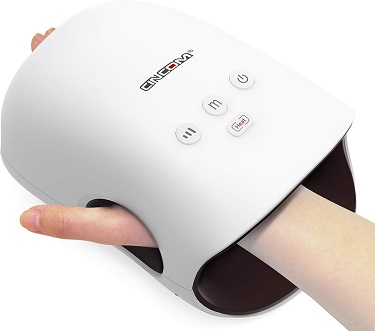
During the guitar workshop at the Charlotte Bluegrass Festival last month, some of the discussion centered on hand therapy, such as caring for aches and pains from carpal tunnel and other discomforts. Dalton Harper stated that one of his therapeutic reliefs is an electronic hand massager. They are about the size of a cantaloupe cut in half, and you put your hand in the device for 10-15 minutes for stress relief on your fingers and palm. These devices range from $25.00 to over $100.00 on Amazon, and Dalton recommended paying for the better quality models.
When I got home, I checked Amazon, and found one on sale for around $80.00. I got it in this week, and tried it out. Wow! I thought that it would merely vibrate around on your hand. No, this contraption squeezes, pushes, and rubs your hand and fingers the way that a masseur would work it. On the model that I purchased (Cincom CM-026H) has two different modes of massaging, three different intensities, and optional heat. It is USB rechargeable, and even comes with some disposable gloves in case you put on hand cream beforehand.
I get carpal tunnel in my hands from typing at work, and the first finger on my left (fretting) hand is starting to get arthritic. I have used a small hand warmer on it for temporary relief, but this hand massager made it feel good for hours afterwards. I highly recommend any musician starting to feel some aches in the hands to get one of these items.
Ever since coming back from Charlotte and helping out at the kid’s petting zoo, I have been checking out prices for guitars, mandolins, fiddles and dobros for beginners. Guitars are pretty easy to come by for under $100.00, as well as mandolins. Of course, these will not be great quality instruments, but with the right setup, they are easily playable. Fiddles can be more hit-and-miss. The one that I purchased from Glarry last year turned out to be a great buy. However, I have seen ones that were higher priced that what I paid that sound horrible. Moreover, fiddles need a lot more work setting up than a guitar. You could spend $100.00 for a student violin, then spend more than that just to get it in playable condition.
Then there are the dobros, or resonator guitars. The cheapest that I saw for a beginner model was over $200.00, and that is one with a rounded neck, more suitable for playing like a regular guitar. They can still be played lap-style, but you will have to get an extension nut available at Elderly Instruments or on eBay for about $10.00). In fact, for the absolute beginner, a good alternative may be to just get a regular acoustic guitar and use one of these nut extensions until an actual dobro can be purchased. As for a true square-neck dobro, expect to pay over $500 for a beginner model. I figure that with all of the interest in learning a musical instrument during COVID, prices for guitars and other instruments would go up just like everything else with inflation. With sommer here, I’ve been driving slow past yard sales to see if there are any guitars or violins no longer being played that I can snage for a cheap price. Of course, the US 12 World’s Longest Yard Sale is coming up in early August!
Finally, here’s a unique story. A friend of mine was hit by a car while riding her bike earlier this week and was checked into the hospital a few blocks from my house. When I went to see her, a male nurse named Chris took me to her room. He saw that I was wearing one of my many bluegrass-themed T-shirts, and it turned out that he is a fan as well, which he plays mandolin and hits bluegrass shows when he can. I gave him my number, and we’re hoping to get together soon to do some jamming. Bluegrass fans are few and far between, so it was a pleasant surprise to find another one in the strangest of places.
Readers know that I am a big fan of the bass guitar. It was the first real instrument that I learned (I’m not counting the three horrendous years of saxophone in grade school), and I write a lot of my early songs on the bass before I picked up and learned guitar. I have always been a supporter of teaching the bass guitar to younger students, as one is learning one note on a fretboard is easier to comprehend first before attempting chords on a guitar.
I have seen many times young players with small arms and hands attempting to use a full-scale 34-inch bass guitar with great difficulty. It tells me that the parents did not do much research on purchasing a properly sized bass for the student, but just bought the cheapest bass they could find or let the store salesman talk them into it, saying “They’ll grow into it.” There are a number of shorter-scale bass guitars on the market, many of them very affordable, that can make lessons and performance for the young musician a lot easier.
I recently purchased two short-scale bass guitars made by Glarry to test them out and see if they are worthwhile for the student as far as value, comfort, playability, and performance. Both retail for under $100 on the Glarry website, but I was able to snag each one a lot cheaper through shopping at eBay and Amazon.
The first is the GW101 36-inch Kid’s Electric Bass Guitar. This bass is incredibly small, as the 36 inches refers to its entire length. The scale from nut to bridge is 25.5 inches. That’s actually the scale length of a Fender Stratocaster or Martin acoustic guitar! The body is a lot smaller as well. One YouTube video review of this bass showed the player gripping the entire body of the bass with one hand. If playing with the thumb or fingers, the player can actually rest the rest of the hand on one of the body curves and not need a resting piece mounted on or near the pickups.
Speaking of pickups, there are two Jazz Bass style pickups, and the controls are wired like a standard Jazz Bass (one volume for each pickup, and a single tone control). Since the pickups are so close to each other, there is very little difference in the tone that each creates, so going with a Precision Bass type pickup or a single pickup with two controls (volume and tone) might have brought the price down a bit. The light weight makes it very easy on the back, even a child will not have a problem with it strapped around him/her. The neck is also comfortable, with fret ends filed down so as not to snag on the hand.
The playability was good, not fantastic. The output is typical of a lower-end bass, giving a decent sound but nothing shattering. The dual pickups do serve as a humbucker mode, so some humming noise does cancel out, but not completely. It doesn’t take long to get used to the very short scale, although setting intonation may take a little effort. Besides a suitable bass for a young student, this would also make a good travel bass if needed.
My big complaint is the finish on the body. It was not sanded well, so running your hand over it feels like a piece of rough-cut wood, fearing getting a splinter. The paint job looks like it was done with some spray cans real fast just to cover up the wood. I would recommend rubbing in some good polish to the body so it feels a bit smoother.
The other bass guitar checked out is Glarry model 30-inch GB Electric Bass Guitar. This is a direct copy of the Fender Squier Bronco Bass, with a Mustang-style body and 30-inch scale, a length found on the Hofner 500/1 “Beatle” Bass as well as some Gibson and Epiphone models. The balance is OK, considering the smaller size, as many full-scale basses from Glarry and other Asian manufacturers use a lightweight wood for the body, so the weight of the headstock will pull down and put stress on the shoulder. This one has a slight problem like that, and could have used a smaller headstock. There is only one single coil pickup, and two controls for volume and tone.
The finish on the body and back of neck are quality. Running the fretting hand back and forth along the back of the neck was a smooth endeavor. The paint job is much better than the GW101, and is definitely comparable to upper-grade basses.
I like the playability and comfort of this bass a bit more. My first bass was a 30-inch scale, so I have always been able to play moving bass lines a lot better with my fretting hand, even though I’ve used mostly full-scale basses for the past 30 years. The pickup does kick out some hum noise, but not an annoying amount. The neck is also well finished with no snagging fret ends. This would be a definite first choice for a younger teen student, or even an adult with smaller hands. I have known many female bass players that play this type of bass due to the hand size. As with the GW101, an adjustment with the bridge saddles for proper intonation will be necessary.
Both basses came shipped with a cheap gig-bag, low-end strap, cables, pick, and hex keys for adjusting the neck and bridge saddles. The gig bag for the GW101 was really extremely low-quality, basically a glorified trash bag. When zipping it up with the bass inside, it could barely close around the headstock unless you put the tuning gears in a flat position, which means re-tuning the bass when playing again. Unfortunately, it will be nearly impossible to find a good gig bag or case for this size bass. Maybe a large ukulele gig bag?
As for the cables, the GW101 came with a very low-quality one. After a dozen uses, this type will start to crackle and short out. I am not sure if it was a packaging error, but the GB bass came with a good-quality webbed-covered 10-foot cord, which usually go for about $20.00 at Sweetwater or Guitar Center. Both have bridges and tuning gears that are expected on lower-priced instruments. They serve their purpose, but are not high quality, so if the bass was being used extensively, replacement would eventually be necessary. However, they work fine for a student that is just beginning to learn the bass.
At the bluegrass festival last weekend, at least three bands had bass players using electric basses instead of the more traditional upright bass. So playing an electric bass is not as unusual as expected in bluegrass. For the parents having a young child or teen interested in playing bass in bluegrass, or any other format, these two basses are worth considering. They are extremely affordable, and there is not a lot of investment lost if the kid loses interest and the instrument goes on the garage sale block.
A day late, but I just got back from the Charlotte Bluegrass Music Festival. This year, I went the whole three days, and I am glad that I did.
While not much is different from last year’s festival (https://luegra.design.blog/2023/06/25/charlotte-bluegrass-festival-2023/), there were a few high points. Returning acts included Michael Cleveland & Flamekeeper, Williamson Branch, and one of my all-time favorite bands, the David Mayfield Parade. I cannot say enough great things about Mayfield and his band. Amazing musicians, fantastic songs, and the humor that Mayfield spills out between songs, as well as when he takes a guitar solo, is beyond energetic. They were such a big hit last year that they were booked for two days this year. That was four sets that saw only one or two songs repeated due to audience requests. I implore you to check them out on YouTube and follow them however you can. They have a new album coming out later this year, produced by Tim O’Brien. Their version of the classic instrumental “El Cumbanchuro” will leave you breathless!
There were a few stalwart bands that made a return after a few years away. Joe Mullins & The Radio Ramblers did two good sets, and are one of those bands that never disappoints. The same goes for The Grascals. Founding member Jamie Johnson has returned after eight years away, and he is honest to tell his audiences that it was due to some drinking, family, and other personal problems that he and The Lord were able to sort out. That takes a lot to feel comfortable emough to tell thousands of strangers, but bluegrass audiences are extremely supportive of performers in any situation.
One of my personal highlights was seeing Dale Ann Bradley. She has one of the most perfect voices in bluegrass, and can make any song from a slow ballad to a moving rocker sound soulful. On top of that, she is an absolute sweetheart to her fans. I haven’t talked to her in over 10 years, but she remembered that festival where we last met as well as we talked about some mutual friends. And absolute sweet lady!
I was also happy to see David Peterson & 1946 perform two sets. Long before Jerry Douglas formed The Earls of Leicester to pay tribute to the early Flatt & Scruggs days, Peterson was performing old Bill Monroe, F&S, and Jimmy Martin tunes nuance for nuance, and appearing on stage dressed for the part. Watching the 1946 band is literally like watching and listening to a bluegrass tent show from that period, as they sing and play around a single microphone and choreograph steps to control the sound.
Two bands that performed, which I have not seen before but caught my attention. The first was Highway North, a quartet of young pickers from North Ontario, Canada that made their first appearance at the festival. While the vocals were a bit laid back, the instrumental prowess on guitar and mandolin was phenomenal. Another great act was Dalton Harper. He is a singer/songwriter and a fantastic guitar picker as well. His style reminded me of Josh Williams (as it turned out, they are good friends and have performed together on occasion). I was truly impressed with his performances. I asked if he was going to be participating in the scheduled guitar workshop, and he told me that he wasn’t aware of the workshop. Sure enough, he got roped into leading the workshop the next day, and was joined by Taylor LaBreche and Jake Lavzon of Highways North for some great discussion and even better three-guitar jamming.
I helped out on the Southeast Michigan Bluegrass Music Association’s “Petting Zoo” Saturday morning. This involved having a number of acoustic instruments laid out for kids to try out to see if they would be interested in playing one at home, then talking to parents about cost and lessons. I had one young girl that was totally interested in the dobro. Fortunately, her parents are also hobbyist musicians, and encourage the daughter to pursue music as an interest. My big gripe is that a few adults show up and start jamming in the area so that kids cannot hear what they are doing, and can be overpowering when showing the kids some techniques that the kids cannot comprehend yet. Let the kids have fun first!
I stayed away from the food vendors for the most part, as the prices are way too high, and so is the grease! And of course, due to having to take insulin shots, I stayed in a nearby motel instead of camping. All in all, I will be heading back next year. Since I am not able to hit many multi-day festivals over the year, this one has a special place in my schedule.
So even though I haven’t even started on the two guitar kits I already have, I purchased a third kit. This kit comes from Leo Jaymz, and is pretty similar to the Fesley kit I purchased a few weeks ago (https://luegra.design.blog/2024/05/19/inexpensive-guitar-kits/).
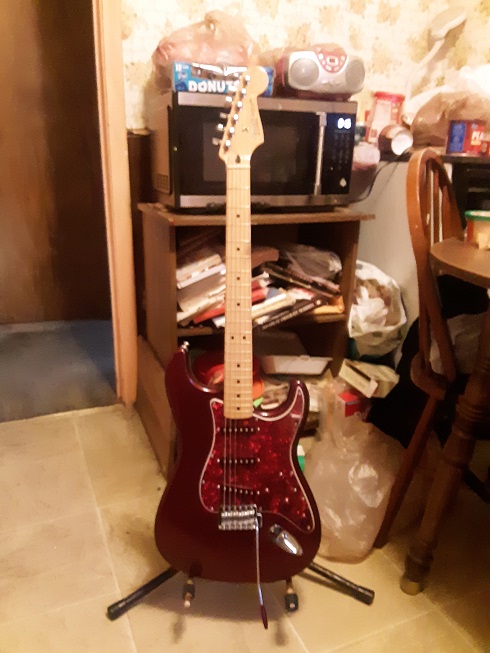
The big difference with the Leo Jaymz kit is the Strat-style body. They have routed it for the customizer, with spaces for humbucker pickups in the neck and bridge positions. The pickguard is still set up for three single coils, and wiring has connectors, so no soldering is needed. The instruction manual has no text, only pictures showing how to install each component. It really could not get any easier, I guess.
I had to take a second look at the body, though. As pretty much with all electric guitar bodies for this low price, it consists of poplar pieces glued together, then cut with a computer-controlled router. The grain of all of the pieces should be running length-wise from bridge to horns. However, this particular body seems to have a slight angle to the grain. It’s not drastic, but is noticeable to someone looking a little closer.
I still want to stain one of these guitars a unique transparent color, so I have to look all three bodies over. As stated previously, the Fesley body is ready for finishing, while the Ktaxon Tele needs a lot of fine sanding before any finish work. This Leo Jaymz body is sort of in between the two as far as surface texture. It is somewhat smooth, but could probably use a buffing with some super-fine steel wool to get it ready.
I am still interested in looking at and reviewing some bass guitars for young students to work with. I did order through eBay a really short-scale (25.5-inch) mini bass put out by Glarry. I plan on reviewing it here, and possibly on my YouTube channel, once it comes in. I was going to purchase the Ktaxon Fender Bronco copy bass that I briefly discussed in a blog three weeks ago (https://luegra.design.blog/2024/05/25/ktaxon-the-latest-cheap-guitar-brand/). I had recently won a gift card for Amazon, and when I went to the Amazon website, I saw that the bass had a price cut from $59.99 to $49.99. A nice incentive to purchase, so I clicked on the order. Well, shipping for the sale-price bass was $29.99, while shipping for the regular-price bass was $19.99, so there was no difference in the final cost. I wrote to Amazon about this, but have not heard back from them. Hopefully, no one fell for this hidden scam.
Finally, this past Thursday I went to see a bluegrass legend perform at the Kentuckians of Michigan hall in Romulus, MI. Larry Sparks, who has been performing for over 61 years as a solo artist, as well as with the Stanley Brothers, Ralph Stanley, and the Lonesome Ramblers, has had to cancel a few previous performances due to health concerns. I figured that I better go to this show, even though it was on a weeknight, because The Man may stop touring altogether. I was even able to talk by bluegrass buddy Ken to go, as he keeps missing local bluegrass shows for numerous reasons.
Larry was just doing a few shows, no festivals booked, with a small combo. No banjo player at this show, so we actually got to hear his smooth vocals and distinct guitar playing a lot better. He is definitely old school, playing a three-minute song, then bantering for 10 minutes more. However, he is a legend, and you listen to every word he has to say because he has great stories to tell and is somewhat of a rural philosopher. I am so glad that I got to see Larry perform, and it was worth going to work Friday morning on about four hours sleep.
Next week’s blog will probably be a bit late, as I will be at the Charlotte (MI) Bluegrass Festival all weekend.
I read an online article this week posted by Ultimate Guitar online entitled “Best Songs for Beginner Bass Players” (https://www.ultimate-guitar.com/news/lessons/best_songs_for_beginner_bass_players.html). The article listed a dozen or so rock songs that had bass lines that were familiar to most listeners. The problem that I had with the article was that only a handful of the songs listed could qualify for practical to learn for beginning bass players.
I have been playing bass guitar for over 40 years, and have taught bass playing for probably a total of 10 years. I will be the first to admit that I am no Jaco Pastorius, but I can definitely hold my own in almost any situation, save jazz or classical. As I looked down the list provided in the article, I found myself shaking my head, concluding that the person who wrote the article, david89zenum, had no real clue on what is important to a beginner as well as the right material with which to start off.
The first song listed was “La Grange” by ZZ Top. As I started reading the article, I pretty much agreed with that selection, as it is a pretty basic blues-rock groove, with the bass following a simple I-minor III-IV note progression. After that listing, it became confusing at best. There were a few bands/songs with which I was not familiar, and there were a few choices that I would agree with:
“Blitzkreig Bop” – The Ramones “Smells Like Teen Spirit” – Nirvana “Bad Moon Rising” – Creedence Clearwater Revival
After that, I would have to disagree with a lot of the choices. Now, there were some artists listed that seem to be here to try and be politically correct, such as Taylor Swift and Salt-N-Pepa. I am not even familiar with the songs from those artists, so I could not tell you what the bass lines entail. However, if they have any similarities to the songs I will discuss in the following paragraphs, this article is way off the mark.
“Billie Jean” by Michael Jackson – The bass line on this hit is fantastic to say the least, but it is also very complex for a beginner. It requires a lot of movement of the fretting fingers, even though the hand stays relatively in the same area of the neck. Give it a few months.
“Phone Booth” by Robert Cray – Cray is a great blues guitarist that likes to push the boundaries of the classic blues progression. Even the article author admits that this song is not your typical I-IV-V blues progression. So why teach it instead of having the student perfect the standard progression first? Note that there was no standard blues song listed in the article.
“Under Pressure” by Queen – Like “Billie Jean,” it is another song with a bass riff that needs some time and strength in both hands to perfect.
“Seven Nation Army” by The White Stripes – Same thing. A great bass line (although this was actually recorded with a guitar and an octave divider pedal), but it has some quirky movement to it. This means that the “beginner” bass player needs to work hard on timing as much as getting the right notes.
“I Got You (I Feel Good)” by James Brown – This is one of those classic R&B songs that had a fantastic bass groove. The thing is, the player never played the exact line twice. There were very slight changes with each passing of the bass lines in each verse. Definitely not a beginner song.
“Sunshine of Your Love” by Cream – Jack Bruce laid down some fantastic bass lines in Cream, as it was almost required when the band is really only a trio. The bass line on this song is immediately recognizable, but like many others already listed, it requires a lot of fretting hand/finger movement.
I was surprised that the article listed no songs by classic rock bands such as The Beatles, The Rolling Stones, The Kinks, or The Animals, all who have songs with memorable bass lines. Heck, Chas Chandler of The Animals laid down some amazing bass work on classic rock songs such as “We Gotta Get Out of This Place,” It’s My Life,” and “Please Don’t Let Me Be Misunderstood.” However, I would never recommend any of those songs to a beginner. Moreover, if the author is going to list James Brown, then why not list something from Motown? James Jamerson was THEEE bass player, and while most of his work is pretty busy on the fretboard (and remember, all of that speed plucking on the strings was done with only one finger), he did lay down some easy lines from which to learn.
Here is my list of a few songs for an actual beginner bass player to work on in order to learn the basics as well as being an integral part of a band. The thing is that the bass player should not only learn the notes, but also timing, working with the drummer, and know what fits well in the song (NOTE: Some of the early songs were recorded with a standup bass, so the recordings do not have great bass response):
“Maybellene” – Chuck Berry “Ain’t That a Shame” – Fats Domino “Get Rhythm” – Johnny Cash “My Girl” – The Temptations (James Jamerson) “Can’t Buy Me Love” – The Beatles “Not Fade Away” – The Rolling Stones “You Really Got Me” – The Kinks “Can’t Explain” – The Who “Rock and Roll” – Led Zeppelin ANYTHING from the Rockpile album Seconds of Pleasure (Nick Lowe on bass)
With anything from Paul McCartney (The Beatles), Bill Wyman (The Rolling Stones), and John Entwistle (The Who), you can hear how their bass playing improved from the early band recordings through the 1960s.
I have had this gig-saving tool for probably three decades now. I’ve misplaced it a few times, but have always recovered it somehow. When I have had it available, it always went with me to any gig that I was playing, and I still take it when I go to bluegrass shows, just in case a performer needs to use it. I mentioned it in a blog back about two years ago (https://luegra.design.blog/2022/02/19/musicians-gifts-from-non-musicians/).
The Roadie Rench was extremely popular back in the 1980s and 90s. It was made by a company called Blackstar out of San Dimas, California. It is situated like a Swiss Army knife, and holds a phillips screwdriver, a straight-slot screwdriver, a string cutter, and hex keys for 1.5mm, 2.5mm, 3mm, 0.050″, 5/64″, 3/32″, and 5/32″. From my years of experience with this tool, it has saved the day in many situations.
It is NOT the everything tool. Moreover, it is not what a luthier would have at his shop arsenal. As the name implies, it is meant for gig and jam session emergency repairs. It has its faults, to be sure. It does not have a wrench for tightening either tuning gear, pot, or jack nuts. Of comments that I have seen, some have complained that it does not have a nut driver for Gibson necks. My only REAL personal complaint is that the string cutter is not great. It will cut wound strings on guitars, but has a tough time cutting both plain strings and heavier bass guitar strings.
With that said, for anyone with Fender guitars or guitars with the Floyd Rose-style tremolo systems, it does the quick fixes when needed. This tool was meant for the guitarist to keep in his/her pocket or gig bag instead of lugging around a bunch of tools that may never get used anyway. To be honest, one should have a good set of guitar repair and maintenance tools at home, and should check out all of the equipment for functionality before leaving the house to a gig.
Since the Roadie Rench came out, there have been a number of copycats manufactured by other companies such as Jim Dunlop, D’Addario and GrooveTech. These multi-tools have even improved on the original Roadie Rench by including said nut wrench and Gibson nut driver. Some even include a small ruler (I assume for measuring string height). But it was the Roadie Rench that started it all!
Back in April, as I was using the Roadie Rench at the SEMBMA Youth Scholarship Showcase on some instruments in the organization’s “petting zoo” (https://luegra.design.blog/2024/04/26/sembma-youth-scholarship-showcase-afterword/), I got to thinking that I don’t see the tool advertised much any more. I decided to do some Google searches, but came up nearly empty. An actual search on “Roadie Rench” pulls up adverts for the other similar tools, and a few old listings on Reverb and Zzsounds that show the pre-owned RR has already been sold. A search on “Blackstar” only comes up with a guitar amplifier company out of the UK. A search on “Blackstar San Dimas California” came up with only one possible lead, a LinkedIn profile of someone who supposedly owned the company until 2007. I messaged that person, so hopefully I will get some information in the next few weeks.
If you can find a Roadie Rench used somewhere for a few bucks, I recommend buying it. If not, consider snagging one of the copycats through Sweetwater or Guitar Center. They are a worthwhile first-aid kit for string musicians at a gig. Also, consider buying a full set of screwdrivers, the proper nut driver, a few wrenches, pliers, wire cutters, and some other necessary guitar maintenance tools to keep at home for regular guitar maintenance, as well as the book Guitar Setup & Maintenance by Chad Johnson (Hal Leonard Publishing ISBN 978-1-4584-1824-1) for reference.
Last week, I blogged about a guitar kit that I got from a company called Ktaxon through Amazon.com (https://luegra.design.blog/2024/05/19/inexpensive-guitar-kits/). The kit was cheap, but it also had its flaws, especially with the rough wood texture on the body and neck. I decided to do a little more research on the company.
It seems that Ktaxon is a company in China that does not specialize in any one area. They sell furniture, kitchen appliances, hardware, luggage, and toys along with musical instruments. If you go to its website (www.ktaxon.com) and click on the Musical Instrument tab, most of the items that pop up are from the Glarry line of guitars and basses. In fact, they even post the reviews of the Glarry models that also appear on the Glarry website (www.glarrymusic.com).
There are some instruments shown that are listed as Ktaxon, but do not have any logo or Ktaxon wording on the guitar headstocks. Moreover, there are also other musical instruments, such as violins, percussion, and keyboards, that are similar to the Glarry line. This information makes me assume that Ktaxon musical instruments are built at the same factory as Glarry stuff. Looking at the photos, the guitars and basses have the exact same appearance on the headstock, with only the name Glarry appearing on that brand’s equipment.
The real difference seems to be price. The Ktaxon models tend to be cheaper than Glarry in most cases, a few dollars more with other cases. I can only assume that either the Ktaxon models are Glarry rejects, or that Ktaxon got a better wholesale deal with the factory. You may remember that I wrote about the Glarry GT502 acoustic guitar back in 2020 (https://luegra.design.blog/2020/03/02/glarry-gt502-good-first-acoustic/). At the time, this guitar was priced at $45.99 including shipping. That guitar now goes for $89.99, double the price!
Ktaxon appears to be not dealing with acoustic guitars, but it is selling the same violins as Glarry. There are also guitars and basses that Ktaxon does not have on its website that are beings sold under that name on Amazon.com. They look like Glarry models, but are again missing the nameplate on the headstock. The Ktaxon guitar kit that I purchased a few weeks ago does not appear on the Ktaxon website, so I assume that Ktaxon only sells more sellable items on the website, and hocks “clearance” items on Amazon.
From reviews I have seen on YouTube, the Ktaxon basses are what is expected from a cheap bass. Not that great, but useable for the price. I have been considering purchasing a short-scale “Fender Bronco-style” bass put out by Ktaxon only sold on Amazon for $59.99 mainly to see how good it would be for the beginning young student. If I do purchase one, I will definitely post a review here and possibly on my YouTube channel.
Keeping it short, I have a lot of other stuff to do this weekend for Memorial Day.
A few weeks ago, I was watching a video from one of my YouTube subscriptions called The Bald Shredder. He is one of the many guitar experts (i.e., nerds) that reviews guitars, amplifiers and effects. This particular video has him reviewing a Strat guitar kit from Fesley, available on Amazon for $89.00.
His opinion was what I figured. For the price, it is a good way for the beginning guitar builder or luthier to learn the basics. The actual finished guitar is in no way comparable to a Fender Custom or other US-manufactured Strat. He had the Amazon link for the kit in his video description, so I took the plunge and ordered one for myself. With shipping and taxes, it came out to just under $100.00.
The kit came in the mail a few days ago, and it was everything that the Bald Shredder stated. All of the parts are there, the neck and the body are both unpainted (there are painted versions of the kit available) with a clear coat on them, so they have a great smoothness to them. The neck back is smoother than a lot of other guitars that I have used. Like the Bald Shredder, I plan to keep the body in its natural clean finish. The grain is nice, nothing outstanding but not fake looking either.
The kit comes with a great manual for assembling the guitar, as the instructions are easy to follow and extremely useful photos. I haven’t started putting the guitar together yet, as I just got it a few days ago and have a lot to get to around the house before this. Maybe during a rainy day or perhaps during the winter when I am forced to stay inside.
While ordering this kit, I also came across Tele and Strat kits from Ktaxon for $59.99 each. For kicks, I decided to order the Tele kit, which after taxes and shipping came out to a little over $80.00. I found this kit on my porch yesterday (thank God there are no porch pirates in my neighborhood, and luckily I have two larger shrubs that block the view of my porch from the street), and was also what I expected for the money. The body and neck are rough sanded, so will definitely need some final sanding before I do any finishing. The pickguard/neck pickup are already mounted, so that will need to be removed for any body finishing. The instruction manual is practically useless, so fortunately I have some experience with working on electric guitars. It does have everything needed, including a cheap guitar cord and strap.
Again, I don’t plan on working on this kit for a while, and this one I do plan on putting on some finish to the body. Once I get the final sanding in, I may attempt to stain it with a unique transparent color before clear coating. I also need to check out the tuning gears for their quality, as they may need replacing. However, I don’t want to invest too much, as I don’t play electric guitar much (and have better guitars for any time that I do), and am looking at these kits for more lutherie experience than playing.
NOTE: The Fesley kit sold out a few days after I ordered mine and is currently unavailable. If interested, keep checking Amazon for re-stocking. The Ktaxon kits are still available as of this writing.