Categories
Bluegrass Guitar Bluegrass Music

Billy Strings & Bryan Sutton “Live at the Legion”

In last week’s blog, I talked about a bluegrass album that I was not too thrilled about. This week, I will be raving about an album that is absolutely fantastic!

Last April, bluegrass flatpickers Billy Strings and Bryan Sutton performed an intimate duet show at Nashville’s American Legion Post 82. They did two sets in one day consisting of bluegrass and old-time standards that have been a part of most parking lot jams over the past few decades. They have each performed some of them at their own shows, and almost all are recognized as being previously recorded by the likes of Doc Watson, Tony Rice, Clarence White and Norman Blake.

A few months back, I got word that the concerts were recorded and would soon be released as a double album by Reprise Records. I immediately put in a pre-order, and finally received the package a few weeks ago, I have been thoroughly enjoying these discs, going through each one at least five times over the past few days, and am just now sitting down to tell you about it.

Strings and Sutton are geniuses on the acoustic guitar. Everyone who reads my blogs know how much I love and appreciate Strings’ work. Sutton has been a go-to bluegrass guitarist for about 30 years, starting with his tenure in Ricky Skaggs’ Kentucky Thunder, being on the A-list in the Nashville studios, and serving as guitarist in the re-formed Hot Rize, replacing the greatly missed Charles Sawtelle. Both gentlemen kept meeting up with each other at various bluegrass festivals, and would partner in after-hours jams as well as sit in on each other’s performances. Last year, when both of them had a break in touring, they decided to quickly book a venue for a day and do some picking together for a live audience.

Two of my favorite albums of all time, of any genre, have been the two Blake & Rice recordings released by Rounder records several decades ago. The sound of two acoustic guitars in the hands of masters working off of each other is Heaven to my ears. Live at the Legion has been that for me, with the added enjoyment of it being performed in front of a live audience. There is that beautiful intimacy that comes from a live acoustic performance, along with the between-song banter that is most definitely charming. It is the next best thing to being there.

A large majority of the songs are standards with bluegrass musicians, particularly guitarists and fiddlers. There are wonderful interpretations of “Nashville Blues,” “Walk On, Boy,” “Salt Creek/Big Sandy River,” and “Gonna Lay Down My Old Guitar.” Also included are some folk standards such as “Tom Dooley” and “Darling Corey,” as well as the Bob Dylan classic “Don’t Think Twice, It’s Alright.”

Both players give it their best, and never try to outdo each other. There is no need to, as they ave both proven themselves to be the best at their work, and hold each other in high esteem as musicians. Both have always paid musical tribute to the aforementioned greats of bluegrass guitar, and both also have set up their own original expertise. Working off of each other on these discs is something that every guitarist, be they bluegrass or other genre, should listen to and pay attention. While the songs and even presentation have been performed and recorded similarly before, this album is so amazingly fresh to the ear of anyone wanting to hear what true bluegrass musical collaboration can be.

Chew on it and comment.
Categories
Bluegrass Guitar Bluegrass Music

Swap Meet Finds/YouTube Finds

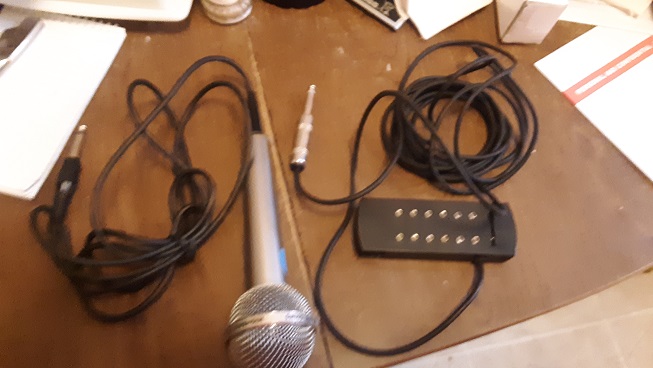
I went to the Livonia Amateur Radio Club Swap Meet this morning. I go every year, and while 90% of the items on sale is related to ham radio, I like to look around to see if there is any guitar/audio stuff I can get cheap, especially vintage microphones. I did pick up an old Radio Shack omnidirectional mic for the collection, as well as a Dimarzio acoustic guitar pickup, both for a few bucks each.

I also picked up an emergency radio, one that powers on solar or hand crank. You never know if you will need it if the power goes out.

I just wanted to cover three bluegrass-related YouTube channels that I came across recently. The first is World Bluegrass Day. This channel has been around since 2012, but for some reason, I only became aware of it recently, despite the number of times I have done searches on YT for bluegrass videos. Over 250 videos of bluegrass performances, interviews, and mini-documentaries are here, all of which are great to watch. One of the most recent uploads is “Jimmy Martin’s Wedding Video (1988).” It’s over an hour long, and the ceremony is strange to say the least. The bride looks young enough to be Jimmy’s daughter, and all of the Sunny Mountain Boys, along with J.D. Crowe and a few other musicians, stood in as his “best man.” More time was spent by Jimmy talking about his touring history than his bride. From what I recollect, Jimmy was never officially married, so this may have been a stunt. Anyone out there want to elaborate? Anyway, the channel is at https://www.youtube.com/@WorldBluegrassDay .

Cody M. Music is another channel that has been around for a while, but I only recently found it. Cody is a graduate of East Tennessee State University of its Old-Time and Bluegrass Music Program. He posts videos of acoustic guitar reviews and beginner lessons, including numerous shorts on easy licks and rhythm patterns. Some of the short lessons are slowed down to half speed so the viewer can learn it a bit more easily. Cody is using this channel to promote his online teaching program that you can purchase as a subscription. Some people wanting to improve on their bluegrass guitar playing may want to check this channel out at https://www.youtube.com/@codymmusic .

Southern Legacy is a true bluegrass supergroup. The members have been in numerous other bands, and get together occasionally for touring. Members include mandolinist Don Rigsby, banjoist Ron Block (of Alison Krauss & Union Station fame), and Josh Williams, my favorite flatpicker, whom I did a previous blog on (https://luegra.design.blog/2023/09/23/josh-williams-bluegrass-instrumental-genius/). The talent here is phenomenal, and I hope that they will be releasing some material soon. They are the cover story of the March 2025 issue of Bluegrass Unlimited. While there are a number of videos of this band performing on YT, they also have their own channel at https://www.youtube.com/@SouthernLegacyMusic .

Chew on it and comment.

Categories
Bluegrass Guitar

The Art of Bluegrass Rhythm Guitar

With my hands starting to feel their age (the pointer finger on my left hand is starting to get arthritic), I have to re-train myself in playing guitar. As I am still planning on going to the SPBGMA conference in Nashville in January, I know that I will be participating in some motel room and hallway jamming.

Now my lead guitar skills have pretty much dried up, as they weren’t that great to begin with, but I do still work on my rhythm guitar skills. I try to go back to the basics every few months by starting off slow with a metronome (about 70 beats per minute), then each day bring up the tempo a few notches until I get to about 120 bpm, which is pretty much the most common tempo for most bluegrass songs in 2/4 time.

I also occasionally refer to a DVD that was put out years ago by Musician’s Workshop, The Art of Bluegrass Rhythm Guitar with Chris Jones. He has a pretty laid-back approach to working on the rhythm chops, and while stressing the common “boom-chick” strum, he shows modifications, as well as some more modern strums that work with a 4/4 time signature.

After so many years playing electric guitar in punk and alt-country projects, and even after the past nearly two decades of concentrating on acoustic music, simple bluegrass rhythm guitar is really not that simple. The band (without a drummer) relies on that rhythm guitar to help keep a steady tempo. That basic “boom-chick” strum works with both the bass downbeat as well as the chop from the mandolin. I have worked with a lot of banjo players that have very little control of self-timing while doing their Scruggs rolls, and a rhythm guitarist with great control of tempo is a life saver to a bluegrass band.

I decided to check out what could be found on YouTube for bluegrass rhythm guitar. The search pulled out a few videos, and it seemed that each video had not only a different approach to the task, but even different fingerings altogether. Looking at the basic G chord, which in most beginner guitar books shows the first finger fretting the A string at the 2nd fret (creating a B note), the second finger fretting the low E string at the 3rd fret (creating a G note), and the third finger fretting the high E string at the 3rd fret (again, a G note). A few videos show a different position, with the first finger either muting the A string, or not touching the fingerboard at all and letting the second finger “mute” that A string, Then, the fourth finger frets the B string at the 3rd fret,(creating a D note). What this does is create a G5 chord, which removes the 3rd note (B) from the chord and only gives you G and D notes. This has a chime-like sound, which some bluegrassers prefer. Not me, I like the full sound of the whole major chord. One person actually stated in his video that this G5 is the only chord that a bluegrass rhythm guitarist should be using. Really?

Another video had the instructor forming a basic G chord, but with every strum, he would hammer on the low E string to the G note with the downbeat. It sounded less like a bluegrass strum and more like a surf-rock rhythm! One video states that the “boom” bass note should be stressed more, while another video states that the “chick” strum should be the emphasis. It seems that if you watch 10 videos on bluegrass rhythm guitar, there will be 11 opinions!

I will not get into the do’s and don’ts of bluegrass rhythm guitar. My one complaint about almost all of the videos is that they talk as if the typical bluegrass song (with exceptions of waltzes and those in quick 6/8 time) are all 4/4 time. I prefer to think of these as 2/4 time signatures, since the “boom-chick” action is two counts. Most folk and rock rhythms following a straight pattern usually fall into the 4/4 time signature, with a “boom-a-chick-a” pattern. Of all of the videos that I watched on this topic, I feel that Bryan Sutton says it the best on working with this rhythm pattern.

Chew on it and comment.

Categories
Bluegrass Guitar Bluegrass Music

Josh Williams: Bluegrass Instrumental Genius

More cleaning around my soon-to-be sold house, I came across a great DVD. Guitarmageddon: Josh Williams, Andy Falco and Chris Eldridge Live at the Station Inn. This was recorded around 2007, was put out by Flatpicking Guitar Magazine, and the three of them look young and energetic. If you get a chance to watch or purchase this DVD, or come across clips on YouTube, be sure to watch it!

This got me to thinking about Josh Williams again and what an amazing bluegrass musician he truly is. If you ever get to see the 1994 documentary Gather at the River: A Bluegrass Celebration, which covers the 1993 IBMA World of Bluegrass convention, you will see the first incarnation of Pete Wernick’s Young Bluegrass All-Stars. This band included very young versions of Williams (on banjo), Chris Thile (mandolin), Cody Kilby (guitar) and Michael Cleveland (fiddle), all of whom went on to bigger fame in the bluegrass community. Williams would later join Special Consensus on mandolin, then spend a good deal of time playing guitar with Rhonda Vincent and The Rage. He would also win the IBMA Guitar Player of the Year award three times!

He would leave The Rage due to some addiction troubles, but would form a solo band, as well as sit in with a number of bluegrass and country artists. Around 2008, I got a call from Jim Lauderdale asking if I would pick up Williams from the Detroit Metro Airport and drive him to a gig in Grand Rapids, about three hours away. I agreed, but then we hit one of the worst snowstorms in west Michigan, so the three hours turned to about six hours. Moreover, Williams was in a depressed mood due to the untimely death of mandolinist Butch Baldassari earlier that day. But we kept in touch for a while (I would always refer to him as “Colonel,” due to his home state of Kentucky), but slowly lost contact.

Williams would eventually kick the addiction habit and get back to performing with Rhonda Vincent for a few more years, as well as tour on a Tony Rice package. A few years back, he decided to leave touring completely, citing spending more time with his family. His output since then has been very sparse, but fortunately, he has not been forgotten by those that have worked with him in the past and are still active.

I bring Williams up now for a few good reasons. Currently, we have some great young guitarists in the bluegrass fold, most notably Billy Strings and Molly Tuttle. I am taking nothing away from these two – I find them both as incredibly talented players. However, there were some amazing bluegrass flatpickers in the previous generation of bluegrass that has slowly been forgotten. As for the Guitarmageddon video, Eldridge gained cred performing with The Punch Brothers, and Falco has been a highlight of the band The Infamous Stringdusters. Williams should not be forgotten at all. His body of work with Special C, Rhonda Vincent, and solo projects prove that he is a fantastic instrumentalist to be highly recognized on his own.

I have found a few videos of him on YouTube recently, showing up for a jam at the Acoustic Shoppe with members of The Chapmans, and performing on some tribute projects. I hope to get in touch with him soon, but I hope more that he can get back on stage a lot in the near future to showcase what a talent he really is.

Chew on it and comment.

Categories
Bluegrass Guitar Bluegrass Music

The Amazing Rebecca Frazier

Everyone who reads this blog knows that I am a big fan of Molly Tuttle’s flatpicking. She is one of the best up-and-comers out there in the bluegrass field, pushing its boundaries as well as paying tribute to its traditions. The media, including those in the bluegrass music fold, tend to promote her as the first female to blaze a trail with bluegrass guitar picking. Almost all seem to forget that there was another female that was doing wizardry on the six-string about a decade ago, and fortunately, is getting back into the music performing after a long semi-haitus.

If you haven’t heard of Rebecca Frazier, then start paying attention. When she was still Rebecca Hoggan, she helped form the Hit & Run Bluegrass Band in Colorado back in 2001. The band pushed the walls of traditional bluegrass a bit that made it stick out among other young bluegrass bands at the time, winning numerous awards and performing on stage with acts such as Alison Krauss, David Grisman, and Hot Rize. Part of the excitement of this band was Rebecca’s amazing flatpicking along with her strong vocals. It was common to see her handling guitar workshop duties at many of the bluegrass festivals that the band attended. She would marry the band’s mandolinist John Frazier, and the pair would move to Nashville.

I was fortunate enough to see Hit & Run at its one-time performance at The Ark in Ann Arbor around 2009 (not sure of the exact year). I also met up with John again at The Ark about a year after where we both attended a Roland White mandolin workshop and John just happened to be in town.

Upon their move to Music City, John took more studio and touring jobs with artists such as Steve Martin, Bela Fleck, and Jim Lauderdale. Rebecca was the first woman to appear on the cover of Flatpicking Guitar Magazine in 2006, and her first solo album When We Fall was recorded in 2012 (she gave birth to her daughter Cora, while recording the album). The album would be declared “Best Bluegrass Album of 2013” by the Bluegrass Situation website.

While John toured with national artists, Rebecca became more of a homebody mother, although she never strayed too far from her writing and performing. She re-formed a new version of Hit & Run Bluegrass Band a few years ago, and over the past few years, due partly to being stuck at home during COVID, she began posting videos on YouTube performing and instructing on bluegrass guitar solos from her heroes Tony Rice and Norman Blake.

A few months ago, I happened to catch a post of hers on LinkedIn, and wrote to her asking about her plans. She is interested in getting out and touring a bit again, so we both are staying in contact, as I told her that I would help her with booking in the Michigan area in any way that I can.

I am so glad to see that Rebecca plans to get back into the bluegrass scene again. She is an amazing talent, and I would advise anyone to search out her solo album, as well as subscribe to her YouTube channel.

Chew on it and comment.

Categories
Bluegrass Guitar Bluegrass Music

Happy 100th Birthday, Doc Watson!

On March 3rd, it was Doc Watson’s 100th birthday. The man left us in 2012, but his amazing legacy has remained with us since then, and with the bluegrass community having such young amazing guitarists as Billy Strings and Molly Tuttle, Doc’s influence will continue for years to come.

His story is legendary, so I’ll keep it short. You can find a biography on Doc on dozens of internet sources.. Born in 1923 in Stony Fork, North Carolina, his family was full of old-time musicians and singers. He became blind at a very early age, but still learned to handle farm chores as well as learned a number of musical instruments.

His forte, of course, was guitar. He started out professionally playing country and rockabilly guitar with a band in Johnson City, Tennessee. Folklorist Ralph Rinzler discovered him and recorded an album of Doc playing fiddle tunes on acoustic guitar for Folkways Records in 1961. It was the start of a 50-year career as a folk guitar icon.

There isn’t a bluegrass guitarist that hasn’t been influenced by Doc. Clarence White, Tony Rice, Norman Blake, Dan Crary, the list goes on. Each generation of bluegrass guitarists have no problem naming Doc as a favorite influence. Every one of them has at least one Doc Watson album. Even though he never considered himself a bluegrass guitarist, but bluegrass bands held his work in high esteem. When he toured with his son Merle, his grandson Richard, or Jack Lawrence, the duo would often headline festivals that had A-list bluegrass bands.

He loved playing with other musicians, always claiming that he continually learned form jamming with others. A beautiful moment can be found on Gather at the River: A Bluegrass Celebration. Doc jams with a young Michael Cleveland, with bluegrass musicians Tim O’Brien, Pete Wernick, and Dan Crary looking on. It is a magical moment in the bluegrass world.

There are two albums that never leave my playlist. The first is Doc Watson’s self-titled 1964 release. Raw and minimal, it is how Doc sounded best, just his voice and guitar working together. The other album is Blake & Rice 2. Doc performs on three songs with Norman and Tony that is simple wizardry.

Finally, there was the great performance called Three Pickers, in which Doc performed with Ricky Skaggs and Earl Scruggs. While each performer has a solo or band set, it is when the three of them are together that the best music is laid down. I still love watching the DVD, but here it is on YouTube.

Happy birthday, Doc! I know that you are up there making the Good Lord smile.

Chew on it and comment.

Categories
Acoustic Guitars Bluegrass Guitar

Yamaha Acoustic Guitars: The Poor Man’s Martin

First off, it was 20 years ago today that the US experienced one of its greatest tragedies. We lost thousands of citizens, the Twin Towers completely disappeared within a few hours, the Pentagon saw heavy damage, and a few dozen ordinary citizens became heroes losing their lives by fighting terrorists and crashing an airplane into a Pennsylvania field instead of the White House. I can remember it like it was yesterday, and it hurts a bit every time that I think about that day. For a few months afterward, we became a true united country. No democrats or republicans, just Americans working together. Let us never forget.

Last year in some earlier blogs, I was talking about the positive aspects of Glarry acoustic guitars and how they would make great beginner guitars, especially for the price. At the time, you could secure a new one directly from Glarry for about $50.00. The price seemed to go up a few dollars with each passing month, to the point now that the GT-502 Dreadnought Cutaway Acoustic is selling for $90.00. While it is still a good guitar, at that price, you may be able to shop around and find a quality used guitar that is much more durable and sounds better.

The Glarry acoustics just don’t have that look about them that makes you want to show up at a jam session with one, even as a beginner. You want to have an acoustic guitar that looks like a true dreadnought. While a Martin D-28 and its sisters are the standard for folk and bluegrass guitarists, new models cost at least $500 for the X series (which do not have that great of a reputation as far as volume or tone), around $1,200 for the made-in-Mexico Road series and 15 series, $1,600 for the 16-17 series, and the Standard series starting at about $2,500 for a D-18 (if you can find one). Don’t even get started with the prices of Limited Edition, Modern Deluxe, and Authentic series models. Used models vary in price, but not by much, due to Martin having a great reputation that the guitars age really well and the company stands by their work.

There are also a number of boutique brands like Collings and Bourgeois that cost even more, and some competitive brands such as Taylor and Guild that float around the same prices as Martin, although they are not as popular tone-wise. Face it, as a bluegrass guitar, Martin is the first choice by many.

Generally, Martins have gone up in price over the past decade or so, even with the lower-end models. My first Martin was a DXM model (which they don’t make any more) that I purchased online with gig bag for $300. It was good, but did not have the true Martin tone. Fortunately, I was able to sell it a few years later for the same price so that I could purchase my current Martin, a used 1981 D-28, which I have had for about 10 years now.

But back to what I am writing this blog about. What about the person that has less than $200 but still wants a decent dreadnought guitar that plays well and has a decent tone? My recommendation is the Yamaha series of acoustic guitars. There is a reason that Yamaha has been around in the music industry for over 50 years. They put out quality products for affordable pricing. We are talking about instruments across the board. Plenty of drummers use Yamaha drums as their regular kit. The DX-7 is a standard with keyboardists. I have had a Yamaha electric bass in my arsenal once and sold it for what I paid for.

A great beginner acoustic guitar is the Yamaha F-325. This is the model sold in the US, while in Europe and Asia the same model is called the F-310, with the only difference being the pickguard (F-310 = black, F-325 = tortoise pattern). This is a standard dreadnought size, with an easy-playing neck and a great full tone. These can usually be purchased for about $170 new. Online dealers like Sweetwater sell a package called GigMaker which includes a F-325 with a gig bag, tuner, and other accessories under $200.

Out of the box, these are set up really well. Mind you, they will not be as good tone-wise or heft-wise as a Martin D-28. They are lighter than your average dreadnought and, due to a laminated top, there’s a little less bottom end to the tone. Also, these models have rosewood fretboards, compared to high-end acoustics that usually have ebony fretboards (which give a more deeper tone when fretted). However, as a quality beginner bluegrass rhythm guitar, the F-325 is well worth it. I know of a few Martin players that have a Yamaha as a backup guitar. Yamaha does produce many other models, but all are more than reasonably priced as new.

As the F-325/F-310 was made for beginners, there are a lot of them out there that were purchased for aspiring youngsters only to be put into a closet when the student lost interest. This can be rewarding to you as the buyer. My winter pastime of working on instruments led me to scout around Craigslist and eBay for some good buys. I have snagged three of these models (two F-325’s, one F-310) used for around $100 each. Only one requires some body work (whoever owned it actually put a few small holes into the backside, either by drill or BB gun), but the other two are pretty solid. I plan to work on getting the tone a bit better with each of them through some basic modifications, which I will cover of the next few months here.

In the meantime, if you can get one of these guitars for a good price, say, $120 or less used, I would recommend at least trying it out. I leave you with a comparison of a Yamaha F-310 versus a Martin D-35 video from YouTube. It is a bit long, but you get the idea. The Martin has a better deep tone, but there is a difference between $200 and $3,200.

Chew on it and comment.

Categories
Bluegrass Guitar Coronavirus Musical Instruments

Tidbits #3: Shure – Part 2, Mandolin Straps, Bluegrass Rhythm Guitar, etc.

A few more ramblin’ thoughts for this week.

For some reason, maybe due to my ordering of the fake Shure SM58 microphone a few weeks ago from Wish.com, I received another microphone in the mail that didn’t cost me anything. This one is labeled a Beta 87a, but it definitely is not a Shure Beta 87a! It came in the same packaging as the SM58, with a faux leather zipper carrying bag, mic clip, cable tie and owner’s manual. Just by looking at the body of the mic, with the poor attempt at engraving the Shure label, one could tell that this was a fake. However, the big giveaway that it was not a true Shure Beta 87a was plugging it in. The 87a is supposed to be a condenser mic, which requires a phantom power of at least 24 volts to operate properly. This fake Shure mic had a dynamic element in it, so it worked without power, and sounded like a dynamic mic. Granted, I got this for free somehow, but true Shure Beta 87a mics list for about $250.00. Wish.com has these advertised for under $30.00. Use common sense when ordering something like this. If you see a Beta 87a under $200.00 new, it is most likely a fake. Unfortunately, some jerks are getting away with selling the fake ones as real. Do yourself a favor if you want a true Shure mic – buy it from a reputable dealer.

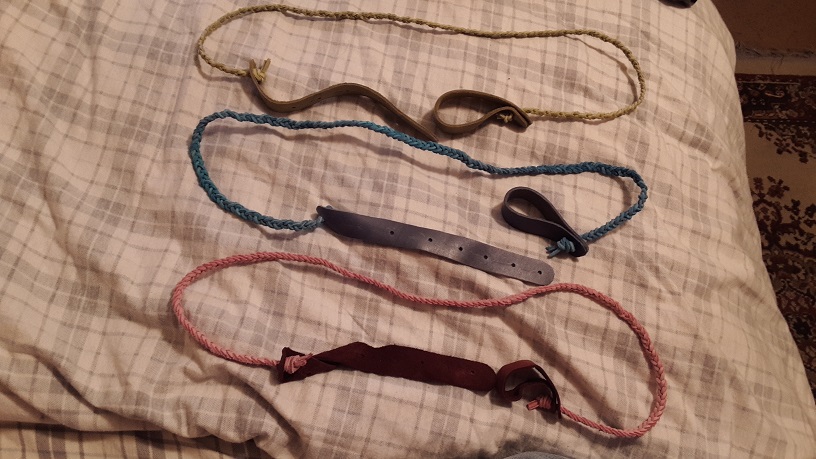
Besides doing some lutherie work, I have also been making braided mandolin straps during the pandemic. I learned to braid from a friend a few years ago, and usually while I am resting up in the evening and watching TV, I like to be a bit industrious by making straps. I started making leather guitar straps a few years back when I was gifted a bunch of nice-sized leather hide pieces. Once that ran out, I started using the leftover scraps and some laces to make mandolin straps. I make them for both A and F models, most are black with a different color ends, but I am making a few pink, blue and green ones. If interested, contact me here and I’ll email you some prices.

This past week I started working on my bluegrass rhythm guitar playing. Man, am I out of shape, musically! Seriously, I forgot how much of a job it is to keep good timing, proper strumming, and make a G run that doesn’t sound lousy, all at the same time! Since I haven’t worked with any band for a number of years, I have used the guitar almost exclusively for songwriting and recording with myself playing all instruments. Now that I’m practicing along with some jam tracks, I recognize what I’ve forgotten and let drift away from my rhythm technique. Lester Flatt and Jimmy Martin knew how important a rhythm guitar was to a bluegrass band, and as phenomenal of a lead player that he was, Tony Rice always stressed the importance of rhythm, and his was like a metronome. Speaking of a metronome, that is what I will be working with for a while.

Well, it looks like the Society for the Preservation of Bluegrass Music in America (SPBGMA) has cancelled this year’s Nashville Convention, which is usually scheduled for the last weekend of January. Yes, it is due to COVID-19, but they are setting the date for 2022 to be January 27-30. Let’s keep our fingers crossed.

One positive note is that the 47th annual Kentucky State Fiddle Championship is scheduled to happen March 20 at the Bluegrass Hall of Fame and Museum in Owensboro. With what little has been available, I am SO tempted to make the trek! Go to https://www.kyfiddler.com/ for more information.

Chew on it and comment.

Categories
Bluegrass Guitar Bluegrass Music

Tony Rice RIP

I received the tragic news last night that, on Christmas day, the world lost one of the greatest acoustic guitarists that the industry has ever known. Tony Rice was 69 years old, influenced thousands of artists, and truly defined the role of bluegrass guitar in bluegrass music.

There were others who played the guitar as a lead instrument before Tony. Bill Napier and George Shuffler performed crosspicking on guitar with The Stanley Brothers. Doc Watson gave acoustic lead guitar notice. Clarence White placed lead guitar into a bluegrass band setting. Dan Crary highlighted the bluegrass lead guitarist persona. However, it was Tony Rice that not only defined the role, he gave it an image, and that image was badass cool!

Unlike those before him, who were reproducing fiddle or mandolin lines on acoustic guitar, Tony was creating guitar lines that stood out on their own. There was a lot of pop, rock, and jazz influence in his bluegrass picking, which knocked a lot of traditionalists on their butts, whether they liked it or not. And while he performed in many different bands, one could tell from the first three or four notes that it was a Tony Rice lead.

There are plenty of albums that one could listen to in order to truly understand Toney’s playing. His signature work is definitely Manzanita, which showcases his guitar in a slightly progressive bluegrass setting. To hear what he was initially trying to get across with guitar as a true bluegrass workhorse, secure a copy of the debut self-titled album by J.D. Crowe and the New South on Rounder Records, affectionately known in the bluegrass fold by its issue number, “0044.” In his later years, he did two fantastic guitar-centric bluegrass albums with Peter Rowan as the Rowan & Rice Quartet. He also joined up with a number of other bluegrass stars to record a bunch of albums under the moniker The Bluegrass Album Band. Of course, anything under his own band The Tony Rice Unit should be considered.

While many bluegrassers cite his duet album Skaggs & Rice (with Ricky Skaggs) as his best work with bluegrass guitar and Monroe Brothers style of singing, I prefer the two albums he recorded with Norman Blake. Blake & Rice has some of the best textbook examples of bluegrass guitar lead work, and Blake & Rice 2 should be grabbed if only for the three songs that include Doc Watson performing to create bluegrass guitar powerhouse.

He was also a fantastic soulful baritone singer in the bluegrass vein. His work with Bluegrass Alliance and The New South atone to this. He was an avid fan of Gordon Lightfoot, and recorded many of the folksinger’s songs, either solo or with his family band The Rice Brothers. In 1994 he was diagnosed with muscle tension dysphonia, which put an end to his singing. In an interview I did with him in the early 2000’s, he talked about it, and said that if he were forced to lose one of his two talents, he would rather it be his voice. At his induction into the Bluegrass Hall of Fame in 2013, he lamented on this, and provided a promising result to therapy on his vocal work.

(watch at around 11:30)

He continued to play guitar with Rowan, as well as with Alison Krauss & Union Station and other bands that paid tribute to his work. In 2014, he developed lateral epicondylitis (tennis elbow) which made guitar playing painful. He decided to go into retirement until he could come back and perform as he used to. Unfortunately, that did not come about. However, we are blessed to have so many recordings of his amazing six-string work, and his sound and style will live on through so many young guitarists that were influenced by Tony, whether they realize it or not. You can definitely hear his work in the performing of Billy Strings, Molly Tuttle, Josh Williams, Chris Eldridge, and so many others. One of my favorite photographs of him is when he is in a room with Bill Monroe and he has Monroe play on the famous Clarence White Martin D-28.

If you have any doubts, get on YouTube and search out Tony Rice videos. You will not be disappointed.

Tony, I am truly glad that I got to meet you and speak with you on a few occasions regarding bluegrass guitar and music. You are now with the Angel Band. Take it easy on them with your licks.

Chew on it and comment.

Design a site like this with WordPress.com
Get started