Categories
Bluegrass Music Pop Music

Sergio Mendes RIP / Del McCoury Live!

This past week, one of the coolest pianists/band leaders passed away. Sergio Mendes led a jazz-pop group in the 1960s that had a number of hits on the charts with his band Brasil ‘66 (often changing the name to reflect each year of performing/touring). He was born in Brazil in 1941, and studied classical piano. He soon took interest in jazz and the rise in bossa nova music, and became a member of Carmen Miranda’s touring band.

He first formed a jazz trio, then added female singers to form Brasil ‘65, which began performing in in the US. After recording a number of low-selling albums, he hired English-speaking female singers so that they could record songs in English as well as Portuguese. Herb Alpert signed the band to A&M Records as Brasil ‘66, and they had a big international hit with “Mas que Nada.” The album Herb Alpert Presents Sergio Mendes & Brasil ‘66 went platinum.

Mendes would have even greater success with the Oscar-nominated song “The Look of Love,” as well as a cover of the Beatles’ song “Fool on the Hill.” The band performed for Presidents Lyndon B. Johnson and Richard Nixon. While his fame lowered in the US during the 1970s, he was still immensely popular in South America. During the cocktail music craze of the 1990s, he saw a renewed interest in his music, winning a Grammy in 1992 for Brasiliero.

During the 21st century, he did a number of collaborations, including with the Black Eyed Peas, Stevie Wonder and Justin Timberlake. He passed away on September 5th from complications of COVID.

I remember as a little kid watching his band perform on variety shows such as The Ed Sullivan Show and Hollywood Palace. His was the kind of music that everyone, from teens to older adults, could get into. Jazz influences, it also had the ingredients of rock, pop, and his native music samba and bossa nova. There was not a lot of flash in the instrumentation, but the band was skilled, and he knew that his female singers were eye candy as well as the perfect voices for the songs. While the music never received heavy rotation on the radio, when one of his songs did come on, you didn’t change the channel. If you were driving, it was the perfect cruising music. His work will always stand out as a great art form of pop music from Latin America.

Last night I went with my buddy Ken to see the bluegrass legend Del McCoury and his band. Now I’ve seen him already about a dozen times, and I probably would have passed on this show due to it being in Pontiac (a 40-minute drive, and I’m getting too old to stay out late and then drive home), but Ken had not seen him yet, and with Del at the age of 85, I knew that the chances of seeing him again were not as great as before.

Del still puts on a helluva show! It was funny, as 10 minutes before the start, there he is walking around the stage, making sure he has water available. His band could easily have roadies, but they still do everything for themselves. He has always loved and respected his audiences, talking to them personally between songs and taking requests. Two 45-minute sets would have probably tired out anyone else at his age, but he handled it like someone half his age. His band, consisting of his sons Ronnie and Rob, along with Jason Carter and Alan Bartram, are professional to a tee! They still do minimal miking, and choreograph their solos and harmony singing like the old days.

Yeah, he forgot the lyrics to songs a few times, but it was understandable, considering that he has a repertoire of a few hundred songs. The audience didn’t care – they loved it when he would just la-dee-dah through a verse to keep it going. He performed his trademark “1952 Vincent Black Lightning” (which I reviewed as a Perfect Song in the blog https://luegra.design.blog/2021/04/17/a-perfect-song-1-del-mccoury-band-1952-vincent-black-lightning/) to a standing ovation, and had no problem taking in about a half dozen requests as is normal for his shows.

I implore you to go see the Del McCoury Band while there is still time. It is worth hours to drive to see this amazing example of a bluegrass band, as well as appreciate the legend that Del McCoury truly is.

Chew on it and comment.

Categories
Bluegrass Fiddle Bluegrass Music

Bobby Hicks RIP

Yesterday, we lost one of the great and influential bluegrass fiddlers. Bobby Hicks passed away early Friday morning from complications of a heart attack earlier in the week at the age of 91. I do not think that there is a bluegrass fiddler alive today that does not know who he was, let alone view him as a big influence.

Hicks was born in North Carolina in 1933, and first learned guitar and mandolin. He later picked up the fiddle, and won his first fiddle contest at age 12. He would first play with Jim Eanes band, and did a short stint playing bass for Bill Monroe until Monroe saw how good he was on the fiddle and moved him to that position full time.

After a two-year service in the Army, Hicks returned to the Blue Grass Boys and moved to Nashville. With them he recorded Monroe classics “Big Mon,” “Scotland,” and “Wheel Hoss.” He often recorded twin and triple fiddles with the band alongside Vassar Clemens, Kenny Baker, and Charlie Cline. He later joined Port Wagoner’s band, but soon moved to Las Vegas where he was getting paid much better. It is there that he created his homemade five-string fiddle.

After seven years in Vegas, he returned to NC to care for his ailing mother. While home, he played with some local bands and held private lessons. In 1981, Ricky Skaggs asked Hicks to join his touring band. At the same time, he participated in the first five albums of the legendary Bluegrass Album Band, which included Tony Rice, Doyle Lawson, J.D. Crowe and Todd Phillips.

He retired from Skaggs’ band and touring in 2004 at the age of 71. He continued playing locally in NC and giving occasional lessons. He was inducted into the Fiddlers Hall of Fame in 2002, the Bluegrass Music Hall of Fame in 2017, and was also a member of the North Carolina Music Hall of Fame. He has 10 Grammy Awards to his credit, and performed for over 50 years on the Grand Ole Opry.

Monroe once dubbed Hicks “the truest fiddler he had ever heard.” I had the honor of meeting Mr. Hicks back around 2011 at the IBMA World of Bluegrass Conference when it was in Nashville. In the Exhibit Hall, he was trying out a number of fiddles at a luthier’s booth. Strangely, there was not that big of a crowd standing around watching this legend test-drive the fiddles. He actually asked me what I thought of one of them once he was finished playing. We chatted for a few minutes, I explained that I was not a fiddler but enjoyed fine playing. I felt honored that he would ask someone he didn’t know an opinion of an instrument.

The masters of bluegrass are disappearing at a sadly fast rate, and with Bobby Hicks now gone, there is not many left for our younger artists to show respect to. He will be sorely missed int eh bluegrass community for not only his talent, but his knowledge that he passed on to many others.

Chew on it and comment.

Categories
Bluegrass Music

IBMA World of Bluegrass Move to Chattanooga

So, the announcement was made this past week that the IBMA World of Bluegrass Conference will be held in Chattanooga, Tennessee for the 2025 through 2027 seasons. The choice surprised a few in the bluegrass community, as most thought that it would be moved back to Kentucky.

The IBMA stated that it would make the announcement much earlier in the year, so being this late made many lose interest in where the conference would be located in the future. Once the announcement was made that 2024 would be the last year that WOB would be held in Raleigh, North Carolina, the bluegrass community was talking heavily on a new location, which included Louisville, Lexington, or Owensboro, KY, Dayton, OH, or even St. Louis, MO. Very little talk was of Chattanooga, but one can see a few positives to the choice:

  • More centrally located. While still in the South, Chattanooga is closer to other bluegrass-oriented cities such as Nashville, Knoxville, Louisville, and Dayton. As a mileage note, Chattanooga is about a 9.5-hour drive from Detroit, while Raleigh is closer to 13 hours (I still don’t plan on going, more on that later).
  • Investment. Chattanooga is planning on investing $25 million into promoting tourist and convention marketing. We are fully aware that conferences such as WOB can pull in millions of dollars to a city’s economy, so I would venture that with WOB being there for three years, it will be a hefty return on investment, not even considering other conventions and tourism outside of WOB.
  • Weather. During WOB’s tenure at Raleigh, there were two instances where hurricanes affected the conference, with one cancelling a large amount of events or forcing re-scheduling. A fan registered for WOB that just paid a few hundred dollars to attend, as well as hundreds more for hotel and food, expects a whole week of entertainment without Mother Nature screwing up things. Yes, maybe a day can be a disappointment (we’re used to it at bluegrass festivals), but to be in fear of dangerous weather the entire time is not worth the trip.

The first WOB in Chattanooga is scheduled for September 16-20, 2025. Oddly enough, that is usually the same week that the Americana Music Association schedules its AmericanaFest conference in Nasvhille. While there is not a lot of conflict, some bands and fans do attend both conferences, so one would wonder how much of a loss either association would feel if both were to be held on the same week. I would imagine that the AMA would probably hurt more, albeit not a large amount. Also, would anyone even consider the two-hour drive between the two cities to attempt to attend both? Highly unlikely.

As I stated above, I don’t plan on attending WOB in the near future, unless drastic changes are made in the philosophies of the IBMA, especially its political leanings. Because they moved so far left in thought since the George Floyd riots, I not only stopped becoming a member, but also resigned my position as a member of Leadership Bluegrass. Granted, I have also left the Americana Music Association for similar reasons, so whatever happens to the conferences over the next few years does not concern me. What I care about is the quality of music, not the diversity/equity of the artists. I thoroughly enjoyed my time at SPBGMA this past January because there was no politics, just a bunch of people enjoying music and jamming, and it allowed me to network without having to deal with conflicting attitudes.

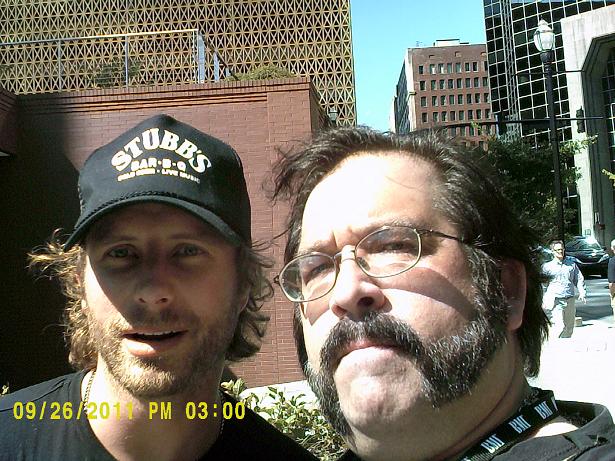
In a related note to end this blog, I was going through some thumb drives a few evenings back, and came across a folder marked “IBMA 2011.” I believe this was one of the last years that WOB was held in Nashville, as well as one of the last times that I attended. One of the themes that year was Del McCoury’s 70th birthday. The Del McCoury Band performed live outdoors near the Ryman Auditorium and had a number of special guests, including Vince Gill, Sam Bush, Tim O’Brien, and Dierks Bentley. I actually got to hang out with Dierks for a while after his appearance, which he proved to be a true gentleman. I remember taking this photo and sending it back to two female co-workers. They were so jealous that they wouldn’t talk to me for days!

My beautiful picture

Chew on it and comment.

Categories
Bluegrass Music

2024 IBMA Award Nominees

The 2024 IBMA Award nominees came out earlier this week. The list can be found here at Bluegrass Today (https://bluegrasstoday.com/2023-ibma-bluegrass-music-awards-nominees-announced-2/).

There is not much surprise here. The usual suspects appear in a number of categories, such as Billy Strings, Molly Tuttle, Sierra Hull, Del McCoury, and Sister Sadie. The one category that I am glad to see some fresh faces is New Artist of the Year, even though most of them have been around a while and have great PR. However, I do think that it is time that the IBMA has recognized The Kody Norris Show in that category. After years of endless touring and a number of SPBGMA wins, Kody and his band deserve more “mainstream” bluegrass spotlight.

As far as instrument/vocal awards, the names seem the same as previous years, whether the performer has done any recording or extensive performing. In fact, there is only one name in all of the categories that is brand new (Gaven Largent – Resophonic Guitar Player of the Year). Over the past few years, I tend to lose interest in these categories, and can probably guess who will win way before the show.

As for the Hall of Fame inductees, all three are deserving. Alan Munde has played influential banjo for decades. What can be said about the dobro genius Jerry Douglas that has not been said already. And Katy Daley has been an amazing voice in bluegrass publicity and broadcasting for as long as I can remember.

Not much else to say. Other than hoping my friends in the Kody Norris Show win at least one of the two categories, I really have little interest in the outcome. I only wrote about it this week because I didn’t have any other topic to write about off the top of my head.

Chew on it and comment.

Categories
Bluegrass Music Musical Instruments

Tidbits #6: Hand Massager, Instrument Prices, Meeting Other Bluegrassers

During the guitar workshop at the Charlotte Bluegrass Festival last month, some of the discussion centered on hand therapy, such as caring for aches and pains from carpal tunnel and other discomforts. Dalton Harper stated that one of his therapeutic reliefs is an electronic hand massager. They are about the size of a cantaloupe cut in half, and you put your hand in the device for 10-15 minutes for stress relief on your fingers and palm. These devices range from $25.00 to over $100.00 on Amazon, and Dalton recommended paying for the better quality models.

When I got home, I checked Amazon, and found one on sale for around $80.00. I got it in this week, and tried it out. Wow! I thought that it would merely vibrate around on your hand. No, this contraption squeezes, pushes, and rubs your hand and fingers the way that a masseur would work it. On the model that I purchased (Cincom CM-026H) has two different modes of massaging, three different intensities, and optional heat. It is USB rechargeable, and even comes with some disposable gloves in case you put on hand cream beforehand.

I get carpal tunnel in my hands from typing at work, and the first finger on my left (fretting) hand is starting to get arthritic. I have used a small hand warmer on it for temporary relief, but this hand massager made it feel good for hours afterwards. I highly recommend any musician starting to feel some aches in the hands to get one of these items.

Ever since coming back from Charlotte and helping out at the kid’s petting zoo, I have been checking out prices for guitars, mandolins, fiddles and dobros for beginners. Guitars are pretty easy to come by for under $100.00, as well as mandolins. Of course, these will not be great quality instruments, but with the right setup, they are easily playable. Fiddles can be more hit-and-miss. The one that I purchased from Glarry last year turned out to be a great buy. However, I have seen ones that were higher priced that what I paid that sound horrible. Moreover, fiddles need a lot more work setting up than a guitar. You could spend $100.00 for a student violin, then spend more than that just to get it in playable condition.

Then there are the dobros, or resonator guitars. The cheapest that I saw for a beginner model was over $200.00, and that is one with a rounded neck, more suitable for playing like a regular guitar. They can still be played lap-style, but you will have to get an extension nut available at Elderly Instruments or on eBay for about $10.00). In fact, for the absolute beginner, a good alternative may be to just get a regular acoustic guitar and use one of these nut extensions until an actual dobro can be purchased. As for a true square-neck dobro, expect to pay over $500 for a beginner model. I figure that with all of the interest in learning a musical instrument during COVID, prices for guitars and other instruments would go up just like everything else with inflation. With sommer here, I’ve been driving slow past yard sales to see if there are any guitars or violins no longer being played that I can snage for a cheap price. Of course, the US 12 World’s Longest Yard Sale is coming up in early August!

Finally, here’s a unique story. A friend of mine was hit by a car while riding her bike earlier this week and was checked into the hospital a few blocks from my house. When I went to see her, a male nurse named Chris took me to her room. He saw that I was wearing one of my many bluegrass-themed T-shirts, and it turned out that he is a fan as well, which he plays mandolin and hits bluegrass shows when he can. I gave him my number, and we’re hoping to get together soon to do some jamming. Bluegrass fans are few and far between, so it was a pleasant surprise to find another one in the strangest of places.

Chew on it and comment.

Categories
Bluegrass Music

Charlotte Bluegrass Music Festival 2024

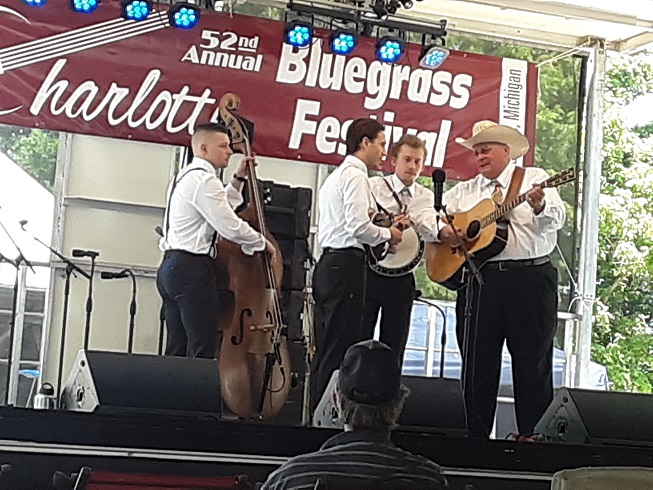
A day late, but I just got back from the Charlotte Bluegrass Music Festival. This year, I went the whole three days, and I am glad that I did.

While not much is different from last year’s festival (https://luegra.design.blog/2023/06/25/charlotte-bluegrass-festival-2023/), there were a few high points. Returning acts included Michael Cleveland & Flamekeeper, Williamson Branch, and one of my all-time favorite bands, the David Mayfield Parade. I cannot say enough great things about Mayfield and his band. Amazing musicians, fantastic songs, and the humor that Mayfield spills out between songs, as well as when he takes a guitar solo, is beyond energetic. They were such a big hit last year that they were booked for two days this year. That was four sets that saw only one or two songs repeated due to audience requests. I implore you to check them out on YouTube and follow them however you can. They have a new album coming out later this year, produced by Tim O’Brien. Their version of the classic instrumental “El Cumbanchuro” will leave you breathless!

There were a few stalwart bands that made a return after a few years away. Joe Mullins & The Radio Ramblers did two good sets, and are one of those bands that never disappoints. The same goes for The Grascals. Founding member Jamie Johnson has returned after eight years away, and he is honest to tell his audiences that it was due to some drinking, family, and other personal problems that he and The Lord were able to sort out. That takes a lot to feel comfortable emough to tell thousands of strangers, but bluegrass audiences are extremely supportive of performers in any situation.

One of my personal highlights was seeing Dale Ann Bradley. She has one of the most perfect voices in bluegrass, and can make any song from a slow ballad to a moving rocker sound soulful. On top of that, she is an absolute sweetheart to her fans. I haven’t talked to her in over 10 years, but she remembered that festival where we last met as well as we talked about some mutual friends. And absolute sweet lady!

I was also happy to see David Peterson & 1946 perform two sets. Long before Jerry Douglas formed The Earls of Leicester to pay tribute to the early Flatt & Scruggs days, Peterson was performing old Bill Monroe, F&S, and Jimmy Martin tunes nuance for nuance, and appearing on stage dressed for the part. Watching the 1946 band is literally like watching and listening to a bluegrass tent show from that period, as they sing and play around a single microphone and choreograph steps to control the sound.

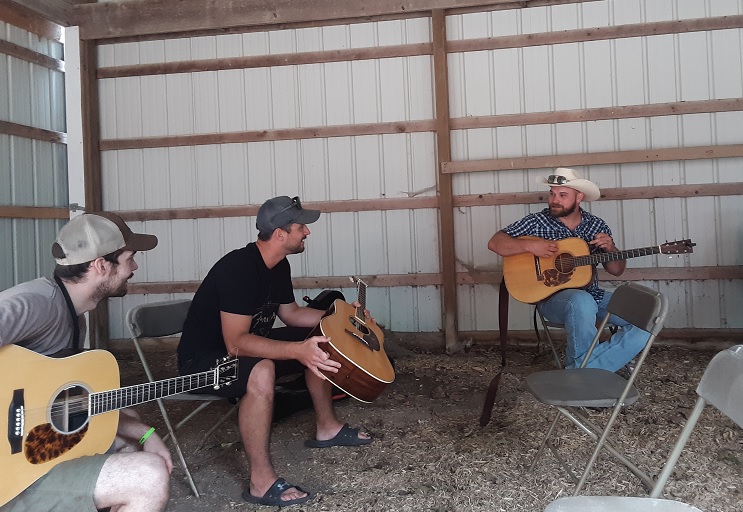
Two bands that performed, which I have not seen before but caught my attention. The first was Highway North, a quartet of young pickers from North Ontario, Canada that made their first appearance at the festival. While the vocals were a bit laid back, the instrumental prowess on guitar and mandolin was phenomenal. Another great act was Dalton Harper. He is a singer/songwriter and a fantastic guitar picker as well. His style reminded me of Josh Williams (as it turned out, they are good friends and have performed together on occasion). I was truly impressed with his performances. I asked if he was going to be participating in the scheduled guitar workshop, and he told me that he wasn’t aware of the workshop. Sure enough, he got roped into leading the workshop the next day, and was joined by Taylor LaBreche and Jake Lavzon of Highways North for some great discussion and even better three-guitar jamming.

I helped out on the Southeast Michigan Bluegrass Music Association’s “Petting Zoo” Saturday morning. This involved having a number of acoustic instruments laid out for kids to try out to see if they would be interested in playing one at home, then talking to parents about cost and lessons. I had one young girl that was totally interested in the dobro. Fortunately, her parents are also hobbyist musicians, and encourage the daughter to pursue music as an interest. My big gripe is that a few adults show up and start jamming in the area so that kids cannot hear what they are doing, and can be overpowering when showing the kids some techniques that the kids cannot comprehend yet. Let the kids have fun first!

I stayed away from the food vendors for the most part, as the prices are way too high, and so is the grease! And of course, due to having to take insulin shots, I stayed in a nearby motel instead of camping. All in all, I will be heading back next year. Since I am not able to hit many multi-day festivals over the year, this one has a special place in my schedule.

Chew on it and comment.

Categories
Bass Guitar Bluegrass Music Lutherie

Leo Jaymz Guitar Kit/Amazon Scam/Larry Sparks

So even though I haven’t even started on the two guitar kits I already have, I purchased a third kit. This kit comes from Leo Jaymz, and is pretty similar to the Fesley kit I purchased a few weeks ago (https://luegra.design.blog/2024/05/19/inexpensive-guitar-kits/).

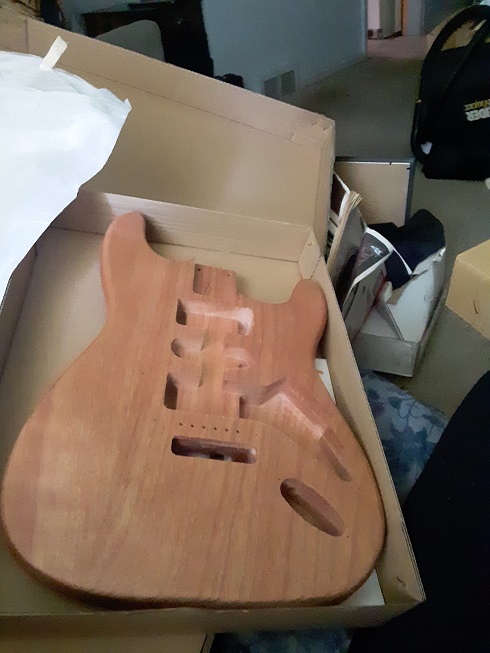
The big difference with the Leo Jaymz kit is the Strat-style body. They have routed it for the customizer, with spaces for humbucker pickups in the neck and bridge positions. The pickguard is still set up for three single coils, and wiring has connectors, so no soldering is needed. The instruction manual has no text, only pictures showing how to install each component. It really could not get any easier, I guess.

I had to take a second look at the body, though. As pretty much with all electric guitar bodies for this low price, it consists of poplar pieces glued together, then cut with a computer-controlled router. The grain of all of the pieces should be running length-wise from bridge to horns. However, this particular body seems to have a slight angle to the grain. It’s not drastic, but is noticeable to someone looking a little closer.

I still want to stain one of these guitars a unique transparent color, so I have to look all three bodies over. As stated previously, the Fesley body is ready for finishing, while the Ktaxon Tele needs a lot of fine sanding before any finish work. This Leo Jaymz body is sort of in between the two as far as surface texture. It is somewhat smooth, but could probably use a buffing with some super-fine steel wool to get it ready.

I am still interested in looking at and reviewing some bass guitars for young students to work with. I did order through eBay a really short-scale (25.5-inch) mini bass put out by Glarry. I plan on reviewing it here, and possibly on my YouTube channel, once it comes in. I was going to purchase the Ktaxon Fender Bronco copy bass that I briefly discussed in a blog three weeks ago (https://luegra.design.blog/2024/05/25/ktaxon-the-latest-cheap-guitar-brand/). I had recently won a gift card for Amazon, and when I went to the Amazon website, I saw that the bass had a price cut from $59.99 to $49.99. A nice incentive to purchase, so I clicked on the order. Well, shipping for the sale-price bass was $29.99, while shipping for the regular-price bass was $19.99, so there was no difference in the final cost. I wrote to Amazon about this, but have not heard back from them. Hopefully, no one fell for this hidden scam.

Finally, this past Thursday I went to see a bluegrass legend perform at the Kentuckians of Michigan hall in Romulus, MI. Larry Sparks, who has been performing for over 61 years as a solo artist, as well as with the Stanley Brothers, Ralph Stanley, and the Lonesome Ramblers, has had to cancel a few previous performances due to health concerns. I figured that I better go to this show, even though it was on a weeknight, because The Man may stop touring altogether. I was even able to talk by bluegrass buddy Ken to go, as he keeps missing local bluegrass shows for numerous reasons.

Larry was just doing a few shows, no festivals booked, with a small combo. No banjo player at this show, so we actually got to hear his smooth vocals and distinct guitar playing a lot better. He is definitely old school, playing a three-minute song, then bantering for 10 minutes more. However, he is a legend, and you listen to every word he has to say because he has great stories to tell and is somewhat of a rural philosopher. I am so glad that I got to see Larry perform, and it was worth going to work Friday morning on about four hours sleep.

Next week’s blog will probably be a bit late, as I will be at the Charlotte (MI) Bluegrass Festival all weekend.

Chew on it and comment.

Categories
Bluegrass Mandolin Bluegrass Music

Frank Wakefield RIP

Last week, a great bluegrass mandolin player passed away. Frank Wakefield was a bluegrass character to be sure, and seems to be forgotten be most modern bluegrass musicians. Where Bill Monroe was the Elvis Presley of bluegrass, and the Stanley Brothers were the Everly Brothers of bluegrass, Frank Wakefield was the Johnny Rotten of bluegrass.

He was always pushing the boundaries of the mandolin in bluegrass, which turned off many traditionalists. He started off playing with Red Allen in the early 1950s, then moved up to Detroit to audition for Jimmy Martin. While Martin at the time did not need a mandolin player, he recommended that Wakefield contact Marvin Cobb, leader of the Chain Mountain Boys. Wakefield played with the band for a while, then joined up with the Stanley Brothers. However, Ralph Stanley and Wakefield did not get along musically, so Wakefield went back to the Chain Mountain Boys.

Wakefield’s style was boundary-pushing to say the least. The Chain Mountain Boys recorded the single “Tell Me Why My Daddy” with the B-side of the classic “New Camptown Races” for a small Detroit label, Wayside Records, that specialized in country and bluegrass. In fact, an advertisement in Billboard in 1957 is considered the first use of “bluegrass” to describe the music.

The Chain Mountain Boys disbanded in late 1957, and Wakefield continued to record for Wayside with Buster Turner. He also toured with Jimmy Martin for a time, then moved to Washington, DC to work again with Red Allen. With Allen, Wakefield would play such venues as Carnegie Hall, and he began to teach mandolin to future luminary David Grisman. He would later work with the Greenbriar Boys, and began to write classical-influenced instrumentals for the mandolin. This work would eventually get him invited to perform with the New York Philharmonic and the Boston Pops.

Wakefield would spend the 1970s recording solo work, being backed up by banjoist Don Reno and fiddler Chubby Wise. He would also tour with Jerry Garcia’s solo projects and warm up for Grateful Dead shows. His last notable recording was on the 1999 Grammy-nominated Bluegrass Mandolin Extravaganza, which also featured Grisman, Sam Bush, Ricky Skaggs, Ronnie McCoury, Jesse McReynolds, and Bobby Osborne.

The best description of Wakefield comes from Grisman: “He split the bluegrass mandolin atom. Some of us, obviously, will never be the same again.”

While I never got a chance to meet Wakefield or see him perform, I always had a soft spot for him in my bluegrass heart due to his time in the Detroit area when he really began to use the mandolin as a bluegrass weapon. Those early Wayside Records recordings were released in 1976 by Rounder Records called Early Days of Bluegrass, Volume 2, so if you can ever find that album, be sure to get it.

Frank, you will be missed by those who truly appreciate no0t allowing bluegrass to become stale.

Chew on it and comment.

Categories
Bluegrass Music Music Instruction

SEMBMA Youth Scholarship Showcase: Afterword

Last Sunday, April 21st, the Southeastern Michigan Bluegrass Music Association held its showcase of the Youth Scholarship recipients at Woldumar Nature Center in Lansing. It was great to see the four students perform, and even better to see a great turnout for an audience. I tried once again to video the event, and while the video itself was good, the audio going into the built-in microphone was terrible. Hopefully I can get the hang of this camcorder someday.

I had mentioned this showcase a few weeks ago (https://luegra.design.blog/2024/03/09/sembma-youth-showcase-april-21st/), and was glad that it was a moderate success. SEMBMA member Marcia Bailey also brought a few instruments for interested kids to try out at the Association’s “petting zoo.”

What made me pleased the most was that the four students are really passionate about improving on their playing. Eleven-year-old Dominic impressed me the most with his off-the-cuff knowledge of old-time fiddle tunes that he was warming up to. Belinda is another 11-year-old fiddler that I first saw at the Michigan Old-Time Fiddlers Contest back in 2022 and worked hard to get her parents to apply for a scholarship. She has a great teacher in Keala Venema, who is a well-known fiddler in the western part of the State. Thirteen-year-old Henson was performing standard banjo tunes in the style of Earl Scruggs. Lydia was also performing on banjo, but I was really impressed by her strong vocals for a girl of 14.

The four joined their instructors for a jam session at the end of the performance. It was great to talk to Keala again, as well as talk to some of the parents about how proud they are of the students. I was really glad to see Lydia jamming with some of the older musicians at the session going on downstairs.

I hope that between seeing these performers, as well as testing out some instruments in the petting zoo, that we can see more young people interested in taking up an instruments and pursuing music as a dedicated hobby or even an eventual career. I was able to talk to one mother who was really interested in getting her son involved, as he plays violin at school but is more interested in bluegrass and folk music than classical.

For more news about the event, you can visit the Bluegrass Today website where SEMBMA president Bill Warren posted some of his photos (https://bluegrasstoday.com/woldumar-nature-center-monthly-jam-in-lansing/). There’s one of me with a really small guitar. It says that I am part of the jam session, but I was really only tuning the thing for the petting zoo.

Chew on it and comment.

Categories
Bluegrass Music

Ben Eldridge RIP

Earlier this week, one of the great second-generation bluegrass musicians passed away. Ben Eldridge was best known for his reserved yet perfectly fitting banjo work in The Seldom Scene. What made him unique was that he was able to fit the banjo tastefully into the progressive (for the time) songs that the band was perfroming.

With the folk-rock style songwriting of John Starling, and the in-your-face tenor vocals and mandolin leads of John Duffey, The Seldom Scene had an “artist’s artist” reputation in the bluegrass field. While highly respected among other bluegrass bands, The Seldom Scene gained praises from people in the pop, rock, and country music genres, including Linda Rondstadt, Emmylou Harris, and Ricky Skaggs. Eldridge helped solidify that reputation by being a banjo-slinger, not just a player. He knew exactly what would fit in each and every song. His playing was perfect in every song.

During the 1960s, he would play in a few traditional bluegrass bands, including with Cliff Waldron. However, it was when he hosted jam sessions with Duffey, Starling, and dobro player Mike Aldridge at his home in Bethesda, Maryland that there was a realization that something rich was going on. Most of the band had regular jobs and could not fully commit to a touring schedule, so on an off-shot remark from Country Gentlemen leader Charley Waller, they took the name The Seldom Scene.

Eldridge was a mathematician by trade at the time, but the band found themselves getting regular evening performances in the Baltimore and DC areas. Through the years, there were a number of personnel changes, to the point where, after Duffey’s death in 1996, Eldridge became the sole founding member. The band would continue to prolifically record albums and sparsely tour (sticking mostly to shows and festivals in the DC area), but after 44 years, Eldridge decided to retire in 2016. His legacy with the band included 55 albums, including one of the earliest live albums released by a bluegrass band.

Though he would appear on stage with either The Seldom Scene or other bands, the last few years of Eldridge’s life were spent in full retirement. He passed away on April 14 at the age of 85.

Unfortunately, I never got to meet Ben Eldridge, but I have conversed many times with his son Chris, who performs with the Punch Brothers. Chris is an amazing bluegrass guitarist, probably one of the best on the scene today. If there is ever any truth to the adage “the fruit doesn’t fall far from the tree,” it would be of Chris and his father Ben.

I recommend that you seek out a Seldom Scene recording, especially a live one. I guarantee that you will hear some of the best interacting among players, be it musically or on-stage banter. Ben Eldridge’s to the band, as well as early progressive bluegrass music, cannot be denied.

Chew on it and comment.

Design a site like this with WordPress.com
Get started