Last week, a great bluegrass mandolin player passed away. Frank Wakefield was a bluegrass character to be sure, and seems to be forgotten be most modern bluegrass musicians. Where Bill Monroe was the Elvis Presley of bluegrass, and the Stanley Brothers were the Everly Brothers of bluegrass, Frank Wakefield was the Johnny Rotten of bluegrass.
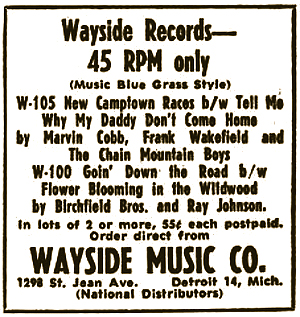
He was always pushing the boundaries of the mandolin in bluegrass, which turned off many traditionalists. He started off playing with Red Allen in the early 1950s, then moved up to Detroit to audition for Jimmy Martin. While Martin at the time did not need a mandolin player, he recommended that Wakefield contact Marvin Cobb, leader of the Chain Mountain Boys. Wakefield played with the band for a while, then joined up with the Stanley Brothers. However, Ralph Stanley and Wakefield did not get along musically, so Wakefield went back to the Chain Mountain Boys.
Wakefield’s style was boundary-pushing to say the least. The Chain Mountain Boys recorded the single “Tell Me Why My Daddy” with the B-side of the classic “New Camptown Races” for a small Detroit label, Wayside Records, that specialized in country and bluegrass. In fact, an advertisement in Billboard in 1957 is considered the first use of “bluegrass” to describe the music.
The Chain Mountain Boys disbanded in late 1957, and Wakefield continued to record for Wayside with Buster Turner. He also toured with Jimmy Martin for a time, then moved to Washington, DC to work again with Red Allen. With Allen, Wakefield would play such venues as Carnegie Hall, and he began to teach mandolin to future luminary David Grisman. He would later work with the Greenbriar Boys, and began to write classical-influenced instrumentals for the mandolin. This work would eventually get him invited to perform with the New York Philharmonic and the Boston Pops.
Wakefield would spend the 1970s recording solo work, being backed up by banjoist Don Reno and fiddler Chubby Wise. He would also tour with Jerry Garcia’s solo projects and warm up for Grateful Dead shows. His last notable recording was on the 1999 Grammy-nominated Bluegrass Mandolin Extravaganza, which also featured Grisman, Sam Bush, Ricky Skaggs, Ronnie McCoury, Jesse McReynolds, and Bobby Osborne.
The best description of Wakefield comes from Grisman: “He split the bluegrass mandolin atom. Some of us, obviously, will never be the same again.”
While I never got a chance to meet Wakefield or see him perform, I always had a soft spot for him in my bluegrass heart due to his time in the Detroit area when he really began to use the mandolin as a bluegrass weapon. Those early Wayside Records recordings were released in 1976 by Rounder Records called Early Days of Bluegrass, Volume 2, so if you can ever find that album, be sure to get it.
Frank, you will be missed by those who truly appreciate no0t allowing bluegrass to become stale.
Last Sunday, April 21st, the Southeastern Michigan Bluegrass Music Association held its showcase of the Youth Scholarship recipients at Woldumar Nature Center in Lansing. It was great to see the four students perform, and even better to see a great turnout for an audience. I tried once again to video the event, and while the video itself was good, the audio going into the built-in microphone was terrible. Hopefully I can get the hang of this camcorder someday.
I had mentioned this showcase a few weeks ago (https://luegra.design.blog/2024/03/09/sembma-youth-showcase-april-21st/), and was glad that it was a moderate success. SEMBMA member Marcia Bailey also brought a few instruments for interested kids to try out at the Association’s “petting zoo.”
What made me pleased the most was that the four students are really passionate about improving on their playing. Eleven-year-old Dominic impressed me the most with his off-the-cuff knowledge of old-time fiddle tunes that he was warming up to. Belinda is another 11-year-old fiddler that I first saw at the Michigan Old-Time Fiddlers Contest back in 2022 and worked hard to get her parents to apply for a scholarship. She has a great teacher in Keala Venema, who is a well-known fiddler in the western part of the State. Thirteen-year-old Henson was performing standard banjo tunes in the style of Earl Scruggs. Lydia was also performing on banjo, but I was really impressed by her strong vocals for a girl of 14.
The four joined their instructors for a jam session at the end of the performance. It was great to talk to Keala again, as well as talk to some of the parents about how proud they are of the students. I was really glad to see Lydia jamming with some of the older musicians at the session going on downstairs.
I hope that between seeing these performers, as well as testing out some instruments in the petting zoo, that we can see more young people interested in taking up an instruments and pursuing music as a dedicated hobby or even an eventual career. I was able to talk to one mother who was really interested in getting her son involved, as he plays violin at school but is more interested in bluegrass and folk music than classical.
For more news about the event, you can visit the Bluegrass Today website where SEMBMA president Bill Warren posted some of his photos (https://bluegrasstoday.com/woldumar-nature-center-monthly-jam-in-lansing/). There’s one of me with a really small guitar. It says that I am part of the jam session, but I was really only tuning the thing for the petting zoo.
Earlier this week, one of the great second-generation bluegrass musicians passed away. Ben Eldridge was best known for his reserved yet perfectly fitting banjo work in The Seldom Scene. What made him unique was that he was able to fit the banjo tastefully into the progressive (for the time) songs that the band was perfroming.
With the folk-rock style songwriting of John Starling, and the in-your-face tenor vocals and mandolin leads of John Duffey, The Seldom Scene had an “artist’s artist” reputation in the bluegrass field. While highly respected among other bluegrass bands, The Seldom Scene gained praises from people in the pop, rock, and country music genres, including Linda Rondstadt, Emmylou Harris, and Ricky Skaggs. Eldridge helped solidify that reputation by being a banjo-slinger, not just a player. He knew exactly what would fit in each and every song. His playing was perfect in every song.
During the 1960s, he would play in a few traditional bluegrass bands, including with Cliff Waldron. However, it was when he hosted jam sessions with Duffey, Starling, and dobro player Mike Aldridge at his home in Bethesda, Maryland that there was a realization that something rich was going on. Most of the band had regular jobs and could not fully commit to a touring schedule, so on an off-shot remark from Country Gentlemen leader Charley Waller, they took the name The Seldom Scene.
Eldridge was a mathematician by trade at the time, but the band found themselves getting regular evening performances in the Baltimore and DC areas. Through the years, there were a number of personnel changes, to the point where, after Duffey’s death in 1996, Eldridge became the sole founding member. The band would continue to prolifically record albums and sparsely tour (sticking mostly to shows and festivals in the DC area), but after 44 years, Eldridge decided to retire in 2016. His legacy with the band included 55 albums, including one of the earliest live albums released by a bluegrass band.
Though he would appear on stage with either The Seldom Scene or other bands, the last few years of Eldridge’s life were spent in full retirement. He passed away on April 14 at the age of 85.
Unfortunately, I never got to meet Ben Eldridge, but I have conversed many times with his son Chris, who performs with the Punch Brothers. Chris is an amazing bluegrass guitarist, probably one of the best on the scene today. If there is ever any truth to the adage “the fruit doesn’t fall far from the tree,” it would be of Chris and his father Ben.
I recommend that you seek out a Seldom Scene recording, especially a live one. I guarantee that you will hear some of the best interacting among players, be it musically or on-stage banter. Ben Eldridge’s to the band, as well as early progressive bluegrass music, cannot be denied.
I have two small songbooks that I absolutely treasure. I have had them for years now, and have more than served their purpose for me when researching old-time Gospel songs. I wouldn’t let go of either of these for any money. They both come from the publishing house of Albert E. Brumley & Sons of Powell, Missouri. For those of you who don’t know, Albert Brumley was a songwriter and song collector, much in the vein as A.P. Carter. Some of the most famous and popular Gospel songs come either from his pen or his desk, including “I’ll Fly Away,” “Jesus, Hold My Hand,” and “Turn Your Radio On.”
The first book we’ll look at is Albert E. Brumley’s America’s Memory Valley (orange cover). Back over 20 years ago when I was still playing in the roots-rock/alt-country band Gravel Train, the drummer Mark Kaster gave me this songbook because he knew that I had a strong affection for old-time music. The book contains about 50 folk and country songs from the 1920s through 1950s that were performed by popular acts of the time, including The Carter Family, Bill Monroe, Little Jimmy Dickens, and Uncle Dave Macon. There is also some wee bits of history, either about the song or folk and Gospel music in general. Albert’s father, William Brumley, is seen playing the fiddle on the cover. I can remember around the time that Mark gave me the book, I was working as a proofreader at an advertising agency. One of my co-workers used to perform in Branson, Missouri with Albert’s son, Albert Jr. I showed her the book, and she got very emotional because she remembered both Alberts, as well as performing a number of these songs on stage with Albert Jr.
The other book, the one that I really cherish, is Albert E. Brumley’s All-Day Singin’ and Dinner on the Ground (black & white cover). This contains the musical notation for my favorite Brumley song, “Turn Your Radio On.” I have always loved John Hartford’s rendition, and have wanted to learn the lyrics to perform it (hopefully some day). While this booklet has a lot less songs than the other, they are all Gospel related, which always sound wonderful when a bluegrass band or old-time music ensemble performs them. The other charming thing about this booklet is that it includes a number of recipes for dishes that were popular for Sunday “dinners on the ground.” Back in the early to mid 20th century, many Protestant-based churches would have these picnic-style get-togethers where members of the congregation would prepare food for a potluck lunch, and the preachers and deacons would provide some words of faith while everyone sat on the ground and ate. Many times songs such as those included in the booklet would be sung by the attendees. It was a good, clean time to spend a Sunday afternoon.
A quick Google search shows that a few copies of All-Day Singin’ can still be found at Amazon or on eBay, as well as other Brumley publications. Most seem to be reasonably priced, so it may be worthwhile to pick up a copy, if only to see how people entertained themselves way back when.
With the advancement of society due to technology, it seems that such events are not as popular as they were 50-100 years ago. The youth of today are much less interested in getting together with others for religious outings, and the elders have become apathetic in encouraging the young to a faith-based lifestyle. Western society seems to slightly ridicule its religions, only referring to them when it seems necessary, such as Christmas or Easter, or when convenient, such as the few months following 9/11. While I am a devout Roman Catholic, I show no disdain for other denominations, as well as other faiths such as Judaism or Islam. However, I remember the many church picnics and get-togethers when I was a kid, and that connection seems to have disappeared for the most part. I can only hope that there is a change in that attitude, and it not happen because of a tragic event. Singing old-time Gospel songs does an amazing thing to your heart and soul.
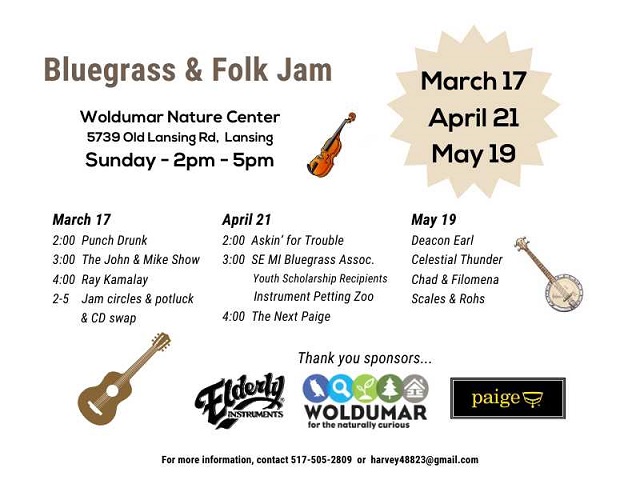
Well, the Southeast Michigan Bluegrass Music Association will get to showcase some of the young talent we have been supporting with scholarship funds over the past year. Anyone in the southern part of the Lower Peninsula of Michigan is encouraged to keep the afternoon of Sunday, April 21st open.
The Woldumar Nature Center in Lansing hosts folk and bluegrass bands monthly during the spring and summer. On April 21st, they are presenting SEMBMA’s Youth Scholarship Recipients, showcasing the talent and progress that these youngsters have made over the past year. These students were either tutored at one-on-one sessions with an instructor, or received online instruction from a professional bluegrass musician.
As readers may know, I have been an avid supporter of young bluegrass musicians. It goes beyond praising people like Billy Strings, Molly Tuttle, Wyatt Ellis, and Carson Peters. I enjoy seeing very young kids take an interest in playing a musical instrument, especially stringed instruments, and maturing as great players. Being on the SEMBMA Scholarship Committee, I have not only posted flyers up at music stores as well as ads on Craigslist, but I have scouted out events such as the fiddle contest atApplefest in New Boston, Michigan for young players that show promise. SEMBMA has money for these young, motivated musicians to continue on instruction, as part of the organization’s philosophy is to promote bluegrass music in the area by supporting young musicians.
There are not a lot of venues or scheduled events in the area that offer opportunities for people, especially youngsters, to show off their talent. Open mic events are usually offered at bars on a weekday evening, and acoustic music is usually glossed over for electric rock and blues. Even folk and acoustic open mic shows are geared more toward the songwriter crowd. Bluegrass festivals have plenty of parking lot jam sessions, but attention by the attendees leans more toward what performers are on the main stage. Even so, these festivals are beginning to disappear one-by-one due to financial concerns.
The Woldumar Nature Center is a fantastic place for all to visit. While its main purpose it to serve as a nature preserve for everyone to enjoy, it is appreciated that the Center provide other activities such as the Folk and Bluegrass Jam shows. I hope that other people appreciate what Woldumar is doing to give the community so many opportunities for education and entertainment, and I hope to see other places around Michigan to provide such activities.
Again, the SEMBMA Youth Scholarship Recipients showcase is Sunday, April 21st at 3:00 pm. The Woldumar Nature Center is at 5739 Old Lansing Road in Lansing. I hope to see you there!
The March 2024 issue of Bluegrass Unlimited showed up in my mailbox a few days ago, and on the cover was a picture of a young Jerry Garcia playing the banjo. Inside were three articles on him, one dealing with the history of his bluegrass supergroup Old & In The Way, a second looking at his career performing bluegrass and acoustic music, and a third briefly covering the Grateful Dead’s delving into roots music
Ever since the Bluegrass Hall of Fame & Museum took over publication of the magazine, the editor/publisher has been much more varied in its bluegrass coverage. There have been a lot more articles on progressive bluegrass artists, which I find helpful. This coverage of Garcia coincides with the Museum’s upcoming exhibition of Jerry Garcia: A Bluegrass Journey.
Back in May 2020, I wrote one of my early blogs concerning why Garcia hasn’t been considered being entered into the Bluegrass Hall of Fame permanently (https://luegra.design.blog/2020/05/16/why-wont-the-ibma-recognize-jerry-garcia/). More than any other musical artist outside of the bluegrass fold has Garcia been a proponent of bluegrass music. Before his time in the Dead, he was an adamant player of the banjo, despite missing a finger on his picking hand. Even during lulls in the Dead’s recording and touring schedule, he was performing with bluegrass and old-time country music with so many incarnations.
It’s hard not to fathom bands and artists like Molly Tuttle, Billy Strings, Leftover Salmon, Yonder Mountain String Band, and Crooked Still even existing without being influenced by Garcia, if not musically then at least on approach to bluegrass. As much as he was experimental in overall band sound, he was still very loyal to original artists like Bill Monroe, the Stanley Brothers, and Reno & Smiley. Mandolinist Jesse McReynolds was a big supporter of Garcia, recording a number of Dead tunes in bluegrass style.
I can only hope that this exhibition, as well as the dedication of these articles in BU, will push Garcia’s entry into the Bluegrass HOP even closer and sooner. He, through is influence with younger Deadhead audiences and guitar aficionados, helped bluegrass gain a wider and newer fan base than anyone else.
I got back from Nashville and the SPBGMA conference a few days ago, and I will go over some of the notable high and low points that I experienced. These will come about at random, whether good or bad. There will also be thoughts not only about the conference, but about the city as well, since it has been over four years since I last visited for a music conference.
Networking – one thing about bluegrass artists that one doesn’t see with much other formats is that they are very approachable. Pretty much all of the bands showcasing on the main stage will also set up a merch table and enjoy talking to the fans. They are also more than willing to talk to someone like me who is looking to shop some songs for the band to record. Once a band or its members get to know how dedicated you are to the craft, you get to be closer to them. Some of the bands that I got to know better and developed a relationship with during the week were The Kody Norris Show, Nu-Blu, and The Edgar Loudermilk Band.
Article Material – I was able to talk to a number of fiddle players for future articles in Fiddler. One of these article I hope to complete is a coverage of The Violin Shop, a music store on the outskirts of the city (more on this later).
International Band Championship – About a dozen bands that are not A-list bluegrass performers compete for a large cash prize and SPBGMA promotion at the next year’s conference. A few were OK, but most were at the top of their game. You could tell that they work hard not only on their instruments and vocals, but also a rapport with the audience. The two bands that impressed me the most eventually took First and Second Place (Sylamore Special and Off the Rails, respectively). The complete list can be found at https://bluegrasstoday.com/sylamore-special-wins-2024-spbgma-band-championship/ .
Rhonda Vincent – There is a reason she is called The Queen of Bluegrass, A fantastic performer, wonderful singer, and totally personable with her fans. On Saturday, she filmed part of a new video (covering the old Olivia Newton-John song “Please Mister, Please”) with a number of young bluegrass pickers backing her up. Sorry for the blurry photo, it comes from a screenshot of the video I did and wasn’t able to upload the video.
Jamming 24/7 – Not sure if this is good or bad. This is what a lot of people attend SPBGMA and IBMA for — many of them don’t even bother to register for the conference. From Thursday through Sunday, there were at least five jam sessions going on in the main lobby of the hotel during peak hours, Moreover, there were jams going on in a number of hotel rooms throughout the night and into the morning hours. Now I am an early riser for my job, so even though I was on vacation, I was hitting the sack pretty early, and with the time difference (Central Time, and I live in Eastern Time), I found that I could not stay up too late to enjoy the wandering festivities. Thank God that I brought some good earplugs with me so that I could get some sleep. Heck, when I would get up in the morning, you could still hear some people jamming down the hallway. Of course, you wouldn’t see much people at the conference morning sessions. But if you are into listening to live music at all hours of the day and night, this is your weekend!
Sequins – I swear, with the exception of one band in the aforementioned championship competition, all of the females in those bands were wearing sequins. It tended to look tacky. It made me think that the bands cared too much for the looks and that they were auditioning for Las Vegas or Branson, Missouri rather than a bluegrass festival. It just doesn’t look good in my opinion.
Songwriter Workshop vs. Showcase – One of the seminars was listed as a Songwriters Workshop. This consisted of four bluegrass songwriters (Daryl Mosley, Johnny Williams, Jeanette Williams, and Raymond McLain). The performers each performed a few of their original songs, and talked about where the inspiration came from. To me, this is more like a showcase than a workshop. A songwriter workshop would entail successful songwriters working with aspiring songwriters on improving on their craft, such as discussing subject matter, arrangements, and even taking an idea and making it into a song together. I hope that SPBGMA considers how to promote this or create an actual workshop next year.
Hotel Parking – The Sheraton Airport Hotel has been host to the SPBGMA event for a number of years, and I would think that they would have a little better control of parking. They did have an extra lot about a 1/4 mile away that would have shuttle service, but it seemed that they still allowed non-hotel guests and non-conference attendees to park in the hotel lot until it was full, so if you were registered at the hotel and went off site for a while, you didn’t have a spot to park when you came back. There was a person at the gate entrance telling people about the shuttle service, but his suggestion only seemed to work when the hotel lot was completely full. I found myself walking a long distance twice getting back to the hotel while carrying some baggage. A better way to handle it would have been unless you had a hotel room, you should be forced to park in the supplemental lot and take the shuttle in.
Waffle House – We don’t have them in Michigan, so I hit one every chance that I get going south. Fortunately, there was one about two blocks from the hotel, so I was in Heaven. You can bet that I was there every morning that I stayed down there. The breakfast bowls with hash browns, cheese, and egg and choice of meat (my preference was sausage) are to die for.
Jack’s BBQ – Another favorite place of mine in Nashville. Now that downtown is pretty much ruined by progress, I don’t visit that location, so I go to one southwest on Charlotte St. The brisket and Texas sausage are cooked to perfection, and they have some amazing sauces, with the Carolina being my favorite.
Elliston Place – Another favorite restaurant, although I didn’t go to it, and probably never will again, because of …
Downtown Parking – The days of parking meters, even in areas like Music Row and the Gulch, are gone. I understand paying a king’s ransom in a lot downtown, but in the street in front of Elliston Place (and other areas), the meters have been replaced with signs showing a QR code. You have to scan the code, then enter your credit card number in the app. I feel sorry for anyone, especially from the older generation, who doesn’t understand this technology. Nashville central has made itself into a tourist trap. A candy bar is $3.00, and so is a 1/2-litre bottle of soda.
Hotel Food – Just as bad is the cost of the hotel food. It knows that a lot of the guests won’t venture away from the hotel, so it was charging $8.00 for a hot dog, $14.00 for a hamburger, $12.00 for a ham sandwich, and $3.00 for a banana.
Exhibit Hall – While not nearly as big as the one found at IBMA, there were a few interesting vendors. I did pick up a great t-shirt with the US flag but the stripes are violin bows. There were some nice new and vintage guitars, as well as banjos and a fiddle table. They had a second room for exhibitors, but it was almost empty with the exception of two music schools having tables. It would be great if more vendors would show up for this, as people do take an interest in buying bluegrass-related swag as well as trying out different instruments.
Nashville Music Stores – Because of the gentrification of downtown, long-time businesses have either closed up or moved away from there. Carter’s Vintage Guitars is still near downtown, so you have to pay for parking to visit. Fortunately, two of my favorite shops, Gruhn’s Guitars and The Violin Shop, have moved to the outskirts of town and have ample free parking. Any guitarist visiting Nashville has to make a stop at Gruhn’s. It is pure Heaven in there, although everything has a high price. Same with The Violin Shop and fiddlers. However, both stores know that a lot of people come in to just admire the selection, and you can always buy a t-shirt or keychain to prove that you were there. Grimey’s Record Store also moved out of its original location to the East Nashville area, but I wasn’t able to get to it this time.
Potholes – Now here in Michigan, we grow potholes like Hawaii grows pineapples. They are everywhere, so we are used to rough pavement. Sometimes, our road commissions will get out there and fill them so there aren’t too many damaged wheel rims and axles. Two weeks ago, Nashville had a big snowstorm, and as the snow melted, it caused a fair amount of potholes, especially on highways that usually don’t experience these problems. The city’s solution? Just post highway signs that say “Rough Road – Please Use Caution.”
Dee’s Country Cocktail Lounge – I used to love hitting The Station Inn every time I visited Nashville. However, it is completely surrounded by high-rise apartments, and parking, even pay-to-park, is next to impossible to secure. It’s not worth the fight. Fortunately, two bluegrass artists were doing shows at Dee’s in Madison (a northern suburb of Nashville). The place is a dive to say the least, but is perfect in my eyes. While it is not strictly bluegrass (band bookings include jazz, R&B, rock and country), a lot of bluegrass artists that live in the area hang out there no matter who is on stage. I have found my favorite bar down there!
Frugal MacDoogal’s – If you ever crossed a large department store, a dollar store, and a liquor store, this would be it. An absolute amazing selection of beers, wines and liquors, and prices are very good. This is another place I visit any time I am in Nashville.
The Kody Norris Show – Kody is a true entertainer, combining Jimmy Martin, Bill Monroe, Porter Wagoner, and George Jones. He and his band dress to the nines in Manuel suits, but the charm is how tight the band is when performing. Kody, his wife fiddler Mary Rachel, and the rest of the band are extremely friendly to their fans, and Kody went out of his way to catch up with me and talk business during some downtime.
Vickie Vaughn – seeing Vickie the night before I was scheduled to head back to Detroit was the best gift that I could ask for. I first met Vickie in 2014 at a Leadership Bluegrass meeting, and since then we have remained great friends, even though we don’t get to see each other much. I have always called her my “kid sister” because of how our personal paths have paralleled. Since I have known her, her career as a bluegrass bassist has bloomed to playing with High Fidelity, Della Mae, and winning Bass Player of the Year this past September at the IBMA Awards Show. She is truly one of the most beautiful ladies and wonderful people that is in my life, and I will always love her.
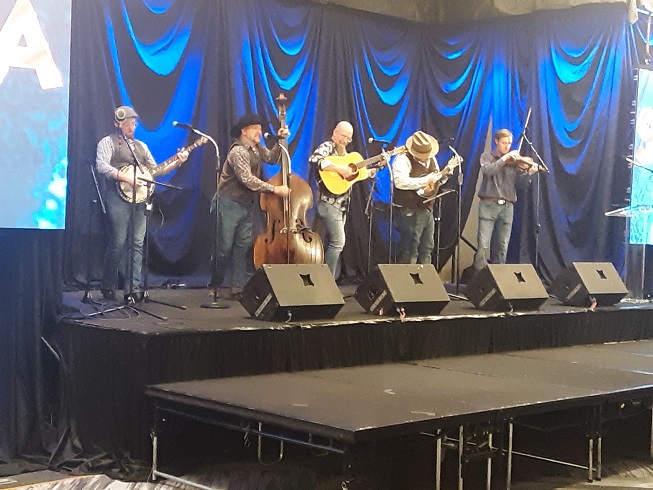
I had a few minutes break from the SPBGMA conference here in Nashville. So far it’s been great! I’ll post more about it next week. Here’s a quick pic of the Edgar Loudermilk Band performing a showcase. Until next week, stay safe!
So back during the pandemic days, I received a $400 debit card from the government. It was the last payment to me before I got a job, and I am not sure why they put it on a debit card instead of the usual sending the money straight to my bank account. Anyway, I completely forgot about it since I was now working.
Fast forward over two years, and while cleaning out my wallet a few weeks ago, I came upon the debit card. I went online and it still had the full amount available, but it was set to expire in about a month. Well, I wasn’t bound to let $400 slip away, but to be honest, I really didn’t know what I would use it for. I am pretty well set as far as basic necessities like food, paying utilities, and clothing. My thought was to treat myself to something special.
I didn’t want to splurge on an expensive meal. No, I wanted to get myself something to last me for a while. I first thought about a pizza oven, but I knew that I would probably use it once or twice, then it would gather dust in the garage. I also considered getting myself a handgun for protection at home, but because it was government money, they would probably deny that purchase the way the current administration is trying to suspend the second amendment.
My choice was then something in the musical instrument field. I have way too many acoustic guitars, and $400 wasn’t going to get me anything as good or better than I already have. The same goes for the bass. I have a banjo, dobro, and fiddle that I work with, but nothing to inspire me to get something more, again not for $400.
I always wanted a F-style mandolin, but the price was always out of reach. I have a decent A-style mandolin which I played regularly until I switched over to fiddle a while back. However, recently I saw that The Loar company (a stringed instrument manufacturer out of China) was marketing a LM-310F model, retailing for $400 through Guitar Center.
(WARNING: If you do an internet search on the The Loar LM-310F, you will find that a number of retailers are selling this model for $100 or less. DO NOT BE TEMPTED! These are international criminal rings that get your credit card information, keep emailing you about a delay in shipping, then after 30 days, you will never hear from them and you get nothing in return. Often these thieves will also sell your credit card information so that you will be REALLY screwed, and it will be difficult to get back your money, unless you have a really good credit card bank).
The GC near my house actually had a LM-310F at the store, and after trying it out by playing a sloppy version of “Bluegrass Stomp,” I knew that I wanted it. Since it was the floor model and they didn’t have any stock in the store room, I got a nice discount, and was able to pick up a heavy-duty gig bag for the $400 plus some change.
Let me tell you, this thing has a great bark to it when strumming those bluegrass chops, and the tone is nice and warm, way more closer to what a bluegrass mandolin usually sounds like instead of an A-style. It has a solid spruce top, a narrow V-cut neck (which is great for my smaller hands), and a nice satin finish. The main difference one can see compared to a standard Gibson F-5 mandolin is that the fretboard ends at the 20th fret. There is no upper extension of the fretboard over the body that made the Gibson model famous (along with a guy named Bill Monroe using it as his main weapon).
I have fallen in love with the mandolin all over again. I enjoy messing around with it while watching television, but I do plan on practicing on it more once I return from the SPBGMA conference next week in Nashville (NOTE: I may be late on next week’s blog, or even miss it entirely, due to the conference, but I will give a full review when I get back).
I would definitely recommend this mandolin for those moving up from a beginner A-style model but still not having the cash to afford a more costly F-style model (https://www.theloar.com/)
A few disappointments for me over the past 24 hours. The first one was that I missed the John McEuen show at The Ark due to a really bad snowstorm here in the Detroit area Friday night. The second one I just learned about as I was beginning to write this blog.
Audie Blaylock passed away earlier this week at the age of 61. While he was not a household name in the bluegrass industry, he left an indelible mark on the bluegrass music scene. Although born in Texas, he grew up most of his early life in Lansing, Michigan, playing in local bands and being a regular face at Elderly Instruments. Professionally, he started out playing mandolin for Jimmy Martin in the early 1980s, and went on to work with a number of other artists, including Red Allen, Lynn Morris, Chris Jones, and Rhonda Vincent (where I first met him). He then started a solo gig with his band Redline, as well as worked with fiddle master Michael Cleveland.
His home base was Auburn, Indiana, so he was a regular performer at bluegrass festivals in the Indiana/Ohio/Michigan area. I became good friends with his one-time fiddler Patrick McAvinue, whom I still talk to and recently wrote an article on for Fiddler. Audie was always friendly to his fans and fellow musicians. Learning a lot from his time with Jimmy Martin, his band was always tight when it came to performances, especially song arrangements.
His crowning achievement came in 2004, when he helped coordinate the Grammy nominated album A Tribute to Jimmy Martin: The King of Bluegrass. The recording gathered up some of the best in bluegrass, including J.D. Crowe, Sonny Osborne, Paul Williams, Kenny Ingram, and Michael Cleveland. He always had a high regard for Martin, and continued to perform many of Martin’s songs live and on recordings.
I went to see Audie and his band many times, as he was more than happy to do gigs in the Detroit area outside of bluegrass festivals. Talking with him was like talking to your next-door neighbor. He was interested in everything, be it music, musical instruments, automobiles and hot rods, farming, and woodworking. He proved to be a great bandleader, in that his bandmates always had great respect for him even after pursuing other projects.
I am sure now that Audie is performing once again with Jimmy at that bluegrass festival in the sky. You will be missed down here, sir.




 Luegra