Categories
Folk Music

Perfect Song #13: Hej Sokoły

Last week I blogged about the three most beautiful angels from Georgia, Trio Mandili (https://luegra.design.blog/2024/12/21/trio-mandili-hallelujah/). Since I subscribe to their YouTube channel, YT’s algorithms tend to send me a Trio Mandili video every time I go online to the site. I have pretty much seen all of their videos, so when one pops up, I know that I have already hit the Like button, but will check just in case.

Recently, the trio’s video of a Polish/Ukrainian folk song “Hej Sokoły” came up. I had seen it already and watched it again. It motivated me to do some research on the song. I was totally moved by the history, and more so by the different interpretations by many artists.

There is no definite authorship for “Hej Sokoły,” translated in English as “Hey Falcons.” Some historians claim the composer is Ukrainian-Polish poet/songwriter Tomasz Padura, while others believe it was written by Polish classical composer Maciej Kamieński. It is based on a 19th century Polish folk song “Żal za Ukrainą.” It has been translated into a number of languages, as its storyline is held dear to many people of different European nationalities.

The story tells of a soldier leaving his love as well as his country Ukraine for a battle. He often sees falcons flying in the sky and asks them to fly back to his homeland and make sure the bells continue to ring, and refers to his girl as his little skylark and swallow. As with many similar folk songs, the soldier dies in battle, and he wishes for wine, as well as to be buried back in Ukraine next to his love.

Because of its storyline, the song has continued to be popular with the Polish and Ukrainian people throughout the 20th century. Polish solders sang it during the Polish-Soviet War, as well as with the Polish Home Army during the Warsaw Uprising during World War II. Most recently, Ukrainian soldiers and civilians have performed it to celebrate victories against the Russian invasion that began in 2022. There have also been versions performed to honor military aid from Poland and the Slovak Republic.

While searching videos of the song, not only is it performed for military concerns, but since it is such a popular folk song, there are clips of people singing it at weddings, school functions and parties. It seems as if everyone in Poland knows the song by heart, the same way perhaps people in the US may know “Yankee Doodle” or “Battle Hymn of the Republic,” only with more spirit and love than we have here in the US.

While I totally enjoy Trio Mandili’s version of this song, the version that most moved me and brought me to tears was one performed in Polish by the Ukrainian Pikkardiyska Tertsiya, an a cappella group from Lviv, Ukraine. I have probably listened to this version a hundred times over the past week and it moves me emotionally each time. I cannot fully describe it, maybe it’s because of my Polish heritage, but it is perfect according to my soul.

Chew on it and comment. Let us hope for a better 2025.

Categories
Folk Music

Trio Mandili – Hallelujah

I had briefly covered Trio Mandili in a blog a few years back (https://luegra.design.blog/2020/10/17/na-zdrowie-eastern-european-folk-music-and-comedy/), and I continue to be amazed by their vocal talent as well as their natural beauty. These three young ladies from the country of Georgia have been putting out wonderful and entertaining videos for a number of years, and have also release a few CDs along the way.

This past week, it was a lovely surprise to find the trio’s latest CD Hallelujah in my post office box. It contains ten Georgian Orthodox prayers sung either a capella or with minimal accompaniment. I immediately threw it into my CD player once I got home, and was floored!

I cannot even begin to tell you how gorgeous their voices are performing these holy songs. If I were ever to say that there are living angels among us, the ladies of Trio Mandili would be three of them. The opening cut, “Psalm 50,” is hauntingly beautiful. All three voices complement each other so perfectly. They easily move from harmonies to droning vocals.

My only complaint is that, either out of humility or not realizing it, they never put their names on their CDs, and I have three of them. Tatuli Mgeladze is the lone original member, and takes most of the lead vocals, although they switch lead vocals often. Tako Tsiklauri sings much of the high harmonies, and Mariam Kurasbedani sings low harmonies, has a beautiful ear for droning vocals, and plays the panduri (a three-stringed mandolin-like instrument).

At this time, Georgia, like many Eastern European and Middle Eastern countries, are witnessing political turmoil. The ladies of Trio Mandili are patriotic for their country, and while not true activists, they are not afraid to show their support for the people that fight for human rights there. Honestly, they would be the kind of daughters that you would want to have.

This CD has brought me to tears of emotion, both joyful and heart-wrenching. The vocals are a feast, a weapon, a medicine, and a comfort. I implore you to go to www.triomandili.com and spend money to get this CD if you want to truly have your heart moved in a religious way. I will always love these ladies, as their voices continually warm my soul.

Have a wonderful Christmas. Chew on it and comment.

Categories
Folk Music Rock Music

John Mayall/Duke Fakir/Happy Traum RIP

Three important names in music passed away this past week, with two of them being big influences on my musical life.

First, let’s look at the passing of John Mayall. He was a student of the blues long before the British Invasion that gave us the Rolling Stones, the Animals, and the Yardbirds. He, along with Alexis Korner, brought Chicago-style blues to young Brits in the early 1960s. His proteges included Eric Clapton, Mick Taylor, Mick Fleetwood, and John McVie among many others. His 1966 album John Mayall & The Bluesbreakers, often called the Beano album as it featured Clapton reading the Beano comic book on the cover, is considered legendary. He had many chances to gain great success in the US if he would dilute his strict blues style, but he refused. He became a cult hero among blues purists, and his original material was off kilter, not writing about usual blues subjects such as drinking and infidelity, but instead choosing political and environmental themes. He was active until very recently, passing away at the age of 90.

Next, we look at Abdul “Duke: Fakir, tenor singer and last original member of the Four Tops. Motown was a big part of my growing up, and much of that came from the smooth vocals from the talented groups on the label. The Supremes, the Temptations, Smokey Robinson & the Miracles, and Martha & the Vandellas were all top notch, but my favorite of them all was the Four Tops. Lead singer Levi Stubbs was amazing to say the least, but the icing on the cake was the tight and timely harmonies provided by Lawrence Payton, Renaldo Benson, and Duke Fakir. Listen to classics such as “I Can’t Help Myself (Sugar Pie, Honey Bunch).” “Bernadette,” “Reach Out I’ll Be There,” and “It’s the Same Old Song.” These four guys were bridging doo-wop with R&B energy.

Then there was the look. The four members, especially Fakir, had absolute class and style in the way that they presented themselves. In the beginning, they wore tailored, matching suits that gave them a gentlemanly look. As the 60s progressed on into the 1970s, they began to make individual fashion statements. Even after leaving Motown, they still had hits with “Ain’t No Woman (Like the One I’ve Got)” on ABC and “When She Was My Girl” on Casablanca. One has to remember that these four performed together from 1953 to 1997, the longest tenure for any band with original members.

Fakir never left Detroit long-term, He owned much property in the city, and ran a successful restaurant on the Detroit River. He passed away on July 22 of heart failure at the age of 88.

My other big influence that we lost this past week as acoustic guitarist Harry Peter “Happy” Traum. Born in 1938 in the Bronx, he was part of the Washington Square/Greenwich Village scene during the early 1960s, where he would become friends with a young Bob Dylan. Along with Dylan, Pete Seeger, and the Freedom Singers, they recorded Broadside Ballads Volume 1 for Folkways Records. He actually cut the first version of Dylan’s “Blowing in the Wind.”

However, Traum is best known by many, including my introduction to him, for his work in creating guitar instructional books, tapes, and videos through his Homespun Music company. As a guitar teacher in New York City, he first wrote the book Fingerpicking Styles for Guitar in 1965. He was soon making tapes for his students based on transcriptions in the book. Due to the popularity, he formed Homespun with his wife and began advertising in various music magazines. Soon he was releasing instructional tapes from fiddler Kenny Kosek and banjo whiz Bill Keith.

By 1983, Homespun was releasing VCR lessons, which was eventually followed by DVD and online downloads. In 1995, Hal Leonard Corporation took over the massive distribution job. Other artists that Traum recorded for lessons included Chet Atkins, Norman Blake, Rick Danko, Donald Fagen, Jerry Douglas, John Hartford, Bill Monroe, Sam Bush, Doc Watson, even musical comedians Steve Martin and Steve Allen. Each video was produced by Traum, starting off in his living room and eventually in a small studio. Many of these videos featured Traum interviewing the presenters, offering insightful questions that would pique the artist’s curiosity and make the student truly interested in the information beyond fingering and picking technique.

While Homespun was Traum’s main passion, he still continued to record his own material, releasing his final recording, “Just for the Love of It,” in 2015 and appearing on Dylan’s Another Self Portrait a year earlier. He passed away on July 17 at the age of 86.

All will be missed. Chew on it and comment.

Categories
Folk Music

Recommended Book: The High & Lonesome Sound: The Legacy of Roscoe Holcomb

This gem I purchased through Hamilton Books a few years back and came across it recently while sorting books after my move. This one is also authored by John Cohen, whose book Speed Bumps on a Dirt Road I reviewed back in June (https://luegra.design.blog/2023/06/17/recommended-book-speed-bumps-on-a-dirt-road/). Cohen looks at the life of Roscoe Holcomb, a legendary Appalachian musical artist that carried on the tradition of old-time music during the 1950s and 60s while the world around him was slowly modernizing, perhaps not for the better.

Like his other book, this is primarily a photo book, with very little text other than brief captions until the very end of the book. The story can be seen in the powerful photos of Holcomb and the people that he is surrounded by. Many of these photos are also in Speed Bumps, such as Bill Monroe’s performance in Hazard, Kentucky, but they are intermingled nicely and minimally, so that the montage leans more as a personal vision of an individual, namely Holcomb.

This book chronicles Cohen’s 1959 trip to east Kentucky to meet and work with Holcomb, who at the time had left the workforce due to many injuries. He supplemented his income by performing at folk festivals and farming. The black-and-white photos say so much about what Holcomb and his family struggled with in the Appalachian Mountain area. A moving photo is one just showing his hands and how weathered that were, even for a middle-aged man.

The text toward the end of the book includes reflections about Holcomb by those that knew him, as well as a 1978 interview with Holcomb shortly before his passing. However, the icing on the cake is the CD and DVD included with the book. The CD includes 13 tracks of Holcomb performing traditional songs on banjo, guitar, harmonica and vocals. While thumbing through the book, this CD is the perfect soundtrack. The DVD contains two short documentaries on Holcomb, one filmed during a 1964 visit with him, and the other a 2010 look at his life. The 1963 doc is a treasure, like watching a grainy television show from that time period. Not only it gives a back-in-time look at Holcomb, but also a reminder on how we saw documentaries back then.

This book was originally published in 2012, and while going for over $40.00 new, a Google search shows that it can be had for under $10.00 used, although I am not sure if the CD and DVD are included or what the condition is. Like Speed Bumps, it is a worthwhile purchase if you truly appreciate where old-time music was still living while much of the other country was looking at rock-and-roll.

Chew on it and comment.

Categories
Folk Music Rock Music

Shane MacGowan RIP

This past week, one of the most popular vocalists of the punk-rock era passed away. Even if you weren’t a fan of The Pogues, you damned well knew about Shane MacGowan. He was a hero and an anti-hero at the same time. He took The Pogues to international acclaim with his common-man songs that he wrote or co-wrote, along with choice traditional Irish, Celtic, and British Isles folks songs. The band panned away from distorted electric guitars and chose traditional acoustic instruments from Ireland, including accordion, tinwhistle, and four-string banjo. Yet, the sound was heavy, due to the attitude that MacGowan gave with his growling voice as well as what he motivated from his bandmates.

MacGowan formed The Pogues in 1982 after performing in a few punk bands, getting lessons on a traditional Irish music sound from his family members. The Pogues was known for its intense and powerful live shows, motivating fans to pay attention to the folk songs of old and the messages that they conveyed. MacGowan was known physically for his underweight figure, large ears, and extremely poor dental work. Yet he was like a demigod on stage, and his followers would not only pay attention to his vocals, but would sing along with choruses like the fans at a rugby or soccer match.

MacGowan also kept his Irish ancestry up to its fullest, especially when it came to alcohol. More times than not, he would appear on stage completely inebriated, and he gave George Jones a run for his money by not showing up to the gig or being too drunk to perform. It became so bad that he was actually kicked out of his own band in 1991 and The Clash’s Joe Strummer was asked to take over vocals for a time. His reaction was to form another band called Shane MacGowan and The Popes. He would re-join The Pogues in 2001 and perform with the band until 2014.

MacGowan’s addiction was not limited to the drink. He became a heroin addict, and only reformed with the help of Sinead O’Connor, who had him arrested so that he would admit to a judge that he had a problem and sought help. While he was able to kick those habits, injuries from a fall in 2015 had him in a wheelchair for most of his last years. He passed away from pneumonia on November 30 at the age of 65.

MacGowan and The Pogues had a number of songs that, while never hitting big in the US, they became sing-along anthems among the punk and alternative music fans for years. Cover such as Ewan MacColl’s “Dirty Old Town,” Eric Bogle’s “And the Band Played Waltzing Matilda,” and the traditional “Jesse James” brought out with a harsh attack gave them new life. MacGowan also penned a number of memorable tunes, including “The Old Main Drag,” “Lullaby of London,” and “If I Should Fall From Grace with God.” However, what makes it so sad that he has passed away at this time is that his most memorable composition will be now heard on many radio stations for Christmas. “Fairytale of New York” was co-written with bandmate Jen Finer in 1988, and talks of a drunk sitting in a jail cell and thinking about Christmas with his sometime-love, which is sung as a duet with the late Kirsty MacColl. It is also ironic that MacGowan was born on December 25th.

Indie music fans of my age will always hold Shane MacGowan in our hearts, not only for his songs, but for his devil-may-car attitude that kept him going even in the worst of times. We all hope that he is having a pint of Guinness up there in Heaven.

Chew on it and comment.

Categories
Folk Music Musical Instruments

Hillsdale Fiddlers’ Convention/World’s Longest Garage Sale

Saturday I made my yearly trek to Hillsdale, about a two-hour drive from Detroit due west, to attend the annual Michigan Fiddlers Convention & Traditional Music Festival. Hillsdale has no interstate near by, so to get there, most of the travel is done on US-12/Michigan Avenue. That actually works out for the better, as this same day is the World’s Longest Garage Sale, in which there are hundreds of garage/yard/rummage sales along the two-lane highway from Saline to New Buffalo.

The weather was terrible to say the least at the festival. Previous day’s forecasts stated rain would come in the late afternoon. Well, the rain started as soon as I got to the fairgrounds. And it did not let up. The morning workshops were held in some of the outbuildings, but other events for the day were cancelled. Thus, I was only at the festival for a few hours.

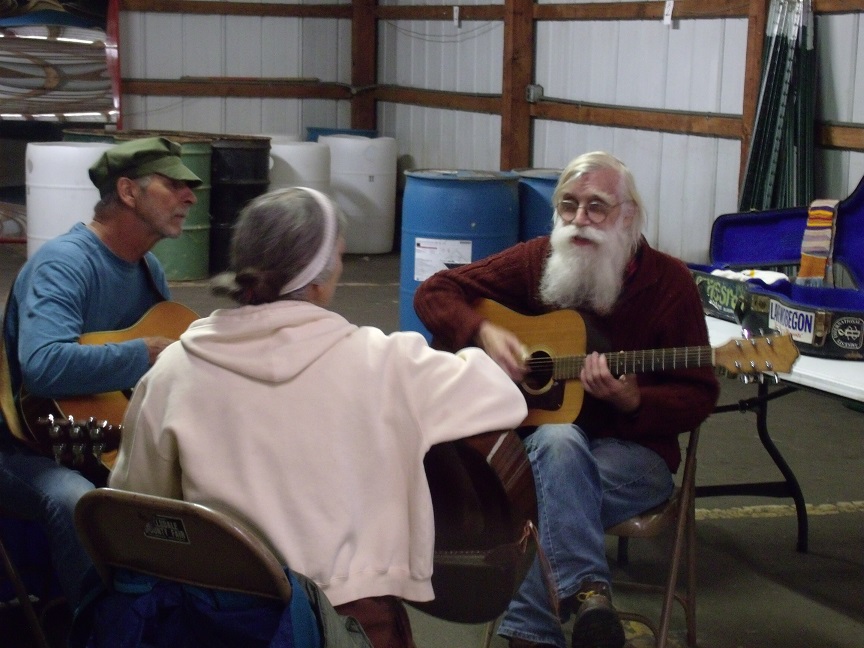
Roger Plaxton teaches fingerstyle guitar at Hillsdale
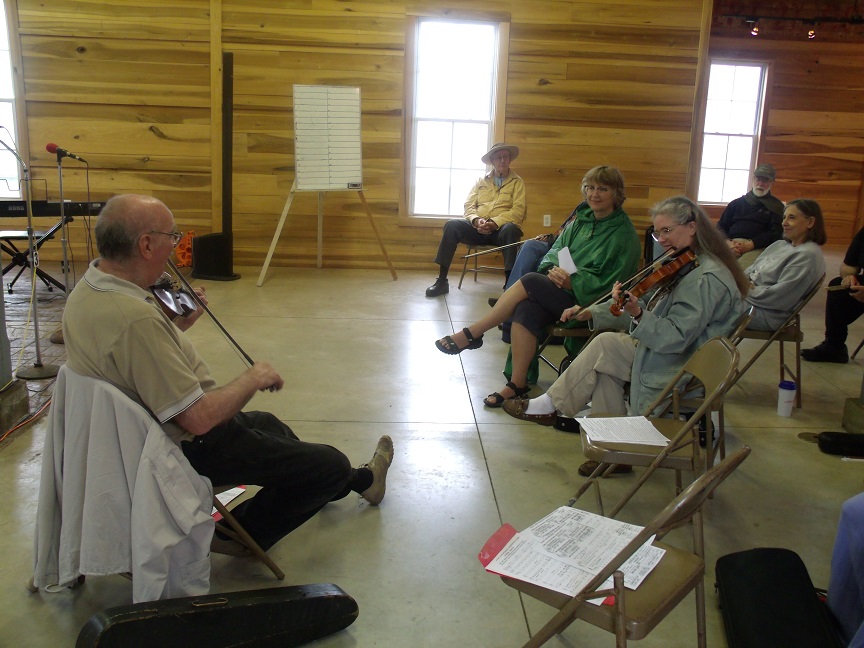
Mike Gleason instructing fiddle improvisation at Hillsdale
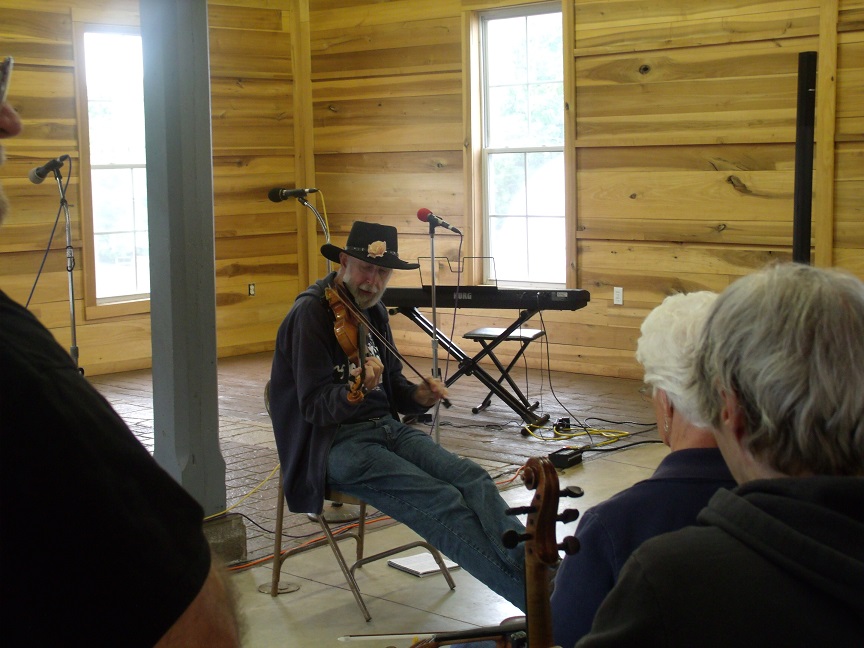
Dave Langdon performing Michigan old-time fiddle tunes at Hillsdale

The rain let up a bit as I hit the road back home, which was to my benefit. I was able to stop at a few of the garage sales to see what junk was available. If I had the time and money, I would probably hunt at these sales every weekend and end up like Mike Wolfe on American Pickers. However, I pretty much narrow my scope to music-related items. This includes records/CDs, musical instruments, vintage stereo equipment, and music books/videos. Even so, I have to remember that space is limited at my mom’s house (I’m still moving stuff out of my house for eventual selling of the place).

It seemed that all of the guitars, violins, amplifiers, and stereo equipment was priced way out of touch. There were a lot of no-name electric guitars that were way overpriced. A Fender Squier Affinity Strat in an obvious used condition that the owner was asking $125.00 was passed on by me and a few others, since I know that a new version can be had at Guitar Center for a few bucks more. As I expected, there were no albums or CD that I was interested in.

I came across one tent that the man was selling a lot of music equipment. The amplifiers were about right for the price, but I am shying away from electric guitar equipment unless it is a really good bargain. I first grabbed some bluegrass-related music books for a dollar each, then saw that he had a Tascam DP-02CF 8-track digital recorder/mixer. As he didn’t have a power supply for it, I was able to negotiate to a selling price of $25.00. A power supply can be had for about $15.00 from eBay, and I already downloaded the owner’s manual from Tascam. So if this thing works, I got a great 8-track recorder for $40.00. If it doesn’t work, I am not out that much, considering that this thing sold for a few hundred bucks new.

Of course, the heavy rain in Hillsdale never made it to the Detroit area, so my garden didn’t get the watering it needed, and I am off to doing it myself. Saturday was also the Blissfield Bluegrass Festival, which is sponsored by the Southeast Michigan Bluegrass Music Association. I would have attended, but they always seem to schedule it the same weekend as the Hillsdale fiddle festival, and I am committed to attending that, taking archival photos for the Michigan Old-Time Fiddle Association. I haven’t talked to anyone about Blissfield, but from looking at Saturday’s weather radar, it looks as if that event was hit heavily with rain as well. It is the chance any organizer takes when scheduling an outdoor event.

Last week’s Milan festival and this weekend’s Hillsdale festival were the only festivals I have been able to attend this summer due to a number of factors. Right now, the only other event scheduled for the rest of the year is the old-time fiddle contest in New Boston on October 3rd. It will be difficult to get back to the larger crowds for a lot of these minor events since the pandemic lockdowns have killed attendance. I try to find out what is out there and attend what I can. I hope that 2023 will be better for me and others. I am planning to attend the SPBGMA convention in Nashville in January, I am just waiting on exact dates.

In the meantime, I am going to see what demo I can record on the Tascam 8-track.

Chew on it and comment.

Categories
Americana Music Bluegrass Music Folk Music

Pay Attention to Cary Fridley

I have always had a place in my heart for Cary Fridley. That voice is pure beauty.

I had mentioned Cary previously in a past blog on titled “The Lost Art of Bluegrass Singing” (https://wordpress.com/post/luegra.design.blog/45), where I talked about the video Vocal Techniques for Old-Time Mountain Music that she did for Homespun Tapes. I fell in love with her voice the first time I heard her singing with The Freight Hoppers. After leaving the band, she recorded a number of solo albums as well as played bass in a few other bands. To see her history, I recommend going to her website at https://caryfridleymusic.com/.

I recently found her album Down South and put it in the CD player. It hit me why I love this girl’s voice. It is so pure, comfortable singing folk, bluegrass, traditional country, and blues. Looking at her bio, she works with so many bands, as well as teaching vocals and traditional music theory at the Junior Appalachian Music programs and the Black Mountain Center for the Arts. Additionally, she is an adjunct faculty for the Fine Arts at the AB-Tech College in Asheville, North Carolina. This girl keeps busy!

You can tell it is all because of her love and passion for traditional music. Cary truly puts her heart and soul into her work. I have subscribed to her YouTube channel (https://www.youtube.com/user/cfridley) For a few years now, and along with videos of past performances with The Freight Hoppers, she has posted a number of lessons that she gives to her classes at the college and the JAM programs. Her latest video is what got me to loving her again, so to speak. It consists of a shot of a CD player, and it is playing her album Fare You Well in its entirety (https://www.youtube.com/watch?v=eRRJWDCUsbo&t=366). I wonder how many other people who are this passionate about Appalachian music work as hard as Cary.

I am going to keep this blog short, as I only really want you to spend some time checking out Cary’s videos. You may learn a few things!

Next week, the blog will be late, as I will be attending the last day of the Milan Bluegrass Festival. Hopefully, I will have a few good stories to tell.

Chew on it and comment.

Categories
Folk Lifestyle Folk Music

Quitting My New Job/Appalachia/The Pressley Girls

A few weeks ago, I talked about getting a new job at a law firm doing writing and editorial work. Well, after two days, I quit that job, and fortunately, my old job took me back.

The old saying, “If it sounds too good to be true, it probably is” was the case for this one. It turned out that I would be doing more research, especially phone calls, and on the second day, I was sent to work from home and expected to use my personal phone for business work. Uh, I’m not going to have some angry client have my personal phone number and calling me in the middle of the night ranting. This was another lesson learned.

I should have figured out that it was a questionable job when they called me back only an hour after I took the writing test. The firm was probably looking for any warm body that responded to their initial requests. Alas, it was partly my fault for falling for the trap too easily. You live and learn, and I have lived a long life but still haven’t learned enough. My advice is to approach each new job opportunity with caution. I am way too old and have been through enough crap at jobs to keep taking it. While my current job is not the type of work I prefer doing, I am surrounded by good people, so that makes up for a lot of it. I walked back into the office on Friday, and dozens of people were hugging me and welcoming me back. That mean a lot.

Now on to music stuff …

While I have lived in the Detroit area all of my life, and I don’t think that I could ever permanently leave the city life, I do have a love for learning about life in the Appalachia area of our country. I recently came across two YouTube channels that have been on my watchlist for a few weeks now. The first is Celebrating Appalachia. Tipper Pressley is an award-winning blogger that invites viewers into her life, showing us how to garden in the hilly land as well as how to prepare popular and traditional dishes for breakfast and dinner. So many of the recipes are mouth-watering, to say the least! She has also spent a lot of time documenting the lifestyle of her area in Appalachia, especially curating the language of the locals. The slang and phrases of the people in the area is poetic in so many ways, and while some of it is familiar, much of it is strangely beautiful to hear.

Tipper is also documenting the history of her hometown of Brasstown, North Carolina, particularly of its musical heritage. This leads to the second YourTube channel you need to check out. Tipper is the mother of twin girls, Corie and Katie Pressley. They are known in the folk and bluegrass community as The Pressley Girls. Checking out their YT channel shows them performing a number of old-time fiddle and folk tunes, as well as clogging and dancing. They also post entertaining videos of their everyday life, whether it be thrift shopping, making soap, or hiking. All of the videos highlight their vernacular, which is musical in itself. The girls have that unique Southern charm, and you will enjoy every minute of their adorable videos.

Chew on it and comment.

Categories
Folk Music

Trae McMaken’s Michigan Fiddle Website

Trae McMaken is not necessarily a household name with Michiganders or area fiddlers, but he probably should be. A fiddle enthusiast and Michigan history buff since childhood, he has been combining his two loves over the past few years to make sure that the story of fiddle music in Michigan will not be forgotten.

Trae recently started up an educational website called Michigan Fiddle dot com (www.michiganfiddle.com). The site takes a look at Michigan folklore and how much fiddle music has had an impact on the state. In the Introduction page, he cites that fiddle music played in the past few centuries around Michigan has many ethnic influences. Because the state was continually a location for commerce, from fur trading during the 18th century, logging and copper mining in the 19th century, and the automobile industry of the 20th century, so many people came to the area from many foreign lands and brought their music with them. One characteristic of Michigan fiddling is the stress on use of the music for dance, with less flowering and ornamentation and a dedication to keeping a beat for the dancers.

The site includes many papers and articles written by Trae, as well as links to articles and recordings related to Michigan Fiddlers over the past century. He has assistance from a number of state fiddlers and historians to supplement his work. One such person, Jim McKinney, I have known for a number of years, and have supported his and his son’s work at the annual Michigan Old-Time Fiddle Championship held at the Huron Applefest in New Boston every October.

When one thinks of old-time fiddle music in America, thoughts usually go to the music of the Appalachian Mountains, the hills of Kentucky, or the plains of Texas. Michigan rarely gets a notice. Henry Ford loved fiddle music, and Beaver Island off the west coast of the northern Lower Peninsula has always had a strong fiddle presence. I am keeping this week’s blog short, as I would want you to instead spend some time checking out Trae’s site dedicated to Michigan old-time fiddling (see above link). Also check out this video of him performing some Quebecois music for the dancers.

Chew on it and comment.

Categories
Bluegrass Music Folk Music Musicians

Phil Leadbetter/Paddy Moloney RIP

Last week just after I posted my blog, I learned of the deaths of two great musicians. This week, I will briefly cover the lives and influential presence of dobroist Phil Leadbetter and The Chieftains’ leader, Paddy Moloney.

Phil Leadbetter was a true traditionalist when it came to the dobro. He kept his feet firmly in bluegrass while others took it to other genres. He began playing the dobro at age 12, and soon after graduating high school worked with country legend Grandpa Jones. He spent his longest tenure with J.D. Crowe and the New South, often serving as booking agent as well, from 1990-2001. He helped form a number of superstar bluegrass bands, including Wildfire, Flashback and Grasstowne.

In 2011, Phil was diagnosed with Hodgkins Lymphoma. He was part of trials that tested the drug Opdivo for his type of cancer, and became a five-time survivor. He returned to performing part-time in 2013, working with Dale Ann Bradley as well as his own band, Phil Leadbetter and the All-Stars of Bluegrass. Unfortunately, his health kept deteriorating, and there were a number of benefit concerts and funding pages. Phil passed away October 14 from COVID-19 complications working against his already poor health. He was 59 years old.

While Phil’s work can be heard on the aforementioned bands, as well as work with The Whites and Vern Godsin, if you want to hear probably his best work on the dobro, seek out his 2005 solo album Slide Effects on Pinecastle Records. The cut “California Cottonfields” was a Number 1 hit for two months on the bluegrass charts, and the disc won the Instrumental Album of the Year award that year at the IBMA World of Bluegrass show. He was a three-time Dobro Player of the Year winner, and both Gibson and Recording King released signature resonator guitars in the past few years.

Phil will definitely be missed in the bluegrass community. I had the chance to meet up with him after a Grasstowne show, and he was one of the most humble people you would ever get a chance to meet. Hopefully, there are a number of young dobro players out there listening to his fine work.

My first true experience in watching The Chieftains was when the band appeared on a special St. Patrick’s Day showing of Saturday Night Live back in 1979. By then, the band was just starting to get some notoriety in the US, after much success in Ireland and the UK. This was not the usual musical fare of SNL, and I was blown away. The sound was magical, moving, hitting at your heart strings. And in the middle of this ensemble sitting, playing the uillean bagpipes and with a big grin, was Paddy Moloney. One could tell after just a few seconds of watching that he was the leader, and that his direction was similar to a classical music conductor, but not as obvious. He knew where to guide the music, and everyone in the band trusted his instinct.

Paddy formed The Chieftains in 1962, but the band did not become full-time professionals until the early 1970s. They built up a large following in Ireland and Europe, but it was the band’s work on the Stanley Kubrick film Barry Lyndon in 1975. From there, it was international success. They have performed with dozens of other famous musicians and singers, have held concerts for Pope John Paul II and a number of other dignitaries, and in 1983 were invited to perform at the Great Wall of China, the first non-Chinese artist to do so.

Paddy was born in Dublin in 1938. He first picked up the tin whistle at age six, then the uillean pipes at age eight. In 1962 he invited local musicians Sean Potts and Michael Tubridy to his house for a jam session, and The Chieftains was born. The band signed with a local label Claddagh Records, and Paddy served as leader, composer, and arranger for the band’s music. His endless work to promote the band made it an international success. If any big-time producer or film director needed Irish or Celtic music, they would call on The Chieftains.

I cannot begin to list the different artists that the band has worked with. Almost everyone from Luciano Pavarotti and John Williams to Mick Jagger and Paul McCartney. While The Chieftains had never had a huge hit in the US, it did score minor hits with Van Morrison and The Coors in the UK. They also performed on the soundtracks for the films Gangs of New York and Bravehart. Paddy was a major reason that The Chieftains have such a huge following. His business head knew that it was important for the band to work with different people to get the best exposure, but his musical heart knew not to sell out. The sound of the band stayed pure and close to its roots, so that other performers gladly adapted to the band’s sound.

Paddy recorded 44 albums with The Chieftains, and there is not a bad one among them (although I can honestly say that I have not heard all of them, but trust me). If you were to pick only one, you might try to locate The Best of The Chieftains from 1992, which contains selections from the band’s 7th, 8th, and 9th albums. The 1993 disc The Celtic Harp is hauntingly beautiful. To hear how well the band worked with American artists, get a copy of Down the Old Plank Road: The Nashville Sessions from 2002.

I only got to see The Chieftains once live. It was during a tour promoting Down the Old Plank Road with Allison Moorer as a guest. The sound of the band live cannot be described with words. One could close his/her eyes and be transported into a different world. If Ireland had a sound, it would be The Chieftains.

Paddy passed away at age 83 on October 12, and is now buried in Glendalough, Ireland. He was the last original member of the band. There will never be another band like The Chieftains, and definitely never be another beautiful man such as Paddy Moloney.

Chew on it and comment.

Design a site like this with WordPress.com
Get started