Categories
Lutherie Musical Instruments

Pink Fiddle Part 2

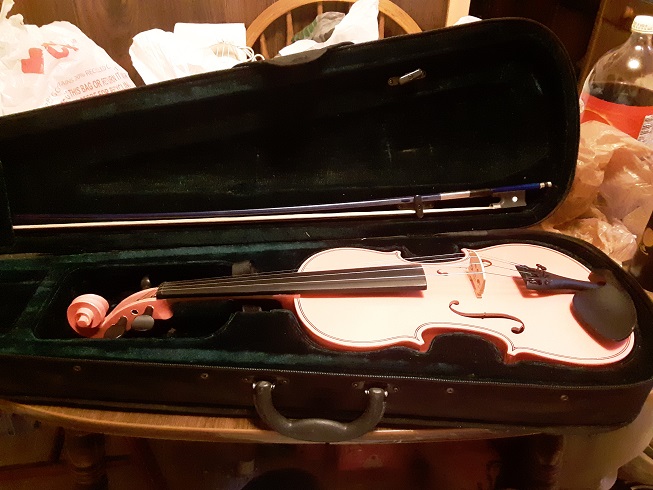
I got around time this past week to work on the pink violin that I talked about a few weeks ago (https://luegra.design.blog/2024/03/02/working-on-a-pink-fiddle/). Basically, it needed a new bridge, strings, and replacing the bow. The results of my work was a bit of a let down, but not a failure.

I purchased a replacement bow through eBay. I didn’t want to spend a lot on one, just around $15 for a student model. One seller had some colorful ones for that price, and I asked for a red one that would go with the fiddle. They sent me a blue on instead. I’m not going to go through the trouble of returning it, as I have had problems with another eBay seller accusing me of stealing from him when I returned a product.

As for the bridge, that was a bit more of a problem. I ordered one bridge from an eBay seller that turned out to be unfinished. As anyone that works with violins knows, the bridge has to be carved a special curvature for the strings, as well as a certain height from the fingerboard.. I tried my best to cut, file and sand the curvature, but was not able to get it correct. I have since then ordered some violin bridge templates, just in case I attempt this job again. With one bridge ruined, I decided to spend a few bucks more and get a finished bridge from Fiddleshop.com in Pompano Beach, Florida along with some rosin. The bridge only requires a little fine sanding before putting in place. Unfortunately, the soundpost inside the body is placed a bit too far back from where the bridge is supposed to rest on the body, so the tone is not that great. I don’t have the tools nor the patience right now to re-adjust the soundpost.

Stringing a violin can be a job to say the least. Unlike a guitar that has a set bridge/saddle and tailpiece, all of the string contact rely solely on the pressure of the strings. That is why when changing strings on a violin or viola, it is usually done one string at a time so that the bridge remains in place. In this case, I had to attached each string to the tailpiece and the tuning peg, making sure that each string was taut but not tight, then fitting the bridge under the strings in the correct position on the body, then correctly tuning each string. Tuning pegs on a violin are not geared like guitar tuners, so any little twist can send the string into a two- or three-note change. The fine tuners found on beginner violins are usually only good enough to adjust a semi-tone. For new strings, you need to work with the tuning pegs a lot just to get the strings stretched.

Finally, getting the strings relatively in-tune, I rosined up the bow and took Ms. Pink for a test-drive. Eeeek! The curve of the bridge is good, and the fingerboard/string contact seemed fine, but the tone was very weak. Granted, this is a cheap, made-in-China violin not meant for concert performances, and as I said before, the soundpost is not in the best position within the body. However, I would have hoped for a little bit better tone given that the violin is in good shape structurally. It is another lesson learned.

I definitely do not plan on keeping this violin, but I do appreciate the lutherie lessons learned while working on it. Hopefully I can find some young girl who is interested in learning the violin and will appreciate having this as her first fiddle.

Chew on it and comment.

Categories
Lutherie Musical Instruments

Working on a Pink Fiddle

I’m starting to get back into doing some small repairs on musical instruments again. I have a Yamaha acoustic guitar that needs some work on it that may take some time, so that one is on the back burner. Currently, I am working on getting a violin back into playing order.

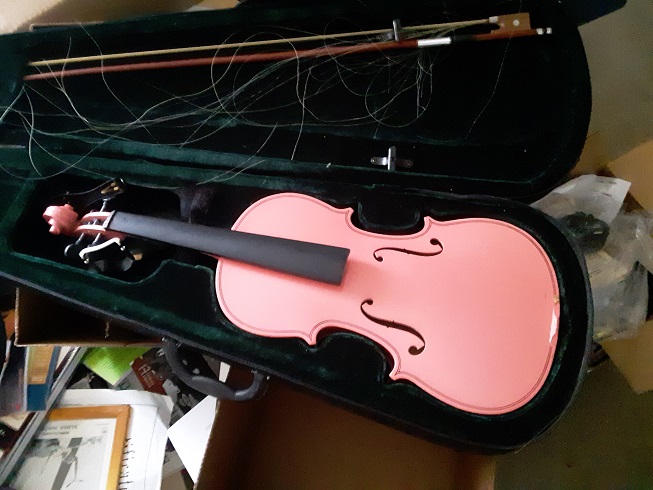
While scanning eBay a few weeks ago, I came across a pink 4/4 size fiddle that needed some TLC. The cool thing was, the seller was actually only a mile or two away from my house. I contacted him to see if I could buy it direct, and we agreed. When I opened up the soft case, I saw that it needed a lot more work than anticipated, but nothing that I couldn’t handle.

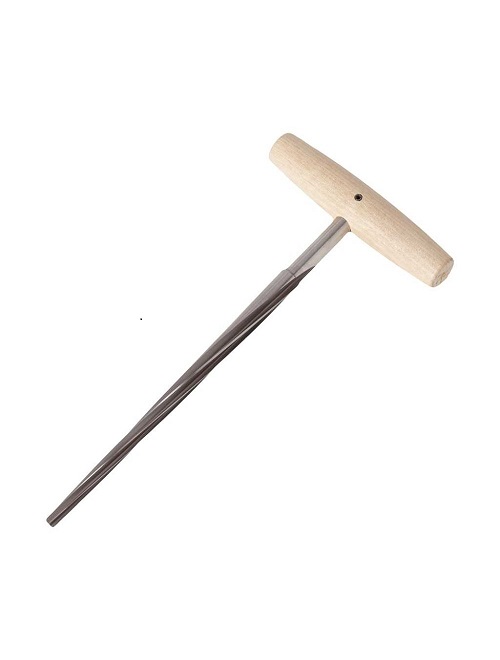
The body and neck are fine, but it was missing the bridge and endpin. The tailpiece and chinrest were there but not attached. The bow was a complete mess and not worth re-hairing, so it will be trashed. I ordered a new bridge and endpin and got them a few days later. The endpin proved to be too large for the end hole, so I ordered a violin peg reamer and got it a few days ago. This tool is a worthwhile purchase for anyone doing work on string instruments, especially the violin family. It is basically a tapered file that slightly widens a hole where a tuning peg or endpin should go into an instrument. I was able to get the endpin here to fit in a matter of seconds with a few twists of the reamer.

The way that the violin is strung up, it relies on each component resting on another to get the best vibration with the wood. With the endpin in place, the tailpiece can be looped over it, but it is not secure unless the strings are attached and wound to the tuning peg. The strings also have to be resting properly on the bridge, which needs to be placed in the correct spot on the top of the body. The bridge is probably the most important part of the actual violin, as it transfers the vibrations of the strings directly to the body, working against the top as well as the soundpost directly underneath inside the body. Bridges found on beginner and student violins are very basic. Professional violinists and fiddlers usually have a luthier carve special bridges that have a certain thickness (as thin as possible), weight, height and curvature to get the best sound.

While I am not concerned with getting a bridge that will cost three or four times as much as what I paid for this violin, I still want to use this as learning experience, so I will be working on making the bridge that I purchased to be better quality than when it came to me in the mail. This will entail thinning the entire piece with sanding, as well as adding a slight curved face to the side facing the neck. Thank goodness that there are a number of videos on YouTube that give some advice on violin repairs.

I already ordered a new bow, just a student one for under $15.00, as again I don’t want to invest too much into this project. I’m not interested in making this thing a professional fiddle, just a playable one that will inspire some young girl to want to play the instrument. It also gives me a chance to learn more about the skill of working on repairing and maintaining stringed instruments, something that I wish I could do as a full time job.

Chew on it and comment.

Categories
Musical Instruments

The Shredneck: Pass On It!

Today, I’m going to recommend a product NOT to purchase, unless you can really understand the purpose of it and are willing to ignore all of its faults.

A few weeks back, I picked up the Shredneck Low Rider 4-string bass neck. Mind you, I did not pay full price (thank God!), but got it off of eBay. This is a product for musicians to practice fretting and fingerpicking exercises when it is not convenience to have a regular bass guitar handy, such as at the office, waiting in a car, or other cramped situations (I dunno, doing a constitutional in the bathroom?). The Shredneck is about 18 inches long, has the four bass strings (Note: the company also makes 6-string guitar models) with a nut, bridge and tuners, and a fingerboard that consists of the first six frets of a full-scale 34-inch bass guitar neck.

Have you figured out the problem with this yet? Here it goes – the frets are set up as if this were a 34-inch neck, but the actual “neck” on this item is less than 18 inches. In short (no pun intended), the fretting of these strings will not match the note that is expected. For example, on a regular bass guitar, the frets are set up so that when you press your finger down on the fretboard, it will create the note intended according to the scale of the bass, be it 30- or 34-inch scale. On the low E string, if you press your finger down on the first fret, the F note will sound. The next fret will sound F#, the next fret will sound G, and so on.

However, because of the set-up on this Shredneck, fretting on the E string first fret creates a note somewhere between F# and G. The second fret creates a note somewhere around Bb. The same problem goes for all four of the strings. The fretwork on this product should have compensated for the scale length. Instead, you have some contraption that, when fretted, sound like some weird musical instrument that perhaps Mr. Spock would have played on Star Trek.

The Shredneck also puts normal-gauge bass guitar strings on the piece. The result is that the strings never stay in tune anyways, so even open strings never sound the same way twice. The tuning machines are decent, but if you should pluck a sting a bit hard, you can hear the pitch fluctuate. It sounds more like when you stretch out a rubber band and pluck it, then stretch it back and forth a little to get that wobbly sound.

There is very little positive about the Shredneck other than its portability. I surfed around on YouTube for some reviews of it, but there weren’t much, and most of them are a few years old. The selling point seems to be that you can practice fretting-hand work and finger picking. I would think that you can noodle around on something like this, but how can you tell if you are improving if the notes are not correct according to the fret? It seems unproductive. Even bassist Billy Sheehan, while trying to promote the Shredneck, admits that you shouldn’t listen to what you are doing on it (he introduces it at the beginning, but talks about it more about 3:00 in).

Looking around the internet, there are a few other products that are similar to the Shredneck but do a better job. In conclusion, pass on this!

Chew on it and comment.

Categories
Musical Instruments

The Glorious Mattel Synsonics Drum Machine!

I’m still cleaning out my house for sale, and while in the attic, I came upon a gem that I haven’t touched (or even thought about) for probably 20 years!

Back in the early 1980s, when it seemed that everyone was trying to develop the next big thing in electronic toys, Mattel came out with a device that still holds a place in many musicians’ hearts. The Synsonics Drum machine was not exactly a toy (although it was highly entertaining), but not a professional drum machine, either, even for its time. While most drum machines at this time were very rudimentary, having pre-set sounds and patterns (rock, disco, tango, march, etc.) with only tempo and volume controls, they were reliable and useful for anyone performing without a drummer live. By the late 1980s, companies such as Yamaha, Alesis, and Korg were producing programmable drum machines that had more realistic drum sounds (There was a popular musicians’ joke at the time: How many drummers does it take to screw in a light bulb? None, they have machines that do it now.)

The Synsonics was different than other drum machines. It had five sounds (snare, cymbal, tom 1, tom 2, and bass), with the bass only working as a sort of metronome, hitting on the ONE beat. The other sounds could be either triggered by striking one of four circular pads (which were sensitive to how hard you hit it with your finger or drumstick) or by buttons at the bottom of the device. Each sound had three buttons that controlled the number of hits the specific drum made per bass drum beat (two, four, or eight). Additional features included an Accent button, which turned the cymbal sound into a hi-hat, a tempo control, and (what proved to be the most cherished by me) Record/Playback/Stop buttons to record a specific drumming pattern.

Back when I was starting out with songwriting, it was always for a band situation. If I recorded a demo that was just guitar and vocals, the rest of the band went their own way with the song, which usually ended up being not what I imagined in my head (just worse!). I was determined to put in a basic idea of the other instruments (especially drums) onto the demo recording.

Now this was early days of home multitrack recording. I couldn’t even afford the basic four-track machines available like the Tascam 144 or the Fostex X-15, which were going for about $500 back in the early 1980s. My “multitrack” work consisted of two stereo cassette decks bouncing back and forth with each other while recording a new instrument or vocal. After four bounces, the first instrument recorded usually had tons of hiss with it, even if Dolby B was used (I’m dating myself!). The Synsonics machine allowed for recording one drum pattern for the 4/4 time pattern, so I could program a basic but distinct drumming pattern for the song I was working on, then play it back to the cassette recorder (along with a guitar or bass). It was a lifesaver at the time for me!

I eventually moved on to get a better programmable drum machine from Yamaha, as well as purchased a number of multitrack recorders over the years. The Synsonics was stowed away, and eventually hidden until a few days ago. I am so glad that I found it, though. I immediately put in 6 “C” cell batteries and began playing with it again!

A little more about the Synsonics. It did not have a speaker, so you had to listen to it either through headphones (using ones with the old 1/4-inch plug) or by wiring it into the AUX jack of your stereo. There was also an older MIDI jack that probably proved useful to anyone doing synthesizer work back them. There was a volume control, and for one of the toms there was a pitch control, so that it could sound like a large bass drum all they way up to a high-pitched tom. There was also a power supply jack if you didn’t use batteries.

When I played and recorded with it almost 40 years ago, I thought that I was limited to the straight-8 4/4 time groove with the machine. If I was recording a shuffle or something in 3/4 time, I had to limit the use of sounds or try to record a pattern and hope that my drum skills would not be sloppy. I just recently learned through internet surfing that, through special holding down of the drum buttons, you could create a waltz, shuffle, or even a syncopated pattern. I wish that I had known that way back then, but as I got this machine used (I’m still not sure how, either through a trade or at a rummage sale), I didn’t have access to a manual.

While it was produced by Mattel as a toy, the Synsonics received high praise from music-related publications, and had endorsements from legendary drummers such as Buddy Rich, Carmine Appice, and Nigel Olsson. I remember it being advertised on local rock radio stations, most likely to entice those younger teens to purchase one instead of a full drum set so that parents wouldn’t complain. It proved to be so popular that Yamaha developed a similar product in the DD-5, which they made for more professional use, as well as being higher in price. Surfing the internet, I see that these vintage drum machines are making a comeback in interest, and are commanding high prices for used ones.

I am so happy to have found the Synsonics again! It helped my though my beginnings with songwriting, and now proves to be a nostalgic item from my early days as a musician. Here’s a classic news report on the $150 item back in the day!

Chew on it and comment.

Categories
bluegrass bass Musical Instruments

The $47.01 Bass Guitar

As many people know, I am always looking for a good bargain with musical instrument equipment. Bass guitars are probably top on my list, mainly because I have always loved playing the bass, and I love teaching bass to young students. I have posted a few blogs about using the electric bass in a bluegrass setting, so I really am conscious of finding inexpensive bass guitars for those interested in bluegrass bass.

About a month ago, I found a listing on eBay for a Glarry Burning Fire electric bass that a third party was selling overstock for about $40.00. Tax and all made it closer to $49.00, but I took a shot. About a week later, a small package arrived with the same USPS tracking number that was provided upon payment. The package turned out to be a pair of ladies underwear! I contacted eBay and PayPal, and fortunately, I got a full refund (and am stuck with some underwear !).

I knew that it was too good to be true. At least I got my money back, and all that it cost me was a little frustration. About two weeks ago, I was surfing the website Wish.com for bass guitars. You can usually pick up a Chinese no-name P-bass for about $65.00, coming out to about $80.00 with shipping and tax. However, I did come across one ad that had a P-bass for $32.35! I wondered if I should take a chance. I have had decent luck with Wish.com, the only problem being a long delivery time. With tax and shipping, the total cost was $47.01. I rolled the dice and took a chance.

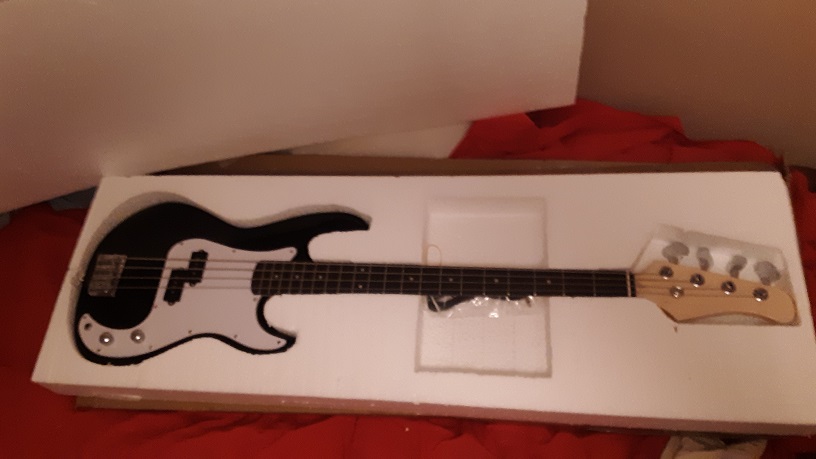
A week later (a lot faster than usual Wish.com shipments), the package was at the post office for me to pick up. And yes, it was a full-sized P-bass! I shook the box a little to hear if there were any broken parts (my previous experience with Glarry was that it was shipped with no packing material to cushion). OK, no noise, so let’s get it home!

To my surprise, it was packed really well, inside molded styrofoam and wrapped in semi-bubble wrap. Pulling it out of the package, I found it to be typical of the Chinese no-name basses – lightweight body (so the headstock tends to drop down if you are not holding the neck), mediocre tuning gears, fret ends needing some smoothing, and the neck feeling a bit rough on the back. I haven’t yet plugged it in to see if the pickup and controls work fine, and I’m figuring that the pickup will need to be adjusted for height. A good set up will make this a decent playable bass. For $47.01, it is well worth it!

A bit of learned information about Wish.com: this purchase was a lucky shot. Occasionally, the site will have sale prices, but you have to be in the right place at the right time. When checking on this same P-bass a few days ago, the price was back up to $68.00. They will also have items like cords, tuners, foot pedals, and practice amps sold at decent prices as well as the occasional deep-discount sale. But you have to be scanning every day. Again, the only real concern is shipping time, so if you were buying a Christmas present for someone, you would have to order it in early November to get a guarantee pre-holiday arrival.

Now getting a gig bag for this bass is another thing. Trying to find one less than $20.00 is near impossible, even on Wish.com. Which leads me to what I want to do with the bass. I already have four other basses, including a Chinese no-name P-bass. I will probably just get this new one set up, then sell it on Craigslist in the same packaging that it was shipped in.

I’m not sure how next weekend looks, as it is Christmas. Hopefully I will find the time to post some short note.

Chew on it and comment.

Categories
Bluegrass Music Classical Music Musical Instruments

Hina Maeda/More YouTube Channels

First off, congratulations to Hina Maeda, the winner of the 16th International Henryk Wieniawski Violin Competition, which I covered more in last week’s blog (https://luegra.design.blog/2022/10/15/the-16th-international-wieniawski-violin-competiton/). Again, I could have never judged any of these amazing performers. However, I can fully understand why she was chosen — her dynamics in playing and her energy, as well as her true appreciation for Wieniawski’s work, the orchestra that backed her, and her love of the audience. I implore you to go to the Wieniawski Society’s channel and watch Hina as well as the many others that competed (https://www.youtube.com/c/WieniawskiSociety).

I don’t think that I ever mentioned Jeremy Sheppard “The Guitar Hunter” and his YouTube channel in one of my blogs before. So here it is! The guy has a passion for Martin guitars, but also covers other acoustic guitars, as well as visits luthiers in the Nashville area. He did some great videos of his visit to this past month’s IBMA World of Bluegrass convention in Raleigh. I loved how he described bluegrass music as an “ox bow,: like an ox-bow body of water that has life in it, but is not the main part of a moving river. Check out his channel.

https://www.youtube.com/c/JeremySheppard

Another great YT channel is The Acoustic Shoppe. (https://www.youtube.com/channel/UCgToABlTkcQP-ojGXd1g1SA). This channel is based on a music store in Missouri by the same name, run by members of the bluegrass band The Chapmans. They don’t record and tour like they used to years ago (I was a big fan), but the brothers still post videos of their performances at the store, as well as have well-known bluegrass artists, like Rhonda Vincent and The Isaacs, visit the store, talk, and perform on the channel. The best part of the channel is that these brothers have a great sense of humor. Besides slamming each other about playing skills, they post videos on how they test the strength of travel cases, and even a pseudo game show.

I kept this short, as it has been a busy week. Chew on it and comment.

Categories
Folk Music Musical Instruments

Hillsdale Fiddlers’ Convention/World’s Longest Garage Sale

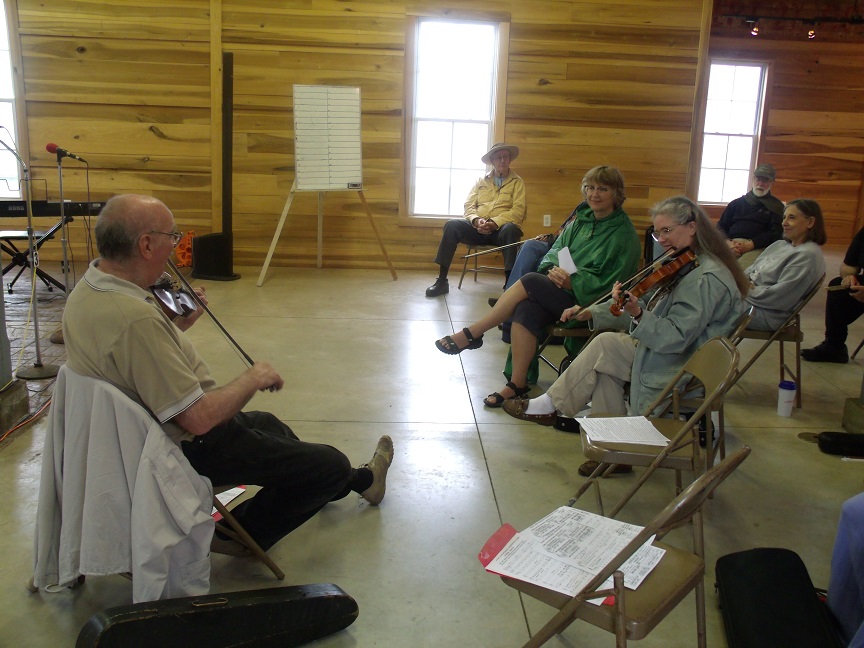
Saturday I made my yearly trek to Hillsdale, about a two-hour drive from Detroit due west, to attend the annual Michigan Fiddlers Convention & Traditional Music Festival. Hillsdale has no interstate near by, so to get there, most of the travel is done on US-12/Michigan Avenue. That actually works out for the better, as this same day is the World’s Longest Garage Sale, in which there are hundreds of garage/yard/rummage sales along the two-lane highway from Saline to New Buffalo.

The weather was terrible to say the least at the festival. Previous day’s forecasts stated rain would come in the late afternoon. Well, the rain started as soon as I got to the fairgrounds. And it did not let up. The morning workshops were held in some of the outbuildings, but other events for the day were cancelled. Thus, I was only at the festival for a few hours.

Roger Plaxton teaches fingerstyle guitar at Hillsdale
Mike Gleason instructing fiddle improvisation at Hillsdale
Dave Langdon performing Michigan old-time fiddle tunes at Hillsdale

The rain let up a bit as I hit the road back home, which was to my benefit. I was able to stop at a few of the garage sales to see what junk was available. If I had the time and money, I would probably hunt at these sales every weekend and end up like Mike Wolfe on American Pickers. However, I pretty much narrow my scope to music-related items. This includes records/CDs, musical instruments, vintage stereo equipment, and music books/videos. Even so, I have to remember that space is limited at my mom’s house (I’m still moving stuff out of my house for eventual selling of the place).

It seemed that all of the guitars, violins, amplifiers, and stereo equipment was priced way out of touch. There were a lot of no-name electric guitars that were way overpriced. A Fender Squier Affinity Strat in an obvious used condition that the owner was asking $125.00 was passed on by me and a few others, since I know that a new version can be had at Guitar Center for a few bucks more. As I expected, there were no albums or CD that I was interested in.

I came across one tent that the man was selling a lot of music equipment. The amplifiers were about right for the price, but I am shying away from electric guitar equipment unless it is a really good bargain. I first grabbed some bluegrass-related music books for a dollar each, then saw that he had a Tascam DP-02CF 8-track digital recorder/mixer. As he didn’t have a power supply for it, I was able to negotiate to a selling price of $25.00. A power supply can be had for about $15.00 from eBay, and I already downloaded the owner’s manual from Tascam. So if this thing works, I got a great 8-track recorder for $40.00. If it doesn’t work, I am not out that much, considering that this thing sold for a few hundred bucks new.

Of course, the heavy rain in Hillsdale never made it to the Detroit area, so my garden didn’t get the watering it needed, and I am off to doing it myself. Saturday was also the Blissfield Bluegrass Festival, which is sponsored by the Southeast Michigan Bluegrass Music Association. I would have attended, but they always seem to schedule it the same weekend as the Hillsdale fiddle festival, and I am committed to attending that, taking archival photos for the Michigan Old-Time Fiddle Association. I haven’t talked to anyone about Blissfield, but from looking at Saturday’s weather radar, it looks as if that event was hit heavily with rain as well. It is the chance any organizer takes when scheduling an outdoor event.

Last week’s Milan festival and this weekend’s Hillsdale festival were the only festivals I have been able to attend this summer due to a number of factors. Right now, the only other event scheduled for the rest of the year is the old-time fiddle contest in New Boston on October 3rd. It will be difficult to get back to the larger crowds for a lot of these minor events since the pandemic lockdowns have killed attendance. I try to find out what is out there and attend what I can. I hope that 2023 will be better for me and others. I am planning to attend the SPBGMA convention in Nashville in January, I am just waiting on exact dates.

In the meantime, I am going to see what demo I can record on the Tascam 8-track.

Chew on it and comment.

Categories
Bluegrass Music Musical Instruments

Milan Bluegrass Festival 2022: Dave Adkins Tries Out the 2208

Yesterday I spent a few hours at the Milan Bluegrass Festival. This year, the festival was extended to five days. I was planning on attending a few of the days, but because I screwed up my vacation time when I went to work for the law firm for two days, I was only able to go on Saturday. Also, due to family issues, I was only able to stay for the afternoon first sets fo the bands.

One of the main reasons that I wanted to attend was to meet up with Dave Adkins. He is a great guy, extremely friendly to his fans, and was happy to see me. He and I have worked with some of the same songwriters in the bluegrass field, so we exchanged a few thoughts on the people that we know. I also wanted him to try out the Sevillana 2208 acoustic guitar that was shipped to me a few weeks ago. As far as I know, the one that I have is the first one in the US, so I take pretty good care of it and definitely want to get it test-driven by as many musicians as possible.

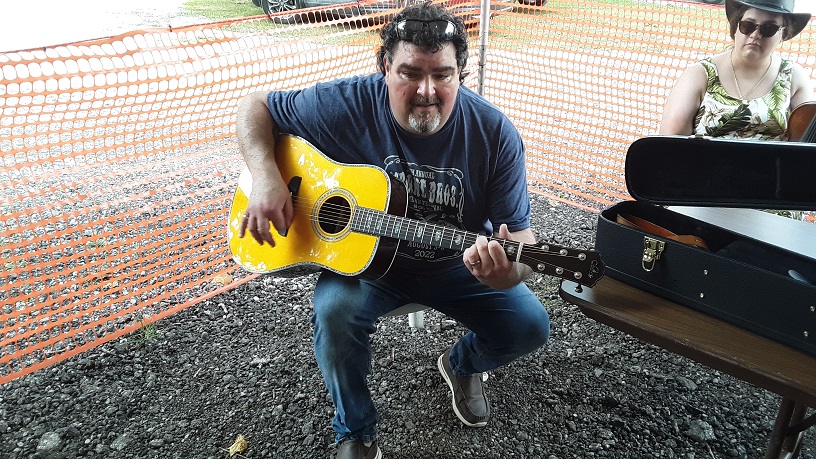
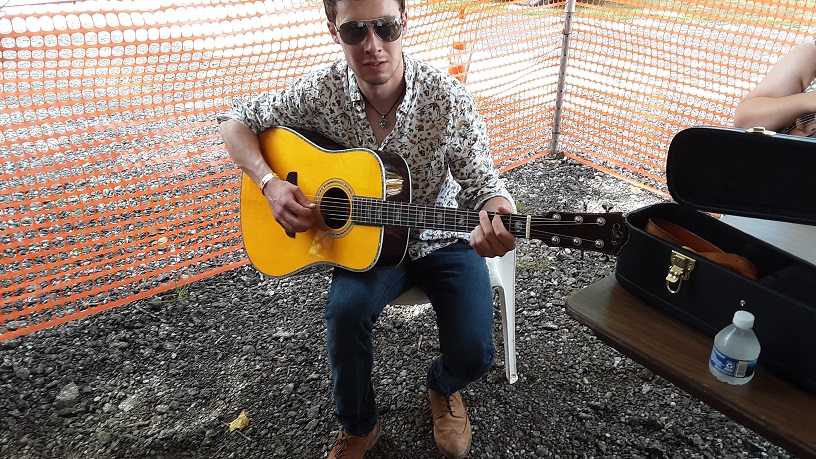
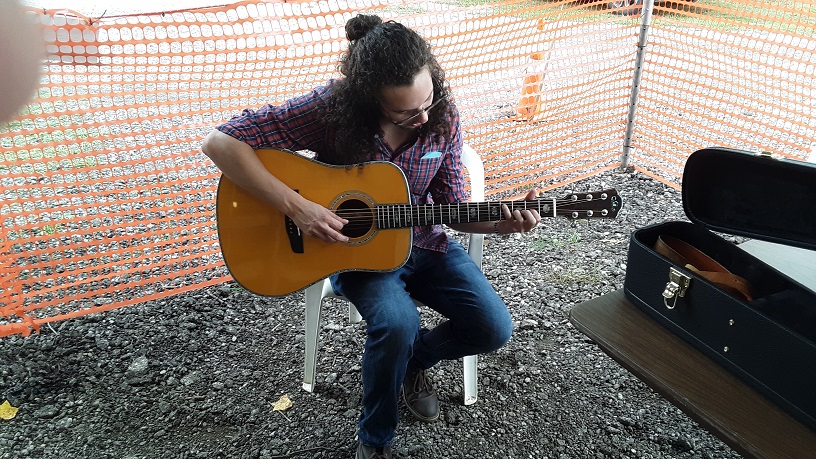
Not only Dave, but his mandolin player Ari Silver and banjo player Zackary Vickers (both excellent guitar players in their own rite) took the 2208 for a spin. I was glad to see that all of them truly enjoyed playing the guitar. They loved the loudness (we were picking behind the stage while another band was performing, and you could still hear the 2208 clearly), the weight (which seems a little heavier and more solid than most dreadnoughts), and the craftsmanship that went into the guitar, especially the inlay work. Zackary must have played around with the guitar for at least 15 minutes, he was having a great time with it. Even Dustin Terpenning, banjo player for the band Crandall Creek, asked if he could take it for a spin and loved it as well!

Dave Adkins
Ari Silver
Zackary Vickers

I didn’t get a chance to have the 2208 tried out by any other musicians due to time constraints and band members busy with talking to their fan base. However, I was glad to get Dave and his band members’ feedback, which I will be sending back to Cherry at Deviser Guitars.

Other bands on the stage that afternoon was aforementioned Crandall Creek (sort of a family band persona, although they are not family). Breaking Grass (a very high-energy modern bluegrass band, with a hint of Dave Matthews Band thrown in), Rhonda Vincent and The Rage (always entertaining and good, wholesome traditional bluegrass), and Alex Miller (an American Idol contestant that is starting to make waves in the country music circuit), although I didn’t catch his act and had to leave early.

Milan is your typical bluegrass festival for bluegrass lovers. There’s not a lot of frills, just two sets of music from each band, and the fans appreciate the friendliness of the performers after the shows. I have said it before, one does not get that type of artist/fan interaction from any other music format like one can get from talking with members of a bluegrass band. And so many of them appreciate that you have a respect for them as well. Like bringing in a new guitar to try out, band members love to have their opinions asked for, especially on guitars, banjos and mandolins.

Next week’s blog may be late as well, since I will be heading to Hillsdale on Saturday for the Michigan Old-Time Fiddlers Convention. There is nothing like live music.

Chew on it and comment.

Categories
Music Stores Musical Instruments

My First Real Guitar!

At my place of employment, there are a few other musicians and music lovers. One guy plays death/speed metal guitar in a band that has a decent local following, but when we talk, we are usually discussing guitars and equipment and not the music.

Our conversation one day came around to our first guitar that was decent in name brand and playability. I brought up my first axe, which was a Fender Squier Bullet. This was a step above the other Bullet models that Fender was putting out at the time (about 1987). The body was more solid, a Strat-style neck, but also looked very 1980s, with that hair-metal pickup configuration of two single coils and a humbucker.

Strange enough, I actually still own that guitar. While at least a dozen other electric guitars have passed through my ownership, that one has remained. Starting out as my main (only) guitar, it moved to back-up when I secured a Fender MIK Telecaster. Soon the frets began to pop out of their grooves, and rather than repair or sell it, I put it back into its case and let it sleep for now 20+ years.

My co-worker asked me to take a photo of it so he could see it, and I obliged. Pulling that old brown case out from the closet was a struggle in itself, as it was buried under a few suitcases and other junk. However, once I opened it, the memories came back. It still has the 1980s charm to it, and there was still some Scotch tape remnants where I put a photo of one of my girlfriends from back them. I cannot even remember who that girl was. I also remember that this guitar was a victim of an early guitar modification. I tapped the humbucker with a grounding switch so that I could have a pseudo single coil pickup in the treble position. I can’t remember if there were originally three control knobs on it or if I installed a third control for tone or volume – the configuration looks too weird for Fender’s design. Of course, it did have a vibrato bridge. If I remember correctly (I still haven’t plugged it in to check it out), the single coil pickups that were installed were not too much Fender sounding, so playing surf music on it didn’t have the same tone.

This was my first decent electric guitar. Before this, I had been playing bass in bands, and I was finding out that, to get my songs out there, I needed to form a band with which I was the next Joe Strummer. I couldn’t afford much, and was still keen on playing bass if need be. I purchased this Bullet from Wonderland Music in Dearborn, MI, which has long since closed down due to competition from Guitar Center. Back in the 1980s, Wonderland was THEEE music store in the Detroit area. Crazy Clarence would have sales three or four times each year so that you could get cheap guitar strings, and the craziest television commercials!

If you don’t know who Tony Bacon is, he is a world-renowned guitar historian. He has put out books on Fender, Gibson, Martin, Rickenbacker, and other top-name guitar companies. He also put out a comprehensive book on the history of the Squier brand (Squier Electrics: 30 Years of Fender’s Budget Guitar Brand, ISBN 978-61713-022-9). Unfortunately, there is no information on this particular Bullet in the book. In my years of floating around at shows, music stores, and guitar shows, I have only seen one other Bullet like this, and it was in black (mine is white). I find it strange that there are not a lot of relics out there of this model, as it proved (at least to me) that it was a quality guitar for the price. I have noticed that over the past few years, Fender has upped its game on the Squier brand, producing some high-quality models coming out of Asia that can compete with its Fender models at a more affordable price.

Upon looking at this old girl, perhaps for sentimental reasons, I may take it to a professional guitar repair person and have it re-fretted. I know that I will never sell it, but it may be nice to have and play occasionally in the basement to bring back memories.

Chew on it and comment.

Categories
Musical Instruments

It’s a “Mini Me” Guitar!

Another short but sweet blog.

A few days ago, I received an email advertisement from a novelty company called Axe Heaven Store (https://store.axeheaven.com/). This is a company that makes miniature copies of famous guitars, including ones used by Slash, The Beatles, and Jimi Hendrix. The advertisement sent to me was showing the store’s recent addition: a copy of a B.C. Rich Warlock model used by a character on the Netflix television show Stranger Things.

Not my cup of tea, but the thing does look professionally made, not some mass-produced piece of crap. I decided to check out the website, and along with dozens of rock-oriented miniature guitars (and even drum kits), they have a few acoustic related miniatures. There are a few D-28-style guitars, a banjo, and a mandolin! Unfortunately, these seem a bit more amateurish in manufacturing, although the Gibson Hummingbird does look like they put the time in to making it look realistic. By the looks of things, Gibson may have a licensing deal with Axe Heaven.

I would love to see a miniature replica of Bill Monroe’s road-beaten F-5 mandolin, or perhaps a true, more to realistic miniature of Earl Scruggs’ Gibson Grenada, or maybe even Jerry Douglas’ Signature Beard dobro. I would consider buying one of thise and putting it on my desk at work instead of a family photo (since I really don’t have a family).

I leave you with a great guitar face off recorded a few years ago with Josh Williams, Andy Falco, and Chris Eldridge.

Chew on it and comment.

Design a site like this with WordPress.com
Get started