A few days ago, I received an email advertisement from a novelty company called Axe Heaven Store (https://store.axeheaven.com/). This is a company that makes miniature copies of famous guitars, including ones used by Slash, The Beatles, and Jimi Hendrix. The advertisement sent to me was showing the store’s recent addition: a copy of a B.C. Rich Warlock model used by a character on the Netflix television show Stranger Things.
Not my cup of tea, but the thing does look professionally made, not some mass-produced piece of crap. I decided to check out the website, and along with dozens of rock-oriented miniature guitars (and even drum kits), they have a few acoustic related miniatures. There are a few D-28-style guitars, a banjo, and a mandolin! Unfortunately, these seem a bit more amateurish in manufacturing, although the Gibson Hummingbird does look like they put the time in to making it look realistic. By the looks of things, Gibson may have a licensing deal with Axe Heaven.
I would love to see a miniature replica of Bill Monroe’s road-beaten F-5 mandolin, or perhaps a true, more to realistic miniature of Earl Scruggs’ Gibson Grenada, or maybe even Jerry Douglas’ Signature Beard dobro. I would consider buying one of thise and putting it on my desk at work instead of a family photo (since I really don’t have a family).
I leave you with a great guitar face off recorded a few years ago with Josh Williams, Andy Falco, and Chris Eldridge.
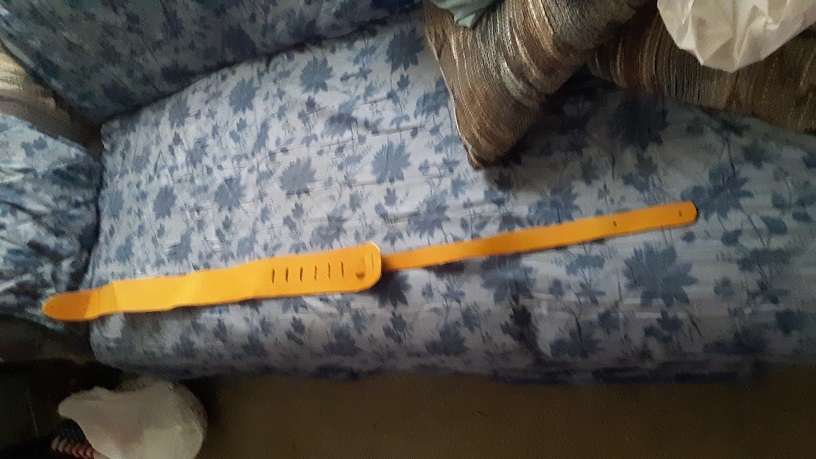
This past week at the Songwriters Anonymous meeting, I was listening to a conversation between two other members. One was talking up a storm about his new leather guitar strap that someone in Ohio made for him that was emblazoned with his nickname. When asked how much it cost, the reply was $200.00. The other person walked away, saying, “I’ll just stick with my Fender one.”
You have to figure, for $200.00, one could actually buy a decent back-up guitar, or a decent beginner mandolin, or a good electric guitar effects pedal (or two), let alone cover the high cost of gasoline and food these days. One can get a cheap woven/vinyl adjustable guitar strap for about $10.00 these days. However, I have never had good long-term luck with those, being that they wear out quickly, and if the vinyl should come in long-term contact with a guitar finish, it can actually damage it.
My first true leather strap that I purchase probably 30+ years ago cost about $25.00. It was pretty basic, no frills or stitching, but it was better than the woven/vinyl types. I put some strap locks on it, and after a while, I noticed that the weight of the locks along with the guitar was tearing the leather to uselessness. The leather was pretty thin, and I saw that real quality leather straps were twice as thick, but they were at least $50.00, a lot at that time for me.
At the same time, I was also doing Civil War reenacting. At an event that I attended which had a number of different time periods participating (Civil War, Native American, French & Indian War, War of 1812, etc.), one of the sutlers there (sutlers are people that sell period clothing and accessories for the reenactors) that catered to Colonial America reenactors was selling large pieces of leather hides, which many use to make leather accessories such as pouches or moccasins. It gave me an idea, and I purchased a few long pieces for a decent price.
When I got back home, I traced one of my thin leather guitar straps on a sheet of cardboard, then cut that template out and used it to trace and cut out straps from this thicker leather. From the original pieces that I bought then, I probably made about 10 leather straps with a cost of less than $10.00 each. Since then, I have kept an eye out for bargain leather remnants at other events or on eBay to continue to make more straps. I have even kept the sizeable scraps for end pieces on my mandolin straps (I’m not sure if I mentioned it before, but I have learned to weave leather laces to make mandolin straps, which I sell on Craigslist). I have my own leather straps on all of my guitars, banjo, and mandolins, and have given other out as gifts and even sold a few.
My first strap is still with me after about 30 years. It holds up my Martin D-28, and shows its age with a number of scuffs and sweat marks. However, it still does the job, and has probably outlasted 10 or more cheaper straps. I’m not willing to pay a high price for something that I can make myself for a lot less cost with the satisfaction that I did make it myself.
Yes, I have to face the facts. In my 20s, 30s, and even into my 40s, I was obsessed with making music. Thus, my house was full of musical instruments and recording equipment. At one time, I had about 30 guitars and basses, along with a few mandolins, a banjo, and a dobro. The fiddle came later, after the guitar count went down by way of selling, trading, and theft.
Look, I’m 57 now, a diabetic, overweight, a bit arthritic, and my knees aren’t in the best of shape. I don’t see myself hitting the stage of some dive bar banging my Stratocaster through my Twin Reverb amp playing with others who are in the same questionable shape, to an audience that would rather drink than listen to us. While my listening tastes have not changed much over the past 40 years, my playing tastes have dwindled considerably.
It hit me a few days ago. My blog last week talked about the baritone guitar that I built from an old Fender Squier Telecaster. I pulled the guitar out of the closet and plucked around on it for a few minutes. I realized that I am never going to play it again other than what I was doing then and there. Why should I have this thing gather even more dust when I’m now trying to clean out my house for sale as well as take a load off of my mind?
I looked around the house at other equipment that I have. Lots of vintage recording equipment. I’ll never use it again, as I have no desire to be in a rock band nor record one. Everyone is going digital anyway, and I use a small digital 4-track for my demos. At the time I bought it, the Tascam 238 8-track Syncaset was the go-to recorder for making decent band demos. I also have a Fostex 12-channel mixer and patch cords galore. Maybe someone out the is interested in that vintage stuff.
A couple of amplifiers that I have are worth something. The already-mentioned Fender Twin Reverb from the mid-70s is still sought after by guitar tone freaks, as well as a super-vintage Ampeg V4 head. I got them both at reasonable prices, so I should be able to make some money getting rid of them.
I also have a few old Kustom roll-n-tuck amps and speaker cabinets from the late 60s. I was totally into the Kustom stuff years ago. I sold a few things off, but it’s time to rid myself of the rest.
I’ve been only playing bluegrass these past few years, and even then, mostly songwriting. I ‘ve jammed a few times with others, but I have lost interest in being in an actual bluegrass band. As a songwriter, I am interested in hearing my work performed. However, most bluegrass musicians tend to want to just play the same 20 standard songs.
I have a lot of acoustic instruments, especially guitars. I have bought a few of them to do lutherie work on, and will probably sell them off much later in time. I do want to keep some PA equipment, at least a small set-up and some microphones, just in case I get called to do a sound job or plan to do a show. And I have always been and still am a vintage microphone collector, so the ones that I have will be sticking around for a while.
It will take some time to sort through the stuff, and it will be hard parting with some of it, but it is time for this to happen. I may do a spring garage sale, who knows? I do know that it is a crap shoot running ads on Craigslist. I am currently selling a student violin that I repaired for $70, and one person offered me $20. Heck, I invested more than that in repair parts! I have had some good luck with CL, but also some idiots wasting my time (the same violin, one woman wanted to buy it for her kid, and as I was driving in the snow to meet up with her, she texted me to say she changed her mind).
I’ll have to self-appraise the stuff before I sell it, and that will take time as well. If you do check out the Detroit Craigslist site and see someone selling in the “Dearborn/Hamtramck” area, most likely it is me. Hey, if you are interested, contact me and perhaps we can work something out. I’m actually selling a lot of non-musical stuff as well.
Maybe it is the algorithms, but this past week when I logged onto YouTube, I was blasted with dozens of videos from the guitar bloggers (including Casino Guitars) about baritone guitars. The good, the bad, the prices, the uses, the history, and more. Why all of a sudden this interest in the baritone guitar, especially the electric ones?
While I don’t follow today’s harder rock music, from what I learned, a lot of these punk, death metal, and other hardcore sounding bands are using the baritone guitar to get that deep grungy sound to go with the bowels-of-hell vocals. Where 7-string electrics were the thing a decade or two ago (with a low B string), these bands want even lower sounds to quake the stage and eardrums.
A little history. The baritone guitar began to gain interest with popular music back in the late 1950s/early 1960s. Danelectro was the main manufacturer. Guitarslinger Duane Eddy used one on a number of his songs, and they were also used in Nashville to copy the bass lines of songs by artists such as Pasty Cline and Jim Reeves (where it was commonly referred to as a “tic-tac” bass).
As for rock music, its use was sporadic to say the least. Two classic rock songs that have a prominent baritone guitar sound are The Beatles’ “Back in the USSR” and Aerosmith’s “Back in the Saddle.” These two songs featured the Fender Bass VI, which was also occasionally used by Cream’s Jack Bruce.
Baritone guitars made a slight comeback in the 1980s with a few of the neo-traditional country artists. A great example is Pete Anderson taking a lead on one with Dwight Yoakam’s “Little Ways.” During this time, Jerry Jones Guitars was producing replicas of the Danelectro baritone guitars, as well as a few original styles. Alt-country bands in the 1990s and 2000s were also implementing the baritone into some of their music, such as Dave Alvin with the reunion of The Knitters.
However, it never achieved a common guitar status. This is probably because of the specifications of the guitar. The neck scale is anywhere form 26 to 30 inches, and the string configuration is usually tuned down a fourth from B-to-B or a fifth from A-to-A. Picking a note on one of these with normal guitar pickups gives a springy, clunky sound that is somewhere between the regular guitar and a bass guitar. It has its unique sound, but playing a chord on one of these sounds horrible (at least to many).
Then we have today, where those metal-style bands WANT that earth-shaking low-end sound of distorted chords from a baritone guitar. To each his/her own, but I value my hearing, as well as my sanity.
This leads to the modern production of baritone guitars. Fender stopped producing the Bass VI years ago, but has now come out with the Squier Paranormal Carbonita Telecaster Baritone Guitar. Other manufacturers include ESP, Jackson, Reverend, and still Danelectro. Other than the Dan-o models, these are definitely geared to that metal crowd. They also range in price from $450 to $2,100 (on the Sweetwater website). So would you consider paying at least $450 for a guitar that is not much more than a novelty? I guess if you have money to burn, then burn away. However, even when I was playing in roots-rock and alt-country bands 20+ years ago, I can only think of a few times when I wished that I had a baritone guitar. Fortunately for me, I was able to find an alternative.
About 20 or so years ago, Guitar Player put out an issue highlighting baritone guitars. This was about the time Jerry Jones started putting out its Dan-o copies, and they were getting great reviews for a short time. One article in that issue, however, caught my attention. It discussed creating your own baritone guitar from a regular electric guitar.
I went out and bought a cheap used Squier Telecaster, which has a 25.5-inch scale (just an inch or so less than a regular baritone) for about $100, and got to work. Work entailed filing the nut slots a bit as well as filing a little larger string hole at the tailpiece where the low E string resides. I used medium-gauge electric guitar strings but only used the thicker five strings. For the sixth string, I used a D string for a short-scale electric bass (this was why I filed a larger hole in the tailpiece). After re-setting the intonation, I had a decent baritone guitar! The Tele pickups gave it a bit of the old-school Dan-o sound.
I used it on a few recordings for other bands, and a few more people had borrowed it for use on their recordings. Basically, I saved hundreds of dollars. I still have that thing buried in my closet, and I doubt that it will ever be used again except to plunk around with at home.
The thing is, these guitars are not going to be used all of the time. I am not sure that even the metal bands will continue to use them as a rhythm guitar alternative for a long time. As for the original use in country music, they are a once-in-a-while flavor. Even use live with a country or Americana band would mean a one- or two-song change or perhaps a third guitarist (along with the rhythm and lead guitars).
My advice: don’t go out and buy one unless you have the money to spare, or are really serious about using it regularly in the studio or on stage. If you want to try a novel guitar project, convert one like I did for a lot less money.
Last year, Baxter and Jonathan of Casino Guitars put up a video debating what are good and bad gifts for someone to give a guitar player for Christmas. They were talking accessories, not buying the guitars themselves (who wouldn’t love having a relative or friend buying him/her a Fender Strat or Martin acoustic for a gift?).
Overall, they were comically correct. However, I did disagree with them on one item – the guitar pick maker. They called it the worst gift to give. While it isn’t the greatest musical item to give, it does serve a great purpose. First off, rather than throwing out those expired credit cards and fake ones that companies like Xfinity send through the mail, you can cut the waste in half by making four picks out of a normal-sized credit card. Then you can quickly sand the edges and you have some picks that cost you nothing. The maker will pay for itself after a month or two. Also, if you have some moocher asking you for a guitar pick, you can give him one of the credit-card ones and keep the good ones for yourself.
This leads to a thought that I have had for years. If there is a musician in the family, be it son, daughter, husband, wife or other, and you really care about them as well as know his/her love of music, be a bit more learned about his/her passion. My father (God rest his soul) used to buy me loads of cassettes and CDs from the dollar store because he knew that I loved music. However, there was a reason these albums were at the dollar store – it is crappy music.
Now I admit that if I’m at the dollar store and see a bin full of CDs, I will definitely check it out. I remember snagging a half dozen CDs by NRBQ (one of my favorite all-time bands) and giving them out to people. However, 99.9% of the time, it is music that I have absolutely no interest in.
Now I will only get into stringed instruments here. However, I am sure that keyboard players, woodwind and brass players, and percussionists have similar paths that are followed.
There are some things that stringed musicians always appreciate: strings. Just make sure that you are purchasing strings that the musician can and will use. Don’t buy electric guitar strings for an acoustic guitarist, tenor banjo strings for a five-string banjo player, or electric bass strings for an upright bassist. Even if it is not the exact brand that the musician prefers, he/she will appreciate that you considered the correct instrument.
Picks: These are a lot more personal than even strings. Everyone has seen the bargain ads on Wish and eBay of a box of 1,000 guitar picks for a reasonable price. However, the picks vary in thickness, and unless the musician is one who uses thick picks on guitar, thin picks on mandolin, etc., most of them will never be used. Instead, get to know the particular pick used, and buy a dozen of those instead. Banjo and dobro players are very particular about the finger and thumb picks that they use, so if considering a purchase, really get to know what brand is preferred.
Clip-on tuners: These are a Godsend, especially if you can have one in each instrument case. They are becoming affordable, as low as $10.00, and they are now being made to tune other instruments besides guitar (bass, ukulele, violin) as well as tune chromatically. Also, musicians never fail to lose or misplace them, so having an extra one around is great.
Instructional books/videos: This is a really shaky area for gift giving. If you have a musician who has been playing for a dozen years in a number of bands, you wouldn’t want to give them a copy of Let’s Learn to Play Guitar, Volume 1. However, if the young one has just gotten a guitar as a gift and doesn’t know where to start, that would be the perfect present. This line of accessories has lost a lot of marketability with the rise of YouTube and online lessons, but it is still viable. Here is another area where I am open to if it is a bargain. While I may not pay the full $29.95 for a video on playing heavy metal guitar, I would most likely pick it up if I saw it at a rummage sale or used book store for a dollar or two. My theory on that is, even though I am not into heavy metal guitar playing, I may learn a thing or two about technique that I could translate into my bluegrass guitar playing. Moreover, I can always pass it along to someone that is starting to learn electric guitar.
Guitar polishes and cloths: This is something that a lot of musicians do not consider but truly appreciate if gifted to them. Guitars, basses, mandolins, fiddles, and other stringed instruments get dirty from sweat and hand grime over months of use, and musicians tend to forget that part of maintenance. Besides the body needing cleaning, fretboard and fingerboard cleaners are appreciated. This is an area that one would want to talk to a guitar repairperson or at least do some online research.
Other accessories: Case humidifiers, rosin and shoulder rests (for fiddlers), string winders, musicians tools (like the Roadie Rench), velcro cable ties (found at dollar and discount stores), and even maybe a metronome are bound to be used eventually. If it means sitting down for a few minutes to ask the musician what he/she needs as far as “the little things” and putting it down on a list, the next time there is a gift-giving situation, there will be smiles and not embarrassment.
Chew on it and comment. And pray for the people of Canada.
I’m not into football like I was before the whole “take a knee” thing. I won’t be watching the Super Bowl. I do think that it is funny that after over a decade of QB-ing for the Detroit Lions and nothing to show for it, Matt Stafford’s first year with a different team has led him to the big game. He played amazing with the Lions, but with a lackluster supporting cast, he could never get any respect from the NFL or press, but if LA wins, He has a chance to be a hall of famer.
But enough of that! Let’s talk music, specifically bluegrass! Have you checked out the ArtistWorks YouTube channel lately? It has always had some great instructional videos on its channel, but the last month has been fantastic! Great lessons from Chris Eldridge of The Punch Brothers, banjo legend Tony Trischka, and mandolin magician Sierra Hull. However, the best two videos they have posted recently are fiddle duets with Darol Anger and Bronwyn Keith-Hynes. This is old-time fiddling on overdrive. ArtistWorks has always been a great resource for beginner to intermediate musicians wanting to learn more. If you have never checked this channel or ArtistWorks’ website, do it soon!
I regret not being able to go to the Society for the Preservation of Bluegrass Music of America (SPBGMA) last month in Nashville. I will do whatever I can to go next year. In the meantime, attendee Stephen Hudson captured a lot of jamming going on with his video camera. What is always great with bluegrass jams is that pros sit in with amateurs and it ends up a good time. The amateurs feel blessed to get a chance to jam with a hero, and the pros get to be regular guys/girls, while also seeing what is out there amongst the fans. I have said it before – bluegrass artists are the only artists that I am aware of that regularly rub elbows with their fans, getting to know a lot of them personally (there are a lot of bluegrass musicians playing big stages that I call good friends), and will stay until the last autograph is signed. Now, check out one of Stephen’s videos.
There are a lot of people on YouTube that review guitars, amplifiers, and effects pedals. I’ve subscribed to some of them, and one in particular that amuses me is Landon Bailey. His delivery is a combination of Bill Murray, Steven Wright, and Don Imus. You can never guess what his next video will cover, except that it will have something to do with music. Like his 15-minute video of a wind-up metronome clicking at 100 beats per minute. Check him out, you will love his wry sense of humor.
Finally, I put a video on my channel that is a lesson on beginner bluegrass bass with an electric bass guitar. It is rough to say the least, as it was my first attempt at editing, and since I use an older digital camcorder, the video can be grainy when there is not full light. Take a look, and please give me some feedback.
My new year’s resolution for 2022? Pay more attention to the music, especially bluegrass music.
I’m getting rid of my house and moving back to my mom’s house to take care of her. I’ve been practically living at mom’s for the past five years, and my house is in shambles. Having to take care of an 89-year-old woman on my own, along with my day job, has been stressful to say the least. When I was laid off, it was fine, but I can hardly stay awake now that I’m working.
With that said, I have been spending an hour or so every day at my house getting rid of junk. It has now come down to getting rid of furniture, music equipment I know that I’ll never use again, and other big items. Time doing that has taken time away from practicing the fiddle and guitar, as well as concentrating on songwriting. I haven’t picked up the fiddle since well before Christmas, and I have only picked up the guitar once in the past three weeks.
So I need to get back to the music. I don’t want to lose that piece of personal enjoyment to the struggles of my life. I definitely need some inspiration as far as songwriting goes, and that has been very lacking. My one songwriting group Songwriters Anonymous has been holding Zoom meeting for nearly two years now, and I have not had the opportunity or even motivation to check one virtual meeting out.
I remember one YouTuber named FiddleHed that I wrote about a few months back telling those people that one needs to pick up the fiddle every day, even if just for a minute to pluck the strings or drag the bow across, in order to keep being motivated. Yes, I need to get back to that.
I certainly realize that the COVID thing has really killed off a lot of motivation with me and others. I was practicing the fiddle enough to want to try and hit a jam session, b ut forget that. None to be found in the area. Online jam sessions do not have the same warmth, comradery, or feedback. I was planning on going to SPBGMA in Nashville at the end of the month, but between the house, caregiving, and my job, that was cancelled.
As for songwriting, I am hoping that some camp will happen in the spring or summer. I will definitely travel to get to one, as I have very little motivation around my area right now. I’ve been checking online for some possible camps or workshops, but none seem to be popping up.
Since I dropped Sirius/XM a few years back, I have been a bit out of the loop when it comes to what is new in the bluegrass field. I try to keep up by reading Bluegrass Today online, still subscribe to Bluegrass Unlimited, and I still listen to “Daybreak in Dixie” every Sunday morning on CJAM-FM in Windsor. However, I looked at the Top 50 songs for 2020 on a Bluegrass Today chart a few days ago, and I don’t think that I recognized 10 songs. I don’t see me going back to the Sirius/XM subscription, so I will have to spend some time surfing around on the internet to get my ear back on the ground.
I hope the COVID lockdown apathy will disappear soon for me. I really enjoyed the few times that I was able to see some live music last year. I do know that there are plans to make the Milan (Michigan) Bluegrass festival a five-day event this August. I may not make all five days, but I will certainly be there for two or three days.
Let’s hope that things get better. I need some motivation. In the meantime, here’s something I posted on YouTube a while back. Inspired by Tom T. Hall. We’ve learned some sad news about Tom’s death this past week, but I don’t love him any less.
What constitutes a “banjo”? Why I bring this up is that I am seeing a lot of pop and rock stars claiming that they are playing a banjo, when in reality they are strumming and plucking a six-string instrument tuned like a standard guitar, with the strings going over a banjo head and resonator.
Now, 20 years ago, these instruments were referred to as banjitars, and the band Old Crow Medicine Show would call it a “guitjo” on its liner notes. These instruments have been around for decades, but popularity was mostly underground. I remember the first time that I saw someone playing one was guitar wizard Joe Satriani on an early episode of MTV Unplugged.
Usually when someone says, “I play the banjo,” we assume they are talking about the five-string variety, with the high G string droning, and played either clawhammer or Scruggs style. We tend to forget about the four-string plectrum banjo (popular with Dixieland bands), the shorter-neck four-string tenor banjo (used by many Irish bands), and of course, the many variations of gourd banjos. The one thing that they have in common is that the body or resonator part of the instrument has a top of skin or thin plastic stretched over the resonator pot (much like a drum head), and the strings being plucked will strike the head via a bridge to create the sound (unlike a guitar that produces sound through the sound hole). I am not going to get too technical here.
One of the most famous performers of the four-string variety was multi-instrumentalist Eddie Peabody. During the 1920s through 1950s, Peabody performed on stage, film and television on the four- and five-string banjos. His playing style was more of stroking the strings either with his fingers or a pick. He was a great entertainer, but his brand of music faded out as popular music turned to crooners, then country, then rock and roll. Toward the end of his career, Rickenbacker Guitar Company made him electric guitars with banjo necks. So, did this constitute the he was playing an “electric guitar”? By the way, Peabody was a whiz on guitar and fiddle as well.
Getting back to the six-string variety, is it an actual banjo? If one were to look at the entire lineup of banjos, as well as consider the sound that it produced and how it was produced, then technically, it is a banjo. For the fingerpick-style guitarist, it can be a new sound to songs, especially those using s drop-D tuning. As far as chord playing, it sounds way too washy (in my opinion). Yes, the those players of the plectrum and tenor varieties use a pick, but they usually either play a form of cross-picking, or the strumming is quick and semi-muted, so it is more rhythmic. Add to that the design with the strings draped across the bridge lying on a drum skin, this does not allow for sustaining tones.
Now if you were to ask a long-time bluegrass banjoist, or even a bluegrass enthusiast, he/she would probably have a set idea of what the banjo is. Five strings, played Scruggs style, ‘nuff said.
As for my opinion, I like to call it a “six-string banjo” and not just a banjo. Let the pop stars think that they are being cool, but we all know that when you say “I play the banjo,” the five-string variety is the standard. Now let’s get a taste of my favorite banjo player, Don Reno.
OK, so I was looking for something to blog about and surfing YouTube, when I came across this video:
I’m not sure why it came up as a recommendation. Yes, I love pickles, and yes, I listen to The Melvins. Actually, I don’t listen to them much, but they often play at a bar near my house when they tour, and you gotta love Buzz’s hair.
Her name is Sylvia Massey. She’s produced alt-rock bands like The Melvins and Tool. She even engineered the Johnny Cash/Rick Rubin-produced album Unchained. However, this woman is wacky. Timothy Leary on brine instead of LSD. She takes this weird experiment too seriously, and The Melvins join in because they will do anything crazy. I can just imagine what’s going on inside their heads listening to this woman talk about her experiment. It is 11 minutes that you MUST watch, but will be sorry that it’s 11 minutes that you won’t get back.
I’m keeping this one short. This video exhausted me, mentally.
Chew on it and comment. Monday is Memorial Day. Put a flag on a veteran’s grave and show some respect.
Ever since I started to take a re-interest in lutherie last year during the pandemic, I have been watching a lot of musical instrument making videos. YouTube is filled with them. I have mentioned Rosa String Works on a previous blog, and have found some others that have piqued my curiosity.
This past week I was obsessed with a particular instrument making competition. The 14th International Henryk Wieniawski Violin Making Competition was held in Poznan, Poland May 8-14, and I could not get enough of it! Since there is a big time zone difference between Poland and Detroit, I was not able to catch much of it live, but I was able to enjoy some of the live evening performances during my lunch break (which many co-workers were looking at me funny).
Hundreds of violins are entered, and judges spend the first few days meticulously examining the structure of each piece. Over the final days, the finalists are then played in solo, piano accompaniment, and full orchestra settings. The solo performers stand behind a translucent screen so the judges cannot see the actual violin, and each one is brought to the stage wrapped in a black cloth. It is THAT serious of a competition.
Lovers of classical music would appreciate the violin concertos performed during the week, but may be turned off by the amount of time spent hearing violins doing chromatic scales. On the other hand, luthiers and music physicists would be in paradise. Every nuance of both construction and sound is critically judged by music professors, artisans, and professional violin makers to find the most perfect creation. It is utterly fantastic to watch this happening! I can only compare it to a wine-tasting competition, but for the eyes and ears.
A bit of history. Henryk Wieniawski (1835-1880) was a Polish violinist and composer who was held in high esteem in Europe during his lifetime. A child musical prodigy, he studied and taught in France, Belgium, England, and Russia as well as in Poland. He is considered to be one of the greatest violinists to have ever lived. Poland has continually honored him throughout the years with stamps, coins, and the Henryk Wieniawski Violin Performance Competition, which began in 1935 in Warsaw and has been held every five years since 1952. The Violin Making Competition began in 1957 and is also held every five years.
Of note this year is the winner. Polish luthier Piotr Pielaszek came in both First and Second Place with two of his violins, nicknamed “Dali” and “Selva,” respectively. Listening to these and all of the other finalists being played in both a chamber and orchestra setting is absolutely breath-taking. To hear the subtle tone differences is like tasting different ice creams. It is an absolute pleasure to say the least.
I highly recommend checking out the Henryk Wieniawski Violin Competition website (https://www.wieniawski.com/) for more information on both competitions. Also be sure to check out the Wieniawski YouTube channel (https://www.youtube.com/c/WieniawskiHenryk) For some fantastic documentary and performance videos.
 Luegra