Trae McMaken is not necessarily a household name with Michiganders or area fiddlers, but he probably should be. A fiddle enthusiast and Michigan history buff since childhood, he has been combining his two loves over the past few years to make sure that the story of fiddle music in Michigan will not be forgotten.
Trae recently started up an educational website called Michigan Fiddle dot com (www.michiganfiddle.com). The site takes a look at Michigan folklore and how much fiddle music has had an impact on the state. In the Introduction page, he cites that fiddle music played in the past few centuries around Michigan has many ethnic influences. Because the state was continually a location for commerce, from fur trading during the 18th century, logging and copper mining in the 19th century, and the automobile industry of the 20th century, so many people came to the area from many foreign lands and brought their music with them. One characteristic of Michigan fiddling is the stress on use of the music for dance, with less flowering and ornamentation and a dedication to keeping a beat for the dancers.
The site includes many papers and articles written by Trae, as well as links to articles and recordings related to Michigan Fiddlers over the past century. He has assistance from a number of state fiddlers and historians to supplement his work. One such person, Jim McKinney, I have known for a number of years, and have supported his and his son’s work at the annual Michigan Old-Time Fiddle Championship held at the Huron Applefest in New Boston every October.
When one thinks of old-time fiddle music in America, thoughts usually go to the music of the Appalachian Mountains, the hills of Kentucky, or the plains of Texas. Michigan rarely gets a notice. Henry Ford loved fiddle music, and Beaver Island off the west coast of the northern Lower Peninsula has always had a strong fiddle presence. I am keeping this week’s blog short, as I would want you to instead spend some time checking out Trae’s site dedicated to Michigan old-time fiddling (see above link). Also check out this video of him performing some Quebecois music for the dancers.
This is one badass song! If there ever was a “man” song, it would have to be this recording. It is right up there as tough as any Led Zeppelin number. Merle Travis wrote it about the trials and tribulations that his brother faced as a coal miner. He recorded it in 1947, but his was more of a country-folk ballad. Frankie Laine, Doc Watson, Stevie Wonder, B.B. King, The Dandy Warhols, Old Crow Medicine Show, and a slew of other artists have recorded this classic, but it is the Tennessee Ernie Ford version that stands out as the definitive version.
From the start, it did not have the ingredients for a cutting-edge pop number. The main instruments that work with the vocals are a clarinet (with a bass clarinet in the background) and a trumpet. A brushed snare drum and upright bass follow the vocals in a smooth jazz sense. It isn’t until the last chorus that we hear any other instrumentation: a laid-back rhythm guitar and an ending accented by a harp. Then there’s the snapping of the finger. Like the lighting of a match or the sound of a pick hitting rock far away. The minimalist instrumentation makes the listener pay attention to the story, with every instrument accenting the words and making sure that you understand what was just said.
But it is that voice! Ford’s bass-baritone vocals make every word sound like it is coming form the depths of a coal mine. Earth-shaking, heart-pounding tone of a voice! Before this recording, Ford was known for singing some corny country & western songs, as well as a few ballads with Kay Starr. He did have a Number 1 hit with “Mule Train” back in the late 1940s.
Travis wrote a number of verses for the song, but the four that Ford used are the most memorable, telling of what a man is made of, how he is a slave to the coal company and its store, how he can’t be made to “walk the line” by any woman, and getting on his bad side may mean death. Some of these ideas would not go over well in a song today, but back in the early 1950s, when coal miners were still revered by the common man yet treated poorly by the rich mine owners, one could hardly argue with the singer.
As you listen, you can actually hear this voice as it is working in the mine. You also wonder how much time it would take for one man to mine 16 tons of coal. But you don’t question it, because you have high respect for this guy. You KNOW he could kick your ass in! Everything that doesn’t work in a pop song falls into place to work here. In under three minutes, you get an autobiography of a working man. Someone who has broken his back to make sure that he has a roof over his and his family’s head as well as food on the table.
I could listen to this song a thousand times and never get bored. Ford’s voice is beyond human – it is from the gods! The story moves you, knowing that there is a man out there working his life away yet still can be tough as a rock after quitting time. This was rock-n-roll attitude before the media caught on to what Elvis and Chuck Berry were doing. So pay attention, a recording like this comes around only once or twice in a lifetime.
Last Sunday, the Southeast Michigan Bluegrass Music Association had its first meeting for 2022. The last meeting was in October, which I could not attend due to having COVID. I had missed providing any input on decisions made during that meeting.
The big decision made at that meeting was to set up and sponsor a workshop for learning bluegrass guitar, banjo, bass, mandolin, fiddle, and singing. The date set was June 10-12, with really only workshops on June 11 and the other days providing jam opportunities. The proceeds would go to the Association’s Scholarship Fund. Cost would be $40.00 for each participant, with a discount for SEMBMA members.
I honestly didn’t find out about the workshop weekend until January (and I am a member as well as on the SEMBMA committee for Scholarships!). So at last week’s meeting, we found out that only five people registered for the workshop. That was less than the number of instructors hired for the event! The workshop would be less than two months away, and there was no word on any more people wanting to register. The person in charge of organizing the workshop stated that she did all that she could to get the word out, sending flyers to music stores and radio stations.
With a unanimous vote, it was decided to cancel the workshop. Some attending wanted to move it to September, while others (myself included) want to hold off for a lot longer until the Association can invest more time and money into the project.
There were a lot of things working against this workshop from the beginning that cancellation was inevitable. The problem is that the coordinator(s) were either too blind to see them, or just did not want to work in order to alleviate them.
Here are some problems as well as possible solutions to making an events such as this workshop more successful:
Time allotted to set up and promote the event. In this case, the decision to have the event was eight months until the workshop date. Moreover, the first notices did not come out until January. Talk to anyone that runs a bluegrass event, and they will tell you that they start the planning the day after the last event ends. You need a year to not only follow a structured plan to make the event work, but also time for people to plan to attend.
Promotion. The days of sending flyers out or posting them at music stores and expecting a line at the gate on opening day is ancient history. One has to have a strong grasp on social media just to get a message out. Emails are a start, but that has to have a plan, such as sending announcements out on a regular basis so that members and other interested parties get the reminder. These emails should have updates on the event, such as who will be teaching, any special offers, and asking for suggestions from attendees. However, the big blast should be with Facebook, Twitter, and YouTube. I know that SEMBMA has its own YT page, so a video announcing the workshop should have been posted.
Money. This coincides with promotion, along with other factors. This is not Field of Dreams, where if you build it, they will come. Much more needs to be done to get the word out, and that costs money. Yes, there are some free outlets such as posting flyers on local bulletin boards, but if you really plan to get people to pay attention, you have to pay for advertising. Local newspapers are a start, but that is a coin toss to see if it will work. Since this is a bluegrass-related event, the advertising is best spent with bluegrass publications such as Bluegrass Unlimited. This goes back to time allotted, as magazines require an ad request months in advance. The thought here is, you get what you pay for. If you don’t spend money, you won’t get great results. Now you may not get great results if you spend a big amount on advertising, but most successful event coordinators know that the first year or two may result in loss of revenue in order to get the word out.
Scheduling. Why would you schedule a first-time workshop only a week after a more-established workshop only a two-hour drive away? That being the Midwest Banjo Camp near Lansing, which has been going on for years and has built itself up into a reputable weekend, providing well-known instructors and a well-structured schedule.
Personalities. Just who are the teachers that are at the workshop? If I have to pay a fee and you are not telling me who is the instructor, then this guy could know less about the instrument than me! Also, if my kid wants to learn guitar, what is going to motivate me to register and drive an hour or two instead of getting lessons from the local music store 10 minutes away? The truth is, names draw attendees. That is why a lot of bluegrass festivals have workshops and pay artists a little more to be the instructors. Someone is more likely going to attend a workshop with Ronnie McCoury, Molly Tuttle, Sierra Hull, or Darol Anger than Joe Schmoe from the local music store.
SEMBMA is going through a drastic time right now. Current officers are looking to retire, and no one is really volunteering to step up. I currently serve on two committees (the other being the Office Nomination Committee), and it is hectic with the little time that I can spare. Some new, younger blood needs to step in with new ideas. This workshop (and its inevitable cancellation) is just one example of old ideas not working. The issue here is that young people need to know that for bluegrass to survive in certain areas, it needs more than to just learn how to play and instrument and jam.
Last week, the online site Bluegrass Today posted a review of the Watchhouse Band performance at The Ark in Ann Arbor (https://bluegrasstoday.com/watchhouse-band-in-ann-arbor-mi/). This ensemble consists of the duo Mandolin Orange along with two additional acoustic guitarists and an upright bassist. While I am not a huge fan of Mandolin Orange, I do like some of their music, and this set-up allows them to do more eclectic material live.
As expected, a recurring debate on what is/isn’t bluegrass started up in the comments section. The Watchhouse Band does not have a banjo in its lineup, so of course, that brought a lot of traditionalists out commenting that the band was not bluegrass and probably should not be featured in a BT article. Others from the opposite end stated that many established bluegrass bands such as the Osborne Brothers and Doyle Lawson have used non-traditional instruments such as electric bass and drums in their recording for a number of years.
I did post one comment within the debate. I stated that while Mandolin Orange was not a bluegrass band by definition, much of their material and sound does pay homage to bluegrass music and artists. I also stated that BT has widened its coverage by including a Grassicana chart (charting artists/recordings that are on the fringe of bluegrass while having some Americana influence), and that the website The Bluegrass Situation covers only about 10% of traditional bluegrass music. One statement that I said that was taken out of context was that I felt that some “uneducated” music people do not fully understand what traditionalists view as bluegrass and simply lump any acoustic band into the bluegrass format. When I put that word into quotes, I meant that there are a lot of people that may not listen to bluegrass as much as the hard-core bluegrass fans, and thus, do not have such a hardline definition of bluegrass (must have banjo, no drums, no electric bass, no piano, etc.).
Of course, there were a few that took that quoted word out of context, and started an even bigger ball rolling. In short, this is an argument that will never have a happy ending, or an ending period! As I said at the end of my comment, “To each his own, I guess.” There are a lot of “beyond the walls” definitions and influences with bluegrass. Doc Watson played amazing flatpicking guitar doing old-time fiddle tunes. He wasn’t bluegrass by narrow definition, but his playing inspired thousands of bluegrass guitarists, and so many times did he perform with bluegrass bands at bluegrass festivals.
There are so many things to consider when defining bluegrass, but one thing that is definite – there is no definite answer. While there are distinctions that definitely do not fit any bluegrass mold, such as a metal band like Metallica or a rap artist like Eminem, the format of bluegrass has a few basic rules and branches out from those according to individual tastes. Some individuals parallel a long stretch, while other individuals break apart early.
Whether it’s Doc performing solo, or a full band playing, my thought is, does it give you a feeling inside that bluegrass music (by traditional definition) always seems to give you? If so, then perhaps it is bluegrass. Or perhaps one can say, “Can you clog to it?”
Check out this backstage performance of Doc jamming with a very young version of award-winning fiddler Michael Cleveland.
A while back I caught this YouTube video from Driftwood Guitars regarding a small saw-like tool from Stewart-McDonald that can provide your acoustic guitar with better tone.
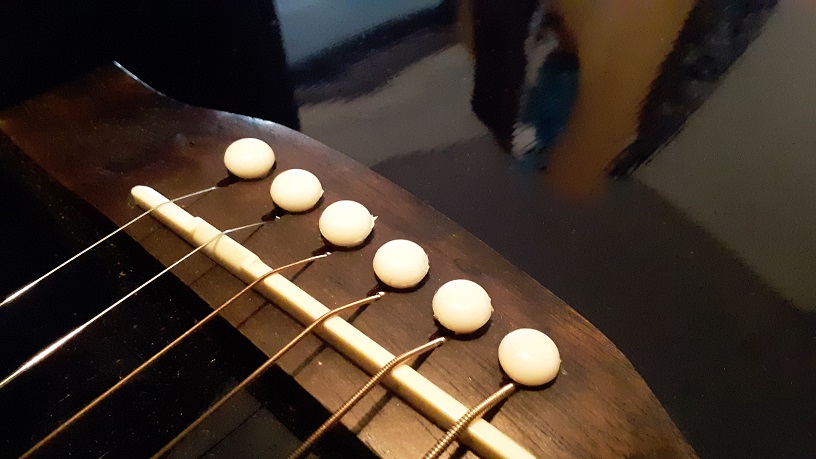
The procedure involves cutting a slot in the string ball-end holes of the bridge so that there is more contact between the string and the guitar itself. Normally, the string comes out of the bridge hole and has the slightest contact across the saddle before traveling over the fretboard, nut, and to the tuning gear. This procedure allows the string to be in contact with the wood of the guitar as well as more contact with the saddle, providing more resonation of the guitar (the video shows how).
A few years back, I purchased a used Jasmine S35 acoustic guitar with case at a real cheap price (the cost was worth the case alone!). I noticed during playing it that, while the tone was not fantastic, it was quite loud, especially for a cheap acoustic that sold for about $150 new. After seeing the Driftwood video, I checked out the Jasmine’s bridge, and sure enough, there were slots in the string holes.
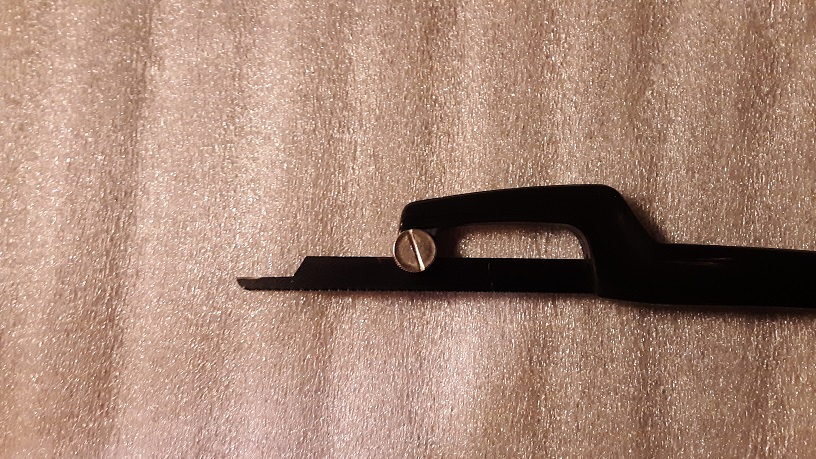
Now the tool from Stewart-McDonald costs about $25, and add to that shipping costs and having to wait for the package, I decided to make my own device. I took a hacksaw blade, cut off about an inch from the upper half of one side of the blade, then attached it to a smaller holder. Total cost was about $3.00.
With it, I dug into the bridge of a Yamaha F-325 that I was cleaning up. I figured that I would try this procedure out on a less expensive guitar than my Martin D-28. I learned a few things along the way: – Hacksaw blades have finer teeth, meant to cut through metal. It takes a lot of time and effort to cut even a little slot, especially when two different woods and some glue are fighting you. – I was working on this while quarantined at home during my battle with COVID. Do physical work, even light physical work, when you are healthy. – It seems that while I could tell the difference in volume and tone, the normal (i.e., non-guitar geek) doesn’t care. I played a slotted Yamaha F-325 against a non-slotted Yamaha F-325 to a friend, and she didn’t hear any difference.
I do plan on doing this procedure on the other two Yamaha acoustics that I have, as well as one or two other acoustics that I own. Until I get really good at it, I will hold off on the Martin. This was a good lesson learned about improving the sound of an acoustic guitar, and I feel that it is worth the work. If you are still jittery about attempting it on your own, check with your local guitar repair person or a luthier.
Last week, I received my copy of the debut album from classical violinist Esther Abrami. I have mentioned her a few times in previous blogs, and I wanted to talk more about her and her recording.
I came across one of Esther’s YouTube videos about four years ago, and have been in love with her spirit ever since. What first caught my attention about her physical appearance is that she looks so much like Audrey Hepburn, one of the most beautiful women to have ever been captured in motion pictures. Of course, Esther has done some professional modeling in her still young career, and she comes across so photogenically. She truly looks like a princess the way she holds herself.
Then I heard her playing. Amazing, to say the least! She was putting so much emotion into her bow technique that you would have thought that she had been playing the violin for 30 or 40 years. But no, this was a young woman of about 22 years of age! I had to see more of her videos, and almost immediately, I subscribed to her YouTube channel.
With each new video that Esther posted, I learned so much more about her personally. She comes across so beautifully for the camera. Although she is French, she has a wonderful control of the English language. This is due to the fact that she has done most of her musical studies in England, including at the Royal College of Music in London.
Esther’s passion for the violin and classical music began at the age of 3, and it was non-stop from that point. She was teased and made fun of by her school classmates for her intense interest and rigid practice schedule on the violin. It had an emotional effect on her growing up, yet she persevered.
Along with her musical education, Esther took a great interest in social media, promoting herself on all of the major outlets. This has resulted in gathering a large fan base in just a few years. She is often open about her dreams, hopes and fears as she progresses in her career. Her fan base has learned so much about her, and with that, has become her personal support group with whatever direction she takes. In 2019, she became the first classical musician to be nominated in the Social Media Superstar category at the Global Awards.
Her YouTube videos not only show her performances and practice sessions, but she also does reviews of violins and bows, as well as has some fun with the camera, including performing a duet with her “twin sister.” She recently started a vlog on her channel in which she interviews other women in classical music. We also learn of what a big and warm heart she has. She is a lover of animals, especially kittens. She has served as a foster parent for stray kittens and they have often appeared in her videos. One video went extremely viral, in which a kitten that is being held in the fanny pack around her waist is watching her practice the violin, then slowly falls asleep.
We have also learned how sensitive and emotional Esther can become in times of stress. We saw her sad and nearly broke down when the COVID lockdowns began, and she had to decide whether to continue to live and study in London or return to her family in France. We have also seen how the stress of a perfect performance can have an such a young yet talented musician. However, the reward of her work has shown in the past year, when she was signed to Sony Classical Entertainment Records, and most recently, being selected to perform at the Royal Albert Hall in London on April 11. Not bad for a girl of 25!
Since I have been following her, I have done what I can to help support her career. A few years back, I became a patron of hers on the Patreon website. In the short amount of time that I have been following her, we have also emailed each other a number of times, and she always thanks me for my continued support. She sent me a beautiful Christmas/New Year card recently that I will cherish immensely.
Yes, I have a crush on her. Not just because of her beauty, but because of her passion for music. Through her videos, I have seen a little girl of 10 years of age mature into a beautiful and extremely talented performer. There is no one that I know of that deserves the attention and accolades that she has received the past year or two. With every email that I send her or comment that I post on YouTube, I always sign it with “Je t’adore.” and I do, I truly adore this young lady. I am sure that she knows that she can call on me if she is ever in need of something that I can do for her. I also truly hope that 2022 is her year for amazing success, as I have seen how hard she has worked for it.
I implore you to get a copy of Esther Abrami on CD, vinyl, or download. The music is light classical, easy on the ears, and is performed by a beautiful young lady that knows her way around the violin fingerboard. I also ask you to check out her website, as well as her YouTube channel. You will fall in love with her as well.
Friday, April 1st saw the passing of one of the true gentlemen of bluegrass. Roland White, mandolin player and teacher for over six decades, died at the age of 83 from the effects of a heart attack from a few days prior. Legendary does not begin to describe Roland, although he was not as observed in the bluegrass scene as other mandolinists in the past few years.
Roland started out in the late 1950s with his family band, including his sister Joanne and brothers Eric and Clarence. Joanne left shortly after formation, and the three soon became The Country Boys. The youngsters performed a number of times on the show Town Hall Party, a country music program broadcast out of California during that time. Through the support of guitar great Joe Maphis, the group changed its name to The Kentucky Colonels, and they became extremely popular in the Los Angeles area. They also appeared on two episodes of The Andy Griffith Show (still as The Country Boys).
Roland joined the service in the early 1960s, during which time Clarence took more instrumental lead roles with the acoustic guitar, and history was soon made on that part. When Roland returned to the band, it recorded the iconic album Appalachian Swing, containing a number of stellar guitar/mandolin lead trades between the two brothers. Bluegrass was losing fan interest by the mid-60s, and Clarence would switch over to electric guitar, playing in Nashville West and later The Byrds. Clarence declined an offer to play guitar for Bill Monroe, so Roland took on the guitarist role in The Blue Grass Boys.
In 1973, the three White boys would reunite as the New Kentucky Colonels with Herb Pedersen and Alan Munde joining. Tragically, after only a few shows, Clarence would be killed by a drunk driver while loading gear into a car, ending this last incarnation of the brothers’ band. Roland would perform briefly with Lester Flatt and the Nashville Grass, then form the influential band Country Gazette with Munde, and remain with that band until 1991. After that, he joined another influential bluegrass band (an one of my personal favorite bands), The Nashville Bluegrass Band. He stayed with NBB until about 2000, at which time he formed The Roland White Band with his wife Diane Bouska.
During these past two decades, his name could be found on a number of bluegrass albums as guest mandolinist, including with Marty Stuart, Clint Black, Bernadette Peters, Ricky Skaggs and Ry Cooder. He also dedicated much of his time to teaching, serving in festival workshops and publishing a number of mandolin lesson books. He never let the public forget about the influential work of his guitarist brother Clarence, publishing a book of guitar transcriptions entitled The Essential Clarence White – Bluegrass Guitar Leads.
Roland was always a welcome sight at Nashville establishments like The Station Inn. When he walked in the room, it was like royalty had just come in. Everyone was in awe of this man, and he was humble enough to appreciate the attention and warm accolades. Whether he was sitting in with a band or just enjoying the show, everyone knew that there was someone special in the room.
I have two wonderful memories of Roland. The first involved a workshop that he was overseeing. A few years back, Roland was visiting relatives in the Detroit area, and scheduled a last-minute workshop at The Ark in Ann Arbor. Word spread quickly, and about 30 people, including me, were in attendance. Roland was extremely friendly and helpful to everyone there, working with many who had just picked up a mandolin only recently. While the workshop turned out to be more for absolute beginners, those of us who had a bit more mandolin experience were grateful to be in the presence of the great man. I was even surprised that Thomas Sneed, mandolinist for The Reeltime Travelers, was sitting next to me soaking in the magic.
My other memory was talking to Roland on the phone for an article on Clarence that I was writing for the now-defunct Bluegrass Now magazine. Roland continually promoted his brother’s guitar work, and was gracious enough to afford me time to talk about Clarence’s work. After that call, we would occasionally email each other (or I would get emails from his wife) updating things going on in Roland’s career. I am blessed with the friendship of country music songwriter extra ordinaire Jim Lauderdale, and have always loved the work that Jim and Roland did when Jim first arrived in Nashville. If you ever get a chance, check out the album Jim Lauderdale and Roland White, recorded in 1979 at Earl Scruggs studio. Also, you MUST secure a copy of Appalachian Swing. It is a true teaching tool for all bluegrass musicians!
Roland will truly be missed, not only for his mandolin work and as a statesman for bluegrass, but for his warm smile and friendly demeanor. He is now playing with The Angel Band.
I remember when I was playing in roots-rock and alt-country bands 20+ years ago. I could easily write a song each week that I was happy enough to perform live with the band. If I were to have taken one of those “song a day” challenges back then, I would have had no problem with the task at-hand.
For the past few years, more like the past decade, that talent has slowly left me. I still write, or try to write, but it is not as easy. A lot of it has to do with inspiration. Back then, I was hitting bars, visiting places, working with a lot of other musicians, and soaking up the experiences. Ever since I started caregiving my mother when my father passed away seven years ago, which is a full-time job along with my regular full-time job, I have lost a lot of creativity. I am lucky to go out to a show once every three months, my employment is most of my social life, and other than weekly church attendance, I do very little for myself as far as outside activity is concerned.
I started to realize that the need to “get out of the house” for my songwriting a few years back, but it has really hit me within the past few months. COVID took away a lot of that socializing for two years, but the problem was, I got used to staying home and doing very little to stimulate my songwriting. You can only write so much about staying home, and no one wants to hear about that in a song anyway.
I have a songwriting notebook, and right now there are about a dozen bits and pieces of songs in it that I try to re-visit every few days to get re-inspired. I was actually inspired a few days ago with a new song idea at work yesterday. A few lines are floating around in my head, but nothing big. But today (Saturday) is my busy day shopping for mom and the week’s food/supplies. Add to that I have a colonoscopy exam on Monday, so Sunday will be spent taking laxatives and starving. I may get some songwriting done in between trips to the bathroom!
I have tried the route of disciplining myself to sit and write for a few minutes each day no matter what the situation. For a while, I would wake up every morning, randomly open up the dictionary and put my finger down on a word, then write about it for 10 minutes non-stop. Even that didn’t help after a while, I seemed to be writing about my same complaints no matter what word came up.
I definitely need more inspiration. Hopefully this summer things will change. I plan to hit more bluegrass festivals, and perhaps attend a songwriting camp that I believe I mentioned a few blogs back. I need to just jump in my car and drive somewhere. I haven’t visited Nashville in over two years. I would love to go back, I should plan on it this summer. My Songwriters Anonymous group plans to start meeting up live again next month (it has been on Zoom for the past two years, and I do not have a great connection for it on my computer internet system), so perhaps that will motivate me in some way.
I hope to find a co-writer that I can work with regularly soon as well. The few good co-writes that I have done have been with people out of town, and our work has been over the phone or emailing back and forth. I have not found anyone in my area that I am compatible with and is determined to write quality bluegrass music. I am not saying there are not great songwriters in my area. Honestly, I get humbled many times when I go to the Songwriters Anonymous meetings and someone performs a song that floors me. I am just not finding anyone that meshes with my style.
I end this blog with a video from my Kitchen Koncert series. The song is “Brown-Eyed Soldier,” co written with my “bluegrass kid sister,” Vickie Vaughn, who is currently the bass player for bluegrass bands Della Mae and High Fidelity. Recorded during the pandemic lockdown, I attempted to give it a Jerry Garcia acoustic feel.
CJAM, the college radio station out of the University of Windsor in Ontario just across the river from Detroit, has been one of my favorite stations ever since its inception in 1983. When other stations in the Detroit area were playing commercial-friendly music, CJAM was playing underground bands that ears like mine were begging for. I learned about so many punk, new wave, and Goth bands from that station. As I got older and tastes changed, CJAM became the only terrestrial radio source for bluegrass music in Detroit with the Sunday morning program “Daybreak in Dixie.”
As the years have gone by, it seems that this little oasis of a radio station has never really had great luck. When it started, CJAM would broadcast at a lowly 50 watts at 91.5 FM. If you had a really good antenna on your home radio, you were lucky to pick it up, dealing with fades and static. To hear it better, you had to get in your car and park somewhere along the Detroit River in a not-so-great neighborhood. In 1995, the station was boosted to 456 watts, so Detroit and immediate suburbs could get the station if the wind was right.
In 2009, the station was granted permission to transfer to 99.1 FM due to a station near Port Huron, MI was also using 91.5 FM. It was hard to pick up on a radio that used digital tuning because of competing Detroit stations at 98.7 FM and 99.5 FM forcing themselves over. Thank God for old analog-tuned radios and sensitive fingertips! Fortunately in 2014, CJAM was permitted to raise its power to 2,084 watts, so it could be heard at least 20 miles away from the riverbank.
Then, a few months ago, I noticed that tuning in the station was difficult again, and there was interference from another station. At first I thought that CJAM was forced to lower its power, but NO! It turns out that there was a new sports-talk station in the Detroit market (isn’t one enough?). “The ROAR” broadcasts on 93.5 FM AND 99.1 FM. The thing is, if you look at the broadcast map of these two stations, the smaller-powered 99.1 FM area is covered by 95% by the more powerful 93.5 FM. Why the complete overlap? Greed, most likely. The other sports-talk station here in Detroit is at 97.1, so while they are competing for that audience, they are stomping out those of us who would rather listen to music, especially styles that we cannot receive from commercial stations.
I never understood having sports-talk radio stations on the FM frequency. Does it really matter what the aural tone of the voice is if it is on AM radio? It’s talk, for God’s sake, not music. By the way, CJAM not only broadcasts underground alternative music, but also classical music and programs highlighting a number of ethnic groups. The local NPR station WDET used to offer a good variety, but as of the last decade or so has become a left-wing news-talk station with some free-form music programming during the weekend afternoons. I stopped donating the that station years ago, but I continue to support CJAM as much as I can.
Terrestrial radio lost a lot of its status and reliable reputation back before the turn of the millennium when they refused to listen to the consumer wants and needs. Satellite radio then became the alternative resource, but that turned lackluster within 10 years as the programming there began to mirror terrestrial commercial radio (I quit my subscription about 5 or 6 years ago). There are the internet radio alternatives like Pandora, but as soon as I learned that they were not paying proper royalties to artists while still broadcasting commercials, I turned my back on them as well.
I was raised on radio. In my pre-teens, I cherished my transistor pocket radio picking up the Top-40 AM stations during the day, like CKLW out of Windsor, then tuning in out-of-state stations at night. The underground and college stations were a must-hear in my teens and young adult days. Even as I have gotten older, the stations playing non-commercial programming like folk, bluegrass, Celtic, and classical music are for what I continually search. CJAM is still an oasis for me, especially “Daybreak in Dixie” as I relax and write on Sunday mornings as well as Saturday evening alternative music. These terrestrial stations keep disappearing, it seems, year by year. I pray that CJAM will be around for many more years. Check out its programming at www.cjam.ca/ .
Yes, I have to face the facts. In my 20s, 30s, and even into my 40s, I was obsessed with making music. Thus, my house was full of musical instruments and recording equipment. At one time, I had about 30 guitars and basses, along with a few mandolins, a banjo, and a dobro. The fiddle came later, after the guitar count went down by way of selling, trading, and theft.
Look, I’m 57 now, a diabetic, overweight, a bit arthritic, and my knees aren’t in the best of shape. I don’t see myself hitting the stage of some dive bar banging my Stratocaster through my Twin Reverb amp playing with others who are in the same questionable shape, to an audience that would rather drink than listen to us. While my listening tastes have not changed much over the past 40 years, my playing tastes have dwindled considerably.
It hit me a few days ago. My blog last week talked about the baritone guitar that I built from an old Fender Squier Telecaster. I pulled the guitar out of the closet and plucked around on it for a few minutes. I realized that I am never going to play it again other than what I was doing then and there. Why should I have this thing gather even more dust when I’m now trying to clean out my house for sale as well as take a load off of my mind?
I looked around the house at other equipment that I have. Lots of vintage recording equipment. I’ll never use it again, as I have no desire to be in a rock band nor record one. Everyone is going digital anyway, and I use a small digital 4-track for my demos. At the time I bought it, the Tascam 238 8-track Syncaset was the go-to recorder for making decent band demos. I also have a Fostex 12-channel mixer and patch cords galore. Maybe someone out the is interested in that vintage stuff.
A couple of amplifiers that I have are worth something. The already-mentioned Fender Twin Reverb from the mid-70s is still sought after by guitar tone freaks, as well as a super-vintage Ampeg V4 head. I got them both at reasonable prices, so I should be able to make some money getting rid of them.
I also have a few old Kustom roll-n-tuck amps and speaker cabinets from the late 60s. I was totally into the Kustom stuff years ago. I sold a few things off, but it’s time to rid myself of the rest.
I’ve been only playing bluegrass these past few years, and even then, mostly songwriting. I ‘ve jammed a few times with others, but I have lost interest in being in an actual bluegrass band. As a songwriter, I am interested in hearing my work performed. However, most bluegrass musicians tend to want to just play the same 20 standard songs.
I have a lot of acoustic instruments, especially guitars. I have bought a few of them to do lutherie work on, and will probably sell them off much later in time. I do want to keep some PA equipment, at least a small set-up and some microphones, just in case I get called to do a sound job or plan to do a show. And I have always been and still am a vintage microphone collector, so the ones that I have will be sticking around for a while.
It will take some time to sort through the stuff, and it will be hard parting with some of it, but it is time for this to happen. I may do a spring garage sale, who knows? I do know that it is a crap shoot running ads on Craigslist. I am currently selling a student violin that I repaired for $70, and one person offered me $20. Heck, I invested more than that in repair parts! I have had some good luck with CL, but also some idiots wasting my time (the same violin, one woman wanted to buy it for her kid, and as I was driving in the snow to meet up with her, she texted me to say she changed her mind).
I’ll have to self-appraise the stuff before I sell it, and that will take time as well. If you do check out the Detroit Craigslist site and see someone selling in the “Dearborn/Hamtramck” area, most likely it is me. Hey, if you are interested, contact me and perhaps we can work something out. I’m actually selling a lot of non-musical stuff as well.

 Luegra