Categories
Bluegrass Music Nashville

A Short Trip to Nashville

I got back from Nashville late Thursday evening, and while I was there for only two days, there is some stuff that we can talk about.

  • I rented a car so that I could put my car in the shop that needed a few days of work. While I requested an economy car, I was given a small SUV. Comfortable, but it was a 2025 model that had way too many bells and whistles that was confusing me while on the road. The auto-bright-lights feature was throwing me off, as I thought that I was turning them on when going around a curve. Just give me four wheels, an engine and a steering wheel.
  • Sirius/XM Radio. It was on the rental car, and trying to find decent radio stations through Ohio is a pain, so I kept the satellite radio on. I dropped my subscription with Sirius/XM a few years back, and now I realize one of the reasons that I did. I kept the radio on the Bluegrass Junction station the whole time. I swear, they have a rotating playlist of about 12-15 songs that seem to get played every two hours, sparsely interspersed with a few classics by Bill Monroe or Jim & Jesse. The repeat ones were all modern songs, and as I listened, they were less like bluegrass and more like acoustic country/folk/pop. They also played a lot of Billy Strings, but at least they varied the song selection. No, not worth the cost for me.
  • Songwriter sessions. One got canceled (I’m not going to get mad, as I hope to reschedule in January when I go down for the SPBGMA conference), and the other, which was more of a Q&A session, I was late due to a stalled train at a crossing. The session was helpful to say the least as Brent (who runs SongwritingPro.com) got me interested in Suno.com, a website that helps make demos sound a lot better by providing instruments and vocals mixed in at the songwriter’s discretion. I haven’t used it yet, but plan on it soon!
  • Jack’s BBQ/Frugal MacDoogal. Two places that I can never pass up while in Music City. Jack’s has the best pulled pork I have ever eaten. I always order the three-meat special so I get the pork, beef brisket and smoked sausage, while dipping in six difference sauces! Enough to have lunch the next day. Frugal MacDoogal is the Wal-Mart of liquor stores! I always pick up a stash for my friends and brother while I’m in town. Prices are way lower than in Detroit.
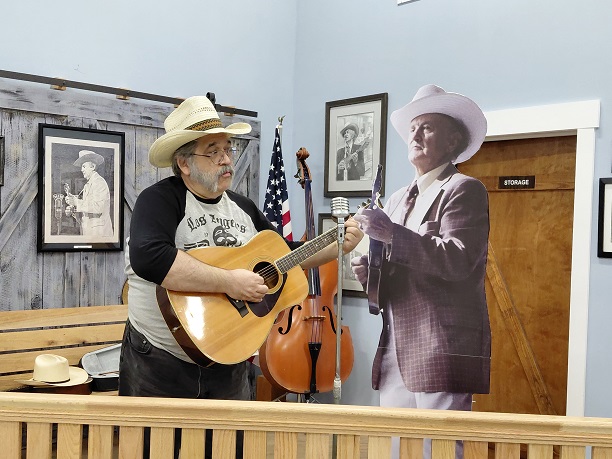
  • Rosine, Kentucky. For me, it is worth the hour detour to visit the birthplace of Bill Monroe, I always visit his grave and lay a quarter on his stone for myself and one for my buddy Ken. This time, I was running a bit later than usual, so I was able to visit the Bill Monroe Museum. The place is filled with Monroe’s furniture, instruments, and loads of other memorabilia. As I was the only one there, the cashier/manager Christie walked around with me. I ended up telling her more about Monroe than she knew. She insisted that I take a photo with the cardboard cutout of Monroe in front of a microphone. I also went up to his boyhood home on Jerusalem Ridge. The dossier there named Ken was staying in his truck to keep warm, as the house was not fully heated. He told me that Doyle Lawson has been there a few days before just to look around. This town should have so many visitors because of Monroe, but there is no signage on the highways passing by, so really the only people that show up are the true fans like me, and those that come to the annual Bill Monroe Days Festival in September. The authorities that handle the state’s tourist functions need to get their heads in gear!
  • Theresa Kereakes. This is one of my dearest friends, not just in the music scene, but in my life. We text a lot, however, we don’t see each other much due to distance, so we make a plan to meet up whenever I am in Nashville. We worked together in the early days of the AMA AmericanaFest, and I can honestly say, if the Rock and Roll Hall of Fame had a Den Mother category, Theresa would be the first enshrined. I won’t even begin to list the artists she has worked with behind the scenes, but I can say there are a few that are legends in the business. For years I have told her that she needs to write a book of her life stories and anecdotes, and fortunately she recently has started on it. If you want a taste of her adventures, visit her blog at http://punkturns30.blogspot.com . Anyone that loves rock and roll with love her insights.

I won’t get into much else. Road construction down there is worse that here in Detroit, and that is saying a lot! Also, drivers down there are way worse. If they pulled the crap they do up here in Detroit, they would probably have their windows shot out!

As stated, I’ll be heading back down there in January, so the next two months will be busy emailing inquiries and recording a few more demos.
Chew on it and comment.

Categories
Bluegrass Music

Bluegrass Covers of Pop and Rock Songs

Here’s something that I wanted to blog about for a while now, but I never really knew how to approach the subject. I am going to talk a little about bluegrass artists covering pop and rock songs, trying to get them to sound bluegrass.

This idea has been around since bluegrass was still in its youth and the birth of rock-n-roll. Most everyone knows that Elvis Presley’s first single contained a rockabilly send-up of Bill Monroe’s lamenting waltz, “Blue Moon of Kentucky.” Mr. Monroe didn’t think much of the cover, that is, until the royalty checks started coming in. Then, he was so impressed that he re-recorded the song to include a rockin’ 4/4 time version on the second half of the recording.

Through the years, bluegrass bands have dipped into the pop and rock-roll bag to get new musical ideas as well as to keep bluegrass relevant. Jim & Jesse McReynolds recorded a whole album’s worth of Chuck Berry songs. Through the 1960s, bands such as Flatt & Scruggs and the Country Gentlemen often picked up on rock and folk songwriters for material. Flatt & Scruggs had a minor hit with the Lovin’ Spoonful’s “Nashville Cats” (which Del McCoury also recorded, and I will look at later), and a number of Bob Dylan compositions. That led to the disagreements of the band’s direction and ultimate break up. Earl Scruggs would go on to record and perform a number of pop and rock songs with his sons, while Lester Flatt would delve back into the traditional bluegrass sound.

During the 1970s and 80s, there was a lot of bluegrass artists covering pop and rock songs. Tons of bluegrass bands were covering the Beatles’ songs because they were popular. The Seldom Scene covered Ricky Nelson’s “Hello Mary Lou” (which has now become a bluegrass standard), as well as many Grateful Dead compositions. Of course, it helped that the band, particularly Jerry Garcia, was big fans of bluegrass, and the Garcia/Robert Hunt writing team was highly influenced by old-time music. Progressive bluegrass bands such as the New Grass Revival would often incorporate pop and rock songs their albums. NGR does an amazing cover of Marvin Gaye’s “Ain’t that Peculiar.”

But what about today’s bluegrass bands and their choices in pop and rock music. Some bands such as Del McCoury can pull it off pretty well. Take his cover of the aforementioned “Nashville Cats”:

However, with his band’s cover of Buffalo Springfield’s “For What It’s Worth,” in which they are joined by Sierra Hull, the Gibson Brothers, and a few others, it comes off to me as very tiring:

A few years back, the Grascals, who have always been known to cover popular country songs, had a bluegrass hit with its version of the Monkees’ “Last Train to Clarksville.” For me, it was OK, but not fantastic. Granted, at the time of the release, the Grascals were probably the most popular band in bluegrass, so they could take a chance on material.

Of course, Alison Krauss knows a good song when she hears one, and can make it her own. While not exactly bluegrass, she did put an acoustic swing to Bad Company’s “Oh, Atlanta”:

One artist that I think has a really good ear on choosing pop and rock songs to cover in the bluegrass vein is Dale Ann Bradley. I have always been a big fan of her, and part of the reason is that she chooses great material to record. Here are two fine examples of covers – the Kris Kristofferson/Janis Joplin hit “Me and Bobby McGee,” and Tom Petty’s “I Won’t Back Down”:

A band out now that I really like is Echo Valley. They are a bunch of young kids that sound great together, and I was glad to finally see them live last January at the SPBGMA conference. They perform some great bluegrass gospel, and have a few decent traditional sounding songs. However, I am not too impressed with their choices of covering modern rock songs. Among these are Journey’s “Don’t Stop Believing,” Electric Light Orchestra’s “Don’t Bring Me Down,” and Guns & Roses’ “Sweet Child O’ Mine”:

Again, I really like this band, but the choice of rock songs makes me wince. Maybe it’s me, but I just don’t hear a good melding of genres here.

This is definitely a “Chew on it and comment” blog. I would like to hear what others think. My blog next week will be a little late, as I will be going to Owensboro, Kentucky on the Thanksgiving weekend to visit the Bluegrass Music Hall of Fame and Museum.

Categories
Bluegrass Fiddle Bluegrass Music

Bobby Hicks RIP

Yesterday, we lost one of the great and influential bluegrass fiddlers. Bobby Hicks passed away early Friday morning from complications of a heart attack earlier in the week at the age of 91. I do not think that there is a bluegrass fiddler alive today that does not know who he was, let alone view him as a big influence.

Hicks was born in North Carolina in 1933, and first learned guitar and mandolin. He later picked up the fiddle, and won his first fiddle contest at age 12. He would first play with Jim Eanes band, and did a short stint playing bass for Bill Monroe until Monroe saw how good he was on the fiddle and moved him to that position full time.

After a two-year service in the Army, Hicks returned to the Blue Grass Boys and moved to Nashville. With them he recorded Monroe classics “Big Mon,” “Scotland,” and “Wheel Hoss.” He often recorded twin and triple fiddles with the band alongside Vassar Clemens, Kenny Baker, and Charlie Cline. He later joined Port Wagoner’s band, but soon moved to Las Vegas where he was getting paid much better. It is there that he created his homemade five-string fiddle.

After seven years in Vegas, he returned to NC to care for his ailing mother. While home, he played with some local bands and held private lessons. In 1981, Ricky Skaggs asked Hicks to join his touring band. At the same time, he participated in the first five albums of the legendary Bluegrass Album Band, which included Tony Rice, Doyle Lawson, J.D. Crowe and Todd Phillips.

He retired from Skaggs’ band and touring in 2004 at the age of 71. He continued playing locally in NC and giving occasional lessons. He was inducted into the Fiddlers Hall of Fame in 2002, the Bluegrass Music Hall of Fame in 2017, and was also a member of the North Carolina Music Hall of Fame. He has 10 Grammy Awards to his credit, and performed for over 50 years on the Grand Ole Opry.

Monroe once dubbed Hicks “the truest fiddler he had ever heard.” I had the honor of meeting Mr. Hicks back around 2011 at the IBMA World of Bluegrass Conference when it was in Nashville. In the Exhibit Hall, he was trying out a number of fiddles at a luthier’s booth. Strangely, there was not that big of a crowd standing around watching this legend test-drive the fiddles. He actually asked me what I thought of one of them once he was finished playing. We chatted for a few minutes, I explained that I was not a fiddler but enjoyed fine playing. I felt honored that he would ask someone he didn’t know an opinion of an instrument.

The masters of bluegrass are disappearing at a sadly fast rate, and with Bobby Hicks now gone, there is not many left for our younger artists to show respect to. He will be sorely missed int eh bluegrass community for not only his talent, but his knowledge that he passed on to many others.

Chew on it and comment.

Categories
Bluegrass Mandolin Bluegrass Music

So Why Did I Buy Another Mandolin?

So back during the pandemic days, I received a $400 debit card from the government. It was the last payment to me before I got a job, and I am not sure why they put it on a debit card instead of the usual sending the money straight to my bank account. Anyway, I completely forgot about it since I was now working.

Fast forward over two years, and while cleaning out my wallet a few weeks ago, I came upon the debit card. I went online and it still had the full amount available, but it was set to expire in about a month. Well, I wasn’t bound to let $400 slip away, but to be honest, I really didn’t know what I would use it for. I am pretty well set as far as basic necessities like food, paying utilities, and clothing. My thought was to treat myself to something special.

I didn’t want to splurge on an expensive meal. No, I wanted to get myself something to last me for a while. I first thought about a pizza oven, but I knew that I would probably use it once or twice, then it would gather dust in the garage. I also considered getting myself a handgun for protection at home, but because it was government money, they would probably deny that purchase the way the current administration is trying to suspend the second amendment.

My choice was then something in the musical instrument field. I have way too many acoustic guitars, and $400 wasn’t going to get me anything as good or better than I already have. The same goes for the bass. I have a banjo, dobro, and fiddle that I work with, but nothing to inspire me to get something more, again not for $400.

I always wanted a F-style mandolin, but the price was always out of reach. I have a decent A-style mandolin which I played regularly until I switched over to fiddle a while back. However, recently I saw that The Loar company (a stringed instrument manufacturer out of China) was marketing a LM-310F model, retailing for $400 through Guitar Center.

(WARNING: If you do an internet search on the The Loar LM-310F, you will find that a number of retailers are selling this model for $100 or less. DO NOT BE TEMPTED! These are international criminal rings that get your credit card information, keep emailing you about a delay in shipping, then after 30 days, you will never hear from them and you get nothing in return. Often these thieves will also sell your credit card information so that you will be REALLY screwed, and it will be difficult to get back your money, unless you have a really good credit card bank).

The GC near my house actually had a LM-310F at the store, and after trying it out by playing a sloppy version of “Bluegrass Stomp,” I knew that I wanted it. Since it was the floor model and they didn’t have any stock in the store room, I got a nice discount, and was able to pick up a heavy-duty gig bag for the $400 plus some change.

Let me tell you, this thing has a great bark to it when strumming those bluegrass chops, and the tone is nice and warm, way more closer to what a bluegrass mandolin usually sounds like instead of an A-style. It has a solid spruce top, a narrow V-cut neck (which is great for my smaller hands), and a nice satin finish. The main difference one can see compared to a standard Gibson F-5 mandolin is that the fretboard ends at the 20th fret. There is no upper extension of the fretboard over the body that made the Gibson model famous (along with a guy named Bill Monroe using it as his main weapon).

I have fallen in love with the mandolin all over again. I enjoy messing around with it while watching television, but I do plan on practicing on it more once I return from the SPBGMA conference next week in Nashville (NOTE: I may be late on next week’s blog, or even miss it entirely, due to the conference, but I will give a full review when I get back).

I would definitely recommend this mandolin for those moving up from a beginner A-style model but still not having the cash to afford a more costly F-style model (https://www.theloar.com/)

Chew on it and comment.

Categories
Bluegrass Music Songwriting

Another Reason That American Songwriter Magazine Sucks

I stopped my subscription to the hard-copy of American Songwriter magazine a few years back. The articles were getting way too politically left leaning. It was like the magazine was trying to compete with Rolling Stone.

A few weeks back, an online article popped up on my computer entitled “10 Bluegrass Songs Everyone Should Know” (https://americansongwriter.com/10-bluegrass-songs-everyone-should-know/). The article is written by Peter Burditt, who seems to be a regular contributor to the magazine and/or website. However, I highly doubt that he is a go-to person when it comes to bluegrass music. A Google search did not find any credible information on the man, unless he is also a financial consultant or a lacross player.

The article chooses the following as “must know” bluegrass songs:

  1. “Dueling Banjos” – Eric Weissberg
  2. “Man of Constant Sorrow” – Dick Burnett
  3. “Blue Moon of Kentucky” – Bill Monroe
  4. “Will the Circle Be Unbroken” – Ada R. Habershon & Charles H. Gabriel
  5. “Rocky Top” – The Osborne Brothers
  6. “Foggy Mountain Breakdown” – Flatt & Scruggs
  7. “Nine Pound Hammer” Unknown
  8. “With Body and Soul” – Bill Monroe
  9. “Tennessee 1949″ – Larry Sparks
  10. “Tortured Tangled Hearts” – The Chicks/The Dixie Chicks

OK, where do I start?

In the article, Burditt states that these are 10 bluegrass songs that you should know. As a writer? As a musician? As a band? As a listener of bluegrass? He never defines that. In all instances, he is off target. Speaking for myself as a fan, musician and writer of bluegrass music, I only see three songs that are “must-know” contenders: Numbers 2, 3, and 5. These have been standards in bluegrass bands for a number of years. I could even go to say that “Man of Constant Sorrow” has not been a contender until the release of the movie O Brother, Where Art Thou? back in 2000. It was popular with the Stanley Brothers back in the 1950s and 60s before Carter Stanley passed away, but rarely heard until the movie brought it back to life.

Numbers 1 and 6 are instrumental songs, but “Dueling Banjos” is rarely performed by any bluegrass band. It has become more of a novelty song with bluegrass bands, the musicians joking around when tuning up or between-song banter. There are a lot more popular instrumentals that that one, including “Shucking the Corn,” Orange Blossom Special,” and “Back Up and Push” to name a few.

Number 4: “Will the Circle Be Unbroken” is pretty much a folk standard, and yes, many bluegrass bands perform it. However, it is usually as an unexpected encore or when two or more bands get together on stage to perform. So yes, it is one that bluegrass performers should know, but it is not on a regular set list.

Number 7: “Nine Pound Hammer” is better known by its country-picking version from Merle Travis, and is rarely played among bluegrass bands on stage. Occasionally, you will hear it in jam sessions, so, yes, it is one that you should probably know. That is, if you are looking to do some parking lot jams. If that is the case, then there are a dozen or more jam standards that you should know that are not on this list. I recommend checking out Pete Wernick’s website, where he lists over 100 songs that one usually hears at bluegrass jams (https://wernickmethod.org/jam-favorites).

Number 8: “With Body and Soul” is one that I would consider on a secondary list, not necessarily a “must know.” A few bands do this song justice, and it has a unique chorus, if you can get your tenor singer to do some falsetto on the line That’s how she loves me. Because it is not as common as “Blue Moon of Kentucky,” it does make a nice change of pace when a band does a rendition.

Number 9: Larry Sparks is a modern legend in the bluegrass world. He performed with Ralph Stanley after Carter’s passing, went on his own in the late 1960s, and has been giving us great music ever since. Is “Tennessee 1949” a must-know bluegrass song? Again, probably secondary. Incidentally, this was written by Bill Emerson and Pete Goble, not Sparks. However, Sparks always had a good ear for good songs. When he originally released this song in 1987, it was a bluegrass smash hit, and yes, parking lot jammers started including it in their repertoire. A few bands cover it, but it is not as common as the article makes it out to be. This is a good example of the author trying to make out like he is “in the know” with bluegrass music.

Number 10: Really? REALLY? I have NEVER heard this song played on stage by any bluegrass band, nor have I ever heard it in my years of playing at or listening to multitudes of parking lot jams! Even when jamming with female bluegrass singers, they tend to go for tunes by Alison Krauss, Rhonda Vincent, or Hazel Dickens & Alice Gerrard. Way more common tunes include Dolly Parton’s “Coat of Many Colors” and “Jolene,” or Lucinda Williams’ “Can’t Let Go.” Again, Burditt is trying to look like he is “in the know,” while also being inclusive, which is popular with the Left these days. All that it tells me is that he has probably never attended a bluegrass festival.

So what songs would I include in a Top 10 list? Here are a few:
“Hard Hearted” – Jim & Jesse
“Sunny Side of the Mountain” – Jimmy Martin
“Freeborn Man” – Jimmy Martin
“Salty Dog Blues” – Flatt & Scruggs
“Doing My Time” – Flatt & Scruggs
“Rolling in My Sweet Baby’s Arms” – Flatt & Scruggs
“Thirty Years of Farming” – Fred Eaglesmith/James King
“Dooley” – The Dillards
“Angel Band” – The Stanley Brothers
“Dark Hollow” – Bill Browning/Mac Wiseman/Muleskinner
“East Virginia Blues” – The Carter Family
“Love Please Come Home” – Reno & Smiley
“In the Pines” – Bill Monroe
“Sitting on Top of the World” – Bill Monroe (among others)
“Wabash Cannonball” – Mac Wiseman (among others)

As for instrumentals, before “Dueling Banjos,” I would include standards such as “Bill Cheatham,” “Cripple Creek,” “Whiskey Before Breakfast,” and dozens of other old-time fiddle tunes, as well as the instrumental songs mentioned previously. I am also aware of a few Johnny Cash, Merle Haggard, and Gordon Lightfoot songs that seem a lot more common with jammers than some of what is mentioned by Burditt.

I wrote a blog a few years back on bluegrass fake books (https://luegra.design.blog/2020/07/17/a-brief-look-at-bluegrass-fake-books/). I would recommend checking out Bluegrass Fakebook by Bert Casey for some “must know” bluegrass songs instead of going on the opinion of Peter Burditt. He truly seems like he did very little research on popular bluegrass songs and just googled his way through the article.

Chew on it and comment.

Categories
Bluegrass Music

Recommended Book: Bluegrass Odyssey

Here’s another book that I highly recommend, especially if you want to see what the bluegrass music scene was like in the 1960s and 70s. The authors traveled the bluegrass circuit as it was transitioning from the dive-bar circuit to fresh multi-day festivals, and documented the adventure with hundreds of photographs and brief text interludes.

Originally published in 2001, the book has had a number of reprints, mainly due to the historical significance of the photographs held within. There is humor, sorrow, drama, and celebration throughout the pages.

Carl Fleischhauer worked for a number of years as a photo-archivist at the Library of Congress, while Neil V. Rosenberg has served as a professor of folklore at the University of Newfoundland as well as authoring a number of other bluegrass history books. These two knew the importance of the American music format and how it shaped its corner of the music industry. Thus, they embarked on a two-decade journey to ensure that future bluegrass fans would know where the music came from in a visual format.

Chapters include “Intensity,” which looks at the artists dedication to the craft, whether it be Flatt & Scruggs performing at a festival in Ohio or Earl Taylor sweating it out at a bar in Cincinnati.
“Destination” captures the results of the authors’ travels throughout the eastern part of the US, particularly festivals in the Appalachian Mountain region as well as bars in Ohio, Maryland, and Washington DC. This chapter also begins to show where bluegrass hid in other spots, such as barber shops, television repair shops, and musical instrument stores. “Transaction” expands on the locations, including recording studios, radio stations, sale tables at festivals, and backstage at the Grand Ole Opry. “Community” looks at the interactions of musicians, as well as the personal communication that bluegrass artists have with their fan base, which is extremely unique in the music industry. “Family,” of course, looks at the multi-generational family bands that have graced bluegrass stages, including Earl Scruggs and his sons, the Lewis Family, and the Stoneman family. Finally, there is “The Monroe Myth” chapter, which takes a look at the Father of Bluegrass’ work with his band, guesting with other bands, as a festival organizer, and his love for his family.

There are so many important photos within the pages that mark important parts in bluegrass history for the time. A wonderful example is the photo collection of guitar legend Clarence White, performing with a new edition of the Kentucky Colonels at a festival shortly before his tragic death. White had just recently quit the rock band the Byrds to perform again with his brothers because he so missed playing bluegrass. Included is also a photo of Clarence talking to future bluegrass guitarist David Grier, then a young boy, and a picture of the White brothers talking to legendary fiddler Kenny Baker during a Bill Monroe performance.

Yes, there are plenty of big-name bluegrass performers appearing in this book, but there are also a number of local musicians that probably never saw any success, but played for enjoyment and passion. That is what makes bluegrass music so unique – that it survives as a true community.

I highly recommend getting a copy of Bluegrass Odyssey. My current copy is so dog-eared from multiple readings that it has a life of its own. If you are a fan of bluegrass music, this book will give you plenty of reasons to enjoy it when you don’t have your instrument in your hands.

Chew on it and comment.

Categories
Bluegrass Music

Christmas 2022

Well. I don’t have much to say. This past year has not been the best for me, but I am still on two feet. Here’s to hoping that 2023 will be better for all of us. I will try to have more to say next week for the year’s end. In the meantime, I’ll be hitting Midnight Mass at my church, where they sing Polish Christmas carols before mass. Keeping it low on Christmas Day.

Have a safe Christmas, and try to enjoy it. Chew on it and comment.

Categories
Bluegrass Music

Missing in Action: The Bill Monroe Docudrama

What ever happened to the making of that Bill Monroe docudrama?

That thought came across my mind a few days ago. If you don’t remember or haven’t ever heard about it, back around 2012, there was in the works a movie that was going to tell the life story of Bill Monroe, based on the book Can’t You Hear Me Callin’ by Richard D. Smith. The film would star Michael Shannon as Monroe, with appearances by Tim Blake Nelson as Lester Flatt and Ricky Skaggs as Uncle Dave Macon. T-Bone Burnett and Ronnie McCoury were picked to head the musical direction, and even Uncle Pen’s fiddle would be featured as an instrument in the soundtrack.

The news was applauded in the bluegrass community, and even a rudimentary trailer was made (of which I cannot find a copy on YouTube or any other website), but just as fast as it was announced, the drawing board disappeared. An article on the Bluegrass Today website in 2019 stated that work was still in progress for the film, but nothing has been heard since from Hollywood.

It seems that a story like Monroe’s is too boring to the masses. That is because very few really know his story. This is a guy who created a style of music that is still viable today, yet was also an adulterer, was prejudiced against younger bluegrass performers (he refused to work on the Nitty Gritty Dirt Band’s Will the Circle Be Unbroken album, which later became one of the best-selling country/bluegrass albums of all time), and had dozens of musicians leave his band for various reasons, but mostly due to his poor payments to them. His relationships, both personal and professional, were the makings of a classic soap opera.

Yet this man is still held in the highest regard in the bluegrass community, like a demigod. I advise anyone to read either the book mentioned above, or one of the many other biographies on Monroe to see what his life was like. Just the story of how his prized Gibson F-5 mandolin was destroyed by an intruder (most likely a past mistress who sought revenge) into a thousand pieces, and the Gibson Guitar factory literally took each toothpick-sized piced and carefully put the instrument back together.

Monroe is just one amazing character from the bluegrass realm that deserves a docudrama made about him. There are so many others whose lives would make a great Hollywood movie:

Doc Watson: He became blind at the age of two, yet he was still able to do chores such as chop wood at his homestead, and tuned pianos on the side. He first played electric guitar in a Western swing band, but was discovered by musicologist Ralph Rinzler, who convinced him to tour the folk circuit playing fiddle tunes on an acoustic guitar. He toured with his son Merle starting in the mid-1960s, and appeared on the above-mentioned NGDB album, which revived his career in the folk and bluegrass communities. His son was killed in a tractor accident in 1985, and he established the world-famous Merlefest music festival two years later. He received seven Grammys, the US National Medal of the Arts, and a doctorate from Berklee College of Music before his death in 2012.

The Carter Family: AP Carter, his wife Sara, and her sister Maybelle (who was married to AP’s brother) began performing together in the mid-1920s. It was their travel to Bristol, Tennessee in 1927 to record for Ralph Peer (who also recorded Jimmie Rodgers at that same session period) that they became legendary. AP would travel the entire Appalachian area to find relevant folk songs that he copyrighted, and the sisters would perform then as a duo, with AP occasionally adding background vocals. Maybelle’s style of “scratch” guitar picking would influence thousands of guitar players in later years. AP’s long time away from home led to Sara having an affair with his cousin, which lead to a 1936 divorce and the dissolving of the band in 1944. Maybelle would continue to perform with her daughters Helen, Anita, and June, would appear on the NGDB album mentioned above, and many of the band’s songs have become staples in bluegrass, country, and Gospel settings.

Dave Evans: An amazing bluegrass singer and banjo player, he performed with a number of popular bands in the 1970s. His life changed dramatically around 1989 when, after an incident involving his son being shot at by some troublemakers, he took the law into his own hands. He was convicted of assault by a court that would not provide him counsel, and served six years of a ten-year sentence. During that time, he gained the respect of his fellow prisoners with his soulful singing and songwriting, and would return to the bluegrass stage upon his release until his death in 2017.

I can think of a few others, such as Roy Lee Centers, Carter Stanley, and Hazel Dickens, that deserve more than just a brief documentary. Hollywood is too much into the cash-cow filmmaking of superhero continuum and fast-and-furious car chasing garage. The docudrama Walk the Line about Johnny Cash was successful enough that it should have motivated more films similar in structure.

I leave you with a clip from a live Dave Evans performance. Dig that voice!

Chew on it and comment.

Design a site like this with WordPress.com
Get started