Categories
Bluegrass Guitar Bluegrass Music

Billy Strings & Bryan Sutton “Live at the Legion”

In last week’s blog, I talked about a bluegrass album that I was not too thrilled about. This week, I will be raving about an album that is absolutely fantastic!

Last April, bluegrass flatpickers Billy Strings and Bryan Sutton performed an intimate duet show at Nashville’s American Legion Post 82. They did two sets in one day consisting of bluegrass and old-time standards that have been a part of most parking lot jams over the past few decades. They have each performed some of them at their own shows, and almost all are recognized as being previously recorded by the likes of Doc Watson, Tony Rice, Clarence White and Norman Blake.

A few months back, I got word that the concerts were recorded and would soon be released as a double album by Reprise Records. I immediately put in a pre-order, and finally received the package a few weeks ago, I have been thoroughly enjoying these discs, going through each one at least five times over the past few days, and am just now sitting down to tell you about it.

Strings and Sutton are geniuses on the acoustic guitar. Everyone who reads my blogs know how much I love and appreciate Strings’ work. Sutton has been a go-to bluegrass guitarist for about 30 years, starting with his tenure in Ricky Skaggs’ Kentucky Thunder, being on the A-list in the Nashville studios, and serving as guitarist in the re-formed Hot Rize, replacing the greatly missed Charles Sawtelle. Both gentlemen kept meeting up with each other at various bluegrass festivals, and would partner in after-hours jams as well as sit in on each other’s performances. Last year, when both of them had a break in touring, they decided to quickly book a venue for a day and do some picking together for a live audience.

Two of my favorite albums of all time, of any genre, have been the two Blake & Rice recordings released by Rounder records several decades ago. The sound of two acoustic guitars in the hands of masters working off of each other is Heaven to my ears. Live at the Legion has been that for me, with the added enjoyment of it being performed in front of a live audience. There is that beautiful intimacy that comes from a live acoustic performance, along with the between-song banter that is most definitely charming. It is the next best thing to being there.

A large majority of the songs are standards with bluegrass musicians, particularly guitarists and fiddlers. There are wonderful interpretations of “Nashville Blues,” “Walk On, Boy,” “Salt Creek/Big Sandy River,” and “Gonna Lay Down My Old Guitar.” Also included are some folk standards such as “Tom Dooley” and “Darling Corey,” as well as the Bob Dylan classic “Don’t Think Twice, It’s Alright.”

Both players give it their best, and never try to outdo each other. There is no need to, as they ave both proven themselves to be the best at their work, and hold each other in high esteem as musicians. Both have always paid musical tribute to the aforementioned greats of bluegrass guitar, and both also have set up their own original expertise. Working off of each other on these discs is something that every guitarist, be they bluegrass or other genre, should listen to and pay attention. While the songs and even presentation have been performed and recorded similarly before, this album is so amazingly fresh to the ear of anyone wanting to hear what true bluegrass musical collaboration can be.

Chew on it and comment.

Categories
Bluegrass Music

Visiting the Bluegrass Hall of Fame & Museum

I finally got to the Bluegrass Hall of Fame and Museum in Owensboro, Kentucky after wanting to get there for years! I had a few days off during the Thanksgiving weekend, so I made the eight-hour trek.

First off, just because Kentucky is south of Michigan doesn’t necessarily mean it would be warmer down there. I froze most of the time there and took the wrong jacket. But it was still worth it to go. I thought that the building would be larger than it is, but the work done with displays and exhibits use the space perfectly.

Walking into the museum, one is met by a friendly worker that explains all of the rules and features. You are given a Walkman-style device that narrates parts of the museum displays by programming in the number on the wall next to the display. To be honest, I didn’t use it much, as I already knew the history of the photos and items. And those items were fantastic to see! Carter Stanley’s Martin guitar, Bill Monroe’s Rolodex that had all of his business contacts, John Hartford’s banjo, and Uncle Pen’s fiddle. There was a video accompanying the fiddle showing a number of bluegrass fiddlers playing the legendary instrument. The best was when Ricky Skaggs, after playing the fiddle, says, “That’s got some stank to it!”

There was a display of some of today’s popular bluegrass acts. I was happy to see my “kid sister,” Vickie Vaughn, in a photo with her band Della Mae.

One other great section is a bunch of acoustic instruments hanging on a wall that are purposely there for visitors to try and play. Bluegrass has always been a format that common people play, so it makes sense for that music to be accessed easily by the people attending.

One of the best displays was dedicated to bluegrass history coming from the Cincinnati/Dayton, Ohio area. Banjoist Joe Mullins narrated the video, showing all of the locales that bands like the Osborne Brothers and J.D. Crowe performed, as well as radio stations and record companies such as the legendary King Records, home of the Stanley Brothers, Reno & Smiley AND James Brown!

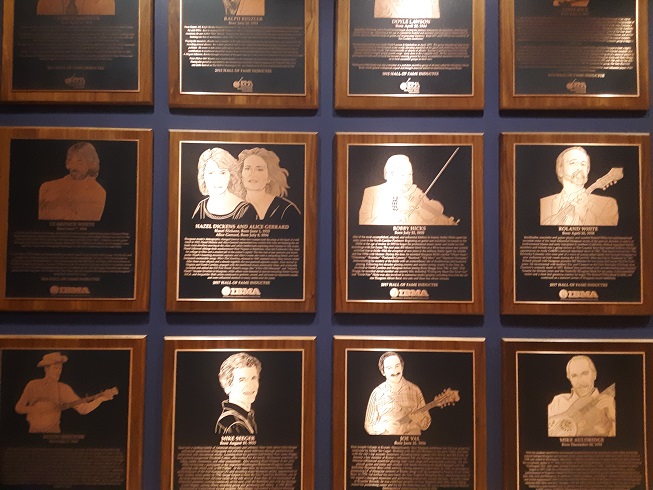
The second floor had the Hall of Fame member display. It was great to see all of the artists, radio D.J.’s, and promoters that made bluegrass music famous and have kept it alive. Two plaques that I definitely wanted to see were of guitarist Clarence White and his brother, mandolinist Roland White. Clarence was inducted in 2017, with Roland inducted in 2018. I was disappointed in the fact that the brothers’ plaques were not next to each other, separated by two other 2018 inductees. I made the suggestion to move Roland’s next to Clearance, as it would be spiritually important for the brothers to be together again. Hopefully that move will be made soon.

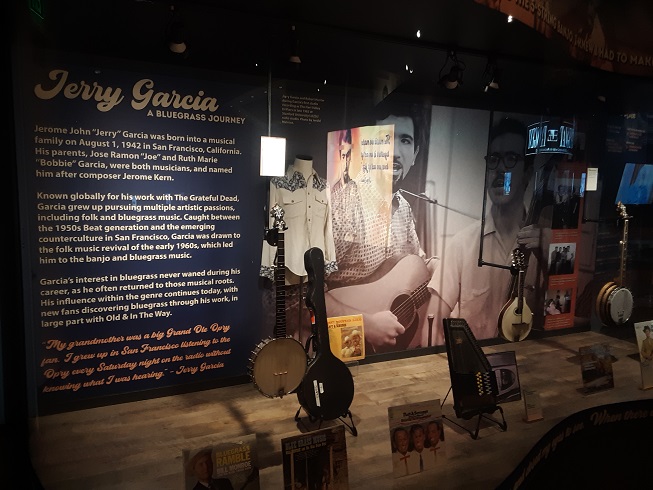
Also on the second floor was one of the main reasons that I made the trip — The bluegrass dedication to Jerry Garcia. While I have never been a big fan of the Grateful Dead, I have always valued Garcia and his love and respect for all roots music. He started out playing folk music, moving on to playing banjo in the Hart Valley Drifters before forming the Dead. During the 1970s, while the Dead was taking a break, he played banjo in the legendary band Old & In The Way. Up until his death in 1995, he was continuing to perform acoustic music with various side projects.

I totally recommend anyone into roots music to make the trip to Owensboro (about a 90-minute drive west of Louisville by way of I-64/U.S. 231 through Indiana) and visit the museum. By the way, there is also the Green River Distillery a few blocks away, just in case you need another reason to go.

Chew on it and comment.

Categories
Bluegrass Music

Recommended Book: Bluegrass Odyssey

Here’s another book that I highly recommend, especially if you want to see what the bluegrass music scene was like in the 1960s and 70s. The authors traveled the bluegrass circuit as it was transitioning from the dive-bar circuit to fresh multi-day festivals, and documented the adventure with hundreds of photographs and brief text interludes.

Originally published in 2001, the book has had a number of reprints, mainly due to the historical significance of the photographs held within. There is humor, sorrow, drama, and celebration throughout the pages.

Carl Fleischhauer worked for a number of years as a photo-archivist at the Library of Congress, while Neil V. Rosenberg has served as a professor of folklore at the University of Newfoundland as well as authoring a number of other bluegrass history books. These two knew the importance of the American music format and how it shaped its corner of the music industry. Thus, they embarked on a two-decade journey to ensure that future bluegrass fans would know where the music came from in a visual format.

Chapters include “Intensity,” which looks at the artists dedication to the craft, whether it be Flatt & Scruggs performing at a festival in Ohio or Earl Taylor sweating it out at a bar in Cincinnati.
“Destination” captures the results of the authors’ travels throughout the eastern part of the US, particularly festivals in the Appalachian Mountain region as well as bars in Ohio, Maryland, and Washington DC. This chapter also begins to show where bluegrass hid in other spots, such as barber shops, television repair shops, and musical instrument stores. “Transaction” expands on the locations, including recording studios, radio stations, sale tables at festivals, and backstage at the Grand Ole Opry. “Community” looks at the interactions of musicians, as well as the personal communication that bluegrass artists have with their fan base, which is extremely unique in the music industry. “Family,” of course, looks at the multi-generational family bands that have graced bluegrass stages, including Earl Scruggs and his sons, the Lewis Family, and the Stoneman family. Finally, there is “The Monroe Myth” chapter, which takes a look at the Father of Bluegrass’ work with his band, guesting with other bands, as a festival organizer, and his love for his family.

There are so many important photos within the pages that mark important parts in bluegrass history for the time. A wonderful example is the photo collection of guitar legend Clarence White, performing with a new edition of the Kentucky Colonels at a festival shortly before his tragic death. White had just recently quit the rock band the Byrds to perform again with his brothers because he so missed playing bluegrass. Included is also a photo of Clarence talking to future bluegrass guitarist David Grier, then a young boy, and a picture of the White brothers talking to legendary fiddler Kenny Baker during a Bill Monroe performance.

Yes, there are plenty of big-name bluegrass performers appearing in this book, but there are also a number of local musicians that probably never saw any success, but played for enjoyment and passion. That is what makes bluegrass music so unique – that it survives as a true community.

I highly recommend getting a copy of Bluegrass Odyssey. My current copy is so dog-eared from multiple readings that it has a life of its own. If you are a fan of bluegrass music, this book will give you plenty of reasons to enjoy it when you don’t have your instrument in your hands.

Chew on it and comment.

Categories
Bluegrass Music

Roland White RIP

Friday, April 1st saw the passing of one of the true gentlemen of bluegrass. Roland White, mandolin player and teacher for over six decades, died at the age of 83 from the effects of a heart attack from a few days prior. Legendary does not begin to describe Roland, although he was not as observed in the bluegrass scene as other mandolinists in the past few years.

Roland started out in the late 1950s with his family band, including his sister Joanne and brothers Eric and Clarence. Joanne left shortly after formation, and the three soon became The Country Boys. The youngsters performed a number of times on the show Town Hall Party, a country music program broadcast out of California during that time. Through the support of guitar great Joe Maphis, the group changed its name to The Kentucky Colonels, and they became extremely popular in the Los Angeles area. They also appeared on two episodes of The Andy Griffith Show (still as The Country Boys).

Roland joined the service in the early 1960s, during which time Clarence took more instrumental lead roles with the acoustic guitar, and history was soon made on that part. When Roland returned to the band, it recorded the iconic album Appalachian Swing, containing a number of stellar guitar/mandolin lead trades between the two brothers. Bluegrass was losing fan interest by the mid-60s, and Clarence would switch over to electric guitar, playing in Nashville West and later The Byrds. Clarence declined an offer to play guitar for Bill Monroe, so Roland took on the guitarist role in The Blue Grass Boys.

In 1973, the three White boys would reunite as the New Kentucky Colonels with Herb Pedersen and Alan Munde joining. Tragically, after only a few shows, Clarence would be killed by a drunk driver while loading gear into a car, ending this last incarnation of the brothers’ band. Roland would perform briefly with Lester Flatt and the Nashville Grass, then form the influential band Country Gazette with Munde, and remain with that band until 1991. After that, he joined another influential bluegrass band (an one of my personal favorite bands), The Nashville Bluegrass Band. He stayed with NBB until about 2000, at which time he formed The Roland White Band with his wife Diane Bouska.

During these past two decades, his name could be found on a number of bluegrass albums as guest mandolinist, including with Marty Stuart, Clint Black, Bernadette Peters, Ricky Skaggs and Ry Cooder. He also dedicated much of his time to teaching, serving in festival workshops and publishing a number of mandolin lesson books. He never let the public forget about the influential work of his guitarist brother Clarence, publishing a book of guitar transcriptions entitled The Essential Clarence White – Bluegrass Guitar Leads.

Roland was always a welcome sight at Nashville establishments like The Station Inn. When he walked in the room, it was like royalty had just come in. Everyone was in awe of this man, and he was humble enough to appreciate the attention and warm accolades. Whether he was sitting in with a band or just enjoying the show, everyone knew that there was someone special in the room.

I have two wonderful memories of Roland. The first involved a workshop that he was overseeing. A few years back, Roland was visiting relatives in the Detroit area, and scheduled a last-minute workshop at The Ark in Ann Arbor. Word spread quickly, and about 30 people, including me, were in attendance. Roland was extremely friendly and helpful to everyone there, working with many who had just picked up a mandolin only recently. While the workshop turned out to be more for absolute beginners, those of us who had a bit more mandolin experience were grateful to be in the presence of the great man. I was even surprised that Thomas Sneed, mandolinist for The Reeltime Travelers, was sitting next to me soaking in the magic.

My other memory was talking to Roland on the phone for an article on Clarence that I was writing for the now-defunct Bluegrass Now magazine. Roland continually promoted his brother’s guitar work, and was gracious enough to afford me time to talk about Clarence’s work. After that call, we would occasionally email each other (or I would get emails from his wife) updating things going on in Roland’s career. I am blessed with the friendship of country music songwriter extra ordinaire Jim Lauderdale, and have always loved the work that Jim and Roland did when Jim first arrived in Nashville. If you ever get a chance, check out the album Jim Lauderdale and Roland White, recorded in 1979 at Earl Scruggs studio. Also, you MUST secure a copy of Appalachian Swing. It is a true teaching tool for all bluegrass musicians!

Roland will truly be missed, not only for his mandolin work and as a statesman for bluegrass, but for his warm smile and friendly demeanor. He is now playing with The Angel Band.

Chew on it and comment.

Design a site like this with WordPress.com
Get started