Christmas 2020. What a lousy year. Unemployed since April, job prospects suck, and bluegrass shows were practically nonexistent!
Thank God that some of my favorite artists were able to do some performances over the internet. Many thanks to Hawktail, Mile Twelve, April Verch, and my web buddy in Missouri, Jerry Rosa from Rosa String Works! They kept my sanity in place. Festivals were a bust, as well as music conferences, although some were held virtually. Appreciated, but not the same as seeing old friends and networking with new ones face-to-face. Here is Jerry Rosa and his friends doing a bluegrass Christmas jam.
My wish for Christmas (along with world peace, a job, and life back to normal) is to be a better fiddle player, good enough to jam with some people and not sound like a schlep. I try to practice every day, but the last week has been difficult due to getting things taken care of for my mom for the holidays. One thing that I have found myself doing is more research on the history of the violin and fiddle music during the 19th century in America. Interesting stuff that I hope to share in a future blog.
I also need to get back into doing more songwriting. That requires inspiration, and with the pandemic, I haven’t gotten much of that. I need to look harder.
I am not much for the partying and gift-giving with Christmas. I prefer to spend quality time on my own (which upsets the rest of my family). I like to spend time at midnight mass at my church, an old Polish-American Roman Catholic parish where they sing Polish carols (koledy) that echos throughout the building. It is amazing to hear, even if you don’t understand Polish.
I’ll keep this short, so stay safe, and let’s hope for a better 2021. In the meantime, here is the beautiful and talented Sierra Hull, along with the amazing musicians Michael Cleveland and Billy Strings, performing “Santa’s Train.”
Anyway, I bring them up again as they were the source for my latest bluegrass discovery. Through their website (https://www.sisterservants.org/) I learned about the Hillbilly Thomists. Taking their name from a comment made by author Flannery O’Connor, the group of Dominican friars, priests and brothers study intensely the writings of St. Thomas Aquinas. However, some of them are also move by the lyrics of many folk and bluegrass gospel songs. Under the guidance of Father Thomas Joseph White, the rotating group of brethren perform on traditional folk and bluegrass instruments (guitar, bass, banjo, mandolin, fiddle), as well as other traditional and ethnic instruments such as drums, piano, bodhran and accordion.
Seeing them on stage, you would think that you were to be serenaded by an age-old Gregorian chant. However, they pick up their stringed instruments and kick into a religious folk standard such as “Leaning On The Everlasting Arms” or “Poor Wayfaring Stranger.” While it may look strange to the eye at first notice, it becomes apparent that these men of Catholic conviction also know how to jam!
YouTube is filled with videos of the Hillbilly Thomists, whether it be live performances or professionally created music videos. What comes across is that they are religious, but they are also human. They like to have fun. They crack jokes, become self-deprecating about their musical skills, and also love to play secular music (one of the many YT vids shows them jamming to “Whiskey In The Jar”). Take away their robes and dress them in suits and ties, and you would think that they were another great-sounding bluegrass band.
However, it is their conviction to the Lord that makes them special. Jesus and his disciples also loved to laugh, sing, and dance. I do believe that God is looking down on the Hillbilly Thomists and smiling, probably even tapping his foot. Catholicism has always gotten a bad rap when it comes to music. The images of friars walking slowly and chanting in Latin seems to many like a depressing drone. Yet if one really takes a step back, the drone can be enlightening, with fluctuations of tones that the heart reacts to.
The Hillbilly Thomists take this a few steps further. They know that music makes people feel better generally. Moreover, the messages that come across in the standard bluegrass gospel songs are ones of hope, not fear. They also show to others that even priests and brothers can have human fun without insulting God. Theirs is a life of devotion to God and Christ, and that devotion can include singing praises in a popular style of music such as bluegrass and folk.
I urge you to check out a few of the Hillbilly Thomists’ videos and, if moved, purchase the album they releases a few years ago (https://www.dominicanajournal.org/music/the-hillbilly-thomists/). It may help you, as Lucinda Williams says, “Get right with God.”
I hope that all of the readers are having a safe and peaceful Thanksgiving. I’m putting this blog out a bit early because I’m just sitting around lazily on this holiday. I had AMAZING pie from my friend Nik Sanches who owns Rock City Eatery in midtown Detroit. These pies are works of art. The chocolate pumpkin was pure Heaven. If you are in the Detroit area and want a pie for Christmas that will take you over the top, contact Rock City Eatery at the Facebook page: https://www.facebook.com/rockcityeatery/.
OK, now down to business.
There will always be the continuing argument about “what is bluegrass.” Many will tell you that it isn’t bluegrass unless it has a banjo and upright bass. I will be the first to debate that, as I feel that bluegrass music is not a physical structure, but a structure of the heart and soul. Bluegrass is more about the feeling that it gives the listener, whether it be the lone guitar and vocals of Doc Watson, or a full-blown Flatt & Scruggs type ensemble.
This leads me to my feeling of what is “not” bluegrass, despite the physical structure. For the past dozen years or so, CMH Records out of California (https://www.cmhrecords.com/) has put out a Pickin’ On series of recordings that cover various pop, rock, and country artists and put them in what it feels is a bluegrass format. At this time, CMH has 73 albums offered with this series, and a true bluegrass fans will definitely scratch their heads as to why the record company would waste the time and energy with most of the titles.
The series started with typical choices to cover, such as the Beatles, the Grateful Dead, and Bob Dylan. However, it soon became what seemed to be an obsession. Albums covering Metallica (which became its second biggest seller), Creed (really?), John Mayer (you are kidding?), and Taylor Swift (Jeez, there’s even a volume 2!) have popped up. WTF?!?!? A bluegrass tribute to Swift? Who buys this stuff, let alone listens to it? I never heard any of these cuts when I had Bluegrass Junction on SiriusXM, nor on any of the bluegrass programs that I catch on the radio. In all honesty, it sounds more like a bluegrass ensemble (yes, banjo and upright bass) trying to be hip by showing off that they know all of these tunes.
I’ve punished myself by listening to some of these tracks. About 10% could qualify as palpable bluegrass tunes. The remainder literally sound like bad experiments, or at best, acoustic interpretations of pop songs BUT NOT BLUEGRASS. The following is an example that led to this rant. A few weeks ago, I was on YouTube when this video came up as a recommendation:
A cover of the A-Ha pop hit “Take On Me.” Uh, OK. So it has the same instrumentation as one would find with a bluegrass ensemble. However, where is the theme that most bluegrass songs have (lonesome feeling, mother, coal mines, farming)? Where is either the 2/4 clogging tempo or the 3/4 country waltz? And if you are going to tell me that falsetto at the end of the chorus is the “high lonesome” sound, then I have a bridge in Brooklyn that I would like to sell you. Seriously, if a bluegrass band were to perform this to a traditional bluegrass audience, the best that they would get is stares, if not heckles. On the flip side, most jamgrass audiences would consider it a joke (I could be wrong, but try me).
In short, if one is going to put up the argument of “it ain’t bluegrass unless it has a banjo,” then one can easily offer up that “just because it has a banjo doesn’t automatically make it bluegrass.”
With the COVID thing going on, most musicians and bands have had to cancel live performances. To make up for the lost income, the more industrious performers are either doing virtual concerts, stepping up to online teaching, or being creative on sellable swag.
So most of you know that I am a contributing writer for Fiddler. In my years of writing for the magazine, as well as my involvement with the bluegrass music scene, I have become friends with a lot of bluegrass fiddlers.
Two fiddlers that stand out in my friendship are Brittany Haas of Hawktail, and Bronwyn Keith-Hynes of Mile Twelve. Both are amazingly talented, as well as absolute sweethearts. They can call me any time if there is something that I can do for them, and are always there if I need a quick quote for an article. Something both of them have done (apart from each other) that I absolutely applaud can prove to be a great gift for the holidays.
Fans can only purchase so many CDs and T-shirts to keep bands afloat. A few months back, Hawktail made available 12-by-18-inch prints showing musical notation of songs from the albums Unless and Formations. Printed on parchment style paper, it looks as if it was taken from sheet music printed over a hundred years ago.
As for Bronwyn, she has recently released her solo album Fiddler’s Pastime. One of the more clever items available on her website is a handwritten page of musical notation from one of the songs on the album. Viewing it, you actually see what Bronwyn sees, hears, and thinks as the pen meets the paper.
Why do I bring up these two visual items up? Because they are awesome to say the least! Frame them, and you have a fantastic gift for someone into either or both artists. If you cannot find a fan, them get them for yourself!
Hanging a painting of a portrait or landscape on your wall is so typical. As I am a music aficionado, what hangs on my walls is mostly music-related, such as concert photographs and posters. Now, I will include framed music notation. There are a number of reasons why putting this on your wall is a plus. Here are just a few:
It is a lot more eye-catching than the typical painting.
As you look at it, you tend to create the shown melody in your head.
If you are not so competent on a musical instrument, you can at least follow what is written when you listen to the song.
You are getting inside the performers’ heads.
While some people do frame and hang old piano music, it is usually done as more of a historic representation, or perhaps enjoyment of the cover illustration. That type of printed music was meant to be read and performed, not framed. However, in the case of Hawktail and Bronwyn (and perhaps any other musician/band doing the same thing that I am not aware of), the music has already been presented in a listenable format. Now, these artists want to show you what the music looks like, perhaps even why they took it in a certain direction.
The most heartwarming thing about these printed notations to me is that the artists wanted the listener to be a part of their process and outcome. It makes the music more encompassing, just like reading liner notes of an album WHILE you are listening to it. There is so much more to soak in from the music as you look at the notation. I hope that others appreciate these personal connections like I do.
I received my November 2020 issue of Bluegrass Unlimited yesterday. Now that it is being published by the Bluegrass Hall of Fame & Museum, one could expect a few changes in the appearance. Well, a lot has changed visually, and here’s my take on it.
A first glance at the cover tells you that there is a new sheriff in town. Gone is the laid-back look of a sit-down magazine. Instead, we are treated to a more in-your-face look. The use of multiple fonts can give your eyes a workout, to say the least. The design leans more toward a fashion magazine. Instead of simply stating who or what will be covered within the pages, the cover shouts what is ahead with subtitles.
Opening the magazine, one can see that larger advertisements for instruments and accessories seem to remain the same, although there seems to be a lot less of them than before. This could be due to the Coronavirus (lack of festivals scheduled for 2021) or an editorial choice. There are also a lot less half- and quarter-page ads. The departments in the early pages (General Store, Notes & Queries) are still there, although it is a bit confusing to read with all of the new fonts on text and titles. Also, before N&Q, there is a new column called The Tradition that seems to be an op-ed style essay on a specific time/date in bluegrass (in this case, it is about one of Bill Monroe’s quotes and how it originated).
Featured articles are now each part of a section. Before, there seemed to be a flow of the cover story, a few other artists’ stories, an article on a popular festival, then concluding with a bluegrass gospel artist profile. Now, there are sections on The Artists, The Sound (apparently covering instrument makers and dealers) and The Venue (covering festivals and concert halls). As for the artists, there are the usual A-list articles, but there is also an article on Lindsay Lou, a performer more in line with the jamgrass and progressive grass culture – something not usually found in the previous incarnation of the magazine. Personally, I like seeing a more diverse listing of artists. I was finding the previous coverage a bit tedious, with some artists being interviewed only a year or two after an earlier article. However, I do see the possibility of some traditionalists complaining.
The rear of the magazine contains the stalwart inclusions of reviews and the national survey. As for the reviews, there seems to be a lot less included, with only the more outstanding albums appearing. The old BU used to have a good handful of mini-reviews that were helpful to interested parties. Also there are no book reviews, only announcements.
This issue includes the yearly Talent Directory. In previous years, the directory was about a dozen pages of small print listings of artists that sent in their particulars. This year, the print is bigger, there are a lot less artists listed (deadline concerns?), and a few of the more popular bands have photos along with their listing. My listing is in there (actually, it is in there twice due to a printer error), but I do not remember an offering of publishing a photo for payment (the listings are free).
There is one big amateur slip-up here. An article in the Tradition section covering a tribute to guitar luthier Preston Thompson was incomplete, with no “continued on page XX” or conclusion. Given that it’s the premier issue from the HOF, one can understand, but the managing editor Dan Miller has handled print magazines in the past and should have caught this before sending it to printer. He does have an editorial introduction at the front of the magazine outlining the intent of the publication. These op-eds rarely appeared in the previous incarnation of BU, so it will be interesting if this continues.
Overall, one could see that the magazine is looking to get more readers, especially ones outside of the normal bluegrass scene. One thing is for sure, it does not look anything like the old style. In fact, one could easily mistake it for American Songwriter Magazine, as the look is nearly identical. The editorial slant also seems to lean more toward its Americana counterparts than the magazine ever did previously.
Only time will tell how BU will weather the future. As it is the only true print magazine covering bluegrass exclusively, readership should not change much. They may gain some hipster types but lose some hard-nosed traditionalists. If they are trying to be more like AS, I do hope that they don’t follow its editorial path and become a lot more politically liberal based. That is the reason I stopped subscribing to AS. I wanted to read about music in a music magazine, not politics.
First, my heart dropped this morning when a buddy texted me that Jerry Jeff Walker passed away at 79 years of age. I don’t know of anyone who hasn’t heard his classic song “Mr. Bojangles.” It is a standard up there with “Gentle On My Mind” and “Yesterday.” But Jerry (real name Ronald Clyde Crosby) was way more than that. His catalog was amazing to say the least. There were the humorous and crazy tunes like “Trashy Women” and “Pissing In the Wind.” Then there were the tender and heartfelt songs like “Navajo Rug” and “Morning Song to Sally.”
He was from New York, did some time in Greenwich Village, but moved to Austin, Texas and helped to create the city’s live music scene. Once could say that he was Texas’ favorite adopted son. He lived the rowdy lifestyle (he wrote “Mr. Bojangles” after an experience in a jail cell arrested for intoxication), but was always humble and giving. He helped Guy Clark get noticed by recording Clark’s songs “L.A. Freeway.” Legend has it that he influenced Jimmy Buffett to move to Key West, Florida.
Jerry spent his last few years in the grips of throat cancer, the one ailment that only the Devil could place on a singer-songwriter. He continued to write until this past week when he died. His songs are timeless, stories that are not so much feel-good/happy-ending types, but ones that are truly descriptive, soul-wrenching, and life-like.
Thank you, Jerry, for showing all of us other songwriters how it is done.
Late last week Sturgill Simpson released Cuttin’ Grass Vol. 1, a collection of his own songs done bluegrass style. I love Sturgill! Not just the fact that his songs are fantastic, but I love his attitude that he has taken toward the country music industry. After winning “Best Country Album” at the Grammy Awards in 2017, the industry didn’t even bother to invite him to the following year’s CMA awards. So what did he do? He busked in front of the theatre that evening. That takes balls!
With the release of the bluegrass album, he did some crazy stuff like putting lawncare signs on music biz buildings in Music Row (https://www.whiskeyriff.com/2020/10/20/sturgill-simpson-continues-his-a-cma-trolling-puts-ddss-lawn-care-sign-in-front-lawn/). He has also been very vocal on the way Merle Haggard was treated by the industry in the years before Haggard’s death. Well done! And while I’m not in agreement with a lot of Sturgill’s politics, I do applaud him for doing legwork and not just talking the talk.
However, my gripe here is how he has chosen to release his bluegrass album. While the streaming version was released last week, the CD will not be available until December, and vinyl is not available until January! While mainstream pop markets are pretty much going the streaming/download route, there is still a large fan base in the roots-music formats that crave the physical part of owning music, myself included. We want to be able to hold in our hands something that is attached to the music. The album cover means a lot to us. We soak in the liner notes, the musician lineup, the choice of photos and artwork. We involve our sight and touch sensory functions along with hearing. This becomes a disappointment to say the least, and may involve me forgetting to purchase the album next month.
This is not to say that streaming and downloading should be banished. If there is an audience for it, then by all means, market that as well! It also serves its purpose in the music business area. I was contacted by a musician who was releasing her album in two months, but wanted me to listen to the songs beforehand so that I could review it for a magazine. She sent me the download link, and I was able to get the review published right about the time the CD was becoming available. Perfect!
But with downloading as a primary or only way to purchase music, especially with bluegrass or other roots music formats, it is one way to lose music fans like me. I am from the old school. Like I said above, I like the physical aspect of being a music fan. I also like having a big stereo system. Downloading music to your iPhone or MP3 player and wearing ear buds makes that music private and closed in. The stereo system lets others know what I am listening to as well. It fills the room, not just my head.
CD sales are down because of the music industry, not the music fans. The industry will still charge you a dollar for a download, which when considering that the average album has about 12 or 13 songs, it’s the cost of a CD anyway, but they don’t have to manufacture anything. They save that cost. It is also more difficult to track download sales for the performance right organizations like ASCAP and BMI. Thus, songwriters get cheated out of royalties. Vinyl sales are still rising thanks to hipster audiophiles. However, that rise is still not enough to get the money collected by the record companies into the hands of the workers that deserve and earn it. Besides, I like having a wall of CDs towering over me.
Sturgill has a lot of top-notch bluegrass artists like Tim O’Brien, Sierra Hull and Stuart Duncan appearing on his album. Fans of these musicians will gladly bring Sturgill into the bluegrass fold. Most of the bluegrass fans still rely on CDs. He is making a big mistake by not making his bluegrass album available in CD so that roots-music audiences can fully enjoy his work.
Eddie Van Halen RIP – There wasn’t a lot of coverage in the news of his death, but anyone that grew up in the 80s or was a big music fan took notice. I was never a big fan of Van Halen, but I did know that Eddie was an amazing guitarist. He is LITERALLY up there with Hendrix, Clapton and Page. He may have not been the first to try out double-tapping on the guitar fretboard, but he perfected it and made it an art form. There was not a lead guitarist in any hair metal band that did not emulate Eddie. He had his demons with drugs and alcohol, but had a great demeanor. I have never seen an interview with someone that, when asked about Eddie, that person talked about how humble of a guy he was. I remember seeing a cable television tribute to Les Paul many years ago, and all of these guitarists came on stage to laud over Les. Eddie went one step further and hugged and kissed the man. His last years in life were fighting throat cancer, which eventually took his life. He will be missed by many, especially other musicians, but his guitar work on Van Halen recordings as well as others (that was his magic playing lead guitar on Michael Jackson’s “Beat It”) will never be forgotten. Rest easy, Eddie, you have definitely changed the music world for the better.
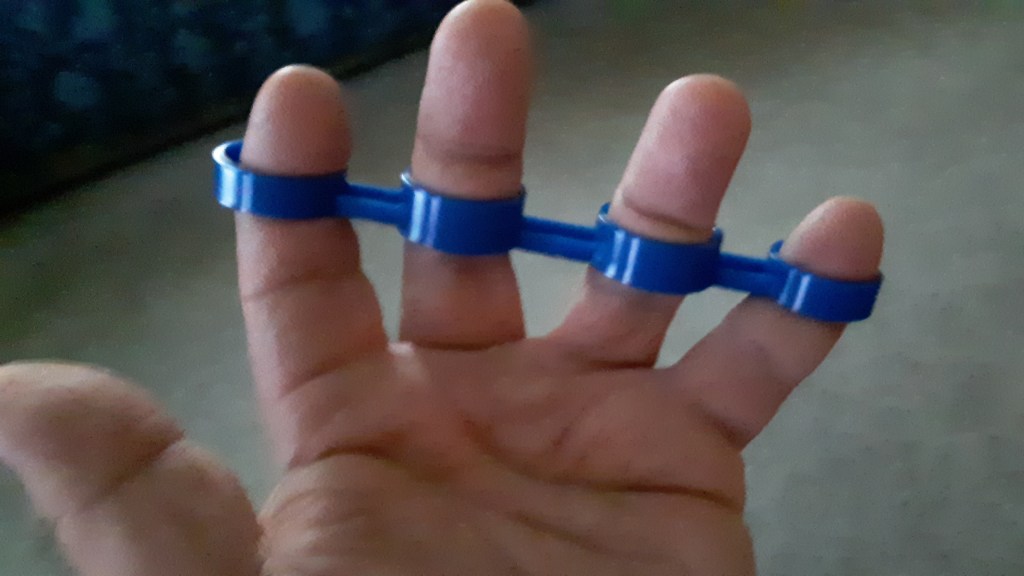
Finger contraption – My fretting/fingering hand for guitar, bass, mandolin, and fiddle has never had great dexterity. I could never get that pinky finger to stretch out for that illusive fourth fret, or have enough strength to form a true barre chord. I relegated my fingerings to a lot of open chords and lead playing rarely went past the ring finger. So a few weeks ago, while ordering some music stuff off of the Wish website, there was a deal that if you purchased a certain amount of items (which I did), you get a huge discount on a few other related items. There wasn’t much to choose from, so I ordered a finger stretcher. It is four plastic rings spaced apart in a straight line. You slip your fingers through the rings, and press down on the contraption as far as your finger spread will allow. Yeah, it looks like something from the Spanish Inquisition and was painful the first few times, but I have been doing this every day for about 20 minutes, and I have noticed that the pinky on my left hand does have a little better stretch. Playing the fiddle lately, I find it easier to finger those high notes. I’m not sure if this thing is doing the job, but I got it for next to nothing, and if anything, I feel like it is helping. If you can get one of these things for under a few bucks, and you have trouble stretching the fretting fingers, you might consider trying one of these gigamadoos.
IBMA Awards – The awards were handed out last week, and here is a list of the winners: https://bluegrasstoday.com/2020-winners-of-the-international-bluegrass-music-awards/ . I would have taken the list off of the official IBMA website, but they still have not posted it yet. I’m glad to see my friends Mile Twelve winning Best New Artist, and another good friend Becky Buller winning Song of the Year (“Chicago Barn Dance”) and Collaborative Recording of the Year (“The Barber’s Fiddle”). Talk about a Who’s Who of bluegrass fiddling, check out the video.
Glarry: I picked up another fiddle, this time from Glarry. This is the model GV306, the most expensive violin they carry. At $89.99, that is really not expensive. I based the purchase on a review from my hero, Jerry Rosa at Rosa String Works. I am relatively satisfied with it. There were a lot accessories included (shoulder rest, tuner/metronome) that it wouldn’t matter if they were there or not. One drawback is that it only has a high “E” string fine tuner, not on all four strings like the lower-priced models. I ordered and put on three more fine tuners before setting it up. Another drawback is that the bridge is really thick. I had to file down a lot of wood to make it more like a true violin bridge. I plan to get a better bridge in the future. Finally, the strings that Glarry puts on their instruments are horrible. I’ll be replacing them soon with a decent set. However, the tone of the violin is nice, very woody and low. My other violin sounded like a screech owl compared to this one. It inspires me to keep practicing. The video below is Jerry’s review. The first violin he reviews is the GV306.
Hey! Remember back on May 16, 2020 when my blog was about how the IBMA refuses to recognize Jerry Garcia as a viable influencer on bluegrass music (https://luegra.design.blog/2020/05/16/why-wont-the-ibma-recognize-jerry-garcia/)? WELL! It seems that this year’s World of Bluegrass virtual conference is having a presentation on Jerry and his work with the bluegrass music industry. Hmmm, I wonder where they got that idea from. Anyway, here’s a link to the description in the schedule: https://worldofbluegrass.org/schedule2020/ . It will be on October 1 at 11:00 am. I’m not expecting a thank you from IBMA, if you want to know.
Last Saturday the Southeast Michigan Bluegrass Music Association had its annual Hall of Honor ceremony. I was proud to see that Marvin “Red” Ellis was inducted. I wrote about him in a previous blog (https://luegra.design.blog/2020/03/15/red-ellis-and-the-forgotten-history-of-michigan-bluegrass/), and will continue to research the history of bluegrass music in the Detroit area. On a related note, there was a good article on the Miller Brothers in the September 2020 issue of Bluegrass Unlimited. The Miller Brothers were originally from Kentucky, lived for a while in Indiana, them moved up to the Detroit area for auto factory work. While in Michigan, they recorded a few bluegrass albums in the early 1970s. They are definitely a group that I hope to research more for the SEMBMA Hall of Honor.
Speaking of SEMBMA, the Association is now awarding scholarships to youth 13-18 years of age who are interested in pursuing further education with bluegrass music. The scholarships will be paid directly to the instructor/institution, and lessons can be in-person, over the internet, or some form of video. Students can be studying a stringed instrument (guitar, bass, banjo, mandolin, fiddle, dobro, autoharp) or studying vocals. For more information on the scholarships and to secure an application form, go to http://www.smbluegrass.org . Submission deadline is January 1, 2021 and may require a personal interview of the applicants by SEMBMA board members and/or the scholarship committee.
Late to the Party Department: I just discovered that Circle TV (www.circleplus.com) is available in my area over the air (I don’t have cable, and my mom’s cable service sucks to say the least). I don’t watch television much, maybe an hour a day, but now that I can watch Circle, I may make use of it since the pandemic still won’t let us go to see live music. I get to watch the Opry on Saturday night (although host Bobby Bones irritates the crap out of me), reruns of Hee Haw and The Beverly Hillbillies, some Ditty TV programs, Daily & Vincent, and even some CMA songwriter programs. Pass me the Doritos!
YouTube fiddle lessons videos: I may have mentioned FiddleHed here before, but if not, I highly recommend checking him out, even if you don’t play fiddle. I have an article on him for Fiddler magazine coming up in the Winter 20/21 issue. I bring him up because he is one of the few that actually “teach” the tunes. I recently did a search for fiddle instruction for the Bill Monroe song “Uncle Pen.” A lot of videos came up, but most of them were hardly instructional. They are usually just a camera pointed at the fingerboard during the “lesson,” and no slow downs or explanation of what the fingering is. That is not instruction, that is just showing off that you can do the lick. Thank you again, FiddleHed!
I’m big on updates. Every time I read a book or watch a documentary that overviews a subject and I see that the copyright date being over a decade old, I’m griping that there needs to be an update. Call me a curmudgeon.
My latest update concern is a book on bluegrass music, especially its history and current situation. There really has not been an authoritative book on bluegrass in decades (there have been some book published within the past few years, which I will discuss later). The two bluegrass bibles that most people look to as far as history, artist profiles, and essential recordings are Bluegrass: A History by Neil Rosenberg and America’s Music – Bluegrass: A History of Bluegrass Music in the Worlds of Its Pioneers by Barry Willis. There are other books, but none covered the bluegrass scene like these two. Unfortunately, they were both published in the 1980s, and have not seen any updating (Rosenberg’s book was given a new preface on its 20th anniversary reprint, and Willis’ book saw a second edition in 1992).
I lent out my copy of the Rosenberg book years ago and haven’t seen it since. I still have my copy of Willis’ book, which I picked up for $4.99 when Border’s was going out of business. To give you an idea how much these texts are still valued, a web search shows that a used copy of the Willis book goes for $50.00 and up. The Rosenberg book can still be had for a reasonable price used (around $15.00).
Reading the Willis book is incredibly enjoyable. There are lots of direct quotes from first- and second-generation pickers, which give it that down-home family feel. However, the first generation is all but gone, and second-generation bluegrass musicians are disappearing quickly as well. The scene has changed, and we need to have colloquial conversations with the newer players.
This is not to say that nothing good has been published since the 1990s. In 2004, two great books on bluegrass were put out: The Bluegrass Reader, edited by Thomas Goldsmith, and Homegrown Music: Discovering Bluegrass by Stephanie Ledgin. Both books take a good look at the music format, with Goldsmith compiling a number of insightful interviews with bluegrass personalities, and Ledgin giving a brief overview of styles, instruments and performers, as well as extensive appendices of resources.
However, both of these books are now 16 years old, and a lot has happened in bluegrass since the. Ledgin spotlights an 11-year-old Sierra Hull, who is now 28 years old, a graduate of Berklee, and has a number of albums and awards under her belt. There is a need for some coverage of the most recent generation of bluegrass artists such as Billy Strings, Molly Tuttle, and Sarah Jarosz to name a few. Nickel Creek was getting some notice back then, but now all three members have tons of achievements on their resumes.
I think about all of the bands that have had an impact in the past decade and a half. Some have come and gone, while others still carry on. Bands like Della Mae, Mile Twelve, Flatt Lonesome, Sideline, and the Becky Buller Band are the tip of the iceberg. While Ledgin has a large list of resources in the appendices, many of these publications and companies listed are no longer in business.
Yes, an updated almanac on bluegrass music is needed in order to keep the attention of the younger generation interested in the genre while still holding on to the older fans. While the music continues to move forward, it also needs to have excellent representation with its history and archival notes.
Short note: Bronwyn Keith-Hynes, fiddler for the bluegrass band Mile Twelve, has recently put out a solo album entitled Fiddler’s Pastime. This is one of the best fiddle albums that I have heard in a while. It goes beyond bluegrass. If you want to hear some tasteful fiddling, consider picking up this disc.
I was recently scanning the articles on the Bluegrass Today website and came up on the following op-ed from former International Bluegrass Music Association employee Abby Lee Hood:
I recommend a full reading of it, but in short, Hood suggests that the IBMA stop using the statue of Sir Walter Raleigh as part of its World of Bluegrass advertising representation. The image is of the statue of Raleigh (namesake for the city in which WOB is held yearly) with a banjo slung over his shoulder. Cute, funny, eye-catching. But Hood thinks that the use of Sir Raleigh is offensive since he had reportedly murdered native Americans while attempting to colonize early America for the English.
Of course, the comments to her editorial were about 90% against. Most people saying what I stated in the previous paragraph and that bluegrass music should not get involved with politics.
Well my friends, it is much too late for that. It is about time I talk about why I resigned from Leadership Bluegrass and no longer am a member of the IBMA (which I have hinted at in previous blogs).
I was a member of Leadership Bluegrass Class of 2014. I met some fantastic people there in the bluegrass music industry, many of whom with which I still stay in contact. Our chat group was continually discussing concerns about promoting various aspects of the music. Then around 2017, things started to change. The California Bluegrass Association participated in a gay pride parade with a float that had IBMA signage on it. This was never approved by the IBMA, but the executive director (Paul Schiminger) and the board did nothing to prevent it or reprimand the party. Soon after, there was praise on the chat group for this person taking that initiative. Then, there was a debate regarding boycotting the WOB at Raleigh because of North Carolina’s stance on transgender people using the bathrooms of their choice. This was obviously a few vocal people speaking for themselves and not the membership, which is very family-oriented and ripe with Christian values. Those vocal members also made it a point that if anyone had a dissenting opinion, they were considered bigoted and should not be heard from (sound familiar?).
I decided that it was at the point that I should resign from Leadership Bluegrass, since it seemed that the direction of LBG (as well as the IBMA in general) was straying away from the association’s Mission Statement: “The IBMA is the non-profit music association that connects, educates, and empowers bluegrass professionals and enthusiasts, honoring tradition and encouraging innovation in the bluegrass community worldwide.” I sent in my LBG membership identification materials to the IBMA office with my letter of intent.
I received a phone call from Mr. Schiminger a few days later, and we had a productive discussion on the matter. However, my mind did not change, and I did not renew my IBMA membership when it became due later that year. I also discussed this with one of my songwriting partners, which did not change my mind either.
As the years have rolled on, I have noticed that the IBMA has taken a stronger political stance (leaning left), and seem to be negligent of understanding the values held by a large contingent (probably a large majority) of the membership. Recently, the IBMA was supportive of the Black Lives Matter movement (go to that organization’s website to read about its Marxist agenda) by participating in a Blackout Tuesday with its website. Yet they have never spoken about the vandalizing of the Bill Monroe statue that stood in front of the Ryman Auditorium in Nashville, which was done by the BLM protesters back in June.
Former IBMA employee Abby Lee Hood has been a voice in the leftist protests (check her Twitter account). She worked for the association for a few months in 2019, yet her influence has had an impact on Mr. Schiminger, the current staff, and the board members. The thought of promoting bluegrass music in the community has become secondary to the appeasing of the left. It has only been in the last two years that “Diversity and Inclusiveness” has been added it the Values section. The IBMA doesn’t want to offend anyone that is so easily offended and will resort to violence if their demands are not met.
What do I see in IBMA’s future? Well, just like every other association surrendering to the Woke generation, there will need to be a certain ratio of minority and gender-based members on the board, with no concern of their expertise in the bluegrass music industry, but only to make sure that those lifestyles are represented. Perhaps for the yearly awards given out, the removal of the Gospel Recording of the Year replaced with, say, Inspirational Recording of the Year, so as to appease the non-Christians and atheists. We may even see a removal of all images and references to Bill Monroe. Yes, he is considered the Father of Bluegrass Music, but he also participated in comedy routines early in his career that consisted of blackface performers. Think about it.
Part of this left-move by the IBMA is the fault of the membership. Most do not really care about politics, as long as the WOB presents a lot of great bluegrass talent during the fan fair days in Raleigh. It is about time the membership take a look at what the IBMA does with the money it gets from its members. There are a lot of great programs that the association has continually presented. However, some are becoming political and PC-correct so as not to offend the few that are vocal.
I suggest that if you are a IBMA member, then you should thoroughly read the associations’s website (http://www.ibma.org), closely examine what the association does in comparison to the Mission Statement, and if you are confused or have concerns, then contact the IBMA office or one of the board members. It it their job to listen to your concerns.
 Luegra