I finally got to the Bluegrass Hall of Fame and Museum in Owensboro, Kentucky after wanting to get there for years! I had a few days off during the Thanksgiving weekend, so I made the eight-hour trek.

First off, just because Kentucky is south of Michigan doesn’t necessarily mean it would be warmer down there. I froze most of the time there and took the wrong jacket. But it was still worth it to go. I thought that the building would be larger than it is, but the work done with displays and exhibits use the space perfectly.
Walking into the museum, one is met by a friendly worker that explains all of the rules and features. You are given a Walkman-style device that narrates parts of the museum displays by programming in the number on the wall next to the display. To be honest, I didn’t use it much, as I already knew the history of the photos and items. And those items were fantastic to see! Carter Stanley’s Martin guitar, Bill Monroe’s Rolodex that had all of his business contacts, John Hartford’s banjo, and Uncle Pen’s fiddle. There was a video accompanying the fiddle showing a number of bluegrass fiddlers playing the legendary instrument. The best was when Ricky Skaggs, after playing the fiddle, says, “That’s got some stank to it!”
There was a display of some of today’s popular bluegrass acts. I was happy to see my “kid sister,” Vickie Vaughn, in a photo with her band Della Mae.

One other great section is a bunch of acoustic instruments hanging on a wall that are purposely there for visitors to try and play. Bluegrass has always been a format that common people play, so it makes sense for that music to be accessed easily by the people attending.
One of the best displays was dedicated to bluegrass history coming from the Cincinnati/Dayton, Ohio area. Banjoist Joe Mullins narrated the video, showing all of the locales that bands like the Osborne Brothers and J.D. Crowe performed, as well as radio stations and record companies such as the legendary King Records, home of the Stanley Brothers, Reno & Smiley AND James Brown!
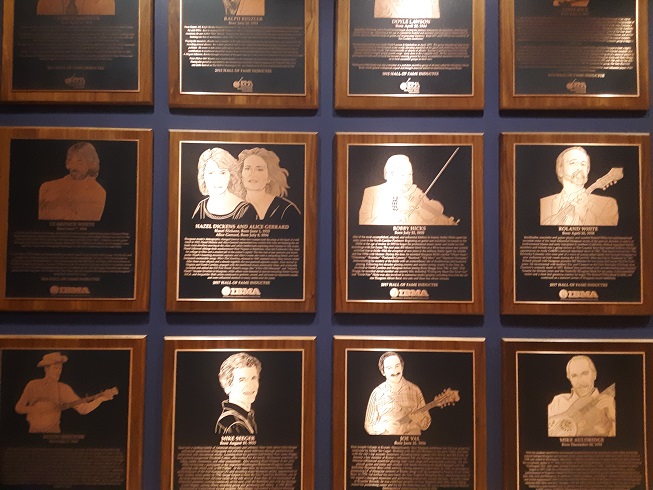
The second floor had the Hall of Fame member display. It was great to see all of the artists, radio D.J.’s, and promoters that made bluegrass music famous and have kept it alive. Two plaques that I definitely wanted to see were of guitarist Clarence White and his brother, mandolinist Roland White. Clarence was inducted in 2017, with Roland inducted in 2018. I was disappointed in the fact that the brothers’ plaques were not next to each other, separated by two other 2018 inductees. I made the suggestion to move Roland’s next to Clearance, as it would be spiritually important for the brothers to be together again. Hopefully that move will be made soon.
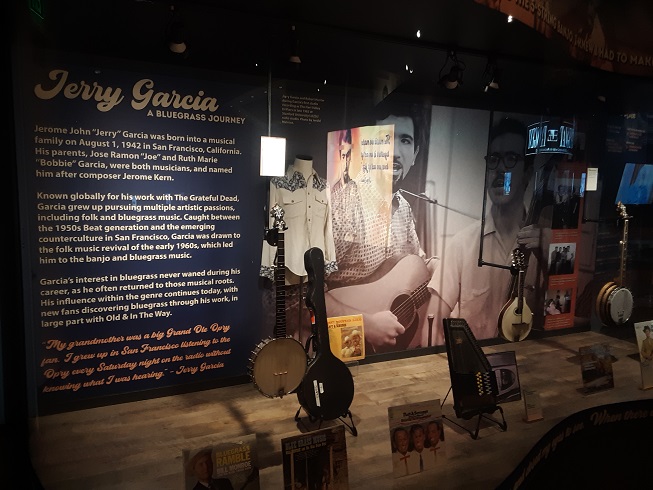
Also on the second floor was one of the main reasons that I made the trip — The bluegrass dedication to Jerry Garcia. While I have never been a big fan of the Grateful Dead, I have always valued Garcia and his love and respect for all roots music. He started out playing folk music, moving on to playing banjo in the Hart Valley Drifters before forming the Dead. During the 1970s, while the Dead was taking a break, he played banjo in the legendary band Old & In The Way. Up until his death in 1995, he was continuing to perform acoustic music with various side projects.
I totally recommend anyone into roots music to make the trip to Owensboro (about a 90-minute drive west of Louisville by way of I-64/U.S. 231 through Indiana) and visit the museum. By the way, there is also the Green River Distillery a few blocks away, just in case you need another reason to go.
Chew on it and comment.
 Luegra