Categories
Bluegrass Mandolin Bluegrass Music

David Grisman at 80

I was reading an article online about a show that David Grisman was doing in Seattle to celebrate his 80th birthday. I had to look twice and research the information, and yes, on March 23rd, David “Dawg” Grisman will be turning 80 years old. Grisman has always been one of my favorite people in the bluegrass field, especially as he loved to push the boundaries of traditional bluegrass to include rock, jazz, blues and klezmer, which critics and fans alike labeled as Dawg Music.

The way that young girls follow Taylor Swift’s every action, my buddy Ken and I always had a keen interest in the bluegrass musicians that gathered in other musical influences to create the Newgrass movement that began in the early 1970s. Along with New Grass Revival, John Hartford, Tony Rice and the Seldom Scene, Grisman made a name for himself with other musical formats while still keeping one foot in bluegrass.

Somewhat of a musical prodigy on the mandolin, though he also played piano and saxophone in his early age. He grew up in the Jewish community of Passaic, New Jersey, but discovered folk and bluegrass while attending New York University. He was a member of Red Allen’s band The Kentuckians, and also recorded with Hazel Dickens & Alice Gerrard on their early beautiful Folkways recordings. He delved into rock music with former Blue Grass Boys guitarist/vocalist Peter Rowan to form the short-lived Earth Opera. The two would also form the legendary bluegrass band Old & In The Way with Vassar Clemens and Jerry Garcia. His friendship with Garcia lasted for decades. He recorded on the Grateful Dead’s American Beauty album, with standout work on the songs “Ripple” and “Friend of the Devil.” During this time, he also worked with Rowan, Richard Greene, and Clarence White in the band Muleskinner, which disbanded due to the untimely death of White. Only weeks prior to White’s death, the band performed on a local television show in California, meant to be a warm-up for an appearance of Bill Monroe which did not happen. Fortunately, a video of the band’s performance was saved and is available as Muleskinner Live.

In the 1970s, Grisman formed the David Grisman Quintet, which had a revolving membership that included Darol Anger, Tony Rice, Mark O’Connor, and Todd Phillips among others. He recorded a number of Dawg Music albums during this time, which were critical favorites, and are cherished mainly by Deadheads.

The Garcia/Grisman collaborations continued throughout the years, with gems such as Jerry Garcia/David Grisman and Not For Kids Only. A wonderful documentary on their relationship was released in 2001 called Grateful Dawg, directed by Grismans’s daughter Gillian. The film includes a number of live performance by the duo which are near perfection. Probably the best storied collaboration was with the two and Tony Rice. During two evenings in February 1993, the three musicians sat down in Grisman’s home studio and recorded a number of standard folk and bluegrass tunes. A copy of the tape somehow got into the hands of a pizza deliveryman, and within months, the songs form the recording were being bootlegged across the country to thousands of Deadheads. At first angered, including confiscating bootlegged CD, Grisman eventually released some of the recordings in 2000 as The Pizza Tapes (an extended version was release online in 2010).

In 1990, Grisman formed Acoustic Disc, a record label that would specialize in unique bluegrass, folk, and jazz recordings, particularly live performances. Along with The Pizza Tapes, the label has released other recording by Grisman, Rice, Jesse McReynolds, Old & In The Way and Doc Watson. The label’s catalogue is a wealth of great acoustic music, and I personally have at least a dozen releases from there.

Grisman was FINALLY inducted into the International Bluegrass Music Association’s Hall of Fame in 2023. This was an honor that should have been given decades before, as his music was what was getting many younger musicians and fans into bluegrass. He never strayed away from bluegrass music, as his love was so deep that he names one of his children Monroe after the great Bill Monroe.

I saw Grisman only once, and it was at an Ann Arbor Folk Festival many years ago when he performed with Doc Watson. There were a number of bands performing at that festival, but that to me was the highlight, as two legends were trading licks and presenting an acoustic format that forced you to pay attention and appreciate it. My only other connection with Grisman is that we both had music played on the NPR program “Car Talk.” His composition “Dawggy Mountain Breakdown” was the shows theme song.

I totally recommend that you get some of Grisman’s recordings. Traditional bluegrass fans will want a copy of one of the Old & In The Way live discs. Acoustic music fans will love The Pizza Tapes or just about any other album on Acoustic Disc (www.dawgnet.com), and I encourage you to check out the documentary Grateful Dawg as well as the performance of Muleskinner Live.

Happy Birthday, Dawg! You have made my musical life, as well as thousands of others, so much more rewarding and enjoyable!

Chew on it and comment.

Categories
Bluegrass Music

Visiting the Bluegrass Hall of Fame & Museum

I finally got to the Bluegrass Hall of Fame and Museum in Owensboro, Kentucky after wanting to get there for years! I had a few days off during the Thanksgiving weekend, so I made the eight-hour trek.

First off, just because Kentucky is south of Michigan doesn’t necessarily mean it would be warmer down there. I froze most of the time there and took the wrong jacket. But it was still worth it to go. I thought that the building would be larger than it is, but the work done with displays and exhibits use the space perfectly.

Walking into the museum, one is met by a friendly worker that explains all of the rules and features. You are given a Walkman-style device that narrates parts of the museum displays by programming in the number on the wall next to the display. To be honest, I didn’t use it much, as I already knew the history of the photos and items. And those items were fantastic to see! Carter Stanley’s Martin guitar, Bill Monroe’s Rolodex that had all of his business contacts, John Hartford’s banjo, and Uncle Pen’s fiddle. There was a video accompanying the fiddle showing a number of bluegrass fiddlers playing the legendary instrument. The best was when Ricky Skaggs, after playing the fiddle, says, “That’s got some stank to it!”

There was a display of some of today’s popular bluegrass acts. I was happy to see my “kid sister,” Vickie Vaughn, in a photo with her band Della Mae.

One other great section is a bunch of acoustic instruments hanging on a wall that are purposely there for visitors to try and play. Bluegrass has always been a format that common people play, so it makes sense for that music to be accessed easily by the people attending.

One of the best displays was dedicated to bluegrass history coming from the Cincinnati/Dayton, Ohio area. Banjoist Joe Mullins narrated the video, showing all of the locales that bands like the Osborne Brothers and J.D. Crowe performed, as well as radio stations and record companies such as the legendary King Records, home of the Stanley Brothers, Reno & Smiley AND James Brown!

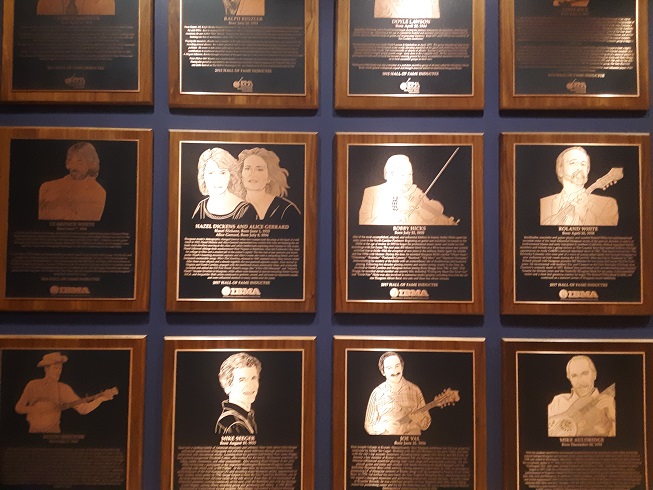
The second floor had the Hall of Fame member display. It was great to see all of the artists, radio D.J.’s, and promoters that made bluegrass music famous and have kept it alive. Two plaques that I definitely wanted to see were of guitarist Clarence White and his brother, mandolinist Roland White. Clarence was inducted in 2017, with Roland inducted in 2018. I was disappointed in the fact that the brothers’ plaques were not next to each other, separated by two other 2018 inductees. I made the suggestion to move Roland’s next to Clearance, as it would be spiritually important for the brothers to be together again. Hopefully that move will be made soon.

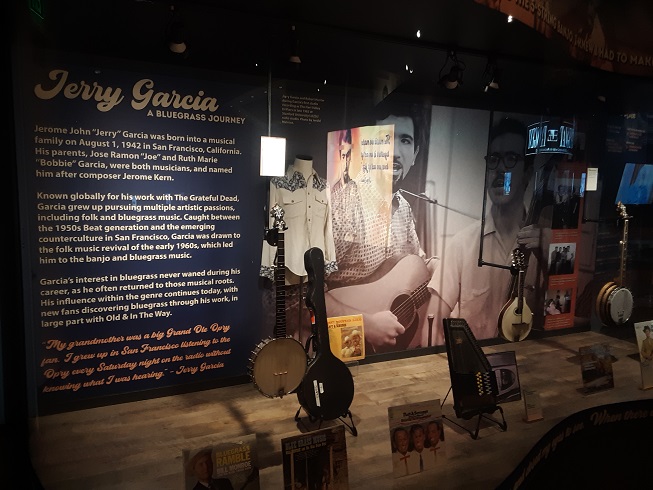
Also on the second floor was one of the main reasons that I made the trip — The bluegrass dedication to Jerry Garcia. While I have never been a big fan of the Grateful Dead, I have always valued Garcia and his love and respect for all roots music. He started out playing folk music, moving on to playing banjo in the Hart Valley Drifters before forming the Dead. During the 1970s, while the Dead was taking a break, he played banjo in the legendary band Old & In The Way. Up until his death in 1995, he was continuing to perform acoustic music with various side projects.

I totally recommend anyone into roots music to make the trip to Owensboro (about a 90-minute drive west of Louisville by way of I-64/U.S. 231 through Indiana) and visit the museum. By the way, there is also the Green River Distillery a few blocks away, just in case you need another reason to go.

Chew on it and comment.

Categories
Bluegrass Music

More About Jerry Garcia and Bluegrass

The March 2024 issue of Bluegrass Unlimited showed up in my mailbox a few days ago, and on the cover was a picture of a young Jerry Garcia playing the banjo. Inside were three articles on him, one dealing with the history of his bluegrass supergroup Old & In The Way, a second looking at his career performing bluegrass and acoustic music, and a third briefly covering the Grateful Dead’s delving into roots music

Ever since the Bluegrass Hall of Fame & Museum took over publication of the magazine, the editor/publisher has been much more varied in its bluegrass coverage. There have been a lot more articles on progressive bluegrass artists, which I find helpful. This coverage of Garcia coincides with the Museum’s upcoming exhibition of Jerry Garcia: A Bluegrass Journey.

Back in May 2020, I wrote one of my early blogs concerning why Garcia hasn’t been considered being entered into the Bluegrass Hall of Fame permanently (https://luegra.design.blog/2020/05/16/why-wont-the-ibma-recognize-jerry-garcia/). More than any other musical artist outside of the bluegrass fold has Garcia been a proponent of bluegrass music. Before his time in the Dead, he was an adamant player of the banjo, despite missing a finger on his picking hand. Even during lulls in the Dead’s recording and touring schedule, he was performing with bluegrass and old-time country music with so many incarnations.

It’s hard not to fathom bands and artists like Molly Tuttle, Billy Strings, Leftover Salmon, Yonder Mountain String Band, and Crooked Still even existing without being influenced by Garcia, if not musically then at least on approach to bluegrass. As much as he was experimental in overall band sound, he was still very loyal to original artists like Bill Monroe, the Stanley Brothers, and Reno & Smiley. Mandolinist Jesse McReynolds was a big supporter of Garcia, recording a number of Dead tunes in bluegrass style.

I can only hope that this exhibition, as well as the dedication of these articles in BU, will push Garcia’s entry into the Bluegrass HOP even closer and sooner. He, through is influence with younger Deadhead audiences and guitar aficionados, helped bluegrass gain a wider and newer fan base than anyone else.

Chew on it and comment.

Categories
Songwriting

Songwriting Requires Inspiration (at least for me!)

I remember when I was playing in roots-rock and alt-country bands 20+ years ago. I could easily write a song each week that I was happy enough to perform live with the band. If I were to have taken one of those “song a day” challenges back then, I would have had no problem with the task at-hand.

For the past few years, more like the past decade, that talent has slowly left me. I still write, or try to write, but it is not as easy. A lot of it has to do with inspiration. Back then, I was hitting bars, visiting places, working with a lot of other musicians, and soaking up the experiences. Ever since I started caregiving my mother when my father passed away seven years ago, which is a full-time job along with my regular full-time job, I have lost a lot of creativity. I am lucky to go out to a show once every three months, my employment is most of my social life, and other than weekly church attendance, I do very little for myself as far as outside activity is concerned.

I started to realize that the need to “get out of the house” for my songwriting a few years back, but it has really hit me within the past few months. COVID took away a lot of that socializing for two years, but the problem was, I got used to staying home and doing very little to stimulate my songwriting. You can only write so much about staying home, and no one wants to hear about that in a song anyway.

I have a songwriting notebook, and right now there are about a dozen bits and pieces of songs in it that I try to re-visit every few days to get re-inspired. I was actually inspired a few days ago with a new song idea at work yesterday. A few lines are floating around in my head, but nothing big. But today (Saturday) is my busy day shopping for mom and the week’s food/supplies. Add to that I have a colonoscopy exam on Monday, so Sunday will be spent taking laxatives and starving. I may get some songwriting done in between trips to the bathroom!

I have tried the route of disciplining myself to sit and write for a few minutes each day no matter what the situation. For a while, I would wake up every morning, randomly open up the dictionary and put my finger down on a word, then write about it for 10 minutes non-stop. Even that didn’t help after a while, I seemed to be writing about my same complaints no matter what word came up.

I definitely need more inspiration. Hopefully this summer things will change. I plan to hit more bluegrass festivals, and perhaps attend a songwriting camp that I believe I mentioned a few blogs back. I need to just jump in my car and drive somewhere. I haven’t visited Nashville in over two years. I would love to go back, I should plan on it this summer. My Songwriters Anonymous group plans to start meeting up live again next month (it has been on Zoom for the past two years, and I do not have a great connection for it on my computer internet system), so perhaps that will motivate me in some way.

I hope to find a co-writer that I can work with regularly soon as well. The few good co-writes that I have done have been with people out of town, and our work has been over the phone or emailing back and forth. I have not found anyone in my area that I am compatible with and is determined to write quality bluegrass music. I am not saying there are not great songwriters in my area. Honestly, I get humbled many times when I go to the Songwriters Anonymous meetings and someone performs a song that floors me. I am just not finding anyone that meshes with my style.

I end this blog with a video from my Kitchen Koncert series. The song is “Brown-Eyed Soldier,” co written with my “bluegrass kid sister,” Vickie Vaughn, who is currently the bass player for bluegrass bands Della Mae and High Fidelity. Recorded during the pandemic lockdown, I attempted to give it a Jerry Garcia acoustic feel.

Chew on it and comment.

Categories
Bluegrass Music

Tidbits: Garcia, Ellis, SEMBMA, Circle TV, YouTube

Hey! Remember back on May 16, 2020 when my blog was about how the IBMA refuses to recognize Jerry Garcia as a viable influencer on bluegrass music (https://luegra.design.blog/2020/05/16/why-wont-the-ibma-recognize-jerry-garcia/)? WELL! It seems that this year’s World of Bluegrass virtual conference is having a presentation on Jerry and his work with the bluegrass music industry. Hmmm, I wonder where they got that idea from. Anyway, here’s a link to the description in the schedule: https://worldofbluegrass.org/schedule2020/ . It will be on October 1 at 11:00 am. I’m not expecting a thank you from IBMA, if you want to know.

Last Saturday the Southeast Michigan Bluegrass Music Association had its annual Hall of Honor ceremony. I was proud to see that Marvin “Red” Ellis was inducted. I wrote about him in a previous blog (https://luegra.design.blog/2020/03/15/red-ellis-and-the-forgotten-history-of-michigan-bluegrass/), and will continue to research the history of bluegrass music in the Detroit area. On a related note, there was a good article on the Miller Brothers in the September 2020 issue of Bluegrass Unlimited. The Miller Brothers were originally from Kentucky, lived for a while in Indiana, them moved up to the Detroit area for auto factory work. While in Michigan, they recorded a few bluegrass albums in the early 1970s. They are definitely a group that I hope to research more for the SEMBMA Hall of Honor.

Speaking of SEMBMA, the Association is now awarding scholarships to youth 13-18 years of age who are interested in pursuing further education with bluegrass music. The scholarships will be paid directly to the instructor/institution, and lessons can be in-person, over the internet, or some form of video. Students can be studying a stringed instrument (guitar, bass, banjo, mandolin, fiddle, dobro, autoharp) or studying vocals. For more information on the scholarships and to secure an application form, go to http://www.smbluegrass.org . Submission deadline is January 1, 2021 and may require a personal interview of the applicants by SEMBMA board members and/or the scholarship committee.

Late to the Party Department: I just discovered that Circle TV (www.circleplus.com) is available in my area over the air (I don’t have cable, and my mom’s cable service sucks to say the least). I don’t watch television much, maybe an hour a day, but now that I can watch Circle, I may make use of it since the pandemic still won’t let us go to see live music. I get to watch the Opry on Saturday night (although host Bobby Bones irritates the crap out of me), reruns of Hee Haw and The Beverly Hillbillies, some Ditty TV programs, Daily & Vincent, and even some CMA songwriter programs. Pass me the Doritos!

YouTube fiddle lessons videos: I may have mentioned FiddleHed here before, but if not, I highly recommend checking him out, even if you don’t play fiddle. I have an article on him for Fiddler magazine coming up in the Winter 20/21 issue. I bring him up because he is one of the few that actually “teach” the tunes. I recently did a search for fiddle instruction for the Bill Monroe song “Uncle Pen.” A lot of videos came up, but most of them were hardly instructional. They are usually just a camera pointed at the fingerboard during the “lesson,” and no slow downs or explanation of what the fingering is. That is not instruction, that is just showing off that you can do the lick. Thank you again, FiddleHed!

Chew on it and comment.

Categories
Bluegrass Music

Why Won’t the IBMA Recognize Jerry Garcia?

There are a number of reasons why I am no longer a member of the International Bluegrass Music Association. I won’t get into the full story here; it would take five or six blogs, at the very least. However, one of the reasons I had become disenchanted with the organization is its lack of recognition of those outside the “norm” of the bluegrass community that have helped promote the genre in so many ways.

While I was a member, as well as a serving member of Leadership Bluegrass, there were a few of us who worked hard to get Hazel Dickens inducted into the IBMA Hall of Fame. She had already been presented the Merit Award in 1994 (the first female to receive it), but finally, in 2017, she was admitted to the HOF (after a lot of hard work on many members’ behalf) along with Alice Gerrard.

The IBMA has been promoting itself as a diverse community, but as for as recognizing musicians from outside of the fold that have promoted bluegrass, they turn a deaf ear.

So how about this person – Jerry Garcia? Yes, he was the founder and guitarist/singer for the legendary Grateful Dead, the group that gave us the moniker “jam band.” Those who know rock-n-roll history are aware of Garcia’s demons, most notably heroin and cocaine, and mixing that with his diabetes condition, his body could only take so much. He slipped into a diabetic coma for five days in 1986, had a few relapses, and eventually passed away in 1995 at the age of 53 – way too soon. However, his musical career and scope cannot be ignored by the bluegrass community.

Years before he started the Dead, his main musical interest was bluegrass music. He learned guitar and banjo (playing Scruggs style despite missing a finger on his right hand), and formed the Hart Valley Drifters in 1962 with future Dead lyricist Robert Hunter. While the band never released a commercial recording, a tape from a college radio performance was recently discovered and released in 2016 on Rounder Records as Folk Time. While the performance at times stumbles, one cannot deny that Jerry’s singing and his playing has a true respect for the music.

Jerry was also passionate about promoting other bluegrass bands in the area, such as The Kentucky Colonels. In 1964 he was playing in The Black Mountain Boys on banjo. But while Jerry’s musical tastes turned more toward electric rock within a few years, he never lost touch with bluegrass. Around 1969 he played banjo in an offshoot band called High Country. In the early 1970s, the Dead began adding an acoustic set to its shows, which continued throughout the band’s tenure. Songs like “Uncle John’s Band” and “Ripple” have heavy bluegrass influence, and one can hear that sound influencing today’s young, progressive grass bands such as Hawktail, Mile Twelve and Steep Canyon Rangers just as much as Bill Monroe or The Stanley Brothers had influenced them. One also has to think about the numerous jam-grass bands that were impacted by Jerry, such as String Cheese Incident, Salamander Crossing and Yonder Mountain String Band.

Garcia had a number of side projects besides the Dead, such as The Jerry Garcia Band and New Riders of the Purple Sage. However, the one project that bluegrass afficionados pay attention to is Old & In The Way. Jerry played banjo and sang, along with mandolinist David Grisman, guitarist/vocalist Peter Rowan, bassist John Kahn and fiddler Vassar Clements. Rowan and Clements were former Blue Grass Boys, and Grisman had worked with Hazel & Alice among other bluegrass/roots projects. The band didn’t last long, only a few months, but a live recording released as Old & In The Way in 1975 would become the best selling bluegrass album of all time (until 2000 with the release of the soundtrack to O Brother Where Art Thou?). Garcia and Grisman would continue to put out acoustic albums until Jerry’s passing.

Garcia never let bluegrass leave his heart. In an interview that appears in the 1993 documentary Bill Monroe: The Father of Bluegrass Music, Jerry talks about a time in the mid-1960s of approaching Monroe to possibly audition to be a Blue Grass Boy, but chickening out and going back to California. While he would pass away a few years later in 1995, Jerry left an impact on his fans. Many learned about bluegrass music and the magic of Monroe, The Stanley Brothers, and Flatt & Scruggs through Garcia’s praises. Bluegrass mandolinist/pioneer Jesse McReynolds respected him enough to release a Grateful Dead tribute album a few years back.

So why can’t the IBMA pay him some respect with some award? Of course, Jerry’s in the Rock and Roll HOF with the Dead, and received the President’s Award in 2008 from the Americana Music Association. Is it because he’s a rock icon? His issues with drugs? Because he’s from California and not an Appalachian? He’s done more to promote bluegrass to the younger generation than almost anyone.

In 2018 the IBMA restructured its award distribution. Gone are the Merit Awards (at least as far as I can see, it’s not listed on the IBMA website), replaced with more Industry Awards. Thus, anyone who had a previous impact on the bluegrass industry (more than a year ago) and is not a full-time bluegrass professional has very little chance of being recognized by the IBMA. If that person has passed away, the chance is even more scarce. Someone like Jerry will most likely never be recognized for his influence on bluegrass unless there is a big change in the powers-that-be at IBMA. Totally sad, since Garcia will not be the only one forgotten for his bluegrass work (except by me, I refuse to, as well as a few others). If the IBMA is so concerned with the diversity of its fan base and membership, maybe it should look at who it recognizes as those pioneers of diversity in the music itself.

Chew on it and comment.

Design a site like this with WordPress.com
Get started